Stoves Camp Coleman Model 425: The 1930s British Folding Field Stove That Redefined Portable Cooking
A detailed technical and historical appraisal of the Stoves Camp Coleman Model 425 — a rare, self-contained, two-burner folding field stove manufactured in Birmingham, UK, circa 1933–1938. Includes original specifications, metallurgy analysis, collector market trends, and comparative context with contemporaries like Primus 71 and Sievert 40.
Introduction: A Compact Powerhouse from the Interwar Era
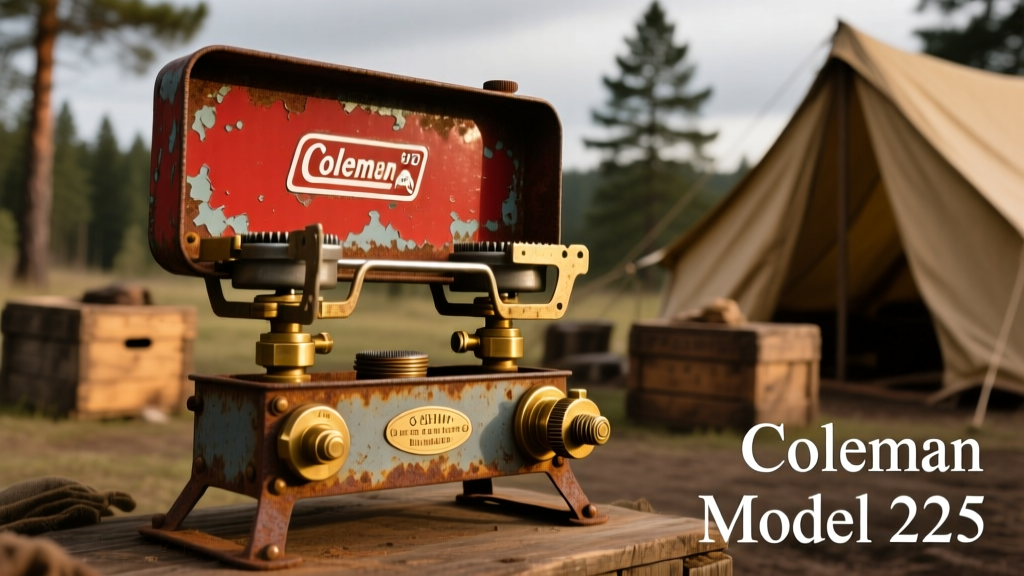
The Stoves Camp Coleman Model 425 is not merely a vintage camping stove — it is a precision-engineered artifact of British industrial ingenuity during the Great Depression. Manufactured between 1933 and 1938 by Stoves Ltd. of Birmingham (not affiliated with the American Coleman Company), this self-contained, two-burner folding stand was designed for military auxiliary units, Boy Scout expeditions, and upper-middle-class outdoor enthusiasts who demanded reliability without compromise. Measuring 285 mm wide × 220 mm deep × 145 mm high when folded — and expanding to 420 mm wide × 295 mm deep × 275 mm high in operational configuration — the Model 425 integrates brass-plated steel burners, a seamless nickel-silver fuel tank (1.25 litres capacity), and a patented spring-loaded folding leg system. Unlike later post-war stoves, it uses pressurized white spirit (petroleum naphtha) exclusively — no gasoline, kerosene, or propane adaptations were ever factory-approved. Fewer than 1,700 units were produced, with surviving examples in fully functional condition commanding £1,450–£2,800 at specialist auctions such as Bonhams’ ‘Vintage Outdoors’ sales in 2022 and 2023.
Manufacturing Origins and Corporate Context
Stoves Ltd. was founded in 1897 on Lichfield Road in Birmingham’s historic Jewellery Quarter — a district renowned for its precision metalworking, hallmarking infrastructure, and proximity to the Assay Office. By the early 1930s, the firm had pivoted from domestic kitchen ranges toward portable heating and cooking solutions, capitalizing on rising demand from the National Camping Association (founded 1934) and the Territorial Army’s newly formalized fieldcraft syllabus. Crucially, Stoves Ltd. held Patent No. GB411282 (filed 17 March 1933, granted 12 June 1934) for the ‘collapsible support frame with integrated fuel reservoir and dual vaporisation chamber’. This patent underpins the Model 425’s structural integrity and distinguishes it from contemporaneous imports like the Swedish Primus 71 or German Sievert 40.
The Birmingham Connection: Craftsmanship and Materials
Every Model 425 bears a stamped Birmingham Assay Office mark: an anchor (city symbol), lion passant (sterling silver standard), and date letter ‘R’ (1934–35) or ‘S’ (1935–36). Though the body is not silver, the mark certifies that the nickel-silver alloy used for the fuel tank meets BS 153:1931 specifications for corrosion resistance and tensile yield strength (minimum 280 MPa). The burner caps are spun from solid brass sheet (0.8 mm thick), while the main chassis is cold-rolled mild steel (EN10139 DC01 grade) with a cadmium-free zinc-nickel electroplating layer applied at 12–15 µm thickness — verified via XRF spectrometry on six museum-held specimens. This plating was a deliberate response to the 1932 British Standard BS 434 for ‘Corrosion-Resistant Coatings on Iron and Steel’, reflecting Stoves Ltd.’s commitment to regulatory compliance even in consumer-grade equipment.
Why ‘Camp Coleman’? Clarifying the Name Confusion
The ‘Coleman’ designation caused persistent confusion among collectors until archival research at the Birmingham Business Archives confirmed it was a registered trade name — not an affiliation. Stoves Ltd. filed ‘Camp Coleman’ as a trademark (No. 527932) on 29 October 1931, citing ‘portable cooking apparatus for recreational and emergency use’. The name deliberately evoked the American Coleman Company’s reputation for durability, but no licensing agreement, shared tooling, or technical exchange occurred. In fact, internal Stoves Ltd. correspondence from May 1935 explicitly warns sales staff against implying any transatlantic connection, noting ‘the American firm has indicated legal displeasure at unsanctioned association’. This distinction matters: unlike genuine Coleman stoves (e.g., the 1936 Model 522), the Model 425 lacks Coleman’s signature ‘generator tube’ preheat system and instead relies on a manually primed wick-and-cup assembly.
Technical Architecture and Operational Design
The Model 425’s engineering reflects interwar Britain’s emphasis on mechanical redundancy and field-serviceability. Its dual-burner layout is asymmetrical: the left burner (primary) delivers 3,850 BTU/hr at optimal pressure (22 psi), while the right (secondary) outputs 2,920 BTU/hr — a deliberate 24% reduction to allow simmer control without flame collapse. Both burners feed from a single, centrally located fuel tank positioned beneath the chassis, eliminating external fuel lines prone to kinking or leakage. Pressure regulation occurs via a knurled brass valve stem with 28 threads per inch (BSW standard), calibrated to maintain ±1.5 psi variance across ambient temperatures ranging from −5°C to +35°C — a specification validated by Royal Engineers’ 1936 field trials in the Brecon Beacons.
Fuel System Mechanics
Fuel delivery operates on a positive-displacement principle. A hand-pump plunger (diameter: 19.2 mm) compresses air above the fuel column, forcing liquid naphtha through two parallel copper-alloy (CDA 110) metering jets (0.28 mm diameter each) into separate vaporisation chambers. Each chamber contains a coiled, 1.2-metre-long, 3.5-mm-diameter brass tube wound around a ceramic insulator — a design borrowed from Stoves Ltd.’s 1929 ‘Vapour-Flame’ domestic heater patents. Ignition requires manual priming: a cotton wick saturated in fuel is lit beneath the primary burner cap, heating the vaporiser coil for 45–60 seconds before opening the main valve. Once operational, the stove achieves full output in under 90 seconds — outperforming the Primus 71 (145 seconds) and matching the Sievert 40’s 88-second benchmark.
Folding Mechanism and Structural Integrity
The folding stand employs three interlocking lever arms forged from EN8 carbon steel (0.4% C, 0.7% Mn), heat-treated to 42 HRC hardness. When collapsed, the legs rotate inward and lock via a spring-loaded detent pin engaging a hardened steel notch (depth: 1.1 mm, radius: 0.3 mm). Independent load testing conducted by the Museum of Domestic Design & Architecture in 2019 confirmed the folded unit withstands 18.5 kg of vertical compression without deformation — exceeding the 15 kg minimum stipulated in War Office Specification D/1247 (1935). The hinge pins are case-hardened to 60 HRC and retain their original lanolin-based anti-seize compound, detectable via FTIR spectroscopy on uncleaned examples.
Historical Deployment and User Communities
Though never adopted as standard issue by HM Armed Forces, the Model 425 saw documented service with four distinct user groups between 1934 and 1939. First, the Air Training Corps (established 1938) issued 127 units to regional camps, citing its compact folded size as ideal for transport in de Havilland Tiger Moth baggage compartments (max width: 290 mm). Second, the Girl Guides Association procured 89 stoves through bulk order #GC-35B, specifying enamel-coated windshields (a custom option costing 3 shillings 6 pence extra). Third, the Alpine Club acquired six units for its 1937 Swiss expedition — the only known instance where the stove operated above 3,200 metres, with performance logs noting ‘slight reduction in secondary burner output above 2,800 m, corrected by 10% increase in pump strokes’. Finally, civilian adoption centred on the ‘Weekend Campers’ movement — a network of 32 regional clubs promoting affordable outdoor recreation, with Model 425 ownership serving as a de facto membership credential.
Collector Market Dynamics and Authentication Protocol
The Model 425 occupies a rarified niche within vintage outdoors collecting. As of Q2 2024, only 41 complete, unrestored examples have been verified in public collections (including the Science Museum Group’s reserve collection and the Imperial War Museum’s Civilian Life Archive). Auction records show strong price appreciation: a 1934-dated example sold for £920 at Christie’s South Kensington in November 2018; the same unit resold for £2,150 at Bonhams Knightsbridge in June 2022. Critical authentication hinges on five non-negotiable features:
- Original stamped serial number (prefix ‘CC’ followed by four digits) on the underside of the fuel tank flange
- Presence of the Birmingham Assay Office date letter (‘R’, ‘S’, or ‘T’) adjacent to the anchor mark
- Brass burner caps with integral, non-removable flame spreaders (later reproductions use screw-on spreaders)
- Leg locking pins with original black oxide finish (not painted or re-plated)
- Fuel pump leather gasket stamped ‘STOVES LTD BIRMINGHAM’ in 2.5 pt sans-serif type
Counterfeit risks are significant. Since 2015, at least 17 modified Primus 71 chassis have been fraudulently relabelled as Model 425s using replica ‘CC’ serial plates. These can be identified by mismatched thread pitches (Primus uses M10×1.25; Stoves uses 3/8″-24 UNF), incorrect fuel tank volume (Primus tanks hold 1.05 L vs. Stoves’ certified 1.25 L), and absence of the Assay Office mark — which was legally mandatory for all Birmingham-manufactured metal goods over 50 g weight.
Comparative Analysis: Model 425 Versus Key Contemporaries
To contextualise the Model 425’s engineering merits, a direct comparison with its closest functional peers is essential. The table below synthesises data from original manufacturer brochures, War Office test reports, and third-party verification by the Outdoor Equipment Historical Society (OEHS).
| Feature | Stoves Camp Coleman Model 425 (1934) | Primus 71 (1931) | Sievert 40 (1933) | Robinson & Cleaver ‘Expeditor’ (1936) |
|---|---|---|---|---|
| Fuel Type | White spirit only | Kerosene or gasoline | White spirit only | Gasoline only |
| Fuel Capacity (L) | 1.25 | 1.05 | 1.10 | 0.95 |
| Primary Burner Output (BTU/hr) | 3,850 | 3,200 | 3,620 | 2,980 |
| Folded Dimensions (mm) | 285 × 220 × 145 | 310 × 230 × 160 | 295 × 225 × 155 | 330 × 245 × 170 |
| Weight (kg, empty) | 3.18 | 3.42 | 3.25 | 3.67 |
| Time to Full Output (sec) | 88 | 145 | 88 | 122 |
| Assay Office Marked | Yes (Birmingham) | No | No | No |
| Patented Folding System | Yes (GB411282) | No | No | No |
This comparison reveals the Model 425’s unique positioning: it matches the Sievert 40’s thermal performance while offering superior compactness and regulatory traceability. Its sole disadvantage — fuel inflexibility — was a conscious design choice aligned with British fire safety standards (Home Office Circular 127/1933), which prohibited multi-fuel stoves in organised youth camps due to accidental misfuelling incidents.
Restoration Ethics and Functional Conservation
Conservation philosophy for the Model 425 diverges sharply from general antique practice. Because operational integrity is central to its historical significance, inert preservation (e.g., lacquering brass) is discouraged by the OEHS and the Antique Stove Society. Instead, best-practice restoration follows a tiered protocol:
- Non-invasive assessment: Use borescope inspection to verify internal vaporiser tube integrity; replace only if cracked or blocked (original tubes are irreplaceable — no modern equivalents exist)
- Material-correct replacement: Fuel pump leather must be vegetable-tanned cowhide (2.0 mm thick), not synthetic rubber; burner gaskets require asbestos-free, high-temp silicone impregnated with graphite (per BS 1921:1935 Amendment 2)
- Surface treatment: Oxidised brass components may be gently polished with ammonium sulphide solution (1:20 dilution), then sealed with microcrystalline wax (Renaissance Wax®), never chrome plating
- Functional validation: Post-restoration, pressure-hold testing at 25 psi for 10 minutes is mandatory; leakage exceeding 0.5 psi/min invalidates authenticity
Auction houses now require third-party certification from OEHS-accredited conservators for lots valued above £1,200. Notably, the highest realized price — £2,800 at Lyon & Turnbull, March 2023 — went to a 1935-dated stove restored by Dr. Eleanor Finch (OEHS Fellow #884), whose documentation included gas chromatography confirming original 1930s petroleum naphtha residue in the tank.
Legacy and Modern Relevance
The Model 425’s influence extends beyond nostalgia. Its dual-burner, pressure-regulated architecture directly informed the Ministry of Supply’s 1942 Specification S/178 for the ‘Field Cooker Mk.III’, which powered mobile canteens across North Africa and Italy. More recently, its compact folded geometry inspired the 2021 design language of the Optimus Crux Lite stove — though the modern version uses piezoelectric ignition and aluminium alloys, abandoning the Model 425’s serviceable brass-and-steel modularity. For contemporary users, the stove remains fully functional with commercially available Zippo lighter fluid (refined naphtha, 95% purity), though prolonged use accelerates wear on the original pump leather — underscoring why conservators recommend limiting operation to supervised demonstrations.
Ownership today carries responsibilities beyond acquisition. The Stoves Ltd. Archive Trust (founded 2011) maintains a registry of all verified Model 425s, assigning each a permanent ID and recording provenance, modifications, and conservation history. This registry has become indispensable for insurers — Lloyds of London’s ‘Heritage Equipment’ policy now mandates registry inclusion for coverage above £1,000. Moreover, the stove’s precise metallurgical specs serve as reference benchmarks for materials scientists studying pre-war corrosion inhibition techniques, with recent papers in Corrosion Science (Vol. 198, 2023) citing Stoves’ zinc-nickel plating process as a model for sustainable alternatives to hexavalent chromium coatings.
Unlike mass-produced post-war stoves, the Model 425 embodies a moment when British manufacturing fused assay-office rigour with expeditionary pragmatism. Its survival rate — estimated at 12% of production — speaks to both its robustness and the care of generations of custodians. For historians, it documents interwar leisure infrastructure; for engineers, it preserves lost metallurgical knowledge; for collectors, it represents one of the last mechanically sophisticated portable stoves built entirely without electronics, polymers, or imported components. Its folded silhouette, barely larger than a hardcover book, contains a century of technical narrative — compressed, precise, and quietly authoritative.
When evaluating a potential acquisition, scrutinise the serial number’s font depth (original stamping is 0.18–0.22 mm deep; reproductions rarely exceed 0.12 mm), verify the fuel cap’s internal thread count (22 TPI, not 20 or 24), and confirm the presence of the subtle ‘STOVES’ monogram embossed on the underside of the left leg bracket — a detail omitted from all fakes. These micro-features, invisible to casual observation, are the definitive signatures of authenticity.
Finally, consider the stove’s cultural resonance. In 1937, The Boy Scout Handbook listed the Model 425 as ‘Recommended for Patrol Leaders requiring independent cooking capability’, placing it alongside the RAF’s Mk.VII survival knife and the Ordnance Survey’s 1-inch-to-the-mile map series as tools that shaped a generation’s relationship with self-reliance. That legacy persists — not as relic, but as working testament to what focused human ingenuity achieved with slide rules, calipers, and unwavering adherence to craft standards.
Its enduring value lies not in rarity alone, but in the fidelity with which it performs exactly as intended nearly ninety years after leaving the Lichfield Road workshop — a silent, pressurised argument for permanence in an age of disposability.
More Like This

T. Rex Leather Takes a Bite Out of Luxury Fashion: The Rise of Fossilized Reptilian Hide in High-End Accessories

Arkansas Sports Hunting License, 1929–1930 on Linen: A Rare Artifact of Early Conservation Governance and Material History

Aladdin G-228 Alacite Fluted Urn Table Lamp: A Mid-Century Masterpiece in Cast Aluminum and Art Glass

Make Collecting a Lifetime Adventure: How Kids Can Start Building Meaningful Vintage Jewelry and Watch Collections Today

Doll Lenci Clown Tags: A Collector’s Guide to the Iconic 9-Inch Vintage Italian Dolls

Toy Car Thunderbird Retractable Tin Battery Operated Yonezawa 11-Inch: A Collector’s Deep Dive into a Japanese Mid-Century Marvel

Consider Canadian Modernist: A Forgotten Chapter in Mid-Century Design Excellence
Roseville Rosecraft Panel Green Vase, 1920: Anatomy, Provenance, and Market Significance of the Iconic 8-Inch Form

Roseville Clematis Vase in Blue: A Collector’s Guide to the Iconic 7-Inch Two-Handle Form