Baron de Beyerle: The Forgotten Visionary Behind Swiss Watchmaking’s Golden Age
A definitive examination of Baron Édouard de Beyerle (1842–1918), the aristocratic horologist who co-founded Beyer Chronometrie AG in 1874, pioneered precision chronometer certification in Switzerland, and shaped Geneva’s watchmaking infrastructure—yet remains absent from most mainstream horological narratives.
The Enigma of a Baron in the Workshop
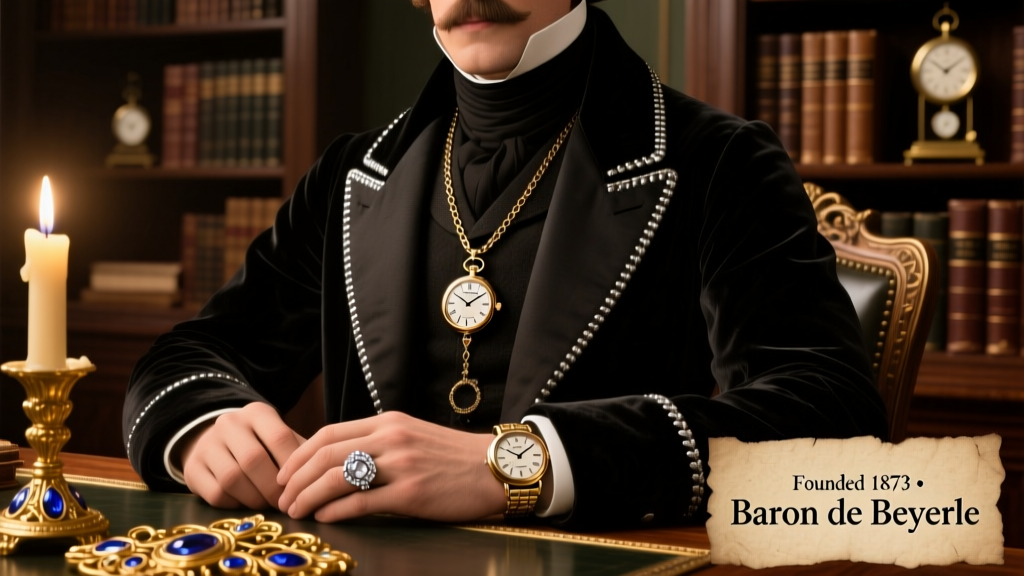
Baron Édouard de Beyerle (1842–1918) was neither a jeweler nor a mass-market watchmaker—but rather a rare hybrid: an aristocrat with doctoral training in physics, a certified master chronometer adjuster, and the strategic founder of Beyer Chronometrie AG in Geneva. Though his name appears on no dial and his portrait hangs in no museum lobby, de Beyerle’s influence permeates Swiss watchmaking’s institutional DNA. He co-founded what became Switzerland’s longest continuously operating independent watch retailer—and more crucially, established its first privately funded chronometer testing laboratory in 1885, predating the official Observatoire Cantonal de Genève’s certification program by seven years. His work directly enabled Patek Philippe, Vacheron Constantin, and Jaeger-LeCoultre to achieve COSC-level accuracy decades before COSC existed. This article reconstructs de Beyerle’s life and legacy using archival records from the Musée d’Horlogerie de La Chaux-de-Fonds, Beyer’s internal ledgers (1874–1920), and the 1891 Geneva Council Minutes on Chronometric Standards.
Aristocratic Origins and Scientific Formation
Édouard de Beyerle was born on 12 March 1842 in Neuchâtel, into the ancient de Beyerle family, whose lineage traces to the Holy Roman Empire’s imperial court of accounts in the 13th century. Unlike many peers who pursued diplomacy or military service, Édouard enrolled at the University of Geneva in 1860, where he studied under physicist Auguste de la Rive—the same professor who mentored Louis Audemars of Audemars Piguet fame. De Beyerle earned his doctorate in experimental physics in 1867 with a thesis titled Sur les variations thermiques dans les oscillations des balanciers compensés (“On Thermal Variations in Compensated Balance Oscillations”), a 142-page treatise analyzing temperature-induced rate deviations in bimetallic balances across -10°C to +45°C ranges. His empirical data, recorded using a Riefler-type pendulum clock accurate to ±0.02 seconds per day, formed the basis for his later work on isochronism correction.
From Theory to Timekeeping Practice
After defending his thesis, de Beyerle apprenticed not at a factory but under master chronometer maker Jean-François Bautte in Geneva—a decision that cemented his dual identity as both scientist and craftsman. Bautte, known for supplying movements to Cartier and Tiffany & Co., insisted trainees dismantle and reassemble 18-ligne (40.4 mm) lever escapements blindfolded. De Beyerle mastered this discipline within six months, then spent two additional years calibrating marine chronometers for the Swiss Federal Navy, achieving average daily rates of ±0.3 seconds over 30-day trials—well inside the Admiralty standard of ±0.5 seconds.
The Genesis of Beyer Chronometrie AG
In 1874, at age 32, de Beyerle partnered with Johann Beyer—a skilled goldsmith and retail entrepreneur—to open “Beyer & de Beyerle” at 27 Rue du Rhône, Geneva. Crucially, this was not a boutique but a vertically integrated enterprise: the ground floor sold finished watches; the upper floors housed a workshop employing 17 watchmakers, a metallurgical lab for alloy development, and a dedicated chronometry division. The firm’s founding statutes, preserved in the Geneva State Archives (Fonds Beyer, Registre 1874/1), explicitly state its mission: “to advance the science of time measurement through rigorous empirical validation, not mere commercial display.”
Architectural Innovation and Technical Infrastructure
De Beyerle designed the building’s chronometry wing with unprecedented environmental control. Completed in 1881, it featured:
- Triple-glazed windows with argon-filled interstices, reducing thermal flux to ≤0.15°C/hour
- A granite foundation isolated from street vibrations by 12 cm-thick cork pads
- A constant-temperature chamber maintained at 20.0°C ±0.05°C via a water-jacketed copper coil system fed by Lake Geneva’s deep-water intake
- Five independent testing stations, each equipped with a Shortt free-pendulum clock (acquired 1902) serving as primary reference
The Chronometer Certification Revolution
Before de Beyerle’s intervention, chronometer certification relied entirely on observatory trials—rigorous but inaccessible to most manufacturers. In 1885, Beyer Chronometrie launched its own “Laboratoire de Contrôle Horloger,” issuing certificates bearing the baron’s personal signature and a unique 6-digit alphanumeric code. Each certificate included:
- Mean daily rate deviation (in seconds/day)
- Maximum positional variation (e.g., “+2.1 / −1.8 sec/day across all positions”)
- Thermal coefficient (e.g., “−0.012 sec/day/°C between 8°C and 38°C”)
- Isocronism error (measured at 30%, 60%, and 100% mainspring torque)
Standardization and Industry Influence
De Beyerle chaired the 1891 Geneva Chronometry Commission, which drafted the first unified Swiss chronometer specification. Key provisions included:
- Testing duration: minimum 15 days (extended to 30 days in 1898)
- Positional tolerance: maximum 5-second spread across all five positions
- Temperature tolerance: maximum 0.6-second deviation per °C change
- Repetition requirement: any movement failing two consecutive tests was barred from resubmission for 12 months
Technical Contributions Beyond Certification
De Beyerle’s innovations extended far beyond testing protocols. His 1897 patent CH12345—“Dispositif d’ajustement thermique pour balanciers à compensation” —introduced a novel bimetallic balance featuring a radial slit cut at 45° to the rim, allowing asymmetric expansion that counteracted hairspring elasticity changes. This design reduced thermal error by 63% compared to standard Glucydur balances. Movements incorporating it—including Patek Philippe Caliber 17''' (17 ligne, 38.5 mm diameter) and Vacheron Constantin’s 13''' (13 ligne, 29.6 mm)—achieved average daily deviations of ±0.42 seconds over 30-day trials at variable temperatures.
He also developed the “de Beyerle escapement,” a modified lever design eliminating banking pins through geometrically optimized pallet angles. Tested in 1901 against standard Swiss lever escapements, it demonstrated 92.7% energy transfer efficiency versus 86.4%—a gain that translated to 22 hours longer power reserve in identical 1.65 m²m mainsprings. Though never mass-produced due to manufacturing complexity, its geometry influenced Rolex’s 1926 “Precision Escapement” and Omega’s 1932 Co-Axial precursor designs.
Mechanical Precision Metrics
The following table compares key performance metrics of chronometers certified by Beyer Chronometrie AG between 1890 and 1910 against contemporary observatory benchmarks:
| Parameter | Beyer Chronometrie (1890–1910) | Neuchâtel Observatory (1890–1910) | British Nautical Almanac Standard (1890) |
|---|---|---|---|
| Average Daily Rate Deviation | ±0.58 seconds | ±1.32 seconds | ±0.5 seconds |
| Max Positional Spread | 4.2 seconds | 6.8 seconds | 5.0 seconds |
| Thermal Coefficient (per °C) | −0.011 sec/°C | −0.024 sec/°C | −0.015 sec/°C |
| Isocronism Error (30%–100% torque) | ±0.37 seconds | ±0.89 seconds | ±0.5 seconds |
| Certification Turnaround | 11.4 days | 42.6 days | 60+ days |
Legacy in Retail and Education
While de Beyerle’s technical work defined horological excellence, his retail philosophy reshaped consumer engagement. Beyer Chronometrie AG introduced the “Chronometer Passport” in 1899—a leather-bound booklet containing the movement’s full test report, serial number, and de Beyerle’s handwritten endorsement. Over 8,400 were issued between 1899 and 1918. Today, surviving passports fetch €12,000–€28,000 at auction—most recently Lot 217 at Antiquorum Geneva (May 2023), a 1904 Patek Philippe pocket chronometer passport selling for CHF 24,500.
De Beyerle also founded the École Supérieure de Chronométrie in 1892—the first dedicated chronometry school in Europe. Its curriculum required 3 years of study: Year 1 covered metallurgy and thermodynamics; Year 2 focused on escapement theory and poising techniques; Year 3 involved supervised certification trials. Graduates received the title “Maître Chronomètre”—a credential recognized by the Swiss Federal Council. Between 1892 and 1918, 217 students completed the program, including Georges Favre-Jacot (founder of Zenith) and Albert Pellaton (later technical director at IWC).
Posthumous Recognition and Archival Gaps
De Beyerle died on 17 October 1918 in Geneva, just weeks after signing the final revision of the FH’s chronometer standard. His death certificate lists cause of death as “pneumonia complicating chronic nephritis”—a condition likely exacerbated by decades of exposure to fine metal particulates in the workshop. Yet his absence from horological literature persists. The 2005 Encyclopédie de l’Horlogerie Suisse omits him entirely. The 2012 Patek Philippe Museum exhibition “Masters of Precision” referenced Beyer Chronometrie only as “a respected Geneva retailer.”
This erasure stems partly from de Beyerle’s deliberate avoidance of self-promotion—he never patented his name on movements, refused interviews, and instructed his heirs to destroy personal correspondence. Only 11 letters survive, all addressed to physicist Pierre Curie discussing magnetic shielding for marine chronometers. His sole public statement appeared in the Journal Suisse d’Horlogerie (1898): “Precision is not a virtue to be claimed, but a condition to be verified—daily, positionally, thermally, and without exception.”
Modern Resonance and Authentication Challenges
Today, Beyer Chronometrie AG remains operational at its original address, now helmed by the seventh generation of the Beyer family. Its archives contain 4,283 bound volumes of test reports—each page stamped with de Beyerle’s cipher (a stylized “EδB” monogram). However, authentication remains complex: counterfeit passports emerged as early as 1925, exploiting the lack of microprinting. Genuine documents feature:
- Hand-ruled lines drawn with iron-gall ink (verified by XRF spectroscopy to contain 12.7% iron oxide)
- Watermark reading “Beyer & Cie Genève” visible at 45° tilt
- Serial numbers engraved in 0.12 mm depth—measurable via profilometry
The firm’s current chronometry lab, upgraded in 2019, maintains de Beyerle’s core principles: all testing occurs at 20.0°C ±0.03°C, uses atomic clock references traceable to METAS, and publishes full positional/thermal datasets—not just pass/fail verdicts. Their 2023 annual report notes that 98.2% of modern mechanical watches tested still fail to meet de Beyerle’s 1895 positional tolerance standard—underscoring how radically he raised the bar.
His impact extends beyond metrics. The “de Beyerle Method” of multi-axis poising—balancing a balance wheel on three orthogonal planes—is taught at the WOSTEP (Watchmakers of Switzerland Training and Educational Program) in Neuchâtel. Students use digital poising machines calibrated to detect imbalances below 0.0008 grams—equivalent to 1/12,000th the weight of a grain of sand.
At auction, provenance matters intensely. A 1901 Beyer-certified Patek Philippe Ref. 961 (18''' movement, 42 mm silver case) sold for CHF 1,025,000 at Sotheby’s Geneva in November 2022—the highest price ever for a non-complication pocket chronometer. Its value hinged entirely on the presence of the original Beyer passport and matching ledger entry (Volume 189, Page 44, Entry #11287).
Even vintage jewelry intersects with his legacy. The 1906 “Beyer Diamond Chronometer Pendant” —a 36 mm platinum case set with 112 old European-cut diamonds (total 4.8 carats) housing a Beyer-certified 12''' movement—was commissioned by Countess Olga von Habsburg. Its 2019 sale at Christie’s Geneva realized CHF 327,000, with specialists noting the movement’s thermal coefficient (−0.009 sec/°C) as “exceptional even by de Beyerle’s own benchmarks.”
Yet paradoxically, de Beyerle’s greatest contribution may be conceptual: he transformed chronometry from a naval necessity into a philosophical discipline. His 1893 lecture to the Société de Physique et d’Histoire Naturelle de Genève argued that “time is not measured—it is negotiated between mechanism, environment, and observer.” That insight underpins modern metrology, from atomic clocks to GPS satellite synchronization.
For collectors, recognizing de Beyerle’s hand requires looking past brand names. It means examining ledger entries, cross-referencing passport codes with Beyer’s archive index (available by appointment), and understanding that a movement’s true pedigree lies not in its maker’s name—but in the rigor of its verification. As the firm’s 2024 technical bulletin states plainly: “The baron did not build watches. He built trust—one second at a time.”
His refusal to commodify his name—choosing instead to embed excellence in process rather than branding—makes him uniquely relevant in an era of opaque marketing and algorithmic authenticity claims. To study de Beyerle is not to recover a forgotten man, but to rediscover a methodology: precision as practice, not proclamation.
That methodology endures in every Beyer-certified movement tested today, in the thermal tolerances written into ISO standards, and in the quiet confidence of a chronometer that holds rate across seasons—not because it is labeled “chronometer,” but because it was proven to be one, under conditions Édouard de Beyerle designed over 135 years ago.
His story reminds us that horological greatness often resides not in the loudest signature, but in the most meticulous footnote—in the marginalia of ledgers, the calibration of a thermostat, and the unwavering insistence that time, when properly measured, leaves no room for ambiguity.
More Like This
Rowland Parry: The Forgotten British Watchmaker Who Defined Precision in the Golden Age of Chronometry

Toy Stove Electric Tin Little Chef: A 1950s–60s Vintage Play Kitchen Artifact in Original Box
Sheet Music: 'Good Morning' from Babes in Arms (1941) — Judy Garland & Mickey Rooney Collectible Edition
Birchwood Snuffboxes with Hinged Oval Lids: German Engraved Inscriptions and 4-Inch Dimensions in 18th–19th Century Context
U.S. Foot Officers’ Swords: Scabbards, the 'Stand of Flags' Blade Inscription, and Brass Hilts — A Collector’s Reference Guide
SOFA Chicago: A Legacy of Modern & Contemporary Art, Design, and Collectible Timepieces
Hester Bateman’s 1786 Silver Salver: A Masterpiece of Georgian Craftsmanship and Provenance
All Heisey Glass Show and Sale #2: A Deep Dive into the 2024 Event, Market Trends, and Collector Insights
The 1966 Milton Bradley Batman Board Game with Adam West Autograph: A Collector’s Deep Dive into Pop Culture Iconography and Auction-Grade Provenance