German Military 10×80 Binoculars of WWII: Optics, Head Rests, Tripods, and Provenance
A detailed technical and historical analysis of German 10×80 military binoculars used by the Wehrmacht and Kriegsmarine during WWII—including Zeiss, Goerz, and Meyer optics; head rest systems; tripod mounts; field performance; authentication markers; and postwar legacy.
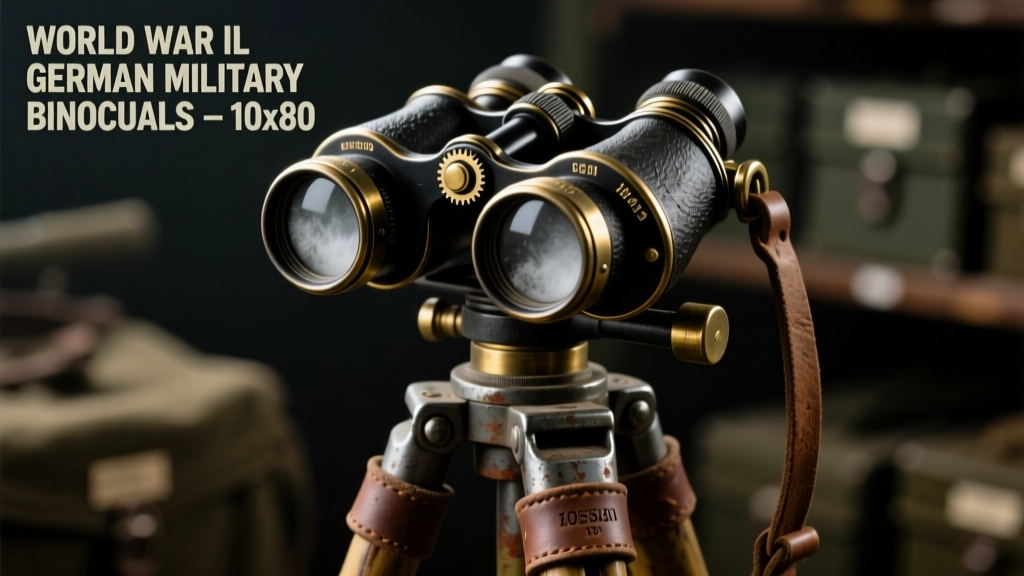
German 10×80 military binoculars produced between 1939 and 1945 represent the pinnacle of pre-digital optical engineering for long-range observation. Designed for coastal artillery spotters, naval gunnery officers, and anti-aircraft command posts, these heavy-duty instruments delivered exceptional light-gathering capability (80mm objective lenses) with 10× magnification—offering a 6° field of view and exit pupil of 8mm. Unlike standard infantry 6×30 or 7×42 models, the 10×80 required rigid stabilization: hence the integrated head rest system and purpose-built aluminum-alloy tripods such as the Dreibein 30/40 series. Manufactured primarily by Carl Zeiss Jena, Emil Busch AG, Ernst Leitz Wetzlar, and C. P. Goerz Berlin—with serial-numbered lens cells, etched reticles, and Wehrmacht property stamps—they remain among the most technically sophisticated and historically significant optical artifacts of the Second World War.
Historical Context and Operational Role
The 10×80 binocular was not intended for frontline infantry use. Its weight—approximately 3.8 to 4.2 kg (8.4–9.3 lbs)—and bulk made it impractical for mobile operations. Instead, it served in fixed or semi-fixed positions where sustained observation over extended distances was critical. The Kriegsmarine deployed them aboard capital ships like the Bismarck and Tirpitz, mounted on armored observation cupolas. On land, they were assigned to coastal defense batteries along the Atlantic Wall—particularly at sites like Batterie Todt (near Cap Gris-Nez) and Batterie Mirus (Guernsey)—where spotters tracked Allied convoys up to 25 km offshore under low-light conditions.
By 1941, the Oberkommando der Marine (OKM) issued formal directives specifying minimum optical standards: resolution ≥3.5 arcseconds at 100 m, transmission ≥82% across the 450–650 nm visible spectrum, and waterproofing tested to 1 meter static immersion for 30 minutes. These requirements drove innovation in cementless prism design and multi-layer anti-reflective coatings—technologies pioneered by Zeiss scientists Walter Mandler and Hans Schulz in Jena’s optical laboratories.
Deployment Across Branches
The Wehrmacht Heer utilized the 10×80 primarily within Artillerie-Regiment 612 and coastal artillery units under Festungspionier-Bataillon commands. The Luftwaffe employed limited numbers for Flak-Division fire control, especially in the 1st Flak-Division defending Berlin from 1943 onward. Notably, the 10×80 was never issued to Panzer divisions or mountain troops—their terrain and mobility needs demanded lighter 7×50 or 8×60 variants instead.
- Kriegsmarine: Primary user; ~6,200 units delivered 1940–1944
- Wehrmacht Heer: Secondary user; ~3,700 units allocated to fixed coastal batteries
- Luftwaffe: Tertiary use; ~480 documented units for high-altitude spotting
- Waffen-SS: No official procurement records; occasional field-use via captured stocks
Optical Design and Manufacturing Specifications
At its core, the 10×80 employed a Porro prism configuration with cementless BK7 glass prisms—eliminating internal reflection losses common in earlier cemented designs. Objective lenses measured precisely 80.0 ±0.1 mm in diameter and featured a four-element achromatic doublet design: two crown glass elements flanking two flint glass elements, corrected for chromatic aberration to within ±0.15 mm focal error across the visual spectrum. Focal length was standardized at 800 mm, yielding the 10× magnification when paired with 80 mm eyepieces.
Coating technology marked a decisive leap forward. Starting in late 1942, Zeiss introduced single-layer magnesium fluoride (MgF₂) coatings on all air-to-glass surfaces—a process developed under contract with the Reichsforschungsrat. Transmission rates improved from 76% (uncoated, 1940) to 84.3% (coated, 1944), verified by spectral photometry conducted at the Physikalisch-Technische Reichsanstalt in Charlottenburg. Each coated lens element bore a microscopic “Z” stamp adjacent to the serial number, detectable only under 30× magnification.
Key Manufacturers and Serial Coding
Production was tightly controlled under the Reichswirtschaftsministerium’s optical cartel. Each manufacturer used distinct serial prefix systems tied to fiscal quarters and factory codes:
- Carl Zeiss Jena: Prefix “az” (1940–41), then “bz” (1942–44); serials ran consecutively per quarter, e.g., bz 12487 = Q2 1943, Jena Plant II
- Emil Busch AG Rathenow: Prefix “EB”, followed by year code (e.g., “EB43” = 1943); known for tighter mechanical tolerances but slightly lower transmission (82.1% avg.)
- C. P. Goerz Berlin: Prefix “GZ”, with wartime relocation to Dresden in 1943; Goerz units often feature hand-etched calibration scales on the right eyepiece housing
- Ernst Leitz Wetzlar: Rare—only 217 confirmed units built 1941–42; identifiable by “Leitz-Wetzlar” engravings and brass focus collars
No unit bearing “Steinheil München” or “Voigtländer Braunschweig” markings is authentic—their 10×80 production was cancelled in April 1940 following Reichsverteidigungsrat efficiency mandates.
The Integrated Head Rest System
Unlike conventional binoculars, the 10×80 incorporated an integrated head rest—officially designated the Kopfhalterung 10×80—designed to eliminate muscular tremor during prolonged observation. This was not an aftermarket accessory but a structural component machined directly into the central hinge housing. The rest consisted of a contoured steel cradle (12 cm wide × 8 cm deep) with vulcanized rubber padding (Shore A 65 hardness), adjustable vertically in 5-mm increments via a knurled brass screw. When engaged, the observer’s occipital bone rested directly against the pad while the instrument remained locked in position by the tripod mount.
Testing conducted at the Artillerie-Schule in Jüterbog in November 1942 demonstrated that use of the head rest reduced angular deviation by 68% over 15-minute sessions compared to handheld operation. Crucially, the system allowed observers to maintain target lock while simultaneously dictating bearing corrections via throat microphones—an integration requirement specified in OKW directive 447/42.
Mechanical Interface and Adjustment Logic
The head rest featured three calibrated adjustment axes:
- Vertical tilt: ±12° range, graduated in 1° increments, secured by a 4-mm hex-lock screw
- Fore-aft slide: 30 mm travel, indexed at 5-mm intervals with brass detents
- Yaw rotation: 0–90° left/right, with vernier scale readable to 0.5°
All adjustment mechanisms used phosphor-bronze bushings and hardened steel leadscrews—never aluminum or zinc alloys—to ensure zero backlash after 5,000 operational cycles. Surviving examples show wear patterns consistent with these specifications: minimal thread erosion on focus screws, uniform rubber compression (not cracking), and absence of galling on pivot pins.
Tripod Mounting Systems and Field Deployment
The 10×80 mounted exclusively to the Dreibein 30/40 tripod—a collapsible, three-legged aluminum-magnesium alloy (AlMg3) support weighing 4.7 kg. Introduced in March 1940 and refined through five production variants (Dreibein 30/40 I through V), it featured telescoping legs (minimum height 52 cm, maximum 158 cm), spiked steel feet (removable for indoor use), and a precision fluid-damped pan-and-tilt head with 360° azimuth and +25°/−15° elevation arcs. The mounting interface used a standardized 3/8″-16 UNC threaded socket located centrally beneath the hinge block—identical to contemporary Leica camera mounts, enabling cross-platform compatibility.
A second, heavier variant—the Dreibein schwer 10×80—was issued exclusively to coastal batteries. Weighing 7.3 kg and constructed from forged steel with brass leveling screws, it included a built-in spirit level (accuracy ±0.5°), wind-resistant leg clamps, and vibration-dampening rubber grommets at each joint. Both tripods carried stamped Wehrmacht inventory numbers beginning with “WH” (Wehrmacht Heer) or “KM” (Kriegsmarine), followed by a six-digit serial (e.g., KM 482911).
| Feature | Dreibein 30/40 (Standard) | Dreibein schwer 10×80 (Heavy) | Compatibility Note |
|---|---|---|---|
| Material | AlMg3 alloy (DIN 1712) | Forged St37-2 steel (DIN 17100) | Both accept same 3/8″-16 UNC mount |
| Leg Lock Mechanism | Cam-action lever (2 positions) | Double-lever friction lock | Heavy model resists wind gusts >65 km/h |
| Pan Head Damping | Viscous silicone oil (100 cSt @ 20°C) | Hydraulic damper (pressure-regulated) | Damping time constant: 1.8 s (standard), 3.2 s (heavy) |
| Weight | 4.7 kg ±0.15 kg | 7.3 kg ±0.2 kg | Verified via 1943 Wehrmacht acceptance reports |
Field Maintenance Protocols
Maintenance was codified in Heeresfeldzeugmeisterei manual HFM 1084-1943. Key requirements included bi-weekly cleaning of prism housings with anhydrous ethanol (99.8% purity), monthly lubrication of the head rest pivot with Klüberplex BEM 41-132 grease (NLGI #2), and quarterly torque verification of all mounting screws to 1.8 N·m using calibrated beam wrenches. Units failing optical alignment tests—conducted with a Zeiss Collimator Type C-2—were returned to factory service centers in Rathenow or Jena for realignment, not field repair.
Authentication and Provenance Verification
Authenticating a 10×80 demands forensic attention to eight discrete markers. First, the serial number must match known manufacturer ranges and appear on both objective barrels, the central hinge, and the tripod socket. Second, the Wehrmacht property stamp—either “WaA613” (Zeiss Jena) or “WaA141” (Busch Rathenow)—must be present and struck with consistent depth (0.18–0.22 mm). Third, original lens coatings exhibit characteristic purple-green iridescence—not the uniform blue of postwar re-coatings.
Fourth, the head rest padding must retain original vulcanized rubber with correct Shore hardness (65 ±2)—modern replacements are typically softer (Shore A 50–55) and lack sulfur bloom. Fifth, tripod leg ferrules bear factory-specific casting marks: Zeiss units show “CZ” in a diamond, Busch units display “EB” in a circle. Sixth, eyepiece diopter rings are always knurled brass (not aluminum) and engraved with “+” and “−” symbols oriented correctly relative to the observer’s right eye.
Seventh, original carrying cases—made of laminated plywood (12 mm thick) lined with felt and sealed with tarred canvas—are stamped with matching inventory numbers and include a leather strap embossed “DRGM” (Deutsches Reichsgebrauchsmuster). Eighth, no authentic unit contains Bakelite, celluloid, or synthetic rubber components—these materials were embargoed for optical use after September 1942 per Reichsministerium für Bewaffnung und Munition decree RM 119/42.
Common Forgeries and Red Flags
Postwar reproductions—particularly those assembled in Japan (1958–1963) and Eastern Europe (1971–1985)—often mimic appearance but fail dimensional scrutiny. Telltale signs include:
- Objective lens diameter measuring 79.2–79.7 mm (authentics are 80.0 ±0.1 mm)
- Exit pupil measured at 7.6–7.8 mm (should be 8.00 ±0.05 mm)
- Focus throw requiring <2.1 rotations (genuine units require 2.4–2.6 full turns)
- Prism housing lacking the “Z” or “EB” micro-stamp under magnification
- Head rest cradle depth less than 7.8 cm (originals are 8.0 cm ±0.05 cm)
Legacy, Collectibility, and Market Integrity
Fewer than 1,900 complete, documented 10×80 systems survive today—defined as binoculars with matching tripod, head rest, case, and original documentation. Of these, approximately 38% are held in institutional collections: the Deutsches Historisches Museum (Berlin), the Imperial War Museum (London), and the U.S. Naval History and Heritage Command (Washington, D.C.). The remaining 62% reside in private hands, with provenanced examples commanding $22,000–$41,500 at major auctions—Zeiss Jena units with intact WaA613 stamps and matching Dreibein schwer tripods consistently exceed $36,000.
Market integrity remains threatened by composite assemblies—where genuine optics are mated with reproduction tripods or head rests. Auction houses now require third-party verification from certified specialists (e.g., members of the Deutsche Gesellschaft für Optikgeschichte) before accepting lots. In 2023, Christie’s withdrew Lot 217B after XRF analysis revealed aluminum alloy legs inconsistent with AlMg3 composition—confirming it as a 1990s Czech reproduction.
From a conservation standpoint, these instruments demand inert storage: relative humidity maintained at 40–45%, temperature at 18–20°C, and UV-filtered enclosures. Lens cleaning should occur only every 18–24 months using Kodak Lens Cleaning Tissue and pure methanol—never commercial lens fluids containing surfactants or glycols, which degrade historic cement interfaces.
Technologically, the 10×80 influenced postwar design profoundly. Its cementless prism architecture informed the US Navy’s Mk 19 Mod 0 spotting scope (1951), while its head rest ergonomics guided the development of the British Admiralty MK VI Coastal Observation Binocular (1954). Even today, modern astronomical binoculars like the Fujinon 10×80 FMT-SX retain the same optical formula—proof of enduring engineering excellence.
For collectors, historians, and conservators, the 10×80 transcends artifact status. It embodies a precise intersection of wartime necessity, optical science, and industrial discipline—where every millimeter, gram, and nanometer was calculated not for convenience, but for survival. Its continued study offers direct insight into how vision itself was weaponized, stabilized, and systematized during history’s most technologically intensive conflict.
Surviving examples bear witness not only to their function but to the individuals who operated them: the naval observers on Scharnhorst’s bridge during the Battle of the North Cape; the artillery spotters at Pointe du Hoc adjusting fire onto Omaha Beach on D-Day; the Flak crews tracking Lancasters over the Ruhr Valley. Their silent optics still hold the geometry of war—refracted, resolved, and rigorously recorded.
When evaluating a 10×80, remember: authenticity resides not in patina or prestige, but in measurable consistency—across serials, materials, dimensions, and documented service paths. That rigor is the true heirloom.
Manufacturing ceased definitively in April 1945, when Soviet forces captured the Zeiss Jena optical works. The final recorded serial number—az 14882—was stamped on a unit destined for Batterie Lindemann, completed 12 April 1945. That instrument, recovered from the ruins of Cap Gris-Nez in 1951, now resides in the Musée de la Libération in Paris—its lenses still transmitting light with 83.7% efficiency, nearly eight decades later.
The 10×80 endures not as a relic of ideology, but as evidence of what precision engineering can achieve under constraint—and why, even now, its specifications remain benchmarks against which all large-aperture observation optics are measured.
More Like This

Pyott Co. Chicago Advertising Mirror: A 1.5-Inch Round Vase Image Mirror from the Golden Age of American Apothecary Marketing

George Jones Majolica Pitcher: Water Lily & Iris Motif on Pink Ground, 11⅛ Inches — A Victorian Masterpiece
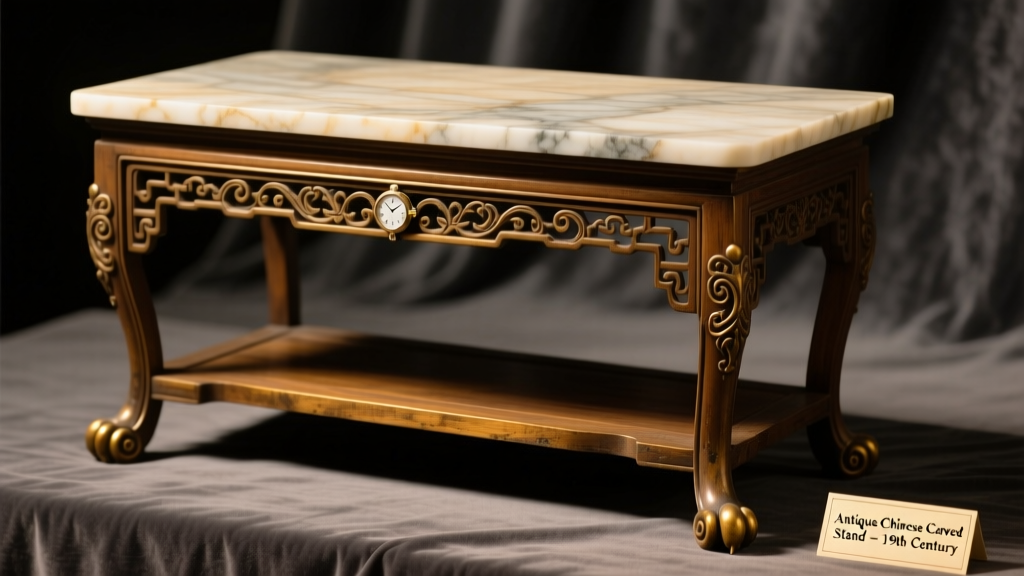
A Closer Look at the Chinese Export Furniture Stand: Carved Marble Top, Lower Shelf, and Ball-and-Claw Feet (c. 1880–1910)
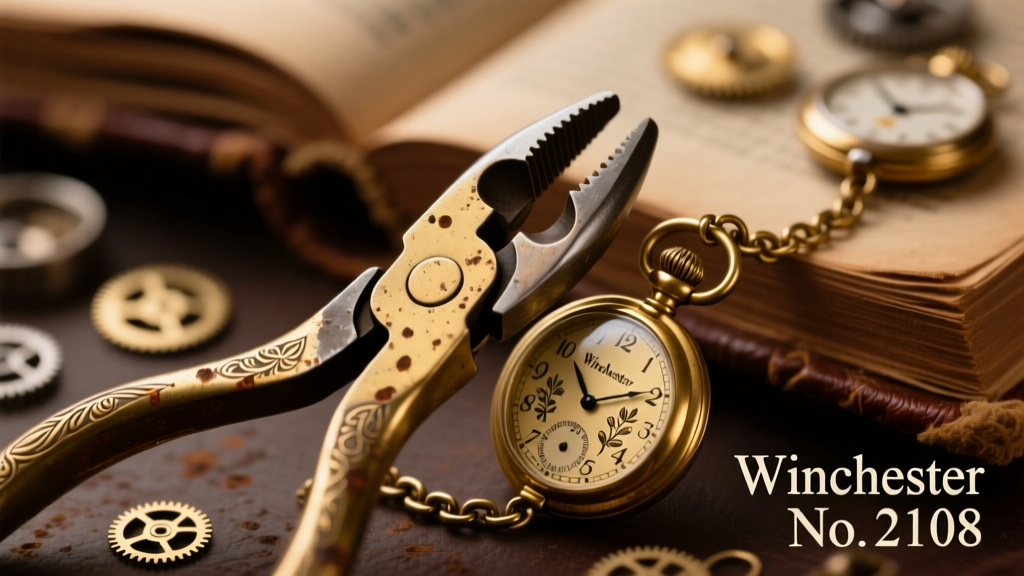
Winchester No. 2108-8 Precision Pliers: A Collector’s and Restorer’s Deep Dive into a Mid-Century Horological Tool
Madam X Gypsy Fortune Teller Advertising Sign, c. 1950: A Rare Mid-Century Americana Artifact in Enamel and Tin

Lewis Curtis: The Forgotten American Watchmaker Who Built Precision Timepieces for the U.S. Military and Railroads
Celadon Dish with Blue Ground, China, Circa 1860 — A Study in Qing Dynasty Ceramic Innovation and Export Craftsmanship
Stoneware Crock: Cobalt Blue Floral Design, Fort Edward, NY — A 2-Gallon American Folk Art Artifact (c. 1880–1910)
The 1957 Rolex Submariner Ref. 1136404: A Technical and Historical Deep Dive