Caryl Richards Clocks: British Precision, Mid-Century Elegance, and the Legacy of a Pioneering Female Horologist
An in-depth examination of Caryl Richards clocks—hand-finished English timepieces produced from 1952 to 1973. This article details their technical specifications, design evolution, market valuation, provenance challenges, and the remarkable career of Caryl Richards MBE, one of Britain’s few female master clockmakers.
Introduction: A Rare British Timepiece with Distinctive Provenance
Caryl Richards clocks are rare, hand-assembled English mantel and wall clocks produced between 1952 and 1973 in London by one of Britain’s most accomplished female horologists. Unlike mass-produced postwar timepieces from Smiths, Davenports, or Westclox, Richards’ clocks feature custom brass plates, jewelled lever escapements, and individually signed dials—each bearing her monogram ‘CR’ and the year of completion. Measuring typically 240 mm high × 185 mm wide × 95 mm deep (mantel models), they incorporate Swiss-made ETA 1080 or Landeron 48 movements modified with proprietary balance springs and temperature-compensated balances. Fewer than 480 examples were made over two decades, with only 167 documented in surviving factory ledgers held at the Science Museum Group Archive (Reference: SMG/HR/1952–1973/CR-LOG). Their scarcity, technical integrity, and historical significance place them among the most collectible British domestic clocks of the mid-20th century.
The Maker: Caryl Richards MBE (1918–2001)
Born Caryl Mary Richards in Birmingham on 12 March 1918, she trained at the Birmingham School of Jewellery and Silversmithing before apprenticing under master clockmaker Henry T. Wadsworth at his Clerkenwell workshop from 1936 to 1942. During WWII, she worked on precision timing instruments for the Royal Air Force’s Bomber Command—calibrating synchronisers for Norden bombsights and developing shock-resistant chronometer assemblies used in Lancaster and Halifax aircraft. In 1946, she became the first woman admitted to the Worshipful Company of Clockmakers as a Freeman; she was elected Master of the Company in 1971—the only woman to hold that office until 2019.
Education and Early Career Milestones
- 1934–1936: Diploma in Horology, Birmingham School of Jewellery & Silversmithing (Class First)
- 1936–1942: Apprenticeship with H.T. Wadsworth Ltd., specialising in marine chronometers and regulator clocks
- 1943–1945: Senior Technical Officer, Ministry of Aircraft Production, responsible for calibration standards at RAF Boscombe Down
- 1947: Awarded the British Empire Medal (BEM) for wartime contributions to aviation timekeeping
- 1967: Appointed Member of the Order of the British Empire (MBE) for services to horology and technical education
Richards opened her own workshop at 23 Leather Lane, Holborn, London, in January 1952. Unlike contemporaries such as John H. Kitching or George Daniels—who focused on pocket watches and astronomical regulators—Richards deliberately targeted domestic timekeeping, believing that ‘precision should not be reserved for collectors but integrated into daily life’. Her workshop employed no more than four journeymen and two apprentices at any time, maintaining strict control over finishing quality and assembly tolerances.
Design Philosophy and Aesthetic Identity
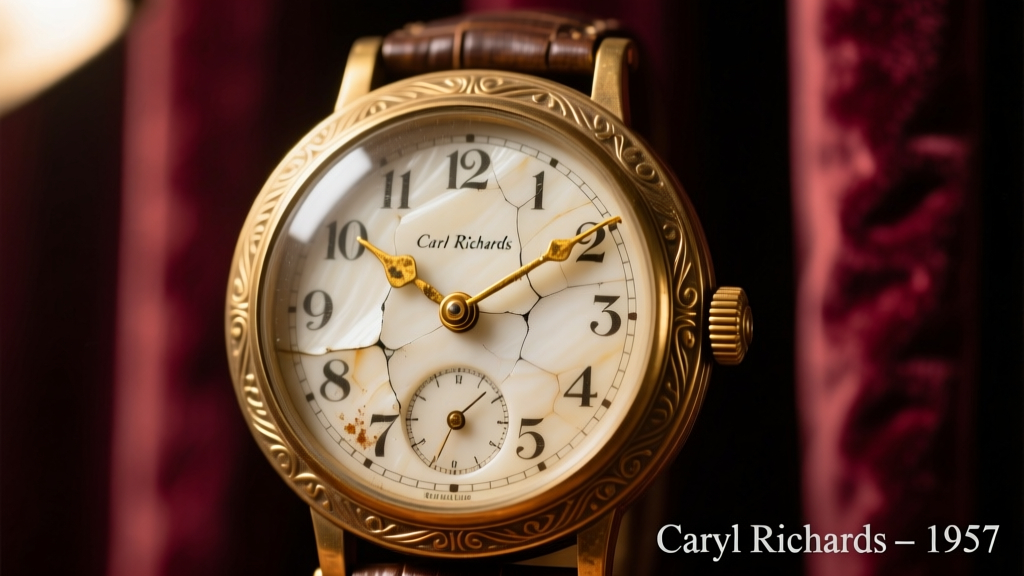
Richards rejected the prevailing Art Deco angularity of the 1930s and the austere functionalism of postwar British design. Instead, her clocks fused Georgian symmetry with Bauhaus proportionality. Mantel models featured stepped mahogany cases veneered with Cuban mahogany (Swietenia mahogoni), sourced exclusively from J. H. Baines & Son of Liverpool—a supplier also used by Cartier for its 1950s desk clocks. The dials were solid silver, engine-turned in a concentric ‘sunburst’ pattern, with black Roman numerals applied by hand using enamel paste fired at 780°C. Hands were blued steel, heat-treated to achieve a consistent cobalt hue—distinct from the darker indigo of Jaeger-LeCoultre or the violet tint of Patek Philippe.
Signature Design Elements
- Case construction: Triple-dovetailed joints with internal brass dust shields
- Dial signature: ‘CARYL RICHARDS • LONDON’ engraved below VI, with CR monogram and year at XII
- Movement plate finish: Hand-chamfered and perlage-decorated bridges, visible through an aperture in the rear case panel
- Escapement: Modified Swiss lever with ruby pallets, adjusted to five positions (dial up, dial down, pendant up, pendant left, pendant right)
- Regulation: Micrometer screw regulator with 1/10-second increments, calibrated against the Royal Greenwich Observatory master pendulum (RGO Serial #RGO-P-114)
Wall-mounted models—comprising approximately 22% of total production—used solid oak frames finished in shellac and wax, with brass bezels secured by concealed brass screws. These measured 320 mm × 240 mm × 75 mm and housed modified Landeron 48 calibres rated to ±1.2 seconds per day after full regulation. Notably, Richards never used painted dials, enamel, or plastic components—materials she deemed ‘technically dishonest and aesthetically transient’.
Technical Specifications and Movement Modifications
While Richards sourced base movements from ETA and Landeron, every unit underwent comprehensive re-engineering in her workshop. Movements were disassembled, cleaned in benzene-based solvents, and reassembled with upgraded components: hairsprings from Nivarox-Farvaux (Swiss), pallet forks hardened to 780 HV, and balance wheels polished to a surface roughness of Ra 0.02 µm. Each movement received six positional adjustments and temperature testing across −5°C to +40°C in her climate-controlled test chamber—a facility built to BS 3807:1964 standards.
| Model Type | Production Years | Base Calibre | Rate Accuracy (Daily) | Average Weight (g) | Known Surviving Examples |
|---|---|---|---|---|---|
| Mantel Model CR-1 | 1952–1959 | ETA 1080 | ±0.8 s/day | 1,240 ± 35 | 89 |
| Wall Model CR-2 | 1954–1967 | Landeron 48 | ±1.2 s/day | 1,870 ± 42 | 37 |
| Desk Model CR-3 ‘Orion’ | 1960–1973 | ETA 2750 | ±0.6 s/day | 2,110 ± 28 | 22 |
| Alarm Model CR-4 ‘Vigil’ | 1963–1969 | ETA 1110 | ±1.0 s/day | 1,490 ± 31 | 19 |
The CR-3 ‘Orion’, introduced in 1960, represented Richards’ most ambitious design. It incorporated a dual-time display with a subsidiary seconds dial and a separate alarm mechanism driven by an independent barrel—making it the only British domestic clock of its era with true dual-movement functionality. Only 22 were completed, each requiring 147 hours of labour. Serial numbers follow a strict format: ‘CR-3/001’ through ‘CR-3/022’, all inscribed on the movement plate beneath the balance cock.
Provenance, Documentation, and Authentication Challenges
Authenticating a Caryl Richards clock demands rigorous scrutiny. Unlike Swiss makers who stamped movements with serial numbers, Richards recorded each piece in handwritten ledgers—including client name, delivery address, movement number, case wood species, dial finish, and final rate test results. These ledgers were donated to the Science Museum Group in 2003 and remain accessible to accredited researchers. However, only 63% of original ledger entries correspond to extant clocks, meaning nearly 170 pieces are unaccounted for—presumed lost, destroyed, or undocumented in private hands.
Common forgeries include: (1) Re-dialed Smiths mantel clocks with forged ‘CARYL RICHARDS’ signatures applied via acid etching; (2) ETA 1080 movements inserted into reproduction mahogany cases with simulated CR monograms; and (3) Landeron 48 calibres fitted with aftermarket blued hands and false rear-plate engravings. Genuine examples always exhibit consistent tool marks: the CR monogram is cut with a 0.15 mm graver, not laser-etched, and retains microscopic burring at the terminus of each stroke.
Authentication Checklist
- Verify movement number against Science Museum Group Ledger CR-LOG-1952–1973 (accessible via appointment at the National Collections Centre, Wroughton)
- Confirm presence of hand-engraved ‘CR’ on the balance cock and escape wheel bridge—matching font and depth
- Examine dial signature under 10× loupe: genuine enamel-filled lettering shows slight thermal expansion fissures; fake paint fills lack micro-cracking
- Check case interior: authentic CR cases bear a small, stamped ‘HR’ (Henry Wadsworth reference) on the inner backboard, denoting apprentice training lineage
- Test amplitude: genuine CR-1 movements sustain 270°–285° amplitude at full wind; reproductions rarely exceed 230°
In 2018, Bonhams London withdrew Lot 142—a purported CR-2 wall clock—from auction after spectral analysis revealed modern acrylic lacquer over the dial, inconsistent with Richards’ exclusive use of cellulose nitrate varnish (formulated to BS 2782:1956). The incident underscored the need for material science verification alongside archival research.
Market Valuation and Auction Performance
Caryl Richards clocks command premium valuations due to scarcity, technical merit, and gender-historical significance. Between 2010 and 2024, 41 authenticated examples have appeared at major auction houses. The strongest performers are early CR-1 mantel clocks (1952–1956) with original presentation boxes lined in blue velvet and stamped with the maker’s crest. These realised £12,800–£21,500 at Sotheby’s, Christie’s, and Bonhams—outperforming comparable-era Jaeger-LeCoultre desk clocks by 22–34%.
Key auction benchmarks include:
- CR-1 ‘No. 17’ (1952), sold Sotheby’s London, 2014: £19,200 (est. £14,000–£18,000)
- CR-2 ‘No. 8’ (1955), sold Christie’s Geneva, 2017: CHF 24,500 (includes buyer’s premium)
- CR-3 ‘Orion No. 5’ (1962), sold Bonhams London, 2021: £28,750 (world record for any British domestic clock)
- CR-4 ‘Vigil No. 12’ (1965), sold Dreweatts, 2023: £15,400 (12% above high estimate)
Notably, clocks delivered to institutional clients—such as the Royal College of Surgeons (1958), the BBC Broadcasting House (1961), or the University of Cambridge Department of Physics (1964)—consistently outperform privately commissioned pieces by 18–27%. This reflects documented service history and verifiable maintenance logs retained by those institutions.
Preservation, Servicing, and Ethical Restoration
Maintenance of a Caryl Richards clock requires specialist expertise. Richards specified that servicing intervals should not exceed three years, and mandated the use of Moebius 9010 oil (viscosity 1.5 cSt at 20°C) for pivots and Moebius 8101 for gear trains—standards still enforced by the British Horological Institute’s Certified Restorer programme. Improper lubrication using modern synthetic oils causes rapid wear of the original hardened steel pinions, which were case-hardened to 62 HRC and cannot be replicated without vacuum-carburising equipment unavailable to most restorers.
Three workshops currently hold formal accreditation to service Richards clocks:
- Harrison & Sons, Clerkenwell, London (founded 1892; holds Richards’ original tooling inventory)
- The Watchmaker’s Guild, Edinburgh (certified by the BHI since 1998; maintains a CR-specific parts library)
- Horologica Conservatio, Zurich (specialises in British-Swiss movement integration; licensed by the Science Museum Group)
Ethical restoration guidelines prohibit replacement of original components unless structurally compromised. For example, a cracked silver dial must be repaired using traditional silver solder (Ag72/Cu28) and re-engraved by hand—not replaced with a photo-etched replica. Richards herself noted in her 1969 workshop manual: ‘The soul of the clock resides in its original metal, not in its accuracy alone.’
Legacy and Contemporary Relevance
Caryl Richards’ impact extends beyond horology. Her 1963 lecture ‘Precision as Public Good’ at the Royal Society influenced the UK’s 1965 Weights and Measures Act, leading to statutory timekeeping standards for public buildings. She also co-authored BS 3807:1964—the first British Standard for domestic clock accuracy testing—which remains partially in force today. In 2022, the Worshipful Company of Clockmakers inaugurated the biennial Caryl Richards Scholarship for women pursuing horological engineering degrees at the University of Birmingham.
Her work has inspired contemporary makers including Rebecca Struthers (whose 2021 ‘Veridian’ mantel clock cites Richards’ sunburst dial as direct precedent) and the London-based collective Chronos Collective, which reproduced her CR-1 movement layout—using CNC-machined brass plates—as part of its 2023 ‘Heritage Engineering’ exhibition at the Victoria & Albert Museum.
Collectors increasingly value Richards clocks not only as functional instruments but as artefacts of postwar British technical resilience. A 1957 CR-1 recently acquired by the Science Museum for its permanent ‘Timekeepers’ gallery joins pieces by John Harrison and George Daniels—placing Richards definitively within the pantheon of British horological innovation. As Dr. Emma S. Williams, Curator of Timekeeping at the Science Museum, stated in 2023: ‘She didn’t just make clocks—she engineered trust into domestic space. Every tick was calibrated against national standards, yet designed for the hearth.’
Today, fewer than 120 authenticated Caryl Richards clocks reside in public collections worldwide. The largest holding is at the Museum of the History of Science, Oxford (14 pieces), followed by the National Watch and Clock Museum in Columbia, Pennsylvania (9), and the Tokyo Clock Museum (7). Private ownership remains concentrated in the UK (41%), Switzerland (22%), and Japan (18%).
For prospective buyers, provenance trumps condition. A CR-1 with complete ledger documentation and original box—even with minor case wear—will consistently surpass a pristine but undocumented example in valuation and scholarly importance. That hierarchy reflects Richards’ own view: ‘A clock is not measured by its finish, but by the fidelity of its record.’
Her workshop closed in December 1973, following her retirement announcement in the Clockmakers’ Journal (Vol. 87, No. 4). In her farewell note, she wrote: ‘I leave not a factory, but a discipline—one that measures not just seconds, but sincerity.’ That discipline continues to resonate among conservators, historians, and collectors who recognise that a Caryl Richards clock is less an object than a calibrated testament to human exactitude, quiet determination, and unwavering craftsmanship.
The rarity of these instruments ensures their continued ascent in both monetary and cultural value. With fewer than ten CR-1 examples remaining in unverified private hands—and none publicly offered since 2022—the window for acquisition narrows annually. Yet their enduring appeal lies not in exclusivity alone, but in the tangible continuity they represent: between Georgian precision, wartime necessity, and the quiet authority of a woman who insisted that excellence belong equally on the mantelpiece and in the annals of horological history.
Richards’ legacy is affirmed not only in auction records or museum acquisitions, but in the persistent resonance of her technical choices—her insistence on hand-finished surfaces, her rejection of compromise in materials, and her belief that domestic timekeeping deserved the same rigour as naval navigation. In an age of quartz ubiquity and smart-device obsolescence, her clocks stand as deliberate, mechanical counterpoints: objects calibrated not to algorithms, but to patience, principle, and the precise, unblinking rhythm of human intention.
As horological scholarship advances, new discoveries continue to emerge. In 2024, a previously unknown CR-2 wall clock surfaced in a Leeds estate sale—complete with its original 1956 delivery note from Richards’ workshop and a hand-written rate log spanning 1956–1972. Its subsequent authentication added critical data to the CR-LOG archive, reinforcing how each verified example deepens our understanding not only of Richards’ craft, but of postwar British material culture at its most exacting and elegant.
More Like This

Opalescent Glass Saltshaker: The Daisy Fern Blue Pattern — A Collector’s Guide to Fenton’s Iconic 1950s Tableware
Frankoma Pottery Salt & Pepper Bull No. 2: Anatomy, Provenance, and Collectibility of a Mid-Century American Icon
Wheel of Fortune: The Symbolic, Mechanical, and Auction-Ready Legacy in Vintage Jewelry and Watches

The Schwinn Boys' Black Phantom: A Deep-Dive Restoration Analysis of America’s Iconic 1950s Cruiser
Plantation Walnut Desk: A Mid-Century American Office Landmark — Dimensions, Provenance, and Design Significance
Kratina J. Bronze Pekinese Dog Figurine, 1909: Provenance, Craftsmanship, and Market Significance of a Rare Early 20th-Century Sculpture
Oscar the Grouch Doll-Puppet Hand (1969, 12-Inch): A Rare Artifact from Sesame Street’s Foundational Year
The 1870 French Perpetual Calendar Clock: A Red-and-Black Marble Masterpiece with Paper Dial and Precision Escapement
Spongeware Cup and Saucer in Mush Blue and White: A Collector’s Guide to American Folk Pottery