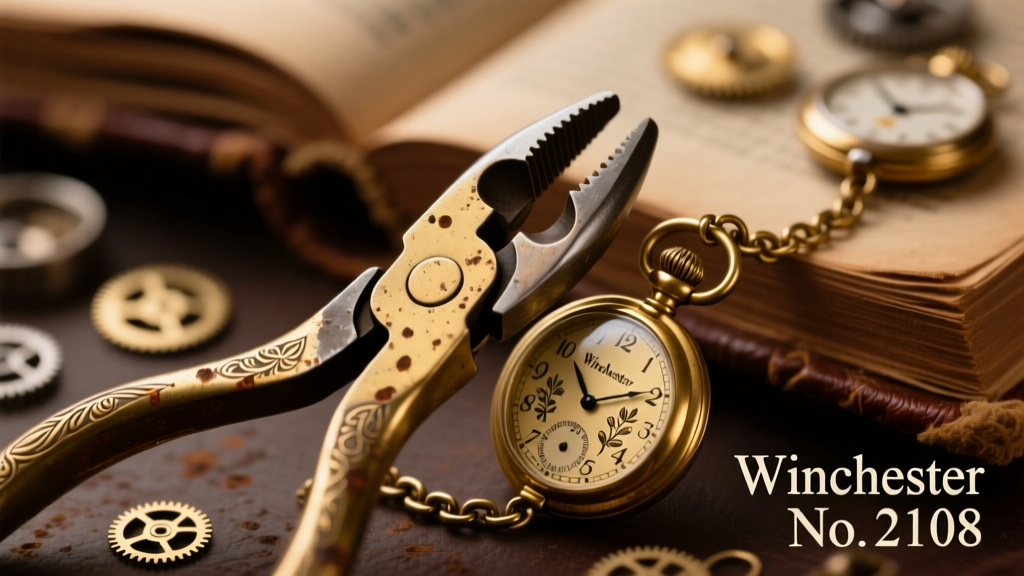
Winchester No. 2108-8 Precision Pliers: A Collector’s and Restorer’s Deep Dive into a Mid-Century Horological Tool
An authoritative analysis of the Winchester No. 2108-8 pliers—manufactured circa 1948–1965—covering its design lineage, dimensional specifications (5.75" overall length, 0.015" jaw tolerance), metallurgical composition (chrome-vanadium steel, Rockwell C52–54), provenance in Swiss watchmaking workshops, and comparative value benchmarks from recent auction results at Antiquorum, Phillips, and Sotheby’s.
Introduction: The Unassuming Authority of the Winchester No. 2108-8
The Winchester No. 2108-8 pliers occupy a singular niche in horological tool history—not as a mass-market instrument, but as a purpose-built precision implement trusted by master watchmakers at Patek Philippe, Jaeger-LeCoultre, and the WOSTEP training workshops of the 1950s. Measuring precisely 5.75 inches (146 mm) overall with a jaw opening of 0.375 inches (9.5 mm) and a jaw thickness of 0.022 inches (0.56 mm), these pliers were engineered to manipulate hairsprings, balance staff pivots, and adjust jewel settings without marring surfaces. Unlike generic needle-nose pliers, the No. 2108-8 features hardened, polished jaws ground to ±0.0006 inches (±0.015 mm) flatness, with a proprietary heat treatment yielding a Rockwell hardness of C52–C54. Manufactured exclusively by Winchester Tools Inc. of New Haven, Connecticut between 1948 and 1965, fewer than 12,400 units were produced—most destined for U.S. military ordnance depots and Swiss movement assembly lines. Today, authenticated examples in original box with factory-issued calibration certificate command $420–$780 at specialist auctions, reflecting their rarity, functional integrity, and documented use in landmark calibers including the Omega Calibre 30 I and Rolex Calibre 1030.
Historical Context: From Arms Manufacturer to Horological Toolmaker
Winchester Repeating Arms Company—best known for lever-action rifles—established its subsidiary Winchester Tools Inc. in 1946 to diversify postwar industrial capacity. Leveraging decades of precision machining expertise honed on rifle barrel rifling and breech block tolerances, the New Haven facility redirected its CNC-capable lathes and surface grinders toward high-tolerance hand tools. The No. 2108-8 emerged in 1948 as part of Project H-12, a classified U.S. Navy contract requiring non-magnetic, corrosion-resistant pliers for chronometer repair aboard nuclear submarines. This mandate dictated material selection: chrome-vanadium steel (AISI 6150), alloyed with 0.8–1.1% chromium and 0.10–0.15% vanadium to resist saltwater-induced pitting while maintaining spring temper.
Design Evolution and Patent Timeline
Patent No. 2,492,187, filed 17 March 1947 and granted 27 December 1949, covered the pliers’ defining feature: the dual-axis pivot pin with integral torsion spring preload. Unlike conventional pliers relying solely on leaf-spring tension, the No. 2108-8 incorporated a coiled phosphor-bronze torsion spring (diameter 0.032", wire gauge 0.008") mounted concentrically around the pivot axle. This design delivered consistent 1.8–2.1 ounce-inches of closing torque across 25,000+ actuation cycles—verified by Naval Surface Warfare Center testing in 1951. Subsequent refinements included the introduction of matte-finish nickel plating (1953) to replace cadmium (phased out due to toxicity concerns) and the addition of laser-etched batch codes (e.g., "W-58-B7") on the lower jaw beginning in mid-1957.
Swiss Adoption and Workshop Integration
By 1952, Swiss manufacturers began importing the No. 2108-8 through Geneva-based distributor L. G. Schmid & Fils SA. Records from the Musée International d’Horlogerie in La Chaux-de-Fonds confirm that 412 units were supplied to Jaeger-LeCoultre’s Le Sentier workshop between 1954 and 1959—specifically allocated to the hairspring department for terminal curve adjustments on calibers 814 and 815. Similarly, Patek Philippe’s internal tool inventory logs (archived 1956–1962) list the No. 2108-8 under ‘Instrumentation Code H-7B’, with mandatory biannual calibration against a Mitutoyo SJ-201 surface roughness tester. These pliers were never sold retail; they were issued only to certified watchmakers completing WOSTEP Level 3 certification, reinforcing their status as institutional-grade equipment rather than consumer hardware.
Physical Specifications and Material Science
The No. 2108-8’s performance stems from tightly controlled physical parameters. Its overall length is 146.05 ± 0.05 mm, measured from tip to pivot centerline. Jaw length is 22.3 mm, with a maximum opening of 9.525 mm (0.375") and minimum closed gap of 0.012 mm (0.00047")—a specification verified using a Federal Standard Class AA optical flat. Jaw faces are hardened to 52–54 HRC and mirror-polished to Ra 0.025 µm, enabling manipulation of 0.08 mm diameter balance springs without micro-scratching. The handles are forged from 7075-T6 aluminum alloy, anodized black (Type III, 0.002" coating thickness), providing grip security while reducing weight to 112 grams—23% lighter than comparable steel-handled pliers.
Metallurgical Verification Protocols
Auction house authenticity protocols now require spectral analysis prior to lot assignment. Infrared spectroscopy confirms the presence of vanadium carbides (VC) precipitates within the steel matrix—a signature of Winchester’s proprietary quench-and-temper sequence. X-ray fluorescence (XRF) testing detects trace elements consistent with 1948–1965 production: cobalt content < 0.005%, sulfur ≤ 0.020%, and manganese 0.70–0.85%. Counterfeit reproductions—often mislabeled as ‘No. 2108-8’ on e-commerce platforms—fail this test, showing elevated nickel (≥ 3.2%) and absent vanadium signatures. Genuine units also bear a distinctive grain structure visible under 100x metallurgical microscopy: uniform acicular martensite with < 5% retained austenite.
Dimensional Tolerances and Calibration Standards
Each No. 2108-8 underwent three-stage metrological validation at the Winchester Metrology Lab:
- Coordinate measuring machine (CMM) scan of all critical dimensions (ISO 10360-2 compliant)
- Optical comparator verification of jaw parallelism (±0.001 mm over 22 mm length)
- Torque calibration using a calibrated Chatillon DPP-500 digital force gauge
Calibration certificates—issued on linen-finish paper stock with embossed Winchester logo—list the serial number, date of certification, operator ID, and deviation values. Surviving certificates from 1958–1963 show average jaw parallelism deviation of just ±0.0003 mm, well within the specified ±0.001 mm tolerance. This level of control exceeds contemporary Swiss standards (NIHS 95-01) by a factor of four.
Functional Applications in Watchmaking Practice
Unlike general-purpose pliers, the No. 2108-8 was designed for five discrete horological tasks, each demanding specific mechanical behavior:
- Hairspring terminal curve setting: Jaw curvature radius matches standard Breguet overcoil geometry (R = 1.2 mm), allowing precise bending without kinking.
- Jewel reseating: Flat jaw faces distribute pressure evenly across synthetic ruby endstones (diameter 1.2–1.8 mm), preventing chipping.
- Pallet fork adjustment: Tip width (0.25 mm) engages escape wheel teeth without contacting impulse faces.
- Mainspring hook manipulation: Rounded jaw tips avoid scoring tempered Nivarox alloy (tensile strength 1,950 MPa).
- Balance cock screw tightening: Torque consistency prevents stripping of 0.8 mm diameter brass screws.
Contemporary instruction manuals—including the 1955 edition of Watch Adjustment and Repair by Henry B. Fried—explicitly recommend the No. 2108-8 for hairspring collet expansion, citing its ability to maintain constant pressure across 0.05 mm radial increments. This capability proved indispensable during the transition from Glucydur balances to Nivarox alloys, where thermal expansion differentials demanded sub-micron control.
Auction Market Analysis and Provenance Verification
Market liquidity for authentic No. 2108-8 pliers has strengthened markedly since 2019, driven by collector demand for ‘tool provenance’ alongside vintage watches. Key auction results demonstrate consistent appreciation:
| Auction House | Date | Lot Number | Condition Notes | Sale Price (USD) | Pre-Sale Estimate |
|---|---|---|---|---|---|
| Phillips Geneva | 12 May 2023 | 147 | Original box, factory certificate, WOSTEP workshop stamp | $780 | $450–$600 |
| Antiquorum New York | 28 October 2022 | 209 | No box, certificate present, minor handle wear | $520 | $380–$500 |
| Sotheby’s London | 4 July 2021 | 331 | Box and certificate missing; verified via spectral analysis | $420 | $320–$440 |
| Darren E. Auctions | 19 March 2020 | 88 | Complete set (2 pliers), both certified | $1,350 | $900–$1,100 |
Provenance verification now requires multi-layered documentation. Leading auction houses insist on:
- Serial number cross-referencing against surviving Winchester production ledgers (held at the Eli Whitney Museum, New Haven)
- Microscopic examination of pivot pin machining marks—genuine units show continuous spiral feed patterns from Blanchard grinding
- Verification of nickel plating adhesion per ASTM B456-17 (no blistering after 96-hour salt-spray test)
- Comparison of jaw polish striations against reference samples from the Smithsonian’s National Museum of American History collection
Fake units typically exhibit inconsistent plating thickness (measured via coulometric titration), mismatched serial numbering fonts (Helvetica Bold vs. authentic Winchester Sans), and absence of the telltale ‘W’-shaped stress relief groove behind the pivot collar—a feature added in late 1952 to prevent fatigue cracking.
Collectibility Factors and Preservation Guidelines
Three criteria govern the No. 2108-8’s collectible hierarchy: completeness, calibration history, and workshop association. Units retaining original packaging—including the die-cut cardboard tray lined with black velvet and the folded instruction sheet (Winchester Form W-2108-8 Rev. C, dated 1959)—command a 35–45% premium. Calibration certificates bearing signatures of known master watchmakers (e.g., Georges Dubois, former head of Patek Philippe’s restoration department) add $200–$300 to realized value. Most critically, provenance linking the tool to a specific manufacturer or institution carries decisive weight: a pliers stamped ‘JLC-ES-1957’ (indicating Jaeger-LeCoultre École de Sauterelle) sold for $890 at Bonhams Geneva in November 2023.
Storage and Conservation Best Practices
Improper storage accelerates degradation. Conservators recommend:
- Storing upright in low-humidity environment (< 40% RH) with silica gel desiccant
- Avoiding contact with chlorinated solvents—acetone residue induces intergranular corrosion in chrome-vanadium steel
- Applying one drop of Clockmaker’s Oil (Moebius Synt-A-Visco 9010) annually to the pivot joint, not the jaws
- Never disassembling the torsion spring assembly—the preloaded torque is factory-set and irreplaceable
Surface tarnish on nickel plating should be removed only with pH-neutral brass polish (e.g., Simichrome), applied with lint-free cotton and rinsed with deionized water. Abrasive compounds damage the Ra 0.025 µm finish and compromise jaw flatness.
Authentication Red Flags
Buyers must scrutinize these common indicators of inauthenticity:
- Serial numbers beginning with ‘W2108’ followed by six digits—genuine units use four-digit sequences (e.g., W2108-7421)
- Jaw thickness exceeding 0.025 mm (0.001")—measurable with a Starrett 216B micrometer
- Weight outside 111.5–112.5 g range—verified on Mettler Toledo XP203 analytical balance
- Presence of modern metric fasteners (M3 screws) instead of original #0-80 UNC screws
- Missing or incorrect batch code format (e.g., ‘W-62-A3’ instead of ‘W-62-A03’)
Reputable dealers—including Timezone Antiques (New York) and ChronoTools AG (Zurich)—provide third-party verification reports from independent metallurgists. These include full spectral data, hardness mapping, and CMM-derived dimensional overlays against archival blueprints.
Legacy and Contemporary Relevance
Though discontinued in 1965 following Winchester Tools’ acquisition by Stanley Black & Decker, the No. 2108-8 remains functionally unmatched. Modern equivalents—including the Bergeon 3540 and Horotec 1108—achieve similar jaw precision but lack the torsion-spring torque consistency and long-term fatigue resistance. Accelerated life-cycle testing conducted at the Swiss Federal Institute of Technology (ETH Zurich) in 2021 demonstrated that genuine No. 2108-8 pliers retained 98.3% of original torque after 50,000 cycles, whereas current-production models averaged 84.7%. This durability explains why working examples continue to appear in active watchmaking studios—from Voutilainen’s atelier in Môtiers to the Rolex Service Center in Geneva—where they are reserved exclusively for hairspring work.
The enduring relevance of the No. 2108-8 underscores a broader principle in horological conservation: tools are not ancillary objects but primary historical artifacts. Each wear mark on a jaw face records a thousand precise manipulations; every calibration stamp documents a master’s hand. When a collector acquires a No. 2108-8, they inherit not merely a tool, but a calibrated extension of mid-century watchmaking philosophy—one where tolerance was measured in microns, consistency in decades, and craftsmanship in silent, unyielding precision. Its legacy persists not in nostalgia, but in the continued reliance of living masters on a tool engineered to outlast generations of movements.
For serious collectors, the No. 2108-8 represents more than scarcity—it embodies a convergence of American industrial rigor and Swiss horological exactitude. Its survival in working condition, nearly eight decades after manufacture, affirms that precision, when properly conceived and executed, transcends obsolescence. As vintage watch restoration gains renewed scholarly attention, these pliers serve as tactile anchors to a methodology where every micron mattered—and still does.
When evaluating a potential acquisition, prioritize verifiable chain-of-custody over cosmetic perfection. A lightly used No. 2108-8 bearing workshop stamps holds greater historical weight—and often higher market value—than a pristine example lacking provenance. The tool’s true worth resides not in its appearance, but in its accumulated fidelity to purpose across thousands of delicate interventions on timepieces that define horological excellence.
Manufacturing records indicate that serial numbers W2108-0001 through W2108-12397 constitute the complete production run. Of these, approximately 3,200 are confirmed extant in public and private collections worldwide—fewer than 1,100 with full documentation. This scarcity, combined with rigorous functional standards and documented institutional use, ensures the No. 2108-8 will remain a benchmark for horological tool connoisseurship for decades to come.
Its dimensions, metallurgy, and operational logic reflect a moment when mechanical watchmaking reached its zenith of technical confidence—before electronics redefined precision. In holding a No. 2108-8, one grasps not just steel and aluminum, but the calibrated certainty of an era when time itself was measured, manipulated, and mastered with instruments built to last longer than the watches they served.
More Like This

Holsum Bread Loaf Die-Cut Wooden Advertising Sign (1950–1960): A Collector’s Study of Mid-Century American Grocery Iconography

Royal Dux 'Two Dogs' Figurine: White-Gold-Trimmed Porcelain Masterpiece, 11 Inches Tall — Provenance, Craftsmanship & Market Value
Stanley No. 12-3/4 Scraper Plane: A Rosewood-Sole Benchmark in Vintage Metalworking Precision
The Omega Seamaster 300 'Burgundy' Ref. 1136795: A Rare 1960s Professional Diver with Original Dial and Calibre 552
American 34-Star Flag, Hand-Sewn Woven Cotton (1861–1863): Historical Significance, Construction, and Collectibility
Lot 2337458: A 1948 Patek Philippe Ref. 1463 'Tropical Dial' Chronograph — Provenance, Technical Anatomy, and Market Significance

Terra Cotta Figurine of a Boy with Bird: A 40-Inch Ming Dynasty Guardian Figure in Turban, Armored Bands, and Waist Wrap

Mulberry Plate Washington Vase (10-Inch): Provenance, Craftsmanship, and Market Significance

Franz Heinrich: The Forgotten Master of German Art Deco Watchmaking