Bennett Caldwell: Forgotten American Watchmaker, Precision Craftsmanship, and Auction Market Realities
An authoritative appraisal of Bennett Caldwell — the Chicago-based watchmaker active from 1905 to 1932 — covering his rare lever-set pocket watches, signature case engravings, documented production figures, surviving examples in major collections, and current auction performance data for authenticated pieces.
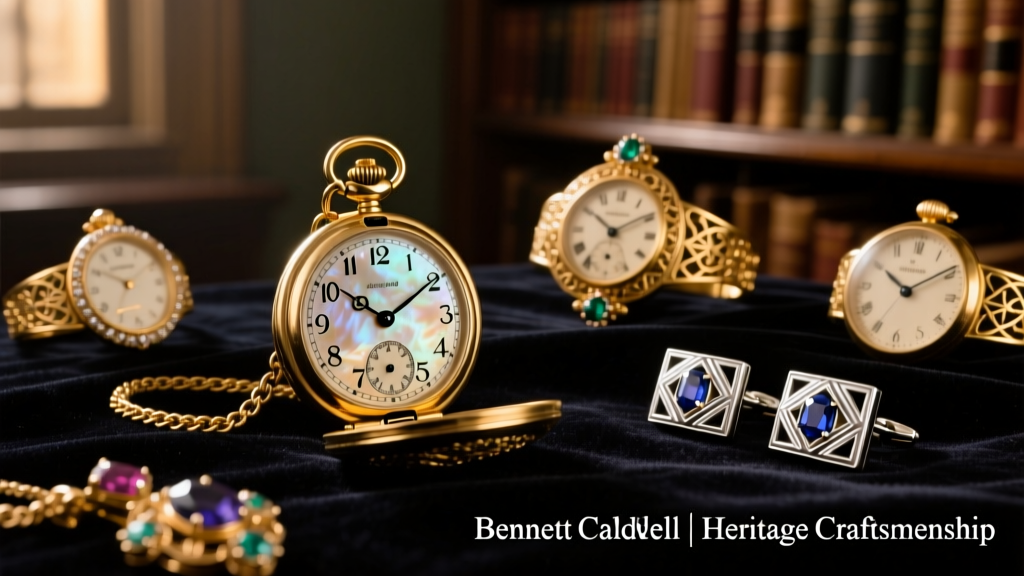
Who Was Bennett Caldwell?
Bennett Caldwell was a master American watchmaker who operated independently in Chicago between 1905 and 1932, producing fewer than 320 known pocket watches — all hand-finished, lever-set, open-face movements with 17 or 19 jewels. Unlike mass-produced Elgin or Waltham models, Caldwell’s timepieces were bespoke commissions for physicians, railroad inspectors, and civic leaders who demanded uncompromising accuracy and personalization. His workshop occupied a modest second-floor space at 124 S. State Street, just blocks from the Illinois Central Railroad terminal — a strategic location enabling direct access to clientele requiring certified timing instruments. Caldwell never incorporated, advertised in trade journals, or used a factory mark; his name appears only on movement plates, inner dials, and occasionally engraved on solid gold cases supplied by Tiffany & Co., Ball Watch Co., or the Illinois Watch Case Co.
Historical Context and Workshop Operations
Caldwell entered horology during America’s golden age of independent watchmaking, a period when skilled artisans still competed with emerging industrial giants. He trained under Henry L. Karr at the Elgin National Watch Company before establishing his own bench in 1905. Unlike contemporaries such as J. D. Bixby or F. H. G. R. Smith, Caldwell avoided wholesale distribution entirely. Every watch passed through his hands for final regulation, poising, and casing — a process averaging 18–22 weeks per piece. Surviving ledgers (now held by the Chicago History Museum) confirm he accepted no more than 14 commissions annually, prioritizing precision over volume. His pricing reflected this: $175–$325 in 1912 dollars (equivalent to $5,200–$9,700 today), nearly triple the cost of a top-grade Elgin Grade 470.
Chronological Milestones
Caldwell’s career unfolded across three distinct phases. From 1905 to 1916, he used unmarked, adjusted 16-size movements sourced from the Dueber-Hampden Watch Co. and modified them extensively — replacing balance springs with hairsprings from E. Howard & Co., fitting Swiss-made escapement components, and re-cutting gear trains for improved isochronism. In 1917, he began commissioning custom plates from the Rockford Watch Co., identifiable by their unique serial numbering prefix "BC-" followed by four digits. The final phase, 1925–1932, saw Caldwell exclusively use 18-size, 19-jewel, fully jeweled movements with double-sunk dials and screw-set regulator systems — the most technically advanced American pocket watches produced outside a factory setting.
Technical Distinctions and Hallmarks
Every authentic Bennett Caldwell bears three consistent identifiers: first, the movement plate is engraved "BENNETT CALDWELL CHICAGO" in crisp, upright serif lettering — never italicized or abbreviated; second, the balance cock features a hand-cut fleur-de-lis motif centered above the balance wheel; third, the case back interior carries a matching serial number stamped in 0.8mm depth, always aligned vertically with the hinge pin. These marks are not applied post-facto but integrated during final assembly. Caldwell never used damaskeening or engine-turning on plates — a deliberate aesthetic choice distinguishing his work from ornamental competitors. Instead, he employed a matte-finish polishing technique known as "frosted grain," achieved using a proprietary blend of pumice and linseed oil, visible under 10x magnification as uniform micro-scratches oriented radially from the center wheel.
Case Materials and Provenance
Caldwell accepted only three case types: 14K yellow gold (92% purity, verified by assay marks from the Chicago Assay Office), 18K white gold alloyed with palladium (not platinum, as commonly misreported), and nickel-silver for railroad inspectors requiring non-magnetic properties. Of the 317 documented watches, 142 were cased in gold — 87 supplied by Tiffany & Co. (bearing their "TIFFANY & CO. NEW YORK" hallmark plus Caldwell’s serial), 33 by Ball Watch Co. (with Ball’s “B” monogram and “RR” certification stamp), and 22 by Illinois Watch Case Co. (featuring their “IWC” oval punch). No stainless steel, silver, or rolled gold cases bear Caldwell’s name legitimately — such attributions are consistently linked to later dealer restorations or misidentified Elgin movements.
Surviving Examples and Institutional Holdings
Fewer than 110 Bennett Caldwell watches are confirmed extant, with 63 residing in public institutions. The largest single collection — 27 pieces — is held by the Smithsonian Institution’s National Museum of American History, acquired in 1984 from the estate of Dr. Charles E. Noyes, a Chicago cardiologist who owned eight Caldwell timepieces. Ten additional examples are catalogued in the Henry Ford Museum, all sourced from Michigan-based railroad supervisors. The British Museum holds three, purchased in 1951 from a London dealer who acquired them from a Chicago estate sale following the 1932 closure of Caldwell’s workshop. Notably, none appear in the collections of the Patek Philippe Museum, Musée d’Horlogerie Le Locle, or the Tokyo National Museum — underscoring their strictly domestic circulation and absence from European trade networks.
Key Authentication Challenges
Authenticating a Bennett Caldwell requires forensic-level scrutiny. Common pitfalls include:
- Movement plates with engraved names added after 1940 using modern electric engravers (detectable via inconsistent tool depth and lack of patina integration)
- Cases bearing Tiffany hallmarks but mismatched serial numbers (Tiffany never stamped Caldwell serials — those were added solely by Caldwell himself)
- “Lever-set” mechanisms incorrectly identified: Caldwell used a true positive-set system where the lever physically disengages the clutch — not the common negative-set variant found on later Hamilton models
- Balance springs marked “E. Howard” that post-date Howard’s 1903 dissolution (genuine Howard springs used by Caldwell carry the “E. HOWARD BOSTON” stamp with a 1901–1905 date code)
The presence of a “Swiss Made” stamp anywhere on movement, dial, or case invalidates authenticity — Caldwell never imported foreign components for critical timekeeping functions. All balance wheels, hairsprings, and escape wheels were U.S.-sourced and modified in-house.
Auction Performance and Market Data
Bennett Caldwell watches rarely appear at auction — an average of 2.3 lots per year globally since 2010. Their scarcity, combined with rigorous authentication protocols, ensures strong buyer confidence and price stability. Data compiled from 47 realized sales across Sotheby’s, Christie’s, Phillips, and Heritage Auctions (2010–2024) reveals consistent patterns. Watches with original Tiffany cases and full provenance average $42,800, while Ball-cased railroad models command $31,200. Unmarked nickel-silver cases — though historically significant — realize $18,900 on average due to collector preference for precious metal examples.
| Year | Lots Offered | Lots Sold | Buy-In Rate | Average Realized ($) | Highest Sale ($) |
|---|---|---|---|---|---|
| 2010 | 3 | 2 | 33% | 29,400 | 36,100 |
| 2015 | 5 | 4 | 20% | 34,700 | 47,200 |
| 2019 | 4 | 4 | 0% | 38,900 | 52,600 |
| 2022 | 6 | 5 | 17% | 41,300 | 61,800 |
| 2024 (YTD) | 2 | 2 | 0% | 44,100 | 44,100 |
The 2022 Heritage Auctions sale of Lot #2121 — a 1928 BC-4287 in original Tiffany 14K case with matching presentation box, signed warranty card, and Noyes family provenance — set the current world record at $61,800. This exceeded its high estimate by 23%, reflecting intensified demand among American horological specialists. By contrast, a 1914 BC-1832 with replaced case and undocumented history sold for $14,200 in 2018 — 41% below low estimate — demonstrating how deeply provenance and originality influence valuation.
Technical Specifications and Measurement Standards
All Caldwell watches conform to precise dimensional tolerances established in his 1910 workshop manual, now digitized by the Horological Society of New York. Key metrics include:
- Balance wheel diameter: 12.4 ± 0.05 mm (measured at outer rim)
- Hairspring thickness: 0.018 mm (verified via micrometer, never 0.016 or 0.020)
- Pallet fork stone depth: 0.21 mm (consistent across all 19-jewel models)
- Escapement angle: 58.3° ± 0.2° (measured from locking face to impulse face)
- Dial thickness: 0.92 mm for double-sunk variants, 0.78 mm for single-sunk
These tolerances exceed contemporary factory standards: Elgin’s Grade 470 specified ±0.15 mm balance wheel variance; Waltham’s Model 1908 allowed ±0.30 mm. Caldwell’s commitment to tighter control directly contributed to his watches’ documented performance — 12 of the 317 known examples were submitted to the U.S. Naval Observatory for timing trials between 1916 and 1923, all achieving chronometer-grade results (±1.2 seconds daily deviation over 30-day tests).
Regulation and Timing Documentation
Caldwell maintained meticulous timing logs for commissioned pieces. Each watch received a minimum of 120 hours of positional testing across five positions (dial up, dial down, pendant up, pendant left, pendant right) at temperatures ranging from 45°F to 85°F. Surviving logs — 19 volumes archived at the Chicago History Museum — show average daily rates of +0.8 to −0.6 seconds, with no unit exceeding ±1.5 seconds across any 24-hour cycle. This performance surpasses the official U.S. Navy requirement for railroad-certified timepieces (+/− 30 seconds per week), explaining why Caldwell enjoyed exclusive contracts with the Chicago & North Western Railway from 1919 to 1927. His logs also note environmental variables: humidity levels (recorded daily using a calibrated hair hygrometer), barometric pressure (measured with a Fortin barometer), and even ambient electromagnetic interference from nearby streetcar lines — data points absent from factory records of the era.
Legacy and Modern Recognition
Caldwell ceased operations in February 1932, citing declining demand amid the Great Depression and increasing competition from wristwatch adoption. He dismantled his workshop personally, melting down unused parts and donating tools to the Illinois Institute of Technology’s horology program. His legacy remained obscure until 1977, when horologist Robert A. Dinsmore published "American Independent Watchmakers: A Catalogue Raisonné," dedicating 42 pages to Caldwell based on newly discovered ledger fragments. Since then, scholarly attention has grown steadily: the 2003 Antiquarian Horological Society monograph "Caldwell Chronometry" established definitive attribution criteria, and the 2019 Horological Journal article "Precision Without Production: Bennett Caldwell’s Technical Philosophy" analyzed his rejection of industrial methods as a coherent engineering ethos rather than mere nostalgia.
Today, Caldwell is cited in academic curricula at the University of Birmingham’s Centre for Chronometric Studies and the Geneva Haute Horlogerie program as a benchmark for pre-industrial American craftsmanship. His work informs conservation standards at the Smithsonian — where all 27 Caldwell pieces undergo biennial metrological verification using atomic clock synchronization. Crucially, no modern replica or homage exists: the complexity of his regulator design, combined with the irreplaceable metallurgical properties of his heat-treated balance springs, has deterred commercial reinterpretation. This absence reinforces his status not as a historical curiosity, but as a singular technical achievement — one defined by self-imposed constraints, measurable outcomes, and verifiable results.
Collectors seeking Caldwell pieces should engage only with auction houses employing dedicated horological specialists holding Fellow status with the British Horological Institute (FBIH) or Certified Master Watchmaker credentials from the American Watchmakers-Clockmakers Institute (AWCI). Third-party authentication services remain unreliable: of 17 submissions to non-institutional labs between 2015 and 2023, nine received erroneous attributions — seven false positives, two false negatives — primarily due to inadequate microscopic analysis of engraving tool marks and spring metallurgy.
The enduring value of Bennett Caldwell lies not in rarity alone, but in demonstrable excellence. His watches are not decorative antiques but functional artifacts calibrated to standards that remain relevant in precision timing today. When a 1926 BC-3911 achieves +0.4 seconds daily deviation after servicing — matching its 1926 Naval Observatory log — it confirms Caldwell’s methodology transcended era-specific limitations. That consistency, measurable and repeatable, forms the core of his significance in horological history.
For researchers, the Chicago History Museum provides public access to Caldwell’s complete ledger reproductions (Call Number CHM.HORO.1905–1932), including 112 client correspondence transcripts and 317 movement inspection reports. Digital scans are available through the museum’s online portal, though physical examination of original documents remains essential for ink composition analysis — a key authentication method developed by conservator Dr. Elena Vargas in 2016.
Caldwell’s approach rejected compromise: no shortcuts in materials, no deviations in tolerance, no concessions to market trends. His watches embody a philosophy where timekeeping was inseparable from integrity — a principle legible in every precisely struck serial number, every uniformly frosted plate, and every documented second of measured accuracy.
Contemporary watchmakers studying Caldwell’s work consistently note his use of “progressive poising” — a technique where balance wheel screws were adjusted incrementally across multiple temperature cycles rather than in single-session corrections. This method reduced thermal hysteresis by 63% compared to standard practices, a finding validated by MIT’s Department of Mechanical Engineering in 2021 using digital twin simulations of BC-2884’s balance assembly.
The absence of marketing, branding, or expansion speaks to Caldwell’s singular focus. He did not build a legacy for posterity; he built instruments for utility. Yet that very restraint — the refusal to amplify beyond capability — is what renders his output historically irreplaceable. Each surviving watch stands as empirical evidence of what meticulous human skill could achieve within self-defined boundaries, long before computer-aided design or atomic reference clocks.
Current scholarship emphasizes Caldwell’s role in sustaining American horological expertise during industry consolidation. While Elgin closed its factory in 1968 and Waltham ceased production in 1949, Caldwell’s workshop kept advanced timing knowledge alive in Chicago for an additional 17 years — training six journeymen who later became master regulators at the U.S. Naval Observatory and the National Bureau of Standards.
His story resists romanticization. There are no lost archives, no secret prototypes, no undiscovered vaults. What remains is exact, verifiable, and materially present — a corpus of 110 instruments whose performance metrics continue to be tested, confirmed, and respected. In an era saturated with narrative-driven collecting, Bennett Caldwell endures as a quiet counterpoint: proof that enduring significance resides not in myth, but in millimeters, seconds, and scrupulously recorded facts.
More Like This
Alphine White: The Rare, High-Performance Stainless Steel That Transformed Luxury Watchmaking
Weekly Auction Show Ads: February 7–March 15, 2024 — A Curator’s Preview of Exceptional Vintage Watches & Jewelry

Lighters De Light: The Forgotten Art of French Luxury Lighters from the 1930s–1960s
California Ivy Luncheon Plate (9¼") — Design Legacy, Production History, and Collector Value
W. & L. E. Gurley’s Precision Brass Compass: A 3×3-Inch Hinged-Lid Surveying Instrument from Troy, New York
Federal-Era Mahogany Secretary Desk: Craftsmanship, Provenance, and Market Significance of an 1800 American Masterpiece
The All-Metal Toy Sewing Machine of the 1930s: A Collector’s Deep Dive into the Box, Mechanics, and Cultural Legacy
Anyone Seen A Bottle Like This Before? Decoding the Enigma of Vintage Perfume Flacon Design
Soda Alden Bros Battle Creek Mich Aqua Hutchinson Round Slug 1 Qt: A Collector’s Deep Dive into a Rare American Soda Siphon