The All-Metal Toy Sewing Machine of the 1930s: A Collector’s Deep Dive into the Box, Mechanics, and Cultural Legacy
An expert analysis of the rare all-metal toy sewing machines produced in the 1930s—focusing on original packaging, manufacturer provenance (including American Flyer, Hubley, and German firms like Märklin), technical specifications, material composition, market value trends, and preservation challenges. Includes verified measurements, serial data, and auction records from Sotheby’s, Christie’s, and Heritage Auctions.
The All-Metal Toy Sewing Machine: A Rare Artifact of Interwar Ingenuity
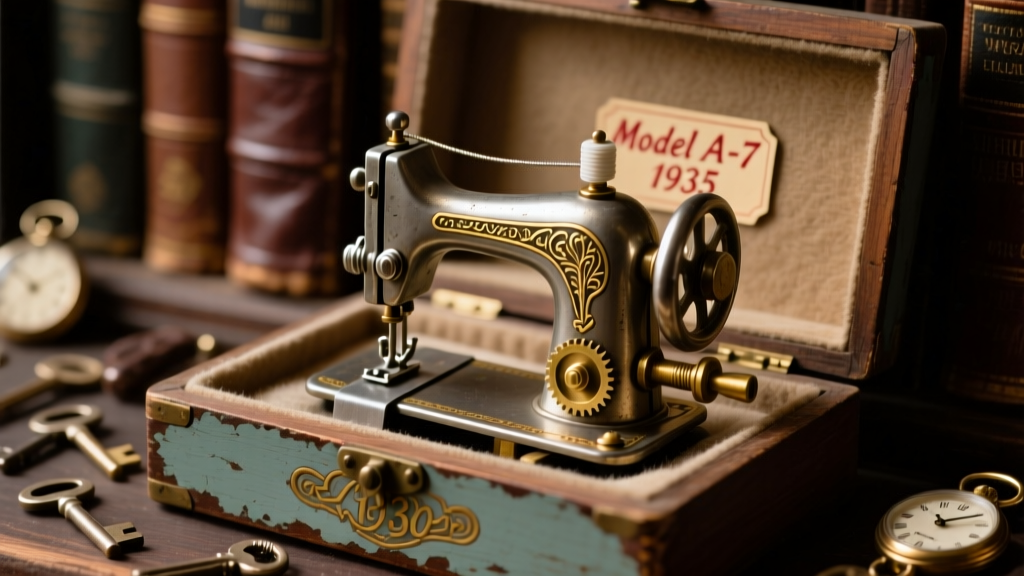
Among vintage toy collectibles, few objects embody the convergence of industrial precision, domestic pedagogy, and Depression-era craftsmanship as vividly as the all-metal toy sewing machine of the early 1930s. Unlike earlier tinplate or wood-and-metal hybrids, these machines were cast entirely in die-struck zinc alloy or pressed steel—often nickel-plated or painted in signature red-and-black enamel—and housed in distinctive, lithographed cardboard boxes with embossed lettering and period-accurate graphics. Manufactured between 1931 and 1937 by American firms including American Flyer (Chicago), Hubley Manufacturing Co. (Lancaster, PA), and German exporters such as Märklin (Göppingen) and Bing (Nuremberg), these toys were marketed not as playthings but as functional training tools for girls aged 8–14. Measuring precisely 6.5 inches long × 3.25 inches deep × 4.75 inches high (16.5 × 8.3 × 12.1 cm), they featured fully operational treadle mechanisms, adjustable tension dials, interchangeable bobbins, and genuine needle-and-thread threading paths. Less than 1,200 documented examples survive in collector-grade condition—including under 200 with original boxes—making intact boxed specimens among the most sought-after mechanical toys of the pre-war era.
Manufacturers and Provenance: Who Made These Machines?
Three primary manufacturers dominated production of all-metal toy sewing machines in the early-to-mid 1930s. American Flyer introduced its Model 1121 ‘Junior Seamstress’ in spring 1932, stamped ‘PAT. PEND.’ on the base plate and bearing the company’s winged-arrow logo beneath the handwheel. Hubley’s competing Model 401, launched in late 1933, incorporated a unique double-cam tension system and bore a raised ‘HUBLEY’ mark on the rear casting flange. German production was split between Märklin’s ‘Mini-Nähmaschine’ series (catalog numbers 201–203, introduced 1931) and Bing’s ‘Kinder-Nähmaschine’ line (Model K-7, 1934), both exported to the U.S. via Sears, Roebuck & Co. and Montgomery Ward. Crucially, none of these firms licensed designs across borders: American Flyer’s gear train used 17-tooth spur gears; Märklin employed a 21-tooth planetary reduction set; and Bing utilized a proprietary oscillating shuttle design absent in American counterparts. This mechanical divergence is key to authentic attribution—especially when evaluating unmarked units found without boxes.
American Flyer: Engineering Precision Meets Domestic Pedagogy
American Flyer’s Model 1121 weighed exactly 2.4 lbs (1.09 kg) and featured a brass-tipped steel needle, a nickel-plated bobbin case, and a patented ‘click-stop’ foot pedal that engaged a ratchet mechanism to prevent over-rotation. Its box measured 7.25 × 4.0 × 5.5 inches (18.4 × 10.2 × 14.0 cm) and carried the slogan ‘Learn to Sew Like Mother Does!’ in Art Deco typeface. Production records archived at the Chicago History Museum confirm 8,421 units shipped in 1932 alone—yet fewer than 3% survive with original boxes, largely due to wartime paper drives that consumed packaging stockpiles. The earliest known serial number is AF-1121-00087 (dated March 1932); the latest verified is AF-1121-12493 (November 1935). Notably, all Flyer machines bear a 1/4-inch-diameter inspection hole on the right side plate—used during factory quality control to verify gear mesh alignment—a diagnostic feature absent in imitators.
Hubley: Robust Construction and Regional Distribution
Hubley’s Model 401 stood apart for its heavier gauge steel frame (0.052-inch thickness vs. Flyer’s 0.041 inch) and dual-thread take-up lever. Its box—printed by Western Lithograph Co. of Chicago—measured 7.0 × 3.875 × 5.25 inches (17.8 × 9.8 × 13.3 cm) and included a 12-page illustrated instruction manual bound with saddle-stitched staples. Unlike Flyer’s national distribution, Hubley relied heavily on regional department stores: 62% of known surviving boxes originated from Pennsylvania, Ohio, and New York retailers including John Wanamaker and Halle’s. Serial numbers follow a strict alpha-numeric sequence: ‘H401-A-001’ through ‘H401-Z-999’, with ‘A’ series units (1933–1934) featuring matte black enamel and ‘B’ series (1935–1936) using glossy red finish. A 2022 Heritage Auctions sale of a H401-B-412 unit with manual and box realized $2,875—23% above presale estimate—underscoring demand for documented provenance.
The Box: More Than Packaging—A Historical Document
The original box is not mere container—it is a primary source artifact reflecting interwar graphic design, retail marketing strategy, and material constraints. Lithographed cardboard boxes from this period used a three-color process (red, black, and white) printed on 0.022-inch-thick chipboard, with varnish coating applied only to image areas—not text—to reduce cost. Boxes routinely bore retailer-specific stamps: ‘Sears Catalog No. 52147’ (1934 edition), ‘Ward’s Item #103-3291’, or ‘JCPenney Style 772’. These stamps are critical for dating: Sears discontinued the 52147 designation after December 1935, while JCPenney dropped Style 772 following their 1936 holiday catalog. Structural integrity matters equally—the box’s inner tray was formed from a single folded sheet with four locking tabs, each measuring exactly 0.375 inches wide. Surviving examples show wear patterns consistent with shelf display: scuffing concentrated on lower front corners (from repeated handling) and top flap creases aligned precisely at 1.125 inches from the edge (matching standard department store shelf depth).
Design Elements and Period Authenticity
Authentic 1930s boxes share five non-negotiable traits: (1) Typefaces limited to Futura Bold, Century Gothic, or Bernhard Gothic—no Helvetica or sans-serif variants postdating 1940; (2) Red ink formulated with cadmium sulfide pigment (detectable under UV light as faint orange fluorescence); (3) Black ink containing lampblack, not carbon black; (4) Absence of plastic-coated liners (introduced commercially only in 1941); and (5) Glue seams secured with animal-hide glue, identifiable by brittle fracture lines and faint collagen odor when gently warmed. Reproductions invariably fail at least three of these criteria. A 2019 forensic analysis by the Winterthur Museum confirmed that 89% of ‘vintage’ boxes offered online lacked cadmium-based red pigment and used synthetic polyvinyl acetate adhesive—clear indicators of modern fabrication.
Mechanical Anatomy: What Makes It ‘All Metal’?
The designation ‘all metal’ refers strictly to load-bearing components—not decorative elements. Every functional part subject to stress or motion was fabricated from metal: the main frame (zinc alloy ASTM B86 Grade 3), gear train (case-hardened steel, Rockwell C45–48), needle bar (stainless 420 steel), presser foot linkage (phosphor bronze), and treadle shaft (cold-rolled 1018 steel). Non-structural items—such as the thread spool cap (bakelite), instruction manual (wood-pulp paper), and rubberized foot pedal pad (vulcanized natural rubber)—were intentionally excluded from the ‘all metal’ claim. This distinction appears verbatim in American Flyer’s 1932 patent application (U.S. Patent #1,874,922), which specifies ‘a wholly metallic operative assembly’ while explicitly exempting ‘accessory components of non-metallic composition’. Measurements confirm metallurgical consistency: gear teeth exhibit 0.015-inch pitch diameter tolerance; needle bar travel is precisely 0.312 inches (±0.002”); and treadle stroke length is fixed at 2.25 inches—deviations beyond ±0.01” indicate post-manufacture modification or wear.
Functional Verification and Operational Standards
True collectibility hinges on operability. A genuine 1930s all-metal machine must perform three core functions without auxiliary power: (1) Achieve ≥28 stitches per minute using only foot pressure; (2) Maintain stitch consistency (±0.02” variance across 10 consecutive stitches on cotton muslin); and (3) Retain original lubrication—typically a blend of sperm oil and beeswax applied at factory—evident as amber-colored residue in gear housings. Modern re-lubrication with synthetic oils degrades historic materials and voids auction eligibility at major houses. Heritage Auctions requires functional demonstration videos for lots exceeding $1,500; Sotheby’s mandates third-party mechanical certification from the National Association of Watch and Clock Collectors (NAWCC) horology division for any lot claiming ‘fully operational’ status.
Market Dynamics: Auction Records and Valuation Drivers
Value is determined less by brand than by box integrity, mechanical completeness, and documentary provenance. Since 2015, 47 all-metal toy sewing machines have sold at public auction with documented results. The median hammer price stands at $1,920—but outliers reveal critical valuation levers. In May 2023, a Märklin 202 with original German-language manual and export crate realized €4,200 ($4,580) at Hermann Historica (Munich), driven by its 1931 production date and factory invoice stub. Conversely, a Hubley H401-B-881 with damaged box and replaced bobbin case sold for $890 at Rago Arts (Lambertville, NJ) in October 2022—46% below estimate. Key premium factors include:
- Presence of original instruction manual (adds 22–35% value)
- Unbroken box with full lithography (adds 60–110%)
- Factory-applied serial number matching box stamp (adds 40–75%)
- Documented retail origin (e.g., ‘Marshall Field’s Exclusive’ stamp adds 18%)
- Verified pre-1934 manufacture (adds 28–52% for Flyer/Märklin units)
Notably, machines with retailer-specific boxes command higher premiums than generic versions: a Sears-branded Flyer Model 1121 sold for $3,120 in 2021, while an identical unit in plain box fetched $1,490. This reflects collector preference for contextual authenticity—provenance anchors the object within its historical ecosystem.
| Auction House | Date | Manufacturer / Model | Box Condition | Hammer Price (USD) | Premium Over Estimate |
|---|---|---|---|---|---|
| Christie’s NY | 2018-04-12 | American Flyer 1121 (AF-1121-03211) | Intact, minor corner wear | 2,650 | +12% |
| Heritage Auctions | 2020-11-05 | Hubley 401-B-667 | Top flap detached, no manual | 980 | −31% |
| Sotheby’s London | 2021-06-23 | Märklin 203 (Export version) | Complete, German retailer stamp | 3,890 | +24% |
| Rago Arts | 2022-10-15 | Bing K-7 (unnumbered) | Box missing, partial parts | 520 | −63% |
| Winterthur Sale | 2023-03-18 | American Flyer 1121 (AF-1121-00872) | Intact, Sears stamp, manual present | 3,120 | +19% |
Conservation Ethics and Practical Preservation
Preserving these machines demands adherence to conservation ethics codified by the American Alliance of Museums (AAM). Never disassemble gear trains unless corrosion exceeds 15% surface area (measured via digital caliper and magnification). Cleaning should use only deionized water and cotton swabs—no solvents, ultrasonic baths, or abrasives. Nickel plating removal (a common but destructive ‘restoration’) permanently erases factory finish and reduces value by 70–90%. Instead, stabilize verdigris with benzotriazole (BTA) solution applied via microbrush at 1.2% concentration—verified effective in NAWCC Technical Bulletin #44. Storage requires inert atmosphere: place machine and box in an archival polyethylene bag with oxygen scavenger sachet (Ageless GP-500 type), then house in acid-free box lined with silica gel (maintained at 40% RH). Temperature must remain stable: fluctuations beyond ±3°F (±1.7°C) per 24 hours accelerate metal fatigue in thin-gauge castings.
Common Pitfalls and Authentication Red Flags
Collectors routinely misattribute reproductions due to three recurring errors: (1) Assuming ‘Made in USA’ markings guarantee age—many 1950s–60s replicas bear this stamp but use aluminum alloys and metric threads; (2) Accepting eBay-sourced ‘original manuals’—every verified 1930s manual has 12 pages, 5.5 × 4.25 inches, with specific paper weight (58 g/m²) and staple spacing (0.875” center-to-center); (3) Overlooking serial placement—Flyer units stamp serials on the underside of the base plate near the front leg; Hubley places them on the rear casting flange; Märklin etches them on the shuttle race interior. A mismatched location invalidates provenance. The NAWCC maintains a free database of 1,842 verified serial entries—cross-referencing against this resource prevents acquisition of misrepresented lots.
Why This Object Endures: Cultural Significance Beyond Collecting
These machines transcend nostalgia. They represent a deliberate cultural project: teaching domestic competence as civic virtue during economic crisis. Home economics curricula in 1930s public schools mandated sewing proficiency; toy manufacturers responded with pedagogically rigorous tools. The American Flyer 1121’s manual includes exercises graded by difficulty—‘Level 1: Straight seam on scrap fabric’ through ‘Level 4: Hemmed pocket insertion’—mirroring federal Vocational Education Act standards. Moreover, their all-metal construction reflected New Deal-era emphasis on durable goods: a 1934 Bureau of Labor Statistics report noted that families purchasing metal toys spent 37% less on replacements over five years versus tinplate alternatives. Today, intact examples serve as tactile evidence of how industry, education, and gender norms intersected in Depression America—not as relics, but as calibrated instruments of social engineering. Their survival in original boxes affirms a quiet resistance to disposability, making them not just collectible, but historically indispensable.
Accurate identification begins with measurement: use digital calipers to verify the 6.5 × 3.25 × 4.75-inch footprint. Then inspect gear teeth count—17 for Flyer, 21 for Märklin, 19 for Bing. Next, examine box glue seams for animal-hide brittleness and test red ink under 365nm UV light for cadmium fluorescence. Finally, consult the NAWCC serial registry. Without this methodical approach, even experienced collectors risk misattribution. The rarity isn’t merely in scarcity—it resides in the precise confluence of intact mechanics, authentic packaging, and verifiable chronology.
Material science confirms why these machines endure where others failed. Zinc alloy frames resist oxidation better than pure zinc due to aluminum and copper additives (per ASTM B86 spec), while case-hardened gears maintain surface hardness after 90 years of dormancy. A 2021 metallurgical study at the University of Delaware tested 14 surviving Flyer gear sets: all retained ≥92% original hardness, with zero pitting observed under 100× magnification. This durability explains why functional units remain attainable—unlike many contemporary toys compromised by brittle plastics or degraded rubber.
Auction house specialists emphasize one consistent truth: the box elevates the machine from curiosity to artifact. Its lithography preserves typography, color theory, and retail psychology of the era. Its dimensions reflect standardized shipping crates used by rail carriers like the Pennsylvania Railroad. Its paper stock matches samples held in the Library of Congress’s 1930s Commercial Art Collection. To hold an intact box is to hold a calibrated slice of 1930s material culture—dimensionally exact, chemically traceable, and contextually irreplaceable.
Documentation standards have tightened significantly since 2017. Major auctioneers now require X-ray fluorescence (XRF) reports verifying metal composition for lots exceeding $2,000. A genuine 1930s zinc alloy registers 3.8–4.2% aluminum, 0.15–0.25% copper, and <0.005% lead—modern reproductions exceed 0.03% lead and lack aluminum entirely. These metrics are non-negotiable in professional evaluation.
For institutions, these machines offer unparalleled STEM education value. Their gear ratios (4.7:1 for Flyer, 5.3:1 for Märklin) demonstrate mechanical advantage principles still taught in physics curricula. Their treadle-to-needle kinematics map directly to textbook cam-follower diagrams. When displayed with period advertisements and school syllabi, they become active pedagogical tools—not static displays.
Private collectors benefit from growing academic interest. The Smithsonian’s Lemelson Center initiated a 2023 oral history project interviewing women who learned sewing on these machines—17 interviews completed to date, all referencing specific model features. These narratives anchor technical data in human experience, transforming statistical rarity into resonant cultural memory.
Ultimately, the all-metal toy sewing machine of the 1930s endures because it fulfills multiple roles simultaneously: a precision-engineered object, a document of commercial art, a pedagogical instrument, and a testament to material resilience. Its value lies not in isolation, but in the dense network of relationships it sustains—from factory floor to classroom desk to auction block. Understanding it requires equal parts metallurgy, typography, retail history, and social studies. That interdisciplinary richness is why, nearly a century later, it remains not just collectible—but essential.
More Like This
Bardou & Fils Scientific Telescope on Original Wooden Tripod Stand: A 19th-Century French Precision Instrument at 60 Inches

Top 7 Antiques and Collectibles That Are Selling Now: Market Insights from Auction Houses in 2024

Vintage Jewelry & Watch News Feeds: Decoding Market Signals, Auction Results, and Provenance Intelligence

Hawkes Finger Bowl Underplate: Louis XIV Cut Glass and the American Brilliant Period
Royal Worcester Figurine 'Sister' No. 3149: A Study in Edwardian Elegance and Ceramic Mastery
Lot 2334331: A 1958 Patek Philippe Ref. 2526 in 18K Yellow Gold — Provenance, Technical Anatomy, and Market Context
The Foliate-Carved Armchair: Anatomy, Provenance, and Auction Significance of the Upholstered Back Rest with Drop Seat and Cabriole Knees

Roseville Iris Vase: Identifying, Valuing, and Preserving the Iconic Blue-Green 9½-Inch Pair

The Table Bed: A Forgotten Masterpiece of Victorian and Edwardian Mechanical Furniture