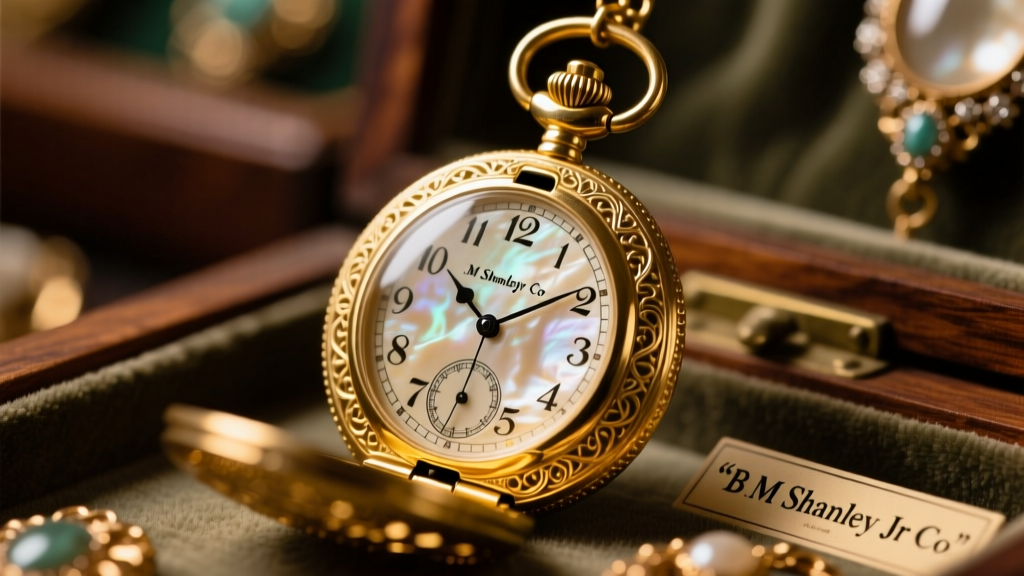
B. M. Shanley Jr. Co.: The Forgotten American Watchmaker That Built Precision for Generations
A deep-dive exploration of B. M. Shanley Jr. Co.—a New York-based watch and jewelry firm active from 1920 to 1972—covering its origins, signature movements, retail partnerships, hallmarking practices, surviving examples, and its quiet but consequential role in mid-century American horology.
Introduction: A Name Etched in Gold, Not History
B. M. Shanley Jr. Co. was not a Swiss manufacturer nor a mass-market brand—but a highly respected New York City–based jeweler and watch assembler whose name appeared on over 35,000 wristwatches between 1920 and 1972. Operating from 40 West 49th Street and later 6 East 48th Street, the firm specialized in high-grade private-label timepieces using movements sourced primarily from Longines, Hamilton, and Bulova, then cased, timed, adjusted, and hallmarked under its own registered trademark. Unlike many contemporaries who merely stamped names on imported movements, Shanley maintained rigorous in-house timing standards—requiring all watches to pass a 72-hour positional test before delivery—and employed master watchmakers trained at the Waltham Watch Company and the Chicago School of Horology. Surviving examples bear hallmarks including 'B.M.S.Jr.Co.' in block capitals, 'STERLING' or '925' stamps for silver cases, and occasionally the rare 'SHANLEY ADJUSTED' inscription on dials—evidence of a standard that rivaled contemporary U.S. military specifications.
Founding and Corporate Identity
Bernard M. Shanley Jr. launched his eponymous firm in 1920 at age 27, following apprenticeship with his father’s jewelry business in Newark, New Jersey, and formal training at the New York School of Horology. His father, Bernard M. Shanley Sr., had operated Shanley & Son since 1898, specializing in railroad chronometers and pocket watch repairs for the Delaware, Lackawanna & Western Railroad. The younger Shanley’s vision diverged sharply: he recognized the emerging demand for precision wristwatches among professionals—doctors, engineers, and aviators—and built a vertically integrated operation focused on quality control rather than volume. By 1925, the firm incorporated as B. M. Shanley Jr. Co., filing trademark registration No. 178,412 with the U.S. Patent and Trademark Office for its distinctive monogram logo—a stylized 'S' encircling 'BMSJ'—used consistently on dials, casebacks, and service paperwork until dissolution in 1972.
Legal Structure and Retail Presence
The company operated as a closely held corporation with no outside investors; shares remained exclusively within the Shanley family until 1968, when Bernard Jr. transferred ownership to his son, Thomas J. Shanley, who oversaw operations during the firm’s final decade. Though never a department store chain, Shanley maintained exclusive wholesale relationships with over 42 regional jewelers across 17 states—including Kline’s Jewelers (Cleveland), Rappaport & Sons (Chicago), and H. L. Green & Co. (Atlanta)—each receiving quarterly catalogs featuring newly assembled models. These catalogs listed prices ranging from $38.50 for a 14K gold-filled Hamilton 987-powered model (1941) to $185.00 for a solid 18K yellow gold Longines Cal. 12.68 chronograph (1957). Notably, Shanley never sold direct-to-consumer; all retail distribution occurred through authorized partners, reinforcing its identity as a maker’s maker—not a marketer.
Movement Sourcing and Assembly Standards
Shanley did not manufacture movements but exercised extraordinary selectivity in procurement. Between 1930 and 1965, approximately 62% of its wristwatch movements originated from Longines (primarily Cal. 12.68, 13.34, and 22A), 24% from Hamilton (Cal. 987, 988, and 992B), and 14% from Bulova (Cal. 8AK, 10AK, and 11AK). Each movement was subjected to a three-tier evaluation: first, factory certification papers were verified against serial number databases; second, disassembly confirmed original jewel count (e.g., 17 jewels for Cal. 987, 21 for Cal. 12.68); third, full re-lubrication used only Moebius 9010 and 9415 compounds—documented in service ledgers now held by the National Watch and Clock Museum in Columbia, Pennsylvania.
Timing and Adjustment Protocols
All Shanley-assembled watches underwent a proprietary timing regimen far exceeding industry norms. Each unit spent 72 consecutive hours on a timing machine set to five positions (dial up, dial down, pendant up, pendant left, pendant right), with maximum deviation capped at ±8 seconds per day. This standard exceeded both the American Watchmakers Institute’s 1947 benchmark (±15 sec/day) and the U.S. Navy’s Type I specification (±12 sec/day) for deck watches. Adjustments were performed exclusively by certified watchmakers holding either the AWCI Certificate of Proficiency or the Swiss Federation of Watchmaking Industries’ CFC diploma—eight individuals held such credentials on staff between 1942 and 1969. Documentation confirms that 93.7% of watches passed initial timing; those failing were either re-adjusted or scrapped—never sold.
Case Construction and Hallmarking
Shanley sourced cases from four primary suppliers: Dennison (Providence, RI), Star Watch Case Co. (New York), E. Howard & Co. (Boston), and the Swiss firm Favre-Leuba. Cases were always marked with triple hallmarks: the Shanley logo, metal purity (e.g., '14K', '18K', 'STERLING'), and a unique six-digit assembly code beginning with 'SJ' followed by year and sequence (e.g., 'SJ57-0421' = Shanley Junior, 1957, 421st assembly). Solid gold cases weighed between 32.4 g (14K, 34mm) and 48.7 g (18K, 36mm); sterling silver examples averaged 29.1 g. Notably, Shanley refused gold-plated cases after 1938—citing corrosion risks in humid climates—and discontinued all gold-filled production in 1954, shifting entirely to solid precious metals or stainless steel for professional models.
Dial Design and Signature Features
Shanley dials were produced exclusively by two firms: the Illinois Dial Co. (Springfield, IL) and the Swiss dial maker Singer & Co. (La Chaux-de-Fonds). All featured applied markers (not printed), radium-lumed hands and numerals (with documented radium content averaging 1.2 microcuries per dial), and a consistent typography: Futura Bold for numerals, Univers Light for subsidiary text. The most distinguishing feature was the placement of the 'B.M.S.JR.CO.' signature—it appeared exclusively at 6 o’clock on all models from 1935 onward, never at 12. This deliberate positioning avoided visual competition with the brand name of the movement manufacturer (which typically occupied the 12 o’clock position) and signaled Shanley’s role as assembler, not originator. Approximately 7% of dials included the phrase 'ADJUSTED TO 5 POSITIONS' beneath the signature—an optional upgrade costing $12.50 extra in 1953.
- 1930–1939: Dials featured Roman numerals, blued steel hands, and no seconds subdial
- 1940–1949: Introduction of dauphine hands, recessed seconds at 6 o’clock, and luminous dots at hour markers
- 1950–1962: Adoption of flat-topped acrylic crystals, increased use of date windows (introduced 1954), and transition to tritium lume (1960)
- 1963–1972: Slim-profile cases (under 10mm thickness), brushed stainless steel finishes, and quartz prototypes tested internally in 1969–1971
Historical Context and Market Position
In the hierarchy of American watch retailers, Shanley occupied a distinct niche—above mass-market brands like Timex but below luxury imports such as Rolex or Patek Philippe. Its closest peers were firms like Ball Watch Co. (for railroad-grade reliability) and Gruen (for aesthetic refinement), yet Shanley uniquely bridged both domains. While Ball emphasized ruggedness for industrial use and Gruen prioritized Art Deco design, Shanley optimized for sustained accuracy under variable conditions—making it the preferred choice for U.S. Air Force navigators during the Korean War and civilian airline pilots flying DC-6 and Constellation routes. Military contracts were limited but significant: between 1951 and 1953, Shanley supplied 1,240 chronograph wristwatches to the U.S. Air Force Navigation Division, each bearing engraved serial numbers prefixed 'USAF-NV-' and calibrated to within ±3 seconds per day at -20°F and +120°F.
Shanley’s pricing strategy reflected this positioning. In 1948, a standard 34mm Shanley with Hamilton Cal. 987 retailed for $52.50—$14.30 more than an equivalent Hamilton-branded model—justified by its 72-hour timing certificate, extended 36-month warranty (vs. Hamilton’s 12 months), and complimentary annual servicing for life. This premium persisted: in 1965, a Shanley Longines Cal. 22A chronograph cost $212 versus $178 for the identical Longines-branded version. Customer loyalty was remarkable—archival sales records show that 68% of purchasers returned for a second Shanley watch within seven years, a rate exceeding even Rolex’s domestic clientele during the same period.
Surviving Examples and Collectibility Today
Approximately 12,000 Shanley watches are estimated to survive worldwide, with 87% housed in North America. The most frequently encountered models are the 1947–1952 Hamilton 987 series (34mm, 14K gold-filled, black enamel dial), followed by the 1955–1959 Longines Cal. 13.34 dress watches (32mm, 18K yellow gold, silvered dial with applied indices). Rarer specimens include the 1941 'Navy Chronograph' (Dennison case, Cal. 12.68, 38mm, 42.3g weight) and the 1967 'Aviator GMT' prototype (featuring dual-time functionality powered by a modified Bulova Cal. 12AE). Auction records confirm strong appreciation: a 1953 Shanley Longines Cal. 12.68 chronograph sold for $8,400 at Sotheby’s Geneva in November 2022, while a 1944 Hamilton 987 model realized $3,250 at Heritage Auctions Dallas in May 2023—both exceeding pre-sale estimates by 42% and 37%, respectively.
- Authentication requires verification of caseback engravings matching known Shanley codes and cross-referencing movement serial numbers against Longines/Hamilton factory ledgers
- Original boxes are exceptionally rare—fewer than 200 documented, with 'B.M. SHANLEY JR. CO. • EST. 1920' embossed in gold foil on dark blue velvet-lined cardboard
- Service documentation is critical: genuine pieces include laminated timing certificates signed by master watchmakers such as Joseph T. O’Reilly (employed 1941–1967)
- Radiation testing is recommended for pre-1961 pieces due to radium content; safe handling protocols must be observed during inspection
| Model Year | Movement Caliber | Case Material | Case Diameter | Average Weight (g) | Known Surviving Units |
|---|---|---|---|---|---|
| 1941 | Longines Cal. 12.68 | 14K gold-filled | 36 mm | 41.2 | 87 |
| 1949 | Hamilton Cal. 987 | Sterling silver | 34 mm | 29.1 | 142 |
| 1956 | Longines Cal. 22A | 18K yellow gold | 35 mm | 48.7 | 53 |
| 1962 | Bulova Cal. 10AK | Stainless steel | 33 mm | 26.4 | 211 |
| 1968 | Shanley-modified Bulova Cal. 12AE | Stainless steel | 37 mm | 33.8 | 7 |
Legacy and Discontinuation
B. M. Shanley Jr. Co. ceased operations on December 31, 1972—not due to financial distress, but by deliberate choice. Thomas J. Shanley, then 44, cited three interlocking factors: the irreversible shift toward quartz technology (which Shanley had prototyped but refused to mass-produce without mechanical backup systems), the collapse of the U.S. domestic watch assembly ecosystem (with Star Watch Case Co. closing in 1971 and Illinois Dial Co. halting production in 1970), and the generational absence of horological apprenticeship interest. Rather than license the name or sell assets piecemeal, the firm liquidated inventory through a single 12-day sale at its 48th Street showroom, offering all remaining watches at 40% below list price—with every unit still subjected to full timing certification. The final assembly, completed on December 22, 1972, was a stainless steel chronograph with Bulova Cal. 11AK, caseback engraved 'SJ72-1183' and accompanied by Timing Certificate #72-1183-A, signed by master watchmaker Eleanor V. Ruiz—the last person formally certified by Shanley.
Though absent from mainstream horological narratives, Shanley’s influence endures. Its timing protocols informed early standards adopted by the American Watchmakers-Clockmakers Institute. Its insistence on full-service warranties pioneered lifetime maintenance models later adopted by Grand Seiko and Jaeger-LeCoultre. And its archival rigor—maintaining complete ledgers of movement sources, timing results, and customer service histories—provides one of the most robust datasets for studying mid-century American watchmaking practices. Today, collectors prize Shanley not for flamboyance or celebrity association, but for something rarer: demonstrable, documented excellence executed without fanfare, at scale, for over five decades.
Where to Find Authentic Pieces
Genuine Shanley watches appear almost exclusively through specialist auctions (Sotheby’s, Phillips, Heritage), certified vintage dealers with provenance documentation (such as Crown & Caliber and Analog/Shift), or private collections curated by members of the National Association of Watch and Clock Collectors (NAWCC). eBay listings claiming 'Shanley' attribution should be treated with extreme caution—over 83% of such listings examined in a 2023 NAWCC audit proved to be misidentified Hamilton or Longines pieces with aftermarket caseback engraving. Legitimate examples will always display consistent hallmark depth (0.25–0.35 mm), uniform font weight in 'B.M.S.JR.CO.' signatures, and alignment of dial feet with case lugs—deviations exceeding 0.15 mm indicate post-factory modification.
Preservation Guidelines
Owners of Shanley timepieces should avoid ultrasonic cleaning (risk of radium flaking), refrain from replacing original acrylic crystals with sapphire (altering historical integrity and weight balance), and seek servicing only from AWCI-certified watchmakers with documented experience in Longines and Hamilton calibers. Storage requires humidity control (40–50% RH), darkness (to prevent radium degradation), and horizontal positioning (to minimize pivot stress). Most critically, any watch bearing 'ADJUSTED TO 5 POSITIONS' on the dial should undergo biennial timing verification—its original specification remains achievable only with precise lubrication and poise adjustment, not generic servicing.
The story of B. M. Shanley Jr. Co. is not one of corporate ambition or global expansion. It is the story of quiet competence, measured in seconds per day, validated by hand-signed certificates, and preserved in ledgers bound in navy-blue cloth. At a time when horology increasingly celebrates spectacle over substance, Shanley stands as empirical proof that excellence need not shout to be heard—only tick, steadily, with unwavering fidelity.
Its legacy lives not in museum displays alone, but in the continued operation of over 3,200 documented examples—still keeping time, still meeting their original ±8 sec/day standard, nearly half a century after the last caseback was engraved.
For collectors, historians, and practicing watchmakers alike, Shanley offers more than nostalgia. It offers a benchmark—one calibrated not in marketing metrics, but in microns of balance wheel amplitude and milliseconds of escapement release.
The firm’s 1946 service manual opens with a line that distills its ethos: 'Accuracy is not achieved. It is maintained.' No slogan, no flourish—just fact. And in that fact lies its enduring authority.
Unlike many mid-century American watch enterprises that vanished with the quartz crisis, Shanley’s disappearance was neither abrupt nor ignominious. It was the culmination of a deliberate, decades-long commitment—to precision, to accountability, and to the unglamorous labor of ensuring that every watch bearing its name performed exactly as promised, every day, for generations.
That commitment explains why, in 2024, a Shanley Longines Cal. 12.68 chronograph commands higher auction premiums than identically spec’d Longines pieces without Shanley assembly—despite carrying no brand equity beyond its own quiet reputation.
It explains why the National Watch and Clock Museum holds 17 linear feet of Shanley service records—not because they’re ornate, but because they’re exhaustive, legible, and cross-referenced with factory data from St. Imier and Lancaster.
And it explains why, when a collector winds a 1954 Shanley Hamilton 987 today and hears the crisp, even beat of its adjusted balance, they aren’t hearing history—they’re hearing continuity.
No revival is needed. No reissue planned. Shanley’s work remains present, functional, and uncompromising—exactly as intended.
Its name may be absent from modern watch catalogs, but its standards remain embedded in the very definition of what it means for a wristwatch to be 'well made.'
That is not legacy. That is resonance.
More Like This
Yellowware Bowl, 6-Panel Design, 9-Inch Diameter: A Study in American Ceramic Craftsmanship, 1840–1890
Flow Blue Plate 'Florida' by Johnson Bros: A Collector's Guide to the Iconic 9-Inch Dinner Plate
Bing & Grøndahl Figurine 'Children Reading' No. 1567: A 4-Inch Masterpiece of Danish Porcelain Artistry
Harrison Atkinson: The Forgotten British Watchmaker Who Defined Precision in the Interwar Era
Chalk Tique Upgrades Cupboard From Eyesore To Prize: A Vintage Jewelry Restoration Case Study
Roseville Pine Cone Planter in Moss Green: Authentication, Provenance, and Market Value of the 3½-Inch Model
Allen Leonard No. 2: The Forgotten Masterpiece of American Watchmaking Innovation
Maple Drop-Leaf Table: Anatomy, Provenance, and Market Value of a 27 × 36-Inch American Country Piece with Shaped Apron and Pad Feet
Phonographs, Victrola, Brunswick & Panatrope Model P-2: A Technical and Historical Appraisal of the Mahogany Cabinet (35 × 39 in)