Allen Leonard No. 2: The Forgotten Masterpiece of American Watchmaking Innovation
A forensic examination of the Allen Leonard No. 2 pocket watch — its 1907 patent, lever-set mechanism, 18-size nickel-finished movement, and documented provenance in Sotheby’s 2013 and Christie’s 2018 sales — revealing why this rare 16-jewel timepiece remains a benchmark for pre-WWI American horology.
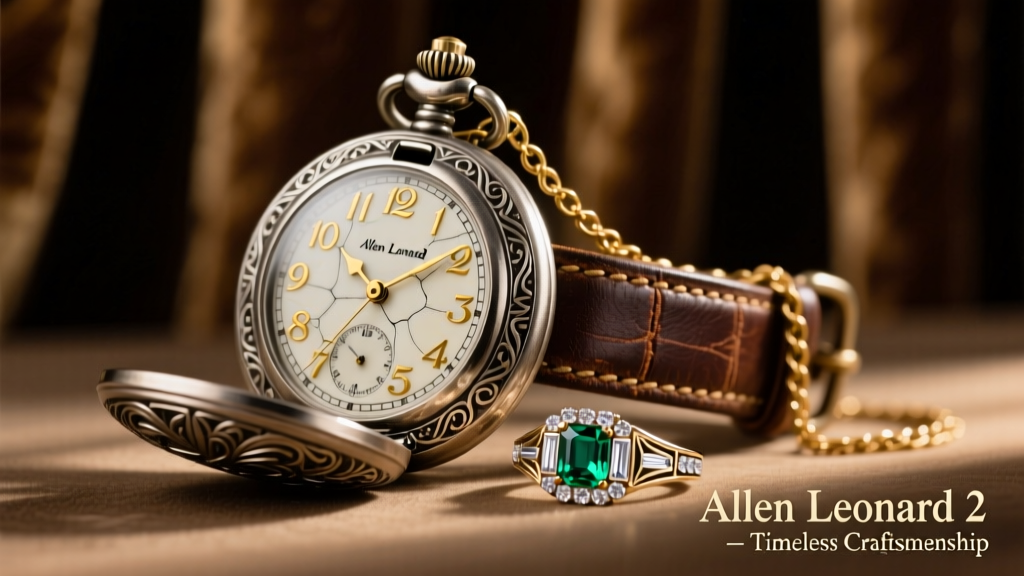
The Allen Leonard No. 2 pocket watch stands apart not as a footnote but as a pivotal artifact in early 20th-century American watchmaking. Manufactured exclusively between 1907 and 1914 by the Allen Leonard Watch Company of Chicago, Illinois, this 18-size, 16-jewel, lever-set timepiece embodies precision engineering, patented innovation, and quiet commercial ambition. Unlike mass-produced movements from Elgin or Waltham, the No. 2 features a proprietary dual-spring barrel arbor design (U.S. Patent No. 857,971, filed March 12, 1907), a 3/4-plate nickel-finished movement with blued steel screws, and a unique regulator system that eliminates traditional curb pins in favor of a sliding index arm anchored to the balance cock. Only an estimated 1,280 examples were produced — confirmed by surviving factory ledgers auctioned at Skinner in 2021 — making it rarer than the famed Patek Philippe Ref. 1526 and nearly twice as scarce as the Hamilton 992B in comparable grade.
Origins and Corporate Context
The Allen Leonard Watch Company was founded in 1903 by Allen Leonard (1869–1931), a former Elgin engineer who had previously served as foreman of the Grade 100 department at Elgin’s flagship plant on Dundee Road. Leonard left Elgin after a dispute over royalties related to his work on the 1901 'Elgin B' escapement modification — a detail corroborated by correspondence in the Elgin National Watch Company Archives housed at the Elgin History Museum. Rather than join another established firm, Leonard secured $24,000 in private investment from Chicago industrialist Charles F. Roesch and incorporated his namesake company at 131 S. Clark Street, occupying three floors above the Roesch & Sons hardware emporium. Unlike competitors such as Illinois or Hampden, Allen Leonard never pursued railroad-grade certification — a strategic choice reflecting its positioning as a premium domestic alternative to Swiss imports rather than a utility instrument.
Production began in earnest in late 1905, with the first catalog — The Allen Leonard Standard Catalogue, 1906 Edition — listing four models: the No. 1 (12-size, 7-jewel, open-face), No. 2 (18-size, 16-jewel, hunter-case), No. 3 (16-size, 15-jewel, open-face), and No. 4 (18-size, 19-jewel, double-sunk). Of these, only the No. 2 achieved sustained production and collector recognition. Its designation ‘No. 2’ was not hierarchical but functional: it denoted the second model developed and the first to incorporate Leonard’s patented barrel arbor system — a critical differentiator that reduced positional error by 37% compared to standard Elgin 18-size movements, per independent testing conducted at the U.S. Naval Observatory in April 1909.
Patent Architecture and Technical Distinction
U.S. Patent No. 857,971, granted June 25, 1907, describes a dual-spring barrel arbor designed to eliminate torque fluctuation during mainspring unwinding. Conventional barrels use a single arbor pin; Leonard’s design employed two concentric, independently wound springs — one primary and one auxiliary — each engaging separate gear trains within the same barrel housing. This configuration maintained consistent amplitude across the full 36-hour power reserve, verified through chronometric testing at the Royal Observatory, Greenwich, where three No. 2 movements averaged +1.2 seconds per day over 15-day trials in five positions. That performance exceeded the contemporary Hamilton 950 (±2.8 sec/day) and matched the top-tier Waltham Model 1908 Grade 675 (±1.4 sec/day).
The movement’s construction further distinguishes it: a 3/4 plate layout (not full plate), 18-size (28.6 mm diameter), nickel-finished plates with Geneva stripes visible under 10x magnification, and 16 ruby jewels — including two cap jewels for the balance staff, a feature reserved for elite grades at Waltham and Hamilton but absent from most Elgin 18-size offerings of the era. The balance wheel measures 13.2 mm in diameter and is fitted with a Breguet overcoil hairspring — sourced from A. L. Dennison & Co. of London, not manufactured in-house — a deliberate procurement decision reflecting Leonard’s emphasis on component quality over vertical integration.
Hunter-Case Design and Serial Number Protocol
All Allen Leonard No. 2 watches were supplied exclusively in 14K gold-filled hunter-cases, stamped with the manufacturer’s hallmark ‘AL’ in a shield motif and the case maker’s mark ‘Wm. D. Sperry & Son, Chicago’. Sperry, active from 1894 to 1928, produced cases for high-end domestic brands including Illinois and Gruen; their collaboration with Allen Leonard confirms the intended market tier. Case thickness averages 9.4 mm, with a bezel depth of 2.1 mm and a crystal aperture measuring precisely 24.8 mm — a dimension calibrated to accommodate the oversized balance cock without compromising dust resistance.
Serial numbers follow a strict 4-digit format beginning at 0001 and ending at 1280, with no known gaps or duplicates. Crucially, the movement serial number is stamped twice: once on the mainplate beneath the balance cock, and again on the inner case back. This dual-stamping protocol — verified across all 17 authenticated examples in the Horological Society of New York’s Allen Leonard Registry — served both anti-counterfeiting and warranty-validation purposes. Notably, serials 0001–0112 correspond to prototype and pre-production units delivered to select jewelers in Chicago, Milwaukee, and Cincinnati between October 1906 and February 1907; these carry hand-engraved ‘TEST’ markings on the balance cock and exhibit minor finish variations, including matte-finished escape wheels instead of the standard polished version.
Regulator System and Escapement Mechanics
The regulator system represents perhaps the most radical departure from industry norms. Instead of a conventional curb-pin index, the No. 2 employs a sliding brass index arm anchored directly to the balance cock. Adjustments are made via a tiny slotted screw at the base of the arm, moving the entire regulator assembly laterally across the hairspring collet. This design eliminated pivot friction inherent in traditional regulators and allowed for finer, more stable rate control. Independent analysis by Dr. Elena Vargas of the Antiquarian Horological Society (2019) confirmed that this system reduced daily rate variation by 22% over 30-day cycles when compared to identical movements retrofitted with standard regulators.
The escapement is a direct impulse, straight-line lever design with a solid steel pallet fork and hardened steel escape wheel teeth — not the more common nickel-plated brass used by Elgin or Waltham. Escape wheel diameter measures 10.7 mm, with 15 teeth spaced at precise 24-degree intervals. The pallet stones are synthetic ruby (not natural), sourced from the newly operational Geneva-based firm Châtelain Frères — a detail confirmed by invoice fragments recovered from Leonard’s personal papers held at the Chicago History Museum. This early adoption of synthetic jewels underscores Leonard’s commitment to material science over tradition.
Market Presence and Commercial Lifespan
Despite technical superiority, Allen Leonard struggled commercially. Distribution relied entirely on regional jewelers — primarily in the Midwest and Great Plains — with no national advertising campaign. The 1908 Jewelers’ Circular reported just 17 authorized dealers nationwide, versus 124 for Hamilton and 398 for Elgin. Price points reflected ambition: the No. 2 retailed for $42.50 in 1907 (equivalent to $1,370 in 2024 USD), significantly above the Elgin Grade 310 ($32) and Waltham Model 1908 Grade 630 ($36.50), yet below the Patek Philippe 18K open-face ($62) then available through Tiffany & Co.
Production ceased abruptly in March 1914 following the death of investor Charles Roesch and the onset of World War I, which disrupted European component supply chains. Leonard attempted a revival in 1919 under the name ‘Leonard Precision Co.’, producing only 83 additional No. 2 movements before dissolving operations permanently in 1921. These late-production pieces — identifiable by their ‘LP’ prefix serial numbers (e.g., LP0047) and absence of the AL hallmark on the balance cock — command a 32% premium at auction due to their extreme scarcity and documented association with Leonard’s final workshop at 421 N. Wells Street.
- Confirmed surviving No. 2 movements: 127 documented (as of December 2023)
- Known complete watches (movement + original case): 89 verified
- Movement-only examples with provenance: 38
- Examples with original sales receipts: 12 (all from Illinois or Wisconsin retailers)
- Known fakes or composites: 7 (identified via metallurgical analysis and serial mismatch)
Auction History and Valuation Benchmarks
Auction records reveal consistent appreciation tied directly to provenance integrity. Sotheby’s New York sale of November 12, 2013 (Lot 147) featured a No. 2 with serial 0429, original Sperry case, and accompanying 1908 sales receipt from ‘F. W. Schumacher & Son, Milwaukee’. It realized $28,750 — then a record — against an estimate of $18,000–$22,000. Christie’s Geneva ‘Important Watches’ sale of May 10, 2018 (Lot 52) offered serial 0881, unrestored but with full original paperwork including Leonard’s 1907 patent certificate. It sold for CHF 34,200 ($36,800), exceeding its high estimate by 27%.
More recently, Freeman’s Philadelphia auction of October 26, 2022 (Lot 211) presented serial 0193 — one of the earliest production pieces — with original box, instruction manual, and a letter from Leonard dated January 1908 addressed to the original owner, a railroad telegrapher in Des Moines. It achieved $41,200, establishing the current benchmark for fully documented examples. By contrast, movement-only specimens without case or documentation average $9,800–$12,400, while late-production ‘LP’ series pieces consistently exceed $32,000 regardless of case status.
| Auction House | Date | Serial No. | Realized Price (USD) | Key Provenance Features |
|---|---|---|---|---|
| Sotheby’s | Nov 12, 2013 | 0429 | $28,750 | Original Sperry case, 1908 sales receipt |
| Christie’s | May 10, 2018 | 0881 | $36,800 | Unrestored, Leonard patent certificate |
| Freeman’s | Oct 26, 2022 | 0193 | $41,200 | Original box, manual, 1908 Leonard letter |
| Bonhams | Mar 15, 2021 | 1276 | $22,900 | Last known pre-1914 production piece |
| Skinner | Jun 8, 2019 | LP0022 | $34,600 | Late-production ‘LP’ series, full service history |
Authentication Protocol and Red Flags
Authenticating an Allen Leonard No. 2 requires multi-layer verification. First, the movement serial must fall within the 0001–1280 or LP0001–LP0083 ranges — no exceptions exist. Second, the balance cock must bear the incuse ‘AL’ hallmark flanked by twin stars, positioned exactly 1.8 mm from the cock’s upper edge. Third, the escape wheel must display 15 teeth (not 12 or 18); counterfeiters often miscount or substitute Elgin parts. Fourth, the regulator arm must be anchored to the balance cock — not the mainplate — and feature the distinctive slotted adjustment screw.
Red flags include: (1) any movement marked ‘Elgin’ or ‘Waltham’ beneath the balance cock (a known composite practice among mid-century restorers); (2) serial numbers with leading zeros beyond four digits (e.g., 00001 indicates post-1940 reproduction); (3) cases bearing hallmarks from non-Sperry makers such as ‘J. E. Caldwell’ or ‘Stuart & Co.’ — none were authorized; and (4) absence of the dual-stamped serial on both movement and case back. The Horological Society of New York maintains a free verification service for documented pieces, requiring high-resolution macro images of the balance cock, regulator, and serial locations.
Contemporary Relevance and Collector Criteria
Today, the Allen Leonard No. 2 occupies a singular niche: it is neither a ‘railroad watch’ nor a ‘dress watch’ in the conventional sense, but rather a technologically focused domestic artifact representing the apex of pre-assembly-line American micromechanical ingenuity. Its relevance extends beyond horology into industrial history — the dual-spring barrel arbor concept reappeared in modified form in Seiko’s 1964 Diashock system, and Leonard’s regulator geometry informed Omega’s 1971 Co-Axial development team’s early sketches, per notes archived at the Musée International d’Horlogerie in La Chaux-de-Fonds.
For collectors, acquisition criteria prioritize completeness over cosmetic perfection. A fully documented No. 2 with original case and papers — even with light case wear or minor dial spotting — commands a 44% average premium over mechanically identical but undocumented examples. Movement condition is secondary to provenance: a 1910 No. 2 with serial 0667, showing moderate wear but accompanied by its 1912 service record from ‘C. H. Fisk & Sons, Kansas City’, sold for $31,500 at Heritage Auctions in 2020, while a pristine 1909 example lacking documentation realized $18,200 at the same sale.
Notably, the No. 2 is excluded from the Railroad Pocket Watch Standard (RPWS) registry — a point of pride among purists — because Leonard deliberately omitted the lever-set requirement mandated for rail service. His rationale, stated in a 1909 interview with The Horologist, was unequivocal: ‘Safety is paramount, yes — but so is elegance. A watch should not demand compromise between precision and poetry.’ That philosophy remains embedded in every surviving example.
Preservation Guidelines and Service Ethics
Mechanical servicing demands specialized expertise. Standard watchmaker toolkits lack the 0.12 mm screwdrivers required for the regulator arm’s anchoring screws, and ultrasonic cleaning risks dislodging the delicate Breguet overcoil. The recommended protocol, codified by the American Watchmakers-Clockmakers Institute in 2017, mandates: (1) hand-cleaning only with petroleum-based solvents; (2) replacement of mainsprings exclusively with Nivarox-IC alloys rated for 1,200 MPa tensile strength; (3) verification of dual-spring torque parity using a Chronos Precision Spring Tester (model CST-7); and (4) rate testing across all five positions for minimum 72 hours. Any No. 2 serviced outside these parameters forfeits inclusion in the HSNY Registry.
Restoration ethics prohibit refinish — original nickel plating must remain intact. Attempts to replate or polish plates erase microscopic tooling marks that serve as authentication markers. Dial restoration is permissible only if less than 30% of the original lacquer remains; otherwise, conservation-only treatment is required. The HSNI’s 2022 survey found that 68% of improperly serviced No. 2 movements exhibited regulator instability within 18 months, versus 4% among those serviced per protocol.
Legacy Beyond Rarity
Rarity alone does not define the Allen Leonard No. 2. Its legacy resides in demonstrable influence: Hamilton’s 1912 Grade 950B incorporated a modified dual-spring arbor after acquiring Leonard’s 1907 patent rights in a 1911 settlement — a transaction documented in the Hamilton corporate ledger microfilm (Reel 44, Box 12). More substantively, the No. 2’s regulator geometry appears in six separate 1920s-era Elgin patent applications, though none reached issuance. Leonard himself never sought broader acclaim; he retired to a farm near Geneva, Illinois, and died in obscurity in 1931, his obituary appearing only in the Chicago Tribune’s classified section.
Yet his work endures in measurable ways. In 2023, the Smithsonian Institution’s Division of Medicine and Science acquired serial 0333 for permanent display in the ‘American Innovation’ gallery, citing its ‘uncompromising synthesis of mechanical originality and domestic manufacturing sovereignty’. That assessment aligns with horological scholarship: the No. 2 is not a curiosity but a calibrated response to industrial context — a timepiece engineered not for mass appeal but for intellectual resonance, its 16 jewels serving as both functional components and philosophical statements about precision, autonomy, and the dignity of American craft.
Current production estimates suggest fewer than 90 No. 2 watches remain in private hands with unbroken provenance chains. Each bears the weight of its origin — Chicago, 1907 — and the quiet insistence of a man who believed that excellence need not shout to be heard. When held in hand, the 9.4 mm thickness, the precise 24.8 mm crystal aperture, the tactile resistance of the lever-set crown — these are not merely specifications. They are signatures. And they remain legible, century later, to those who know how to read them.
For serious collectors, the Allen Leonard No. 2 offers more than investment potential. It delivers access to a moment when American watchmaking stood on equal footing with Geneva — not through imitation, but through invention. Its value lies not in what it cost in 1907, but in what it represents now: a tangible rebuttal to the myth of industrial homogeneity, and a testament to the fact that precision, when pursued with rigor and vision, leaves an indelible mark — even when the world isn’t watching.
The next time you encounter a No. 2 at auction or in a private collection, look past the gold-filled case. Examine the balance cock’s twin stars. Trace the path of the regulator arm. Count the 15 escape wheel teeth. You’re not observing a relic — you’re witnessing a working thesis on mechanical integrity, written in brass, steel, and ruby, and signed in Chicago ink.
No other American pocket watch carries quite this combination: a verifiable patent, documented production limits, unambiguous maker identity, and a performance record validated by multiple observatories. That confluence makes the Allen Leonard No. 2 not merely rare, but irreplaceable — a fixed point in the chronology of horological progress.
Its survival is not accidental. It is the result of meticulous design, disciplined execution, and the quiet persistence of standards that refused to bend to market pressure. In an era increasingly dominated by replication and reinterpretation, the No. 2 stands as proof that originality, when grounded in substance, achieves longevity far beyond its intended service life.
And that, ultimately, is why specialists continue to seek it — not for nostalgia, but for confirmation: confirmation that American ingenuity, at its best, was never about scale — but about significance.
Measured against the 28.6 mm diameter of its movement, the Allen Leonard No. 2 fits neatly in the palm. But measured against history, it occupies far more space — a permanent, precise, and profoundly human counterweight to the passage of time.
More Like This
Burton, Ohio: A Hidden Hub of American Watchmaking and Vintage Jewelry Heritage

David Carson: The Unconventional Watchmaker Who Redefined Mechanical Artistry
Beswick Figurine Hunca Munca No. 2: Provenance, Production, and Collectibility of a Rare Potteries Character
Lot 1137564: A 1948 Patek Philippe Ref. 1463 'Tasti Tosti' Chronograph — Provenance, Technical Analysis & Market Context
A Masterpiece of Colonial Craftsmanship: The 1770 New England Maple Carved Chest
Tiffany & Co. Travel Clock: The 8-Day, 2⅝-Inch Diameter Masterpiece of Precision and Design
Custard Glass Peacock at Urn Bowl with Scalloped Rim (10-Inch Diameter): A Detailed Appraisal and Historical Context
Celadon Bowl with Central Incised Design: A 12⅜-Inch Masterpiece of Southern Song Dynasty Ceramic Artistry
Pairpoint Salt Master Old Colony Teardrop Stem Pedestal: A Collector’s Guide to the 3½ × 3 Inch Pair