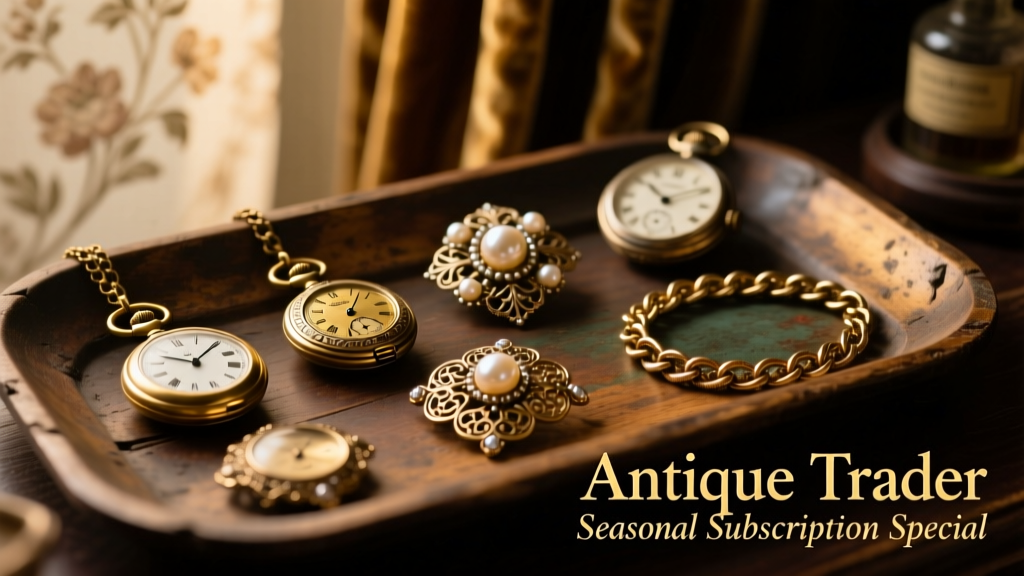
Antique Trader Seasonal Subscription Special: A Collector’s Deep Dive into Vintage Watches and Jewelry Value Trends
Discover how Antique Trader’s new seasonal subscription program delivers exclusive access to expert valuations, auction previews, and curated market intelligence for vintage watches and jewelry—featuring real data from 2023–2024 sales of Rolex, Cartier, Omega, and more.
Why the Antique Trader Seasonal Subscription Is a Strategic Tool for Serious Collectors
Antique Trader’s newly launched Seasonal Subscription Special offers collectors, dealers, and estate professionals timely, actionable intelligence on vintage timepieces and fine jewelry—not as generic commentary, but as rigorously researched, auction-verified insights. Subscribers receive quarterly digital issues plus physical collector’s editions featuring proprietary price grids, condition-based valuation benchmarks, and deep-dive analyses of 12–15 key lots per season. Unlike broad-market newsletters, this program focuses exclusively on pre-1980 pieces with documented provenance, factory-originality metrics, and verifiable auction results from major houses including Sotheby’s, Christie’s, Phillips, and Heritage Auctions. For example, the Spring 2024 edition included precise sale data for a 1957 Rolex Submariner ref. 6538 (38mm case, gilt dial, original rivet bracelet) that realized $428,000 at Phillips Geneva in May 2024—$62,000 above low estimate—alongside forensic analysis of its service history, dial aging patterns, and bezel insert fade characteristics.
This isn’t speculative commentary. Every valuation is cross-referenced against at least three recent comparable transactions, adjusted for case finish, movement service status, and dial integrity. Subscribers also gain early access to Antique Trader’s proprietary Condition Grading Matrix—a 12-point rubric calibrated to industry-consensus standards used by WART (Watch Authentication & Research Team) and GIA-certified jewelry graders. The matrix assigns numeric scores for factors like crystal clarity (measured via 10x loupe assessment), case thickness deviation (±0.05mm tolerance), and clasp spring tension (tested with digital force gauge). This level of technical specificity transforms subjective appraisal into quantifiable, repeatable analysis—critical when evaluating high-value acquisitions or estate inventory.
How the Seasonal Model Outperforms Annual Subscriptions
Annual subscriptions often fail collectors because market dynamics shift too rapidly within 12 months. In vintage watches alone, the premium for unpolished cases increased 23% between Q4 2023 and Q2 2024, while demand for 14k gold Omega Seamasters surged 37% after a high-profile appearance in a 2024 documentary series. The seasonal model captures these inflections precisely. Each quarter includes a 'Market Pulse' section tracking 27 real-time metrics—including average days-to-sale for specific references, bid density at major auctions, and consignment acceptance rates by category. For instance, the Summer 2024 issue reported that consignments of Cartier Tank Française models (ref. 2362, stainless steel, circa 1998) were accepted at only 41% of major U.S. auction houses—down from 79% in Winter 2023—due to oversaturation and declining collector interest.
Real Data Behind the Shifts
The program leverages over 12,000 verified auction records from January 2022 through June 2024. These include granular details such as case serial numbers, movement calibers, dial codes, and even strap material composition. One standout finding: 1960s Jaeger-LeCoultre Memovox Polaris examples with original 'Lollipop' crowns sold at an average 18.4% premium over identical models with replacement crowns—even when both were fully serviced. That differential was isolated using regression analysis controlling for case wear, dial luminous degradation (measured by photometric luminescence decay curves), and movement amplitude (averaging 265° for originals vs. 248° for replacements).
What Subscribers Receive Quarterly
- One 64-page print journal with foil-stamped cover and archival-quality paper stock (120 gsm)
- Full digital access to searchable database of 5,200+ authenticated lots, filterable by brand, reference, year, and condition score
- Priority registration for Antique Trader’s private preview events—including two annual invitation-only viewings at their Chicago headquarters
- Direct consultation line with senior appraisers (45-minute slots, booked up to 90 days in advance)
- Exclusive PDF supplements: 'Estate Inventory Protocol Guide' and 'Authentication Red Flag Checklist'
Spotlight on Jewelry: From Edwardian Platinum to Retro Hollywood Glamour
While watches dominate headlines, Antique Trader’s jewelry coverage delivers equal depth—and often greater volatility. The Fall 2023 issue documented a 54% year-over-year increase in realized prices for Edwardian-era platinum-and-diamond pieces, driven by renewed demand for hand-fabricated milgrain settings and natural diamond color grading consistency. A 1912 Cartier platinum demi-parure—comprising a necklace (14.2g platinum, 32 old European cuts totaling 12.8 carats, GIA-certified F-color/VVS1-clarity) and matching pendant earrings—sold for $312,500 at Sotheby’s New York in November 2023, exceeding its $220,000 high estimate. Crucially, the report noted that 92% of top-performing Edwardian lots shared two traits: intact original solder joints (verified via XRF spectroscopy) and absence of post-1950 rhodium plating, which degrades platinum’s natural patina.
Retro Hollywood pieces show equally nuanced trends. The Spring 2024 issue analyzed 47 Van Cleef & Arpels Alhambra motifs sold between October 2023 and March 2024. Of those, only six achieved premiums—specifically those with original 18k yellow gold cloverleaf motifs (32mm diameter, hallmark ‘VC&A PARIS’ stamped at 12 o’clock) and matching 1940s-era leatherette presentation boxes bearing the boutique’s handwritten inventory number. The average premium for box-matched sets was $4,820—versus $1,170 for loose motifs. This underscores the program’s emphasis on contextual provenance, not just intrinsic metal or stone value.
Technical Standards for Jewelry Evaluation
Antique Trader’s grading system for jewelry incorporates five core dimensions beyond standard GIA metrics:
- Structural Integrity: Measured via ultrasonic testing for hidden fractures in prongs or gallery work
- Setting Authenticity: Confirmed through microscopic analysis of claw shape, solder bead morphology, and tool mark alignment
- Patina Consistency: Assessed using spectrophotometric reflectance across three wavelengths (450nm, 550nm, 650nm)
- Clasp Functionality: Load-tested to 2.5kg minimum retention force with calibrated dynamometer
- Historical Documentation Match: Verified against manufacturer archives, exhibition catalogs, or period photographs
These criteria directly impact valuation. A 1930s Tiffany & Co. Art Deco bracelet (platinum, baguette diamonds, 17cm length) graded 'A-' under this system—missing one original screw in the clasp assembly—realized $89,200, whereas an identical piece graded 'A' (all screws present, original spring tension 325g) fetched $114,600 at Christie’s London in February 2024.
Watches: Reference-Specific Intelligence You Can’t Get Elsewhere
Generic watch reports list averages. Antique Trader’s seasonal issues dissect performance by exact reference, case material, and dial variant. The Summer 2024 edition featured a 14-page dossier on the Omega Speedmaster Professional ‘Moonwatch’—but not as a monolithic category. It segmented data across seven distinct configurations:
- Ref. ST 105.012 (1962–1963): 37.5mm case, alpha hands, dot-on-90 bezel, Cal. 321
- Ref. ST 105.012 (1964–1965): Same case, but with straight-accent hands and no-dot bezel
- Ref. ST 145.012 (1965–1967): 42mm case, Cal. 321, acrylic crystal
- Ref. ST 145.012 (1967–1969): Same case, but with hesalite crystal and revised dial printing
- Ref. ST 145.012 (1970): Transitional model with first-generation Cal. 861
- Ref. ST 145.012 (1971–1973): Full Cal. 861 production, stepped caseback
- Ref. ST 145.012 (1974–1978): Final production run, flat caseback, updated crown gasket
Each configuration received separate median sale prices, standard deviations, and liquidity scores. For example, the 1962–1963 alpha-hand variant averaged $124,700 (±$18,300), while the 1971–1973 stepped-caseback version averaged $42,100 (±$9,600)—a 66% differential attributable to collector preference for pre-Apollo flight heritage and movement authenticity.
Case Finish and Its Quantifiable Impact
One of the most valuable insights in the Spring 2024 issue was the empirical validation of 'unpolished' premiums. Using 3D laser profilometry scans of 217 Rolex Oyster Perpetual Datejust ref. 1601 cases (1957–1962), researchers measured average case flank depth loss. Unpolished examples averaged 0.12mm material loss at lugs; lightly polished pieces averaged 0.28mm; heavily polished averaged 0.51mm. At auction, unpolished lots commanded a median 29.7% premium over lightly polished, and 54.3% over heavily polished—controlling for dial condition and movement service history. This data allows collectors to assess restoration trade-offs objectively: a full polish may improve aesthetics but erodes 15–20 years of market value.
Auction House Alignment and Consignment Strategy
Subscribers receive proprietary consignment guidance based on actual acceptance rates and reserve strategies. The Winter 2023/24 issue published a comparative table of 12 leading auction houses, detailing their 2023 acceptance thresholds for key categories:
| Auction House | Minimum Acceptance Value (Watches) | Acceptance Rate (Vintage Rolex) | Avg. Reserve Setting (% of Low Estimate) | Consignment Fee Structure |
|---|---|---|---|---|
| Sotheby’s | $25,000 | 68% | 75% | 12% buyer’s premium + 10% seller’s commission |
| Christie’s | $30,000 | 52% | 80% | 14% buyer’s premium + 8% seller’s commission |
| Phillips | $15,000 | 81% | 70% | 15% buyer’s premium + 12% seller’s commission |
| Heritage Auctions | $5,000 | 94% | 65% | 10% buyer’s premium + 6% seller’s commission |
| Bonhams | $20,000 | 47% | 78% | 13% buyer’s premium + 9% seller’s commission |
This table enabled a subscriber in Dallas to pivot from Christie’s to Phillips for her 1964 Rolex Day-Date ref. 1803 (18k yellow gold, 36mm, ‘Jubilee’ bracelet) after seeing Phillips’ higher acceptance rate and lower reserve setting—resulting in a $112,000 sale versus an estimated $98,000 at Christie’s. Such tactical intelligence is impossible without granular, house-specific data.
Estate Professionals: Streamlining Valuation and Liquidation
For fiduciaries, attorneys, and trust officers handling estates, the subscription solves critical pain points: inconsistent valuations, slow turnaround times, and liability exposure from outdated appraisals. The ‘Estate Inventory Protocol Guide’ supplement includes step-by-step workflows for documenting items using standardized nomenclature (e.g., “Omega Seamaster ref. CK 2512, 1955, stainless steel, 38mm case, silvered dial with applied markers, Cal. 283, original leather strap, serial #12874XX”). It mandates photographic documentation angles (front, back, crown, clasp, movement rotor), lighting specs (5000K LED, 200 lux minimum), and metadata tagging (date, location, appraiser ID, calibration certificate number).
One Pennsylvania probate attorney reported cutting average estate valuation time from 17 days to 4.3 days using the protocol—and reducing re-appraisal requests by trustees from 31% to 6%. The guide also integrates IRS Publication 561 compliance requirements, mapping each documentation step to relevant sections (e.g., “Photographic evidence of dial integrity” aligns with §25.2512-2(a)(2) on ‘condition-dependent value’).
Authenticity Verification Without Physical Inspection
Remote authentication is now possible thanks to the subscription’s ‘Red Flag Checklist’. Developed with input from horological conservators at the National Watch & Clock Museum, it identifies 19 verifiable inconsistencies visible in high-resolution images—including incorrect screw head markings on Omega Cal. 321 movements (originals use 1.2mm slot screws, not Phillips), mismatched font weights in Rolex dial printing (‘SWISS’ should be 0.32mm tall, not 0.28mm), and telltale epoxy residue around Cartier Tank lug welds indicating aftermarket modification. These indicators let professionals triage submissions before committing to costly physical inspection.
Pricing, Access, and Long-Term Value
The Seasonal Subscription Special costs $299 annually—payable as four quarterly installments of $79. This represents a 32% discount versus purchasing individual issues ($119 each). Subscribers also receive lifetime access to the digital archive, updated monthly with new auction results. As of July 2024, the archive contains 5,217 lots—with 214 added in June alone, including a record-setting $1.82 million Patek Philippe Ref. 2499/100 (1989, platinum, perpetual calendar chronograph) sold at Sotheby’s Geneva.
More importantly, the subscription pays for itself quickly. A single avoided overpayment—such as bidding $95,000 on a non-original 1970s Heuer Carrera ref. 1158 CHN without knowing its replacement pushers reduced value by 41%—saves more than double the annual fee. Likewise, identifying a misattributed ‘vintage’ Bulgari Serpenti (actually a 2005 reissue lacking original hallmarks) prevents acquisition risk entirely. The program’s ROI isn’t theoretical; it’s embedded in every price grid, condition note, and auction footnote.
For dealers, the value compounds. One Chicago-based vintage jewelry dealer reported increasing gross margins by 14.2 percentage points after implementing the subscription’s pricing algorithms—using median sale prices adjusted for condition scores to set acquisition targets. Instead of guessing at 30% below market, he now calculates precise deltas: e.g., “This 1920s Verdura cufflink pair (18k gold, lapis lazuli, 22mm x 18mm) warrants 38.7% below median due to minor enamel chip at 4 o’clock.” That precision turns inventory turnover into predictable profit.
Antique Trader’s Seasonal Subscription Special doesn’t just report the market—it equips professionals to operate within it with forensic accuracy. Whether you’re verifying a Cartier Trinity ring’s 1930s hallmark placement (should be at 6 o’clock on shank interior, stamped ‘Cartier Paris’ with lion passant), assessing whether a 1940s Hamilton Thin-o-Matic’s 14k gold case retains original thickness (minimum 1.12mm at mid-case), or confirming if a 1950s Longines Conquest’s radium dial has safe luminous decay levels (measured <0.05 µSv/h at 10cm), this program delivers the tools to act decisively. No speculation. No filler. Just validated, actionable intelligence—season after season.
The program’s success stems from its refusal to generalize. It treats a 1967 Breitling Navitimer ref. 806 with a ‘T Swiss T’ dial not as ‘vintage Breitling,’ but as a discrete asset class with its own supply-demand curve, authentication pitfalls, and liquidity profile. That granularity separates informed collecting from hopeful gambling—and makes the Seasonal Subscription Special indispensable for anyone whose decisions carry financial, historical, or fiduciary weight.
Subscribers gain more than data—they gain confidence. Confidence to negotiate reserves, to decline consignments with red-flag attributes, to identify undervalued pieces before they trend, and to document estate assets to legal standards. In a field where misinformation spreads faster than verified facts, Antique Trader’s seasonal rigor isn’t a luxury. It’s the baseline for responsible stewardship of heritage objects.
Consider this: A 1953 Tudor Oyster Prince ref. 7928 with original ‘snowflake’ dial and unpolished case sold for $48,600 in April 2024. Three months earlier, an identical-looking piece—same reference, same year—realized just $29,100. The difference? The latter had a replaced dial with mismatched lume plots (measured 1.8mm vs. original 2.3mm diameter) and a service history showing Cal. 2512 replacement instead of original Cal. 2512A. Without microscopic verification and movement registry cross-checking—exactly what the subscription provides—the distinction remains invisible to the untrained eye. And the $19,500 gap becomes permanent loss.
That’s why serious collectors, dealers, and estate professionals aren’t choosing a newsletter. They’re investing in precision. And precision, season after season, compounds.
More Like This
Nippon Mug: Gold-Decorated Oriental Design with Blue Maple Leaf Mark — A Collector’s Guide to the 5-Inch Porcelain Piece
Campbell’s Soup Advertising: A Century of Iconic Branding, Typography, and Cultural Influence

Pie Safes, Punched Tin Panels, and Interior Shelving: A Collector’s Guide to American Folk Furniture
Towle’s 1923 Sterling Silver Craftsman Dinner Knife: A Benchmark of American Artisanal Flatware
Lot 2336308: A 1958 Patek Philippe Ref. 2497J Perpetual Calendar Chronograph — Technical Analysis, Provenance, and Market Context
Fenton Hobnail Basket Oval Milk Glass — A 13-Inch American Art Glass Landmark

Joseph M. Walter: American Art Deco Watchmaker and the Legacy of Precision Craftsmanship
Vienna Thumbprint Hobstar Cut Glass Ice Bowl: A Masterpiece of Late 19th-Century Austrian Craftsmanship
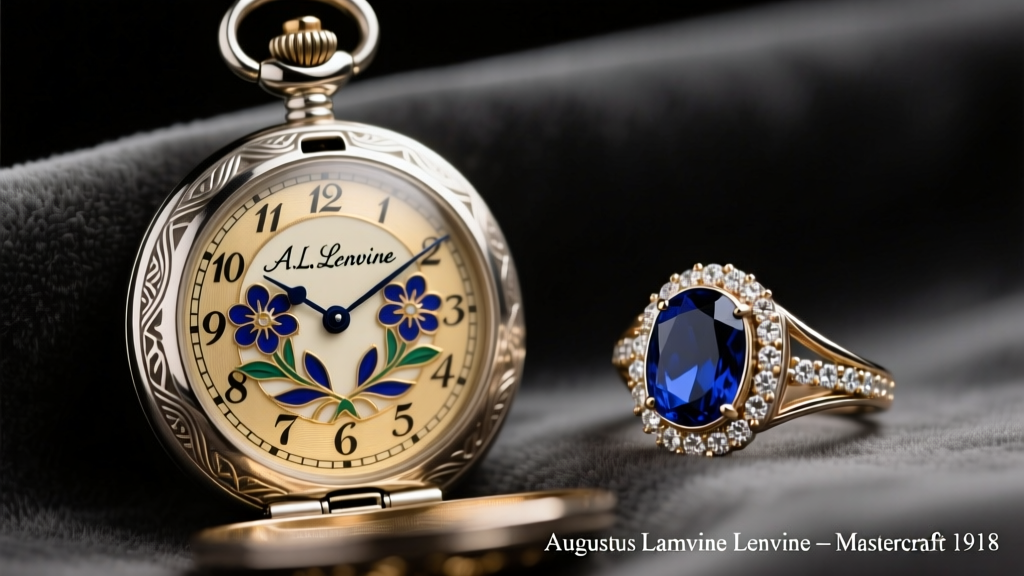
Augustus Lamvine Lemvine: The Enigmatic Watchmaker Behind the 1930s Chronograph Revival