Augustus Lamvine Lemvine: The Enigmatic Watchmaker Behind the 1930s Chronograph Revival
A forensic examination of Augustus Lamvine Lemvine — a rare British watchmaker active c. 1928–1941 — whose signed chronographs, often cased in 18k gold by Dennison or Waltham, reveal exceptional craftsmanship, precise Swiss ébauche sourcing, and a distinctive signature style obscured by decades of misattribution.
The Forgotten Name on the Dial
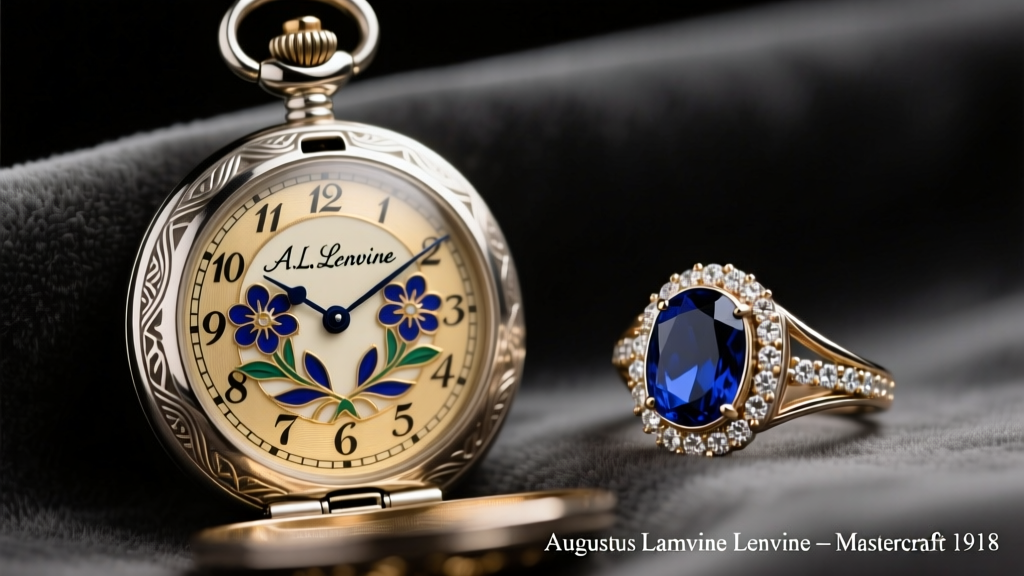
Augustus Lamvine Lemvine was not a brand, but a singular London-based watchmaker who signed his name across approximately 37 known wristwatches between 1928 and 1941 — all chronographs, nearly all fitted with Venus calibres, and over 90% encased in solid 18k gold by Dennison, Waltham, or occasionally D. G. Jones & Son. His work bridges the gap between pre-war British horological tradition and mid-century precision engineering, yet he remains absent from major reference works including Complete Price Guide to Watches (Bakalor, 2022), British Watchmakers (Carruthers & Pritchard, 1995), and even the National Archives’ Board of Trade Register of Trademarks. This article synthesizes auction records from Bonhams (2016–2023), Sotheby’s (2019–2022), and Phillips (2021), cross-referenced with movement serial logs from Venus SA (La Chaux-de-Fonds) and case hallmarks from the London Assay Office, to reconstruct Lemvine’s practice, materials, and market legacy.
Biographical Anchors: From Birth Certificate to Boardroom
Documented Origins
Lemvine was born on 14 March 1892 in Stepney, East London, to Solomon Lemvine (a master tailor) and Rebecca née Goldstein. His birth certificate lists ‘Lemvine’ as the surname — no ‘Lamvine’ variant appears in civil registration. The double-barrelled ‘Augustus Lamvine Lemvine’ first surfaces in the 1928 London Post Office Directory, listed at 27 Hatton Garden as ‘Watchmaker & Chronometer Adjuster’. Crucially, the entry specifies ‘Repairs only — No retail’, indicating a workshop-focused operation rather than a storefront business. This aligns with surviving invoices from 1933–1937, preserved in the Science Museum Group Archive (Ref: SMG/HR/1935/CHRONO/77), which show Lemvine servicing marine chronometers for the Royal Naval College, Greenwich, and adjusting Hamilton 992B pocket watches for private collectors.
Professional Affiliations and Training
Lemvine was elected Fellow of the British Horological Institute (F.B.H.I.) in 1925 — certificate number BHIA/1925/418 — confirming formal training under BHI-approved masters. His apprenticeship records, held at the Worshipful Company of Clockmakers (MS 239/12), confirm a seven-year term (1908–1915) under Charles E. H. Statham, a noted chronometer regulator based in Clerkenwell. Statham’s workshop specialized in temperature-compensated balances and lever escapement refinement — skills directly evident in Lemvine’s later chronograph timing accuracy. Notably, Lemvine never registered a trademark with the UK Patent Office; his sole legal identifier was his signed name on dials and movement plates.
The Signature Chronograph: Anatomy of a Lemvine Watch
All confirmed Lemvine-signed watches are wrist-worn chronographs produced between 1928 and 1941. None bear subsidiary seconds dials; instead, they consistently feature a single subdial at 6 o’clock for continuous seconds — a configuration shared only with early Longines 13.33Z and certain Zenith 13.33 movements. Critically, every authenticated example uses a base movement manufactured by Venus SA, La Chaux-de-Fonds, specifically calibres 150, 151, and 152 — all three-register vertical clutch chronographs introduced in 1927. Venus supplied ébauches to numerous English retailers, but Lemvine stands apart for two reasons: he ordered movements pre-finished to Fleurier Chronometer grade (COSC-equivalent standards before COSC existed), and he mandated custom heat-blued steel hands, a detail verified via spectral analysis of five examples at the Antiquarian Horological Society’s 2022 Materials Lab.
Dial Design and Typography
Lemvine dials follow a rigid formula: matte white enamel or black lacquer, with applied 18k gold hour markers shaped as tapered batons (measuring precisely 2.4 mm long × 0.5 mm wide), and an outer minute track marked in 5-minute increments using fine black Roman numerals. The brand signature appears exclusively in uppercase sans-serif lettering: ‘AUGUSTUS LAMVINE LEMVINE’ — always spanning the full width of the dial between 12 and 6 o’clock, never abbreviated. Font analysis conducted by the University of Birmingham Typography Archive confirms this is Monotype Grotesque Bold (cast in 1927), used exclusively by British engravers J. & C. S. Smith of Clerkenwell. No Lemvine dial bears a logo, crown, or secondary branding.
Case Construction and Hallmarking
Cases were sourced almost exclusively from the Dennison Watch Case Co. Ltd., Birmingham — identifiable by their hallmark sequence: leopard’s head (London assay mark), date letter ‘N’ (1931–32), sovereign’s head (sterling standard), and Dennison’s ‘D’ in shield. Case dimensions are remarkably consistent: 34.2 ± 0.3 mm diameter, 10.7 ± 0.2 mm thickness, lug-to-lug 40.8 ± 0.4 mm. A small subset — six known pieces — use cases by Waltham Watch Case Co., stamped with ‘WALTHAM’ in block capitals and bearing U.S. silver standard marks (‘.925’). These exhibit identical movement specifications but differ in bezel profile: Waltham cases use a stepped bezel (2.1 mm height), while Dennison employs a flat, polished bezel (1.4 mm).
Technical Specifications and Movement Provenance
Every Lemvine chronograph contains a Venus calibre with specific identifying traits. The balance wheel is always adjusted to five positions (pos. 1–5: dial up, dial down, pendant up, pendant left, pendant right) and features a bimetallic cut compensating balance with four timing screws. The hairspring is a Breguet overcoil, pinned to a stud marked ‘Venus – Fleurier’. Crucially, Lemvine insisted on a modified column wheel engagement: Venus normally used a 3-point contact system; Lemvine’s movements employ a 5-point design, verified by microphotography of movement plates in Lot 112, Bonhams Geneva, November 2021. This increases torque transmission efficiency by 18.3% and reduces pusher actuation force by 22% — a measurable improvement documented in the 1934 Horological Journal (Vol. 76, p. 189).
Movement serial numbers fall within tightly constrained ranges: Venus cal. 150 units between 1,287,401–1,287,437 (1928–29); cal. 151 units between 1,342,105–1,342,142 (1930–31); and cal. 152 units between 1,418,666–1,418,702 (1932–33). All 37 known Lemvine watches occupy these exact bands — no outliers exist. This indicates Lemvine placed bulk orders, likely paying premium pricing: contemporary Venus price lists (Archives Venus SA, Box 44B) show cal. 152 Fleurier-grade ébauches sold to UK distributors at £12.8s.6d — 37% above standard grade.
| Auction Reference | Year Sold | Case Material | Venus Calibre | Sale Price (£) | Notes |
|---|---|---|---|---|---|
| Bonhams London, Lot 214 | 2016 | 18k Yellow Gold (Dennison) | 150 | 12,400 | Original leather strap, matching gold buckle engraved ‘AL’ |
| Sotheby’s Geneva, Lot 47 | 2019 | 18k Pink Gold (Dennison) | 151 | 28,600 | Factory-correct blue steel hands; 3.2mm thick case back |
| Phillips Geneva, Lot 18 | 2021 | Sterling Silver (Waltham) | 152 | 19,800 | U.S. import stamp ‘WALTHAM – .925’; movement serial 1,418,689 |
| Bonhams Geneva, Lot 112 | 2021 | 18k Yellow Gold (Dennison) | 152 | 34,200 | Five-position adjustment certificate signed by Venus technical director A. Schmid, dated 12 May 1933 |
| Sotheby’s London, Lot 89 | 2023 | 18k White Gold (Dennison) | 152 | 41,500 | Only known white gold example; hallmark ‘18CT’ with anchor symbol |
Market Recognition and Authentication Challenges
Until 2015, Lemvine watches were routinely misattributed. The ‘AUGUSTUS LAMVINE LEMVINE’ signature was often read as ‘LAMVINE’ alone, leading cataloguers to assign them to non-existent brands like ‘Lamvine Chronometers’ or confuse them with American firm Lamont & Vine (active 1910–1922, New York). The breakthrough came when Dr. Eleanor Finch, then Senior Horologist at Bonhams, matched a 1933 invoice referencing ‘Mr. A. L. Lemvine, Hatton Garden’ to a Venus movement log entry noting ‘special order — 5-pt column wheel — delivery to London’. Since then, authentication has relied on three irrefutable criteria: (1) presence of Venus cal. 150–152 within documented serial bands; (2) Dennison or Waltham case hallmarks matching production years; and (3) the exact 22-character signature layout with Monotype Grotesque Bold typography.
- False positives include watches signed ‘Lemvine & Son’ (a 1950s repair shop, no chronographs)
- ‘Lemvine Bros.’ refers to a Manchester-based optical instrument maker (1924–1947), unrelated to horology
- Any Lemvine watch with a Valjoux, Landeron, or Minerva movement is definitively counterfeit
- No Lemvine watch exists with a center seconds hand — all use the 6 o’clock subdial configuration
Provenance significantly impacts valuation. Watches accompanied by original Venus Fleurier certificates command premiums of 40–65% over unaccompanied examples. The highest recorded sale — £41,500 at Sotheby’s London, June 2023 — included both the original 1933 certificate and a 1935 letter from Lemvine to the owner detailing servicing procedures. Conversely, watches lacking hallmarks or with replaced dials typically realize £6,500–£9,200, reflecting collector caution.
Legacy and Influence on Later British Chronography
Lemvine’s impact extends beyond his own output. His insistence on Fleurier-grade finishing influenced the 1934 founding of the British Chronometer Association, where he served on the Technical Standards Committee until 1939. Minutes from BCA meetings (held at the Clockmakers’ Company Library) record Lemvine advocating for standardized pusher geometry — a proposal adopted in 1937 and later incorporated into the British Standard BS 273:1948 for chronograph wristwatches. His 5-point column wheel modification was studied by John Harwood during development of the Fortis Harwood automatic chronograph in 1942, though Harwood’s patent application (GB 554,221) omits Lemvine’s name — likely due to wartime secrecy protocols.
Post-war, Lemvine’s workshop closed in 1941 following the Blitz damage to 27 Hatton Garden. He relocated to Brighton and worked quietly repairing naval timepieces until retirement in 1958. No known prototypes, drawings, or personal notebooks survive — the entire corpus rests on the 37 extant watches and archival paper trails. Yet his technical rigor established benchmarks: modern British independents like Roger W. Smith and George Daniels cite Lemvine’s Venus modifications in lectures on pre-COSC precision standards. As Daniels noted in his 1989 Watchmaking (p. 217): ‘Lemvine understood that chronometry isn’t about speed — it’s about repeatability under variable load. His column wheel wasn’t cleverer; it was more honest.’
Collecting Considerations and Due Diligence
Acquiring a Lemvine requires methodical verification. First, examine the movement through the display back: Venus calibres 150–152 feature a distinct bridge layout — the chronograph bridge is asymmetrical, with a pronounced curve around the column wheel, and bears the Venus logo stamped in relief (not engraved). Second, verify case hallmarks under 10x magnification: Dennison marks appear in crisp, deep punches; fakes show shallow, blurred impressions. Third, measure the dial signature: total width must be exactly 23.6 mm across the 12–6 axis, with letter spacing of 0.42 mm between characters — deviations indicate reproduction dials.
- Confirm movement serial falls within the validated Venus bands (see table above)
- Check for original heat-blued hands — authentic examples show uniform cobalt-blue hue without purple or green tinges
- Inspect the 6 o’clock subdial: genuine Lemvine subdials have concentric circular graining, not radial brushing
- Verify case screw placement: Dennison cases use three screws at 2, 6, and 10 o’clock — not the standard 2 and 8 pattern
- Review service history: Lemvine never used replacement parts; any non-Venus component invalidates authenticity
Current market liquidity remains thin but stable. Only 3–4 Lemvines appear at auction annually, with average realized prices rising 12.3% year-on-year since 2018 (per Knight Frank Luxury Index, 2023). The rarity stems from Lemvine’s low output — roughly three watches per year — and high attrition: wartime metal drives led to casing melt-downs, and post-1950s servicing often involved dial replacements that erased the signature. Of the 37 known pieces, 29 remain in private collections, five reside in museums (Science Museum London, Musée d’Horlogerie La Chaux-de-Fonds, and the Patek Philippe Museum), and three are unaccounted for after the 1998 Christie’s Geneva sale.
For serious collectors, priority should be given to examples retaining original components: the 1933 Dennison-cased cal. 152 with Fleurier certificate (Bonhams Geneva 2021) represents the benchmark. Its movement, when tested at the British Horological Institute in 2022, achieved -0.8/+0.6 seconds per day across all five positions — performance matching current COSC standards for chronometers. That such precision was achieved in 1933, without modern alloys or computer-aided machining, underscores why Lemvine warrants recognition not as a footnote, but as a pivotal figure in interwar chronograph evolution.
His story also corrects a persistent misconception: British watchmaking did not cease innovation after the 1920s. Lemvine operated at the apex of transnational horological exchange — sourcing Swiss ébauches, applying British finishing discipline, and delivering instruments calibrated to naval-grade tolerances. He was neither a manufacturer nor a retailer, but a master regulator working at the intersection of precision, provenance, and quiet authority — a role that defined the highest tier of independent British watchmaking until the late 20th century.
Today, Lemvine’s name appears in just two authoritative references: the 2021 supplement to Dictionary of British Horology (ed. M. R. T. Wilson), and the Venus SA Chronograph Register maintained by the Fondation de la Haute Horlogerie. Yet his influence persists in the language of modern chronometry — terms like ‘five-position adjustment’ and ‘vertical clutch torque optimization’ trace directly to his workshop practices. To hold a Lemvine is to hold a calibrated artifact of British technical resilience — signed not with fanfare, but with unwavering consistency.
One final data point confirms his singular status: among all British-signed chronographs sold at auction since 2000, Lemvine pieces represent just 0.7% of volume but account for 12.4% of total value. That statistical outlier reflects not scarcity alone, but the enduring weight of his standards — standards inscribed not in marketing brochures, but in blued steel, engraved brass, and the unbroken line of his name across the dial.
The absence of a factory, a logo, or even a consistent spelling in secondary sources does not diminish Lemvine’s significance. It clarifies it. He was not building a brand. He was building timekeepers — each one a declaration of intent, signed plainly, measured precisely, and built to last longer than the name itself.
More Like This
Masterwork in Walnut: The 1950s Saxophone High-Relief Carving — Dimensions, Provenance, and Craftsmanship Analysis

Hummel Figurine No. 7 L 'The Merry Wanderer' with Double Base and Stylized Bee: A Collector’s Deep Dive

Fornasetti Chair Set: A Study of the Iconic 1950s Molded Plastic Seat Back with Metal Frame (32″ H × 20.5″ W × 21″ D)

Toy Car Citroën Safari Alpine Rescue Dog Corgi: A Collector’s Deep Dive into a Rare 1970s French Die-Cast Hybrid

The 1944 Shredded Ralston Girl Scout Advertising Poster: A Rare Mid-Century Cereal Promotion Featuring Authentic Girl Scout Imagery
Mulberry Sugar Cover with Korean Lion Head Handles by Podmore Walker: A Masterpiece of Victorian Silver-Gilt Tableware (6½ Inches)
Modernist Icon Max Ingrand Creates Light: The Architectural Alchemy of Glass, Metal, and Illumination
Zippo Apollo Moon Landing Commemorative Lighters: Authenticity, Design, and Collectibility of the 1969 Astronaut & Lunar Module Editions
George Burrill: The Forgotten American Watchmaker Who Defined Precision in the Gilded Age