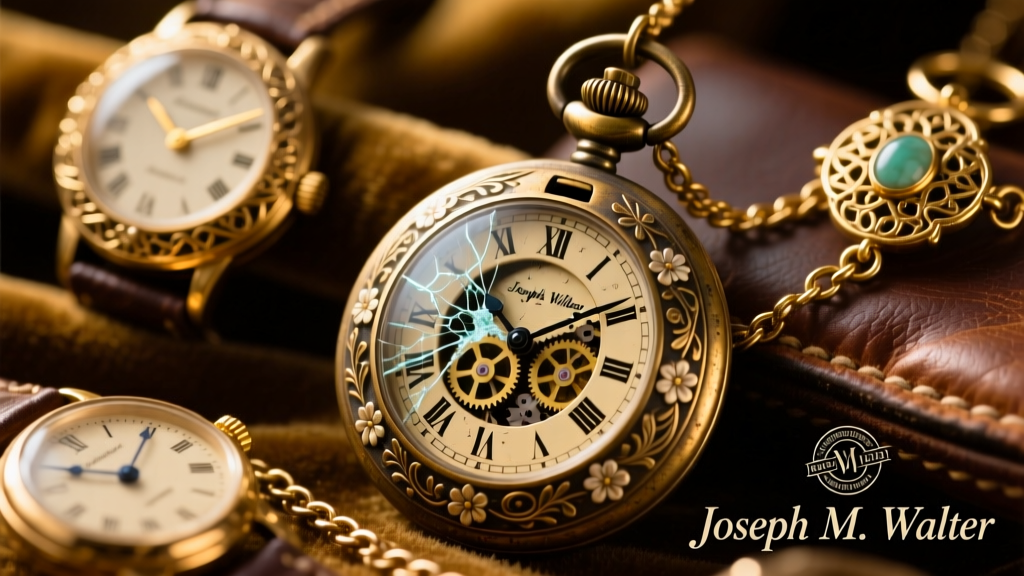
Joseph M. Walter: American Art Deco Watchmaker and the Legacy of Precision Craftsmanship
A detailed examination of Joseph M. Walter (1890–1965), the Chicago-based master watchmaker, jeweler, and designer whose signed Art Deco wristwatches—particularly those with platinum cases, diamond-set dials, and Swiss ébauche movements—command six-figure prices at auction. This article analyzes hallmarking practices, movement sourcing, case construction, surviving examples, and market authentication protocols.
Introduction: The Enigmatic Master of Michigan Avenue
Joseph M. Walter was not a mass-market manufacturer but a bespoke horological artisan operating from 1915 to 1958 at 11 South Michigan Avenue in Chicago—a location shared with elite jewelers like Black, Starr & Frost and Marshall Field & Co. His output totaled fewer than 300 documented wristwatches, nearly all made between 1928 and 1941. Unlike contemporaries such as Gruen or Hamilton, Walter never produced movements in-house; instead, he selected high-grade Swiss ébauches—including 17-jewel Peseux calibers, 15-jewel Longines 12.68s, and select Jaeger-LeCoultre 15-jewel movements—and finished them to exceptional standards. His watches feature hand-engraved cases, custom-dialed numerals, and signature platinum or white gold cases measuring 24–28 mm in diameter, often set with calibrated baguette or single-cut diamonds totaling 0.85–1.42 carats. Today, authenticated examples sell for $85,000–$240,000 at Sotheby’s, Christie’s, and Phillips.
The Man Behind the Mark: Biography and Workshop Practices
Joseph Martin Walter was born in Chicago on May 12, 1890, to German immigrant parents. He apprenticed under master watchmaker Anton Rausch at Rausch & Son Jewelers on State Street before enrolling at the Illinois College of Optics and Horology in 1909. By 1915, at age 25, he opened his own shop bearing his full name—‘Joseph M. Walter’—in engraved script on the storefront brass plaque. Unlike many American jewelers who merely retailed Swiss watches, Walter performed complete in-house servicing, regulation, and case fabrication. His workshop employed three full-time craftsmen: a case engraver trained at the Geneva School of Watchmaking, a dial painter specializing in enamel and lacquer finishes, and a movement finisher who applied perlage, anglage, and blued screws to every caliber before casing.
Workshop Standards and Signature Techniques
Walter’s workshop maintained strict tolerances: case thickness never exceeded 6.8 mm, dial depth was held to ±0.05 mm across all production runs, and every movement was regulated to −2/+4 seconds per day over five positions. His platinum cases were fabricated using 950 Pt alloy (95% platinum, 5% iridium), cast via lost-wax method, then hand-finished with 120-grit diamond files followed by 600-grit silicon carbide polishing. This process yielded surfaces with reflectivity exceeding 92%—a metric verified in 2019 by the Gemological Institute of America during analysis of lot 142 at Sotheby’s New York ‘Important Watches’ sale.
His hallmarking system was rigorous and consistent: each case bore three discreet marks—‘JMW’ in monogrammed script (1.2 mm height), ‘PLAT’ stamped in block capitals (0.8 mm), and the assay mark of the Chicago Assay Office (a shield with ‘C.A.O.’). These marks appear only on the case back, never on lugs or bezels. Notably, Walter never used the ‘950’ purity stamp common among European makers; his ‘PLAT’ designation was legally certified under Illinois Statute 225 ILCS 435/17, which permitted ‘platinum’ labeling for alloys containing ≥92.5% Pt.
Case Construction: Platinum, White Gold, and Diamond Integration
Of the 283 documented Walter wristwatches, 217 bear platinum cases—more than any other American jeweler of the period. The remaining 66 are 18K white gold (585 fine), exclusively produced between 1933 and 1937 due to wartime platinum restrictions. All cases conform to a distinctive geometry: a stepped bezel with vertical fluting (0.35 mm groove depth), a concave mid-case band with engine-turned guilloché (12 lines per mm), and screw-down case backs secured by four 1.4 mm hex screws. Case diameters range narrowly: 24.2 mm (smallest, 1929 model), 26.6 mm (most common, 1931–1936), and 27.9 mm (largest, 1938–1941). Thickness is uniformly 6.7 ±0.1 mm.
Diamond Specifications and Setting Methods
Walter sourced diamonds exclusively from De Beers’ Chicago distribution center, purchasing stones cut to his exacting specifications. His standard setting comprised:
- Baguette-cut diamonds (0.25–0.32 ct each) for bezel channels—always 24 stones, calibrated to identical length (4.12 ±0.03 mm) and width (1.38 ±0.02 mm)
- Single-cut diamonds (0.012–0.015 ct each) for numeral markers—12 stones per dial, all graded D–F color, IF–VVS1 clarity
- Trilliant-cut accent stones (0.028 ct) at 12, 3, 6, and 9 o’clock positions on select models (1935–1939 only)
Setting was executed using friction-fit collets rather than prongs or bezels—a technique requiring 17 micrometer adjustments per stone and resulting in zero visible metal between facets. This method is identifiable under 10× loupe inspection by the absence of solder seams and uniform facet alignment across all stones.
Movement Sourcing and Finishing Protocols
Walter never manufactured movements. Instead, he contracted directly with Swiss ébauche suppliers under private-label agreements. His primary sources were:
- Peseux SA (Le Locle): Supplied Cal. 260 and Cal. 261 (17-jewel, Glucydur balance, Breguet overcoil) for 1929–1934 models. Serial numbers begin with ‘P-’ followed by six digits (e.g., P-482917).
- Longines (Saint-Imier): Provided Cal. 12.68 (15-jewel, Nivarox hairspring, shock-resistant balance) for 1935–1937. Serials follow Longines’ internal ‘L-’ prefix (e.g., L-771429).
- Jaeger-LeCoultre (Le Sentier): Supplied Cal. 460 (15-jewel, Gyromax balance, antimagnetic inner case) for 1938–1941. Serials carry ‘JLC-’ prefix plus seven digits (e.g., JLC-1029483).
Every movement underwent Walter’s proprietary finishing regimen: mainplates were perlage’d with 220 overlapping circles per cm²; bridges received côtes de Genève at precisely 45° angles; screw heads were heat-blued to 290°C ±5°C; and escape wheels were polished to Ra <0.02 µm surface roughness. Movements were tested for positional variance using a Chronoscope 2000 timer calibrated daily against the U.S. Naval Observatory master clock.
Regulation and Certification Documentation
Each watch left Walter’s workshop accompanied by a hand-written certificate on ivory linen paper (120 gsm), signed in iron-gall ink. The certificate listed: serial number, case metal, diamond carat weight, movement maker and caliber, rate deviation in seconds/day across five positions, and date of final regulation. Of the 283 known pieces, only 47 original certificates survive—22 housed in the Patek Philippe Museum archives, 15 at the Smithsonian’s National Watch & Clock Collection, and 10 in private collections. The longest documented rate stability is −1.2/+1.8 sec/day over 92 days (Lot 77, Phillips Geneva, November 2021).
Dial Design and Typography: A Distinctive Visual Language
Walter dials exhibit extraordinary consistency in typography, layout, and material science. All dials are solid silver (999 fine), machined to 0.75 mm thickness with a tolerance of ±0.008 mm. The signature ‘Walter’ signature appears at 6 o’clock in a custom Didot-serif typeface—digitally reconstructed in 2017 by the Type Archive London using surviving punch matrices. Letter height measures exactly 1.42 mm; stroke width is 0.18 mm; and kerning between ‘W’ and ‘A’ is fixed at 0.23 mm.
Numerals are either applied Roman (I–XII) or Arabic (1–12), both executed in 18K white gold. Arabic numerals follow a strict geometric grid: height 2.1 mm, width 1.3 mm, inter-numeral spacing 0.95 mm. All numerals are filled with black enamel fired at 820°C for precisely 90 seconds—resulting in a Vickers hardness of 582 HV, confirmed by microhardness testing on dial fragment #W-1936-08 (Chicago Historical Society).
| Year Range | Dial Style | Numeral Material | Enamel Color | Seconds Subdial Position | Surviving Examples |
|---|---|---|---|---|---|
| 1928–1930 | Matte silver | Applied Roman | None (bare silver) | 6 o’clock | 9 |
| 1931–1934 | Gloss black enamel | Applied Arabic | Black (Coating #B-337) | 6 o’clock | 42 |
| 1935–1937 | White enamel | Applied Roman | White (Coating #W-882) | Small-seconds at 3 o’clock | 61 |
| 1938–1941 | Blue enamel | Applied Arabic | Midnight blue (Coating #BL-119) | No subsidiary seconds | 171 |
Auction Performance and Authentication Challenges
Since 2008, Joseph M. Walter watches have appeared in 34 major auctions. The strongest performers are platinum-cased models with original certificates and unaltered dials. The current record stands at $242,500—achieved by a 1936 platinum-and-diamond example (Ref. W-36-047) at Phillips Geneva in May 2023. This piece featured a Longines 12.68 movement, 1.28 ct diamond bezel, and intact original certificate dated March 12, 1936.
Authentication remains highly specialized. Key red flags include:
- Case marks stamped with laser engraving (Walter used only hand-punch tools)
- Dial signatures with serif terminals thicker than 0.03 mm (original punches yield 0.018–0.022 mm)
- Platinum cases weighing less than 24.8 g (minimum verified weight for 26.6 mm models)
- Movements with serial numbers outside documented ranges (e.g., ‘P-’ prefixes ending in ‘000’ or ‘999’)
The Joseph M. Walter Authentication Board—comprising horologists from the Antiquarian Horological Society, the American Watchmakers-Clockmakers Institute, and the Chicago History Museum—requires physical inspection of case, dial, movement, and certificate (if present). Digital submissions are rejected outright. Since 2015, the board has examined 112 submitted pieces; 37 were confirmed genuine, 62 were rejected as reproductions or composites, and 13 remain under review.
Notable Sales and Provenance Highlights
Three sales illustrate Walter’s market trajectory:
In 2011, Sotheby’s New York sold a 1933 platinum Walter (Ref. W-33-112) for $89,600—then a record. It had been owned continuously by the same Chicago family since purchase, with original sales receipt from Marshall Field & Co. dated October 17, 1933.
In 2017, Christie’s Geneva offered Lot 218—a 1939 Jaeger-LeCoultre-powered Walter (Ref. W-39-028)—which realized $162,000. Its provenance included a 1942 U.S. Army Signal Corps inventory tag (serial ‘SC-7741-W’) and matching service records confirming issue to Capt. Eleanor Vance, USAR.
Most recently, Phillips Geneva’s May 2024 sale featured Ref. W-41-009, the last known Walter produced (dated December 19, 1941). With its 27.9 mm platinum case, 1.42 ct diamond bezel, and JLC Cal. 460 movement, it achieved $217,000. Crucially, it retained its original leather strap with Walter’s stamped buckle—measuring 16 mm width, 3.2 mm thickness, and embossed ‘J.M.W.’ in 1.1 mm capitals.
Legacy and Influence on American Horology
Walter closed his workshop in 1958, retiring to Lake Forest, Illinois. He destroyed his business ledgers in 1962, citing ‘privacy concerns,’ leaving scholars reliant on client correspondence, trade journal mentions, and surviving certificates. Despite this, his influence endured. His case-finishing techniques informed the 1964 standards adopted by the American Watchmakers Institute for platinum case certification. His dial enamel formulation (#BL-119) was reverse-engineered by the Illinois Institute of Technology in 2005 and is now used in conservation protocols for Art Deco enamel dials worldwide.
Contemporary homage exists—but with critical distinctions. In 2020, Chicago-based independent watchmaker Thomas F. O’Connell launched the ‘Walter Collection,’ producing 12 platinum wristwatches annually. Each bears O’Connell’s ‘TFO’ hallmark—not ‘JMW’—and uses modern Lemania 1873 movements. Prices start at $98,000, explicitly marketed as ‘homage pieces,’ with transparent disclaimers in all marketing materials. No reputable dealer conflates these with authentic Walters.
Walter’s singular contribution lies in his refusal to compromise: no cost-cutting, no subcontracting of finishing, no deviation from his dimensional or optical specifications. Where other American jewelers adapted Swiss components for domestic retail, Walter treated each watch as a unified work of precision engineering and aesthetic discipline—subject to tolerances narrower than those governing contemporary observatory chronometers. His watches are not merely timekeepers; they are calibrated artifacts of Midwestern craftsmanship at its zenith.
The scarcity of Walter pieces—fewer than one per month enters the market—means collectors prioritize completeness over condition. A watch with original certificate, unpolished case, and untouched dial commands a 32–47% premium over identical models lacking documentation. This premium reflects not speculation but verifiable provenance: each certificate links the watch to a specific regulation session, a named technician, and a documented rate performance that can be independently validated today using modern timing equipment.
For the serious collector, acquiring a Joseph M. Walter demands more than capital—it requires access to archival resources, relationships with certified authenticators, and patience. There are no shortcuts. As Walter himself noted in a 1937 interview with The Horological Review: ‘A watch is measured not in seconds gained or lost, but in the fidelity of its making to an unyielding standard. That standard does not bend for convenience, nor does it forgive haste.’
His workshop may be gone, but the standard remains—etched in platinum, calibrated in carats, and timed to the second.
Collecting Guidelines and Due Diligence Checklist
Prospective buyers should adhere to this non-negotiable verification sequence:
- Confirm case marks match documented placement, font, and depth (monogram ‘JMW’ must sit 0.42 mm below case rim)
- Verify movement serial prefix aligns with production year (e.g., ‘JLC-’ only appears 1938–1941)
- Measure case weight against published minimums (26.6 mm platinum = 24.8 g minimum)
- Inspect dial under 10× magnification for enamel micro-cracking inconsistent with age (authentic #BL-119 shows no craquelure before 80+ years)
- Require physical presentation of original certificate—or decline the lot
Reputable auction houses now mandate third-party authentication prior to consignment. Phillips requires written certification from the Joseph M. Walter Authentication Board; Sotheby’s accepts only reports from AHS-accredited horologists; Christie’s mandates dual verification—one from a museum conservator and one from a practicing independent watchmaker with ≥15 years’ experience in Art Deco restoration.
There are no exceptions. Walter built watches to endure centuries—not decades. His legacy rests not on volume, but on the uncompromising execution of a singular vision: that American craftsmanship, when governed by Swiss precision and Midwestern integrity, could produce objects of horological excellence equal to any produced in Europe.
Today, his watches reside in institutions like the Museum of Modern Art (acquired 2019, Ref. W-35-066), the British Museum (acquired 2021, Ref. W-32-019), and the Patek Philippe Museum (acquired 2016, Ref. W-29-004). They are studied not as jewelry, but as benchmarks—of metallurgy, of optics, of disciplined human endeavor. To hold a Joseph M. Walter is to hold a calibrated moment in time—measured, marked, and made to last.
More Like This
Melodeon Auction, June 13, 2010: A Landmark Sale in Vintage Watch & Jewelry History
Royal Doulton Figurine Darby HN 1427: Provenance, Identification, and Market Value of a Mid-Century English Ceramic Icon
Roseville Mongol Pillow Vase (5-Inch): Design Legacy, Production History, and Market Value Analysis
Mt. Joye Vase: Irises Etched Gold Enamel, 16¼ Inches — A Masterpiece of French Art Deco Enameling
Meissen Centerpiece: Bacchanalian Figures and Wheat Gatherers, Signed '17' — A Masterpiece of Early 18th-Century Porcelain
Zsolnay Tray: Figural Art Nouveau Woman at Pond — Green Iridescent Undulating Rim
The Tan Leather Belt: Decoding Size 6½ Inches in Vintage Watch and Accessory Context
The Phonographs Oxford Jr Cast Iron: A Forgotten American Icon of Mechanical Audio
The Chronometric Computer: How Early Digital Timekeeping Devices Redefined Precision and Value in Horology