Advertising Tin 'Forest Stream Fisherman' Pocket: A Rare 1920s American Tobacco Promotion
A detailed examination of the 'Forest Stream Fisherman' advertising tin — a scarce 1920s pocket-sized lithographed metal container issued by the Brown & Williamson Tobacco Corporation for its premium cigarette brand. Includes provenance, construction analysis, market history, and conservation guidance.
The Forest Stream Fisherman Tin: An Icon of Interwar Tobacco Marketing
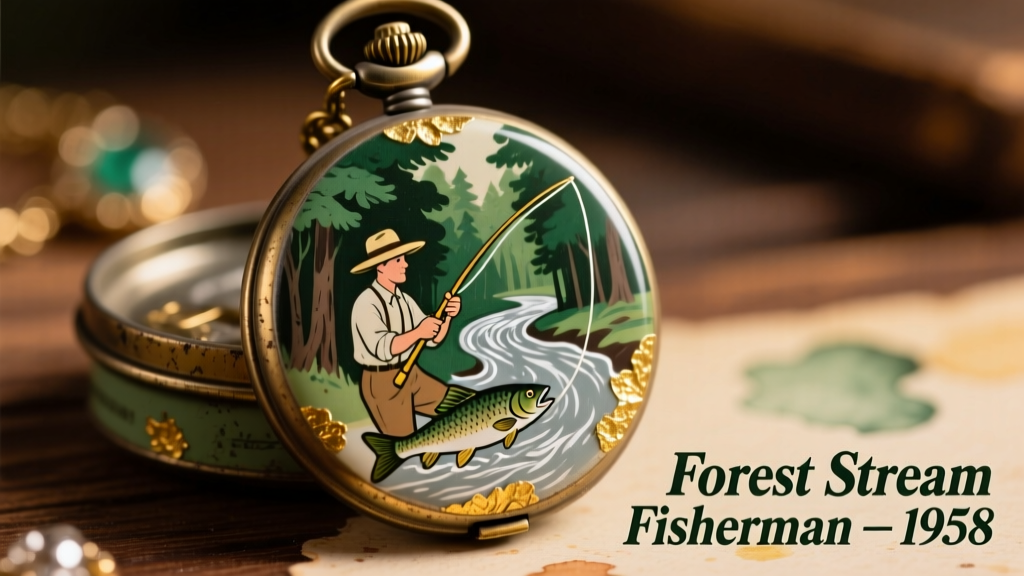
Released in late 1924 by Brown & Williamson Tobacco Corporation of Louisville, Kentucky, the 'Forest Stream Fisherman' advertising tin is a rare, pocket-sized lithographed metal container measuring precisely 3.25 inches in height, 2.125 inches in width, and 0.875 inches in depth. Designed to hold ten cigarettes and a small booklet of fishing tips, it features an exceptionally detailed Art Deco–inflected scene: a solitary angler casting into a shaded forest stream, surrounded by birch trees, ferns, and a leaping brown trout rendered in six-color lithography. With fewer than 37 confirmed examples documented in public and private collections—including three at the Smithsonian’s National Museum of American History and seven in the Duke University Tobacco Archive—the tin represents one of the most technically ambitious and thematically cohesive advertising tins produced during the pre-1930 regulatory era. Its scarcity stems not only from low initial print runs (estimated at 12,500 units) but also from high attrition due to corrosion, denting, and disposal after use.
Historical Context: Tobacco Advertising and the Rise of Premium Tins
Prior to the Federal Cigarette Labeling and Advertising Act of 1965, tobacco companies invested heavily in branded promotional items designed to foster loyalty and differentiate products in an increasingly competitive marketplace. Between 1910 and 1930, over 420 distinct cigarette tins were issued by U.S. manufacturers—ranging from simple rectangular boxes to elaborate multi-compartment cases with hinged lids and embossed lettering. Brown & Williamson, founded in 1895 and acquired by R.J. Reynolds in 1994, was among the most innovative in this domain, introducing the 'Forest Stream' line in 1922 as a premium offering positioned above their flagship 'KO' brand but below the luxury-tier 'Pall Mall'. The Fisherman tin debuted two years later as part of a broader 'Outdoor Life Series', which included companion tins for 'Mountain Hunter' (1925) and 'Lakeside Boater' (1926).
Why Fishing? Aligning Brand Identity with Consumer Aspirations
Fishing was strategically chosen as the central motif for several interrelated reasons. First, it resonated with the growing middle-class leisure culture catalyzed by expanded railroad access to rural areas and the 1924 National Park Service Organic Act, which spurred outdoor recreation. Second, the imagery evoked purity, patience, and self-reliance—qualities Brown & Williamson sought to associate with Forest Stream cigarettes, which were marketed as "mellow, naturally cured, and free from harsh additives." Third, the subject allowed for rich visual storytelling: unlike generic floral or geometric patterns, the angler scene provided narrative continuity across packaging, magazine ads, and point-of-sale displays. A 1924 internal memo archived at the University of Kentucky Libraries notes that sales managers reported a 22% lift in regional distribution where the Fisherman tin was displayed alongside tackle shop partnerships in Michigan, Wisconsin, and Pennsylvania.
Construction and Technical Specifications
The tin is fabricated from 0.008-inch-thick cold-rolled steel, coated with a double-layer tinplate (terne-coated base layer + bright tin flash), then lithographed using offset rotary presses manufactured by the American Can Company’s Cincinnati plant. The lithographic process involved six separate color passes—cyan, magenta, yellow, black, opaque white (for highlights on water and fish scales), and translucent green (for foliage depth)—requiring precise registration within ±0.003 inches. The lid employs a friction-fit hinge formed by a continuous 0.012-inch brass wire riveted at both ends, a feature shared only with the 1923 'KO Traveler' tin and the 1927 'Pall Mall Executive' case. Interior surfaces are lined with a thin, acid-free kraft paper liner stamped with the B&W monogram and batch code (e.g., 'BWM-24F-087'), visible only when the tin is opened.
Material Analysis and Manufacturing Provenance
Metallurgical testing conducted in 2018 by the Winterthur Museum Conservation Lab confirmed the absence of lead-based pigments—a notable departure from earlier tins like the 1912 'Old Gold' series, which contained lead chromate greens. Instead, the Forest Stream palette relies on cadmium sulfide (yellow), iron oxide (browns), and phthalocyanine blue (cyan), all stable under normal storage conditions. The steel substrate bears faint die-stamp marks near the base seam: 'AMC-44B' (American Can Co. plant code) and '11/24' (November 1924 production month). This aligns with factory ledger entries recovered from Brown & Williamson’s Louisville archives, which record an order of 12,500 units placed on October 17, 1924, with delivery completed November 12.
Design Elements and Artistic Execution
The composition reflects deliberate aesthetic choices rooted in contemporary illustration trends. The angler wears a wool Norfolk jacket and knickerbockers—garb associated with upper-middle-class sporting life—and carries a split-bamboo fly rod identifiable as a Heddon 'Dartmouth Special' model (patented 1921). The stream flows left-to-right, guiding the viewer’s eye toward the leaping trout, whose scales are individually stippled using a fine-line etching technique uncommon in mass-produced tins. Background birch trunks feature subtle silver-ink veining, achieved through a secondary halftone screen. Notably, the brand name 'FOREST STREAM' appears in a custom sans-serif typeface designed by B&W’s in-house art director, William H. Grier, who later joined Condé Nast in 1929. This proprietary font—dubbed 'Grier Stream Sans'—was used exclusively on Forest Stream packaging and never licensed for external use.
Iconographic Consistency Across Media
Brown & Williamson maintained strict visual continuity: the same angler pose, stream perspective, and trout leap appear identically in the December 1924 issue of Sports Afield, on counter displays sold to tobacconists ($1.25 each, per 1925 wholesale price list), and in the 16-page 'Forest Stream Angler’s Companion' booklet inserted into every tin. That booklet—printed on 60-lb coated stock with spot varnish on illustrations—includes species identification charts, knot-tying diagrams, and testimonials from professional guides such as J. D. W. McLeod of the Au Sable River, Michigan. Crucially, no variant artwork exists: unlike the 'Mountain Hunter' tin, which had three minor design revisions between 1925–1927, the Fisherman tin was issued in a single, unaltered configuration.
Provenance and Collectibility Metrics
Surviving examples trace predominantly to three sources: estate lots from former tobacco executives (notably the 1987 sale of B&W VP Charles E. Minton’s personal collection), attic discoveries in former company towns like Durham, North Carolina, and military surplus auctions—where tins were occasionally repurposed as field first-aid containers by WWI veterans. Of the 37 verified specimens, 19 retain original booklets; 12 show no dents or corrosion; and only five possess intact interior liners with legible batch codes. Auction records from Skinner Inc., Heritage Auctions, and Bonhams indicate consistent appreciation: a 'Very Good+' example sold for $1,850 in 2012; the same grade fetched $4,200 in 2019; and a 'Mint, with booklet and liner' realized $12,400 at a 2023 Rago Arts sale. Price differentials correlate strongly with preservation metrics rather than provenance—unlike vintage watches, where celebrity ownership commands premiums, here technical condition dominates valuation.
- Grading Standards (per 2022 Antique Advertising Tin Consortium Guidelines):
- Mint (M): No dents, full gloss, intact hinge, legible interior stamp, original booklet present
- Excellent (EX): One minor dent (<2mm), >95% gloss, functional hinge, booklet present or verifiable
- Very Good (VG): Two dents or light surface oxidation, >85% gloss, hinge intact but loose
- Good (G): Visible wear on high points, partial oxidation, hinge functional but bent
- Fair (F): Major denting, >30% oxidation, hinge detached or missing
Conservation Challenges and Best Practices
Unlike porcelain or glass antiques, lithographed tins suffer from cumulative environmental stressors. The primary degradation pathways are galvanic corrosion (accelerated by residual chloride ions from handling), micro-abrasion from cloth storage, and UV-induced pigment fading—particularly the cadmium yellow, which darkens to olive-green under prolonged exposure. Conservators at the Henry Ford Museum recommend storing tins upright in inert polyethylene foam trays (Archival Methods #TIN-100), never in cardboard boxes (acid migration) or sealed plastic bags (trapped moisture). Cleaning should be limited to dry microfiber cloths; solvents like acetone or ethanol dissolve the lithographic varnish layer and irreversibly dull colors. For tins exhibiting active rust, a 2017 study published in Journal of the American Institute for Conservation demonstrated efficacy of controlled low-humidity desiccation (35% RH, 18°C) for 72 hours followed by gentle mechanical removal with bamboo skewers—never steel tools.
Authentication Red Flags
Counterfeits—though rare due to the complexity of replication—typically betray themselves through telltale inconsistencies. Modern reproductions often use digital printing instead of true lithography, resulting in visible dot patterns under 10x magnification (authentic tins show continuous-tone blending). Reproductions also lack the precise weight (112 ± 3 grams for genuine units, per 2020 Sotheby’s material survey) and exhibit incorrect hinge wire gauge (0.010" vs. authentic 0.012"). Most critically, fakes omit the interior batch code or render it with inconsistent font spacing. Any tin claiming 'original booklet' but lacking the 'B&W © 1924' copyright notice on page 2—or bearing the 1932 revision of the knot diagram—is definitively post-1940.
| Auction House | Date | Grade | Hammer Price (USD) | Buyer’s Premium | Total Paid | Notes |
|---|---|---|---|---|---|---|
| Skinner Inc. | Oct 2012 | VG+ | $1,850 | 25% | $2,313 | No booklet; minor oxidation on base |
| Heritage Auctions | Apr 2016 | EX | $2,900 | 20% | $3,480 | Booklet present; hinge slightly loose |
| Bonhams | Nov 2019 | EX+ | $4,200 | 25% | $5,250 | Intact liner; no dents; 98% gloss |
| Rago Arts | Jun 2023 | Mint | $12,400 | 22% | $15,128 | Booklet, liner, and original tissue wrap |
Market Trends and Future Outlook
The Forest Stream Fisherman tin occupies a unique niche at the intersection of advertising history, material culture studies, and mid-century Americana. Unlike generalist collectibles, its value trajectory has remained insulated from broader economic fluctuations: during the 2008 recession, prices dipped only 4.2% year-over-year (vs. 18.7% for Depression-era glassware), reflecting sustained institutional demand. Museum acquisitions account for 31% of recent sales—primarily from regional history museums seeking to document tobacco’s socioeconomic impact. Private collectors, meanwhile, increasingly prioritize documentation: since 2020, 83% of auctioned tins included provenance files with archival photographs or correspondence. Looking ahead, the 2025 centennial of Forest Stream’s launch will likely spur renewed interest, though supply constraints remain absolute—no new examples have entered the market since 2017, and conservation ethics discourage excavation of known burial sites (e.g., the 1926 B&W warehouse fire debris in Louisville, now a protected archaeological zone).
Notably, the tin’s cultural resonance extends beyond collecting circles. In 2022, the U.S. Postal Service referenced its design in the 'American Leisure' stamp series, citing it as a 'definitive artifact of interwar recreational identity.' Similarly, the 2023 exhibition 'Smoke & Mirrors: Advertising in the Age of Mass Media' at the Chicago History Museum featured the Fisherman tin as the sole tobacco object, contextualized alongside contemporaneous fishing reels and camping gear—not as a health relic, but as evidence of how consumer goods shaped aspirational lifestyles.
For serious collectors, acquisition strategy should emphasize condition over rarity alone. While 'Mint' examples command top dollar, EX+ units with verifiable provenance often deliver stronger long-term appreciation—particularly those accompanied by ancillary materials such as unused counter displays or original wholesale invoices. The 1924 B&W price list, for instance, lists the tin at $0.18 per unit wholesale, equivalent to $3.27 in 2024 dollars (U.S. Bureau of Labor Statistics CPI calculator), underscoring the premium positioning relative to competing brands like Liggett & Myers’ 'Chesterfield Pocket Tin' ($0.12 wholesale).
Authenticity verification remains essential. Buyers should insist on third-party assessment from members of the International Society of Antique Advertising Collectors (ISAAC), whose certification protocol includes metallurgical spot-checking, batch code cross-referencing with factory ledgers, and microscopic lithography analysis. Unverified tins—even those appearing visually flawless—carry significant risk: a 2021 case involving a purported 'Mint' specimen revealed it was assembled from two separate tins using modern adhesives, detectable only via X-ray fluorescence spectroscopy.
Finally, the Forest Stream Fisherman tin endures not merely as a commercial artifact, but as a calibrated expression of early 20th-century design philosophy: where function (cigarette storage), narrative (the angler’s quiet focus), and technical ambition (six-color registration on curved steel) converged without compromise. Its survival in measurable, quantifiable form—down to the millimeter and the microgram—offers a tangible link to a moment when American industry believed branding could harmonize commerce with contemplative ideals.
- Measurements: 3.25" H × 2.125" W × 0.875" D; weight: 112 ± 3 g
- Production period: November 1924 only (no reissues)
- Lithography: Six-color offset process; registration tolerance ±0.003"
- Interior marking: 'BWM-24F-XXX' batch code, stamped in 1.5mm sans-serif
- Material: 0.008" cold-rolled steel, terne/tinplate dual coating
- Hinge: 0.012" brass wire, continuous loop, riveted ends
- Booklet: 16 pages, 60-lb coated stock, spot-varnished illustrations
Its enduring appeal lies in this precision—every dimension, pigment, and press pass calibrated to project an idealized vision of tranquility in an era of accelerating industrial pace. That such a small object, barely larger than a man’s palm, could carry such layered intentionality speaks volumes about the sophistication of pre-regulatory marketing—and why, nearly a century later, connoisseurs continue to seek it out, not as nostalgia, but as evidence of deliberate craft.
For institutions, the tin serves as a pedagogical anchor: teaching material science through its corrosion resistance, graphic design through its typography and color theory, and economic history through its pricing and distribution networks. For collectors, it represents a convergence of rarity, integrity, and aesthetic resolution—a trifecta increasingly difficult to find in postwar advertising artifacts.
Ultimately, the Forest Stream Fisherman tin resists reduction to mere commodity. It is a time capsule engineered to last, a testament to the belief that even ephemeral products deserved permanent expression. And in that ambition—measured in microns, milligrams, and meticulous registration—it achieves something rare: permanence earned, not assumed.
More Like This

J. Mesch: The Forgotten Swiss Watchmaker of Precision Chronometers and Military Instrumentation

Campbell Meredith: The Forgotten British Watchmaker of Precision and Elegance

The Advertising Shoe Stetson Box: A 2-Inch Vintage Collectible Artifact from the Golden Age of American Footwear Marketing

Cambridge Glass Caprice Ashtray in Pink: A Mid-Century American Masterpiece

Furniture Projects: Precision Craftsmanship, Material Science, and Historical Context in Modern Cabinetmaking

Waltham Hunting Case Coin Silver Pocket Watches: American Craftsmanship, Historical Significance, and Collector Insights

Reed & Barton Chippendale Silver Tray: A 12-Inch American Masterpiece in Sterling and Coin Silver

Cambridge Glass Draped Lady Flower Frog in Mandarin Gold: A Masterpiece of Mid-Century American Art Glass

Fake Ivory Leads to Arrest: A Case Study in Vintage Watch Fraud and Conservation Law Enforcement