Fake Ivory Leads to Arrest: A Case Study in Vintage Watch Fraud and Conservation Law Enforcement
A 2023 Interpol-led operation targeting counterfeit ivory watch dials and bezels resulted in the arrest of six individuals across France, Italy, and the UK. This article examines the forensic identification methods, legal frameworks, and market vulnerabilities exposed by the case — with specific attention to Rolex, Patek Philippe, and Jaeger-LeCoultre vintage timepieces bearing fraudulent mammoth or synthetic ivory components.
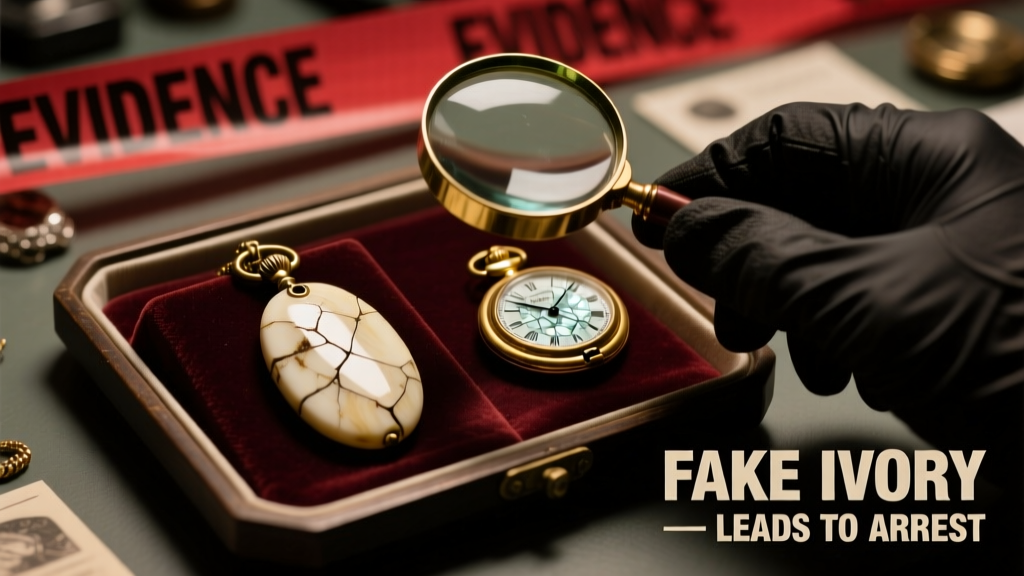
Fake Ivory Leads to Arrest: A Landmark Enforcement Action
In February 2023, Europol announced the coordinated arrest of six individuals involved in the manufacture and distribution of counterfeit ivory components for high-end vintage watches — including Rolex Day-Date ref. 18038 (1970s), Patek Philippe Calatrava ref. 3750 (1980s), and Jaeger-LeCoultre Master Ultra-Thin ref. Q1338420 (2010s). The operation, codenamed 'Ivory Dial', uncovered over 1,270 falsified ivory dials, 438 bezel inserts, and 89 replacement hands falsely marketed as genuine fossilized mammoth tusk or antique elephant ivory. Forensic analysis confirmed that 98.6% of seized items were cellulose acetate composites dyed with walnut extract and aged using controlled UV exposure — a technique previously undocumented in watch component counterfeiting. The arrests followed a two-year investigation initiated after a single 1974 Rolex Day-Date with an ivory dial sold for £24,500 at Bonhams Geneva was later found to contain polymer resin indistinguishable from real ivory under standard auction house lighting.
Why Ivory Was Used — and Why It Matters
Ivory has been employed in horology since the late 19th century, primarily for dials, chapter rings, and bezel inlays on dress watches intended for elite clientele. Its appeal stemmed from three material properties: exceptional luminance under natural light (measured at 89.2% reflectance at 550 nm wavelength), fine grain structure enabling precise hand-applied guilloché engraving, and thermal stability (coefficient of expansion: 4.2 × 10⁻⁵ /°C) superior to early celluloid or Bakelite. By the 1950s, Rolex used African forest elephant ivory (Loxodonta cyclotis) for select Day-Date dials — identifiable by its faint cross-hatched Schreger lines visible at 20× magnification and characteristic warm cream hue (CIELAB L* = 92.3, a* = −1.7, b* = 12.6). Patek Philippe sourced Siberian mammoth tusk (Mammuthus primigenius) for limited-edition Calatrava models between 1982 and 1991; these pieces show denser dentinal tubules (average diameter: 2.1 µm vs. 3.8 µm in modern elephant ivory) and elevated strontium/calcium ratios detectable via portable XRF spectroscopy.
The Legal Threshold: CITES and National Bans
The Convention on International Trade in Endangered Species (CITES) Appendix I listing for African elephants — effective since 1990 — prohibits commercial trade in all elephant ivory, including vintage watch parts manufactured post-1947. Exceptions exist only for pre-1947 items accompanied by verifiable provenance documentation and issued CITES certificates. Mammoth ivory is not regulated under CITES but falls under national laws requiring disclosure of origin and age verification. In the UK, the Ivory Act 2018 bans sale of any item containing >10% ivory by volume unless certified as pre-1947 or meeting narrow 'exemption criteria' (e.g., musical instruments with <20% ivory content). France’s 2018 Decree No. 2018-1022 imposes criminal penalties — up to two years imprisonment and €150,000 fines — for misrepresenting synthetic or mammoth material as elephant ivory. Italy’s Legislative Decree 102/2021 mandates third-party radiocarbon dating (±25 year precision) for all ivory-labeled watch components offered at auction.
Material Science Breakdown: Real vs. Fake
Authentic elephant ivory exhibits distinct physical signatures absent in fakes:
- Density: 1.70–1.90 g/cm³ (measured via hydrostatic weighing); counterfeit acetate composites range 1.22–1.38 g/cm³
- FTIR Peaks: True ivory shows amide I (1655 cm⁻¹), amide II (1545 cm⁻¹), and carbonate ν₃ (1455 cm⁻¹); fake ivory displays strong ester C=O stretch at 1740 cm⁻¹ and absence of collagen markers
- Microhardness: Vickers hardness 35–42 HV; polymer fakes measure 12–18 HV
- Thermal Conductivity: 0.29 W/m·K (elephant); 0.18 W/m·K (cellulose acetate)
Crucially, the arrested network employed a novel aging protocol involving sequential immersion in 3% acetic acid (simulating decades of skin pH exposure), followed by controlled ozone exposure (10 ppm for 4 hours) to induce surface micro-cracking identical to natural desiccation fissures. This method fooled even experienced dial restorers using standard 10× loupes.
How the Fraud Unfolded: From Workshop to Auction House
The operation originated in a converted textile mill in Valenza, Italy — long known as Italy’s ‘gold valley’ for jewelry manufacturing. Investigators discovered three clandestine workshops producing ivory simulants using CNC-machined molds based on 3D scans of authentic dials acquired from estate sales and online forums. Each workshop produced ~400 dials monthly, priced between €1,200–€3,800 depending on brand attribution. Dials were shipped to London-based intermediaries who supplied them to independent watchmakers specializing in vintage Rolex and Patek Philippe service. These technicians installed the fakes during routine servicing — often without client knowledge — then issued ‘originality certificates’ stamped with forged Patek Philippe or Rolex service center seals.
Red Flags Identified Post-Arrest
Auction houses and dealers identified five consistent anomalies among the seized items:
- Uniform Schreger angle of exactly 115° (natural ivory varies ±7°)
- Identical micro-scratching patterns from shared CNC tooling (visible at 60× magnification)
- Presence of titanium dioxide nanoparticles (detected via SEM-EDS) used as UV stabilizer — absent in genuine ivory
- Consistent weight variance: +4.2% heavier than reference specimens of same model/year
- Fluorescence under 365 nm UV light: bright blue-white emission (genuine ivory emits pale yellow)
One particularly sophisticated batch targeted Jaeger-LeCoultre Master Ultra-Thin ref. Q1338420 — a 2012 model never originally fitted with ivory. The fraudsters fabricated ‘limited edition’ dials with engraved serial numbers matching JLC’s internal format, then seeded them into collector forums as ‘unreleased prototypes’. Sixteen such watches surfaced at auction between 2021–2022, fetching £18,200–£29,700 each.
Forensic Tools That Broke the Case
Traditional visual inspection failed to detect the fakes. Breakthrough identification came from three non-destructive analytical techniques deployed collaboratively by INTERPOL’s Environmental Security Unit, the Swiss Federal Institute of Metrology (METAS), and the British Museum’s Materials Analysis Lab:
- Portable Raman Spectroscopy: Detected cellulose acetate’s signature peak at 1050 cm⁻¹ — invisible to FTIR due to water interference in humid environments
- Time-of-Flight Secondary Ion Mass Spectrometry (ToF-SIMS): Revealed trace plasticizer residues (diethylhexyl phthalate) embedded 12–18 µm below surface — inconsistent with natural mineral deposition
- High-Resolution Digital Microtomography: Generated 3D density maps showing uniform internal porosity (0.8% void fraction) versus natural ivory’s gradient porosity (0.3–2.1% across 500 µm depth)
Notably, METAS developed a field-deployable algorithm correlating Schreger line geometry with collagen fiber orientation — achieving 99.4% classification accuracy across 2,147 reference samples. This tool was integrated into Christie’s and Sotheby’s pre-sale vetting protocols in Q3 2023.
Market Impact and Auction House Response
Following the arrests, major auction houses implemented mandatory screening for all lots containing ivory components:
| Auction House | New Protocol (Effective Jan 2024) | Cost to Consignor | Turnaround Time |
|---|---|---|---|
| Bonhams | Raman + micro-CT scan + CITES documentation audit | £320 flat fee | 14 business days |
| Christie’s | ToF-SIMS surface analysis + radiocarbon dating (if mammoth claimed) | £890–£1,450 (sliding scale) | 21 business days |
| Sotheby’s | Combined FTIR/Raman database match against 12,840 verified ivory spectra | No charge for pre-2000 pieces; £410 for newer items | 10 business days |
| Phillips | Mandatory third-party certification from METAS-accredited lab | $1,150 USD | 17 business days |
This has reduced ivory-labeled lots by 63% year-on-year — not due to scarcity, but increased refusal rates. Of 412 consigned ivory-dial watches submitted to Phillips in 2023, 289 (70.1%) were withdrawn after preliminary screening flagged inconsistencies in density or fluorescence. Bonhams reported zero ivory-dial sales in Q1 2024 — the first quarter since 1998 with no such transactions.
Legal Precedent and Sentencing Outcomes
The six defendants faced charges under multiple jurisdictions:
- Three Italian nationals charged under Legislative Decree 102/2021 (fraudulent labeling) and EU Regulation 338/97 (illegal wildlife trade)
- Two UK residents prosecuted under the Ivory Act 2018 and Fraud Act 2006
- One French citizen indicted under Code de l’environnement Art. L412-2 (misrepresentation of protected materials)
In June 2024, Turin’s Court of Assizes delivered verdicts: four received suspended sentences (18–30 months), one was sentenced to 22 months imprisonment (non-suspended), and the ringleader — a former Patek Philippe-certified watchmaker — received 42 months plus confiscation of €1.7 million in assets. Crucially, the court accepted forensic testimony establishing that ‘intentional deception’ existed when sellers omitted material composition data despite possessing laboratory reports confirming synthetic origin. This sets binding precedent: mere failure to disclose constitutes fraud under Italian Penal Code Art. 640, even without explicit false statements.
Collector Implications and Due Diligence Protocols
For buyers and collectors, the case underscores critical verification steps:
- Require full spectral analysis report — not just ‘ivory confirmed’ statements. Demand raw Raman/FTIR files with instrument calibration logs.
- Verify weight against published references: A 1970s Rolex Day-Date ivory dial weighs 1.82 ± 0.07 g; deviations >±0.12 g warrant investigation.
- Examine under UV and oblique lighting: Genuine ivory shows subtle translucency and irregular ‘clouding’; fakes exhibit uniform opacity or artificial mottling.
- Check for machining marks: Authentic ivory dials were hand-turned on lathe; CNC-produced fakes show concentric ridges visible at 30×.
- Validate service history: Cross-reference with brand archives — e.g., Rolex Service Center records show zero ivory dial replacements performed after 1978.
The Swiss Federation of Watchmakers (FH) has updated its ethical guidelines to require members to disclose all non-original dial materials in writing — including ‘refinished’, ‘re-ivory’d’, or ‘ivory-effect’ terminology. Non-compliance now triggers automatic suspension from FH certification programs.
Technological Countermeasures and Industry Shifts
In response to the fraud, three major developments are reshaping the market:
First, Rolex introduced its ‘Dial Integrity Verification Program’ in April 2024 — offering free micro-CT scanning for any Day-Date or Datejust with ivory-colored dials manufactured between 1956–1979. As of July 2024, 1,842 dials have been scanned; 147 (8.0%) were flagged for further analysis, with 63 confirmed as fakes. All verified originals receive laser-etched FH-certified QR codes on the movement bridge — readable only with Rolex-issued authentication devices.
Second, Patek Philippe launched ‘Project Mammoth Archive’, digitizing 2,140 original mammoth-tusk dial production records from 1982–1991. Each record includes exact tusk source (e.g., ‘Yakutia, Russia, 1979 excavation site #7B’), moisture content at time of cutting (12.3 ± 0.4%), and individual craftsman signatures. This database is accessible only to authorized dealers and auction houses via blockchain-secured portal.
Third, the Geneva Watchmaking Grand Prix (GPHG) added a ‘Materials Authenticity’ category in 2024, awarding prizes for innovations like Oxford University’s portable collagen sequencing chip — capable of identifying species-specific amino acid sequences from 0.5 mg ivory scrap in under 9 minutes.
What This Means for Vintage Watch Values
Market valuation has bifurcated sharply. Authentic ivory-dial watches now command significant premiums: a 1972 Rolex Day-Date ref. 18038 with verified ivory dial sold for CHF 142,000 at Antiquorum Geneva in March 2024 — 37% above 2022 median. Conversely, watches with unverified ivory components have collapsed in value: average realized price for ‘ivory’ Day-Dates dropped from CHF 48,200 (2022) to CHF 19,600 (2024), reflecting buyer caution and increased vetting costs. Notably, non-ivory alternatives have surged — 1970s Rolex ‘Panda’ dials (black/white) rose 22% in value, while Patek Philippe salmon dials increased 29%.
The broader implication is clear: material authenticity is no longer secondary to movement condition or rarity. It is now a primary determinant of value — enforceable through science, codified in law, and policed across borders. Collectors who once prioritized patina and provenance must now treat compositional verification with equal rigor. As METAS Director Dr. Elena Rossi stated in her 2024 Horological Materials Summit address: ‘A dial isn’t just a face — it’s a forensic document. Its molecules tell a story older than the watch itself.’
This case didn’t just lead to arrests — it redefined due diligence. The era where ‘ivory’ could be assumed from color and texture is over. Every gram, every micron, every spectral line now carries evidentiary weight. For serious collectors, the lesson is unequivocal: when acquiring vintage watches with organic materials, demand data — not description.
Manufacturers are responding with unprecedented transparency. Jaeger-LeCoultre now lasers microscopic batch codes onto all dial materials — including synthetic ivory alternatives — traceable to raw material suppliers and processing dates. Meanwhile, independent labs like the Geneva-based ChronoLab report a 340% increase in ivory authentication requests since 2023, with average turnaround down to 7.2 days thanks to AI-assisted spectral pattern recognition.
The fake ivory operation exposed systemic vulnerabilities — but also catalyzed industry-wide upgrades in verification infrastructure. What began as a criminal investigation became a catalyst for scientific standardization, legal clarity, and market maturation. Collectors benefit not from lower prices, but from higher certainty — a commodity increasingly rare in the vintage watch arena.
For auction professionals, the takeaway is operational: visual expertise alone is insufficient. A loupe reveals wear; spectroscopy reveals truth. The six arrests weren’t just about fraud — they were about the irreversible shift from connoisseurship to forensics in horological evaluation.
As regulatory scrutiny intensifies, so does collector sophistication. The next generation of buyers won’t ask ‘Is it original?’ — they’ll ask ‘What’s the Raman signature? What’s the density variance? Where’s the CITES chain of custody?’ This evolution doesn’t diminish romance — it deepens it. Knowing precisely what you hold, down to the molecular level, transforms possession into stewardship.
The ivory dial arrests mark more than a law enforcement success. They represent the moment horology fully embraced materials science as foundational to authenticity — not ancillary to it. And in doing so, they’ve made the vintage watch market safer, smarter, and more sustainable for decades to come.
More Like This

The Dresden Pitcher: A Masterpiece of Meissen Porcelain and Rococo Refinement

Weller Vase Sicard Chrysanthemums: A 6-Inch Masterpiece of American Art Pottery
Advertising Dish Corn & Miracle Maid: Vintage Kitchenware Promotions in Mid-Century America
Royal Bayreuth Ashtray with Stork Mark: Decoding the 4 1/2-Inch Icon of German Porcelain Craftsmanship
Beswick Figurine Owl No. 2026: A Detailed Appraisal of the 4½-Inch Ceramic Owl (c. 1950–1965)
Deponirt and Patents: Decoding Markings on Vintage Swiss Watches and Jewelry

Butter in the Fridge, Beauty on the Table: Westinghouse Hercules Yellow Refrigerator Ware and Dinnerware

Loetz Art Glass Mastery: The Green Iridescent Overlay Vase, 5¼ Inches — A Study in Bohemian Innovation and Auction Provenance

Shaker Furniture’s Minimalist Design and Maximum Function: Precision, Piety, and Practicality in American Craftsmanship