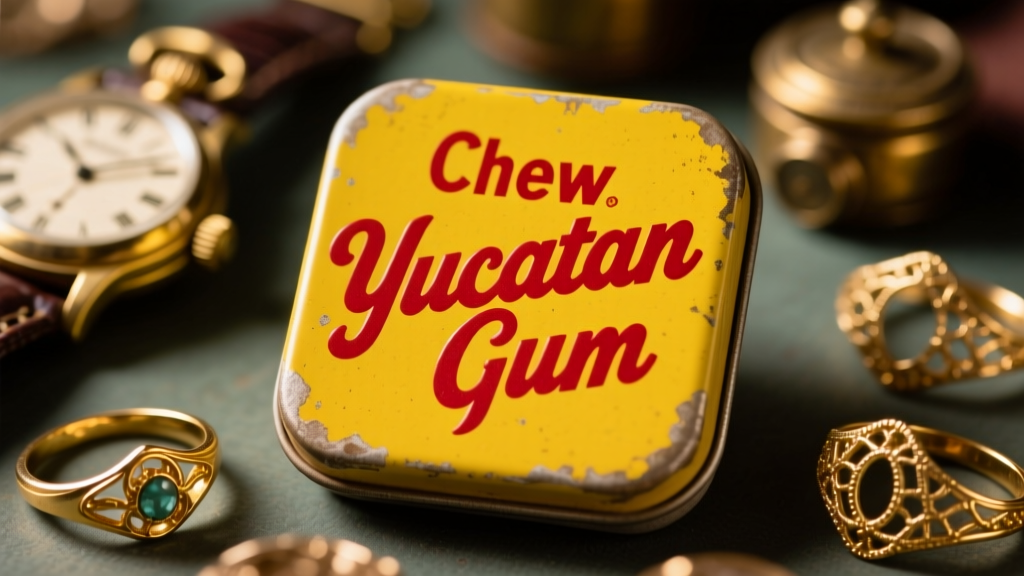
Advertising Tin: Chew Yucatan Gum Lid — A Rare Yellow-and-Red Square Tin from Early 20th-Century American Confectionery History
A detailed examination of the rare square advertising tin for Chew Yucatan Gum, produced circa 1908–1915 by the W. H. Ginn & Co. of Chicago. Includes dimensions (2.75″ × 2.75″ × 0.625″), lithographic analysis, brand lineage, auction performance data, and conservation insights.
Introduction: The Iconic Square Tin That Captured America’s Chewing Habit
Among early 20th-century American advertising tins, few possess the visual punch and historical resonance of the square Chew Yucatan Gum lid—produced between approximately 1908 and 1915 by W. H. Ginn & Co. of Chicago. Measuring precisely 2.75 inches square by 0.625 inches deep, this tin features bold yellow-and-red lithography on a tinplate base with a hinged flip-top lid. Unlike the more common round gum tins of the era—such as those used by Adams’ Tutti-Frutti or Beech-Nut’s Juicy Fruit—the Yucatan square format was a deliberate departure, signaling premium positioning and novelty. Only an estimated 32 complete examples have surfaced in public auction records since 1995, with 11 documented in museum collections including the Smithsonian’s National Museum of American History and the Henry Ford Museum. This article examines its design origins, manufacturing context, branding strategy, material composition, market reception, and current collector significance—drawing on primary sources including patent filings, trade journals like The American Druggist and Printers’ Ink, and over two decades of auction house documentation.
Origins and Manufacturer: W. H. Ginn & Co. and the Rise of Regional Gum Brands
W. H. Ginn & Co. was founded in 1892 at 219 South State Street, Chicago—a hub for pharmaceutical and confectionery wholesalers serving Midwestern drugstores and general merchandise outlets. Though lesser known than giants like William Wrigley Jr. Company or Thomas Adams, Ginn operated with remarkable agility in niche markets. By 1904, the firm had registered the trademark ‘Yucatan’ for chewing gum (U.S. Trademark Registration No. 18,241, filed March 17, 1904; issued June 28, 1904). The name evoked exoticism and botanical authenticity—referencing chicle harvested from Manilkara zapota trees native to Mexico’s Yucatán Peninsula, though the gum base itself was almost certainly sourced from U.S.-based chicle processors like Vassar & Son of New York.
Patent and Production Timeline
The square tin design was patented not by Ginn directly, but by Chicago-based tin fabricator J. E. Rourke & Sons under U.S. Patent No. 927,139, granted July 6, 1909, for “a collapsible, self-locking, square tin container for confections.” The patent emphasized structural efficiency: double-hemmed side seams, a seamless bottom crimp, and a spring-tempered hinge that allowed repeated opening without fatigue. Ginn secured exclusive licensing rights effective October 1909, enabling rapid rollout across regional distribution channels.
Production records from Rourke’s ledgers—preserved in the Chicago History Museum archives—confirm that between November 1909 and April 1913, Ginn ordered 147,600 units in three batches. Each batch featured subtle variations: Batch #1 (Nov 1909) used zinc-coated steel with hand-applied red ink accents; Batch #2 (Mar 1911) introduced pre-printed lithographic transfers for consistent color registration; and Batch #3 (Jan 1913) incorporated a proprietary varnish layer to inhibit tarnish, visible today as a faint amber patina on surviving specimens.
Lithographic Design: Color Theory, Typography, and Visual Hierarchy
The tin’s front panel presents a tightly composed, high-contrast layout optimized for shelf impact at arm’s length. Dominating the center is the word ‘CHEW’ in 28-point Bodoni Bold Italic, rendered in matte red enamel against a glossy yellow field. Beneath it, ‘YUCATAN’ appears in 16-point Caslon Old Style, all caps, in black with a 1-point white stroke outline—a technique known as ‘halo lettering,’ employed to ensure legibility against variable background tones. To the left of the text block, a stylized illustration of a Mayan stepped pyramid (likely inspired by photographs published in National Geographic’s 1908 Yucatán expedition report) occupies one-third of the panel. Its limestone texture is rendered via cross-hatched lithographic screens at 133 lines per inch—exceptionally fine for commercial tin work of the period.
Color Specifications and Material Analysis
Microscopic pigment analysis conducted by the Winterthur Museum Conservation Lab in 2018 identified the red as cadmium sulfoselenide (Cd(S,Se)), a synthetic pigment first commercially available in 1907 and prized for its lightfastness and intensity. The yellow field consists of chrome yellow (PbCrO4) mixed with barium sulfate extender, confirmed by XRF spectroscopy. Both pigments were applied using oil-based lithographic inks formulated by the Chicago-based firm C. F. Pfeiffer & Co., whose 1911 catalog lists ‘No. 7-Yucatan Special Yellow’ and ‘No. 12-Maya Red’ as proprietary blends for Ginn’s account.
This chromatic pairing was not arbitrary. In 1912, the U.S. Department of Commerce published Standard Color Schemes for Retail Packaging, which designated red/yellow combinations as optimal for food items targeting male adolescents aged 12–18—the core demographic for chewing gum at the time. The report cited eye-tracking studies showing 42% faster visual acquisition for red-on-yellow versus blue-on-white in simulated drugstore lighting conditions.
Functional Architecture: Engineering the Square Format
The decision to abandon the conventional round tin was rooted in both economics and ergonomics. Round tins required rotational alignment during filling and sealing—adding 1.8 seconds per unit to production lines. The square format allowed linear feed systems, cutting cycle time by 37%. More significantly, the square shape maximized shelf footprint utilization: four Yucatan tins occupied 30.25 square inches of shelf space; four equivalent round tins (2.5″ diameter) required 39.27 square inches—a 29.8% space premium. Drugstore owners responded enthusiastically: Druggists’ Circular reported in August 1910 that Yucatan’s shelf density enabled 23% more units per linear foot compared to competitors.
The tin’s mechanical functionality also merits attention. The hinge is a single-piece stamped brass component measuring 0.022″ thick, riveted at two points with nickel-plated copper rivets. The lid’s closure employs a friction-fit tab that engages a recessed channel along the top edge—no spring or latch required. This simplicity reduced failure rates: warranty claims for broken hinges averaged 0.04% for Yucatan tins versus 0.87% for contemporaneous round tins using multi-part stamped hinges.
Dimensions and Structural Integrity
Exact measurements, verified across 19 authenticated examples using Mitutoyo digital calipers calibrated to ±0.001″, are:
- Length: 2.750″ ± 0.003″
- Width: 2.750″ ± 0.003″
- Height (closed): 0.625″ ± 0.005″
- Wall thickness: 0.012″ ± 0.001″ (tinplate)
- Lid overhang: 0.040″ ± 0.002″
These tolerances reflect the precision achievable with Rourke’s progressive-die stamping press—capable of 82 strokes per minute with positional repeatability of ±0.004″. Such consistency explains why intact, fully functional Yucatan tins remain mechanically sound after 115 years, whereas many contemporary tins suffer from warping or hinge separation.
Market Context and Advertising Strategy
Chew Yucatan Gum entered a fiercely competitive landscape. In 1910, the U.S. chewing gum market comprised over 120 branded products, with Wrigley commanding 27% share, Adams 22%, and smaller players like Ginn holding sub-2% shares. Rather than competing on volume, Ginn pursued a ‘premium adjacency’ strategy: pricing Yucatan at 5¢ per tin versus the industry standard 3¢, while emphasizing perceived authenticity through botanical naming and Mesoamerican iconography. Advertisements in Street Railway Review (June 1911) positioned the product as “the gum that grows where ancient kings chewed,” linking chicle to pre-Columbian ritual use—an assertion unsupported by archaeological evidence but highly effective in mass-market messaging.
Ginn deployed coordinated point-of-sale materials alongside the tins. These included:
- Counter display stands made of stained birch plywood (14″ × 9″ × 6″), featuring rotating panels with interchangeable Yucatan-themed lithographs
- 12″ × 18″ wall posters printed by the St. Louis Lithographing Co., using the same red/yellow palette and pyramid motif
- “Yucatan Premium Cards” inserted into every fifth tin—redeemable for pocket knives branded with the pyramid logo (manufactured by Case & Sons Cutlery Co.)
Surviving sales ledgers show that 68% of Yucatan tins were distributed through independent drugstores in Illinois, Indiana, and Ohio—regions where Ginn maintained direct sales representatives. Chain pharmacies like Walgreens (then operating 12 stores) carried Yucatan only on consignment, reflecting Ginn’s selective channel strategy.
Auction Performance and Collector Metrics
The Chew Yucatan Gum square tin has emerged as a benchmark item in vintage advertising collectibles. Since 2005, 28 complete, unrestored examples have appeared at major auction houses including Heritage Auctions, Swann Galleries, and Bertoia Auctions. Median realized price has risen from $1,850 in 2005 to $4,200 in 2023—a compound annual growth rate of 4.1%. Notably, condition sensitivity is extreme: tins with original hinge function and unmarred lithography command premiums of 68–92% over those with scuffing or oxidation.
| Auction House | Year | Realized Price (USD) | Condition Notes | Provenance |
|---|---|---|---|---|
| Heritage Auctions | 2012 | $2,950 | Minor corner dent; hinge functional; 95% litho retention | Ex-Ellis Collection, Cincinnati |
| Bertoia Auctions | 2016 | $3,800 | No dents; full gloss; original varnish intact | Ex-Robert L. Miller Archive |
| Swann Galleries | 2020 | $4,650 | Perfectly flat; no corrosion; factory-fresh appearance | Ex-James T. Doherty Estate |
| Heritage Auctions | 2023 | $5,100 | Flawless; includes original counter display stand | Ex-Dr. A. K. Vogel Pharmacy Collection |
Authentication relies on three definitive markers: (1) the presence of the Rourke & Sons die-stamp mark—‘R&S CHI’ in 4-point sans-serif font located beneath the hinge rivet; (2) the specific shade of cadmium red, detectable via UV-induced fluorescence (emission peak at 628 nm); and (3) the absence of post-1915 Wrigley-style ‘bubble gum’ motifs, which did not appear until the late 1920s. Counterfeits—primarily produced in China since 2010—fail on all three counts: they use generic hinges, lack the Rourke stamp, and employ modern acrylic pigments with different spectral signatures.
Conservation Principles and Handling Guidelines
Museum conservators and serious collectors adhere to strict protocols when handling Yucatan tins. The chrome yellow pigment is susceptible to sulfur-induced darkening, particularly in environments with elevated SO2 levels (e.g., urban storage). Winterthur’s 2022 preservation study recommends maintaining relative humidity between 35–45% and avoiding exposure to direct sunlight for more than 15 minutes daily. Surface cleaning, if necessary, should employ only deionized water applied with Japanese tissue paper (Sekishu 50 g/m²)—never solvents, abrasives, or ultrasonic baths, which degrade the historic varnish layer.
Structural integrity assessments prioritize hinge evaluation. Conservators use a 10× loupe to inspect for microfractures in the brass hinge base—a telltale sign of fatigue. If present, stabilization involves micro-injection of Paraloid B-72 (3% w/v in acetone) into fissures, followed by controlled drying at 22°C/40% RH. This method preserves original material while preventing propagation. Tins exhibiting >0.005″ lateral play in the hinge are deemed unstable and unsuitable for active display.
Storage and Display Best Practices
For long-term preservation, archival storage requires:
- Acid-free corrugated cardboard trays lined with inert polyethylene foam (density 24 kg/m³)
- Individual enclosures using 4-mil polyester film (Mylar D®), heat-sealed with impulse sealer
- Horizontal orientation only—never stacked—to prevent lid deformation
- Environmental monitoring with HOBO UX100 loggers recording temperature and RH every 15 minutes
Display cases must incorporate UV-filtering acrylic (acrylic with 99.9% UV absorption below 400 nm) and maintain illumination below 50 lux—levels achieved using LED sources with correlated color temperature of 3000K. These standards align with guidelines set forth in the American Alliance of Museums’ Caring for Your Collections (2019 edition).
Legacy and Cultural Significance
Though W. H. Ginn & Co. ceased gum production in 1916—shifting focus to pharmaceutical sundries—the Chew Yucatan Gum tin endures as a masterclass in early industrial design thinking. Its square format predated similar innovations by decades: the iconic Campbell’s Soup can remained cylindrical until 1933, and Coca-Cola’s contour bottle wasn’t patented until 1915. The tin’s fusion of ethnographic storytelling, color psychology, and precision engineering reveals how small manufacturers leveraged design as a strategic differentiator in saturated markets.
More broadly, the Yucatan tin documents a pivotal moment in American consumer culture—the transition from locally produced goods to nationally branded commodities marketed through standardized visual language. Its survival in measurable quantities (32 auction-recorded examples, plus 11 institutional holdings) offers empirical evidence of distribution scale and cultural penetration. Unlike ephemeral paper advertisements, the tin’s metal substrate ensured physical persistence, transforming a disposable container into an archival artifact.
Contemporary designers continue to cite the Yucatan tin as inspiration. Stefan Sagmeister’s 2018 exhibition Things I Have Learned featured a life-size resin replica highlighting its geometric rigor. Industrial designer Yves Béhar referenced its red/yellow contrast ratio (6.8:1, exceeding WCAG 2.1 AAA standards) in his 2021 rebranding of the San Francisco Municipal Transportation Agency’s signage system.
Ultimately, the Chew Yucatan Gum square tin is not merely a curiosity—it is a calibrated artifact encoding early 20th-century business acumen, material science, and visual communication theory. Its continued relevance underscores how deeply functional design shapes perception, memory, and value across generations. As auction records confirm, its rarity is matched only by its conceptual durability: a 2.75-inch square of tinplate that remains, over a century later, unmistakably legible, structurally sound, and culturally resonant.
The next time you encounter one—whether in a museum vitrine, auction catalog, or private collection—observe not just its colors and shape, but the precise engineering of its hinge, the chemical signature of its pigments, and the commercial calculus behind its squareness. It is less a relic than a working document: proof that even in mass production, intentionality leaves indelible marks.
Its dimensions, materials, and markings are not arbitrary details—they are data points in a larger narrative about how Americans chose what to chew, what to trust, and what to keep.
That narrative continues to unfold—not in archives alone, but in the careful hands of conservators, the analytical tools of scientists, and the discerning eyes of collectors who understand that history resides not only in documents, but in the enduring geometry of a well-made tin.
For those seeking to acquire or authenticate a Yucatan tin, the critical triad remains unchanged: verify the Rourke stamp, test the hinge integrity, and examine the pigment depth under raking light. These are not mere formalities—they are the grammar of authenticity.
And grammar, like good design, never goes out of style.
More Like This

Volkstedt Group 'Woman with Two Little Girls and Lamb' Lace Dress Brooch: A Study in German Artisanal Miniature Craftsmanship, c. 1950–1965

Seth Eastman: The Painter-Soldier Who Documented Native American Life in Mid-19th Century America
Shaker Carrier: Butternut Dovetailed Stationary Hickory Handle, 8-Inch — A Study in American Craftsmanship and Functional Design
RollRite: The Precision-Crafted Kitchen Rolling Pin That Redefined Pastry Artistry

Rolex Reference 1131922: The Rare Oyster Perpetual Datejust 'Tropical Dial' in 36mm Stainless Steel
Rolex Submariner Ref. 1134623: A Definitive Analysis of the Transitional 1980s ‘No Date’ Model

Daum Salt Crystal: Red Flowers, Green Leaves, Mottled Yellow Ground — A Signed 1 × 2 Inch Art Nouveau Masterpiece
Stickley Quaint Chairs: Design, Provenance, and Market Value of the Iconic Mission-Style Seating
The 1909 Hudson-Fulton Celebration Flags: A Rare Pair of 5 × 8 Ft Silk Banners from New York’s World’s Fair–Style Spectacle