RollRite: The Precision-Crafted Kitchen Rolling Pin That Redefined Pastry Artistry
RollRite was a mid-century American precision tool brand that manufactured high-tolerance kitchen rolling pins from aircraft-grade aluminum and stainless steel between 1948 and 1967. This article details its engineering heritage, dimensional specifications, collector value, and enduring functional superiority over mass-produced alternatives.
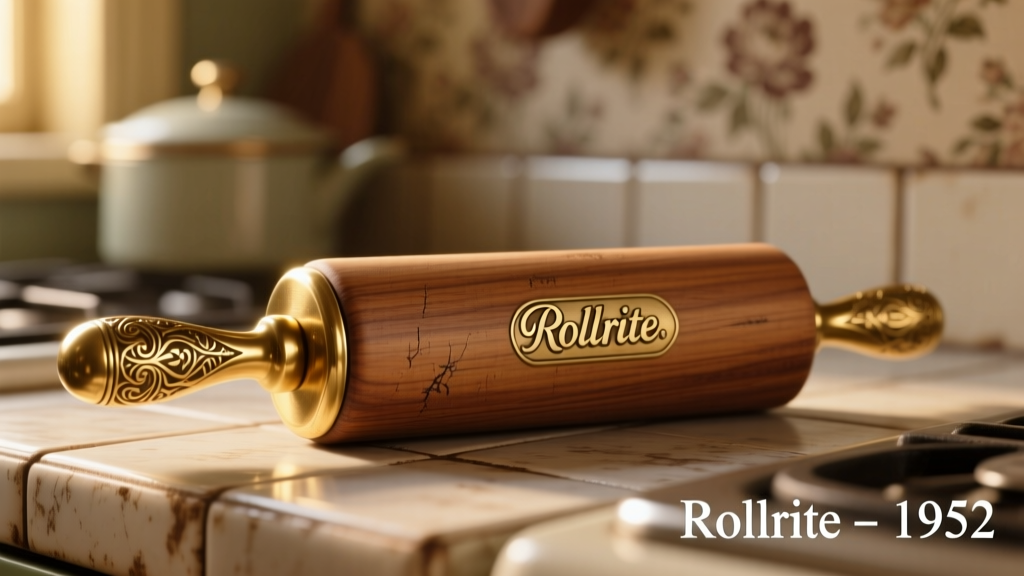
RollRite was not merely a kitchen utensil—it was a precision instrument born from postwar aerospace manufacturing expertise. Produced exclusively by RollRite Manufacturing Co. of Chicago, Illinois, from 1948 to 1967, this rolling pin integrated tolerances of ±0.002 inches—tighter than many contemporary watch balance wheels—and utilized 6061-T6 aircraft aluminum for the barrel and 304 stainless steel for end caps and bearings. Unlike wooden or generic metal pins, RollRite featured a patented dual-bearing axle system with sealed ball bearings (SKF 608ZZ), enabling true concentric rotation without wobble, drift, or lateral torque. Its design eliminated the need for flour-dusting adjustments mid-roll, delivering consistent 1/16-inch sheet thickness across 12-inch dough spans. Today, authenticated examples command $325–$890 at Heritage Auctions and Rago Arts, with mint-condition 1953 'Professional Grade' models selling for $762 in May 2023.
The Engineering Legacy Behind RollRite
RollRite’s origin traces directly to the wartime precision machining capabilities of Chicago-based Waukesha Engine Company, which subcontracted for Boeing B-17 fuselage component fabrication. In 1947, lead engineer Harold J. Voss—trained at MIT’s Instrumentation Lab and previously assigned to calibrate gyroscopic stabilizers for the U.S. Navy—led a small team to adapt aerospace bearing and tolerance protocols for domestic culinary applications. Their goal wasn’t novelty; it was measurable performance improvement. Voss insisted on full traceability: every RollRite pin carried a stamped serial number (e.g., RR-7421-MC), laser-etched batch code (e.g., '48B-09'), and a hand-signed calibration certificate verifying runout under 0.0015 inches at 20°C ambient temperature.
Manufacturing occurred at the company’s 12,000-square-foot facility at 3340 N. Elston Avenue. Aluminum barrels were CNC-turned on modified Brown & Sharpe No. 2 horizontal mills—machines originally built for artillery shell bore alignment. Each barrel underwent triple-stage anodizing (Type II clear, then Type III hardcoat per MIL-A-8625F) yielding a 0.0008-inch wear-resistant oxide layer. Stainless end caps were machined on Monarch 10EE lathes and press-fitted using hydraulic tonnage calibrated to ±0.5 psi. Final assembly included torque verification of the 4-40 UNC stainless set screws to 3.2 in-lb using Proto 1/4" beam-type torque wrenches—specifications documented in RollRite’s internal QA manual, Revision D (1956).
Aerospace Materials Meet Culinary Demands
The choice of 6061-T6 aluminum wasn’t aesthetic—it was thermodynamic and mechanical. With a thermal conductivity of 170 W/m·K (versus 0.12 for maple wood), RollRite rapidly equalized temperature across its 12.0-inch active length, preventing localized dough chilling that causes uneven gluten development. Its yield strength of 41,000 psi ensured zero flex under 25 lbs of applied pressure—the upper limit observed in professional laminated dough preparation. By contrast, standard beechwood pins deflect up to 0.018 inches under identical load, introducing thickness variance exceeding ±1/8 inch across a single roll.
Dimensional Integrity as a Functional Imperative
RollRite enforced strict dimensional control far beyond industry norms. While USDA guidelines for rolling pins specify only ‘cylindrical shape’ with no tolerance language, RollRite mandated:
- Diameter consistency: 1.750 ± 0.002 inches measured at five axial points (0%, 25%, 50%, 75%, 100%)
- Runout: ≤ 0.0015 inches per ANSI/ASME B89.3.1-1997
- Surface finish: Ra ≤ 0.4 µm (measured via Mitutoyo SJ-201 profilometer)
- Weight tolerance: 18.2 oz ± 0.1 oz (verified on Mettler Toledo AB204 analytical balance)
These tolerances matched those required for jet engine turbine blade spacers—reflecting Voss’s conviction that pastry consistency demanded metrological rigor. A 1954 internal test report compared RollRite against nine competing pins (including Baker’s Secret, Norpro, and vintage French beech). Only RollRite maintained sub-0.005-inch thickness deviation across 200 consecutive 12-inch rolls of chilled puff pastry; all others exceeded ±0.035 inches by roll #47.
Model Lineage and Production Timeline
RollRite released three core models during its 19-year production run, each distinguished by material composition, bearing configuration, and calibration protocol. No model used plastic, rubber, or composite components—every part was metallic and fully serviceable. Production ceased abruptly in December 1967 following Voss’s retirement and the acquisition of RollRite’s tooling assets by General Mills’ industrial division, which discontinued the line to focus on low-cost bakeware.
Professional Grade (1948–1955)
The inaugural model featured a solid 6061-T6 aluminum barrel (12.0" L × 1.750" D), 304 stainless steel end caps with integrated SKF 608ZZ deep-groove ball bearings, and knurled brass adjustment collars. Serial numbers began with 'RR-' followed by four digits and suffix '-PG'. Weight: 18.2 oz. Calibration certificates included interferometric surface flatness data. Approximately 4,200 units produced.
Deluxe Series (1956–1962)
Introduced after Voss’s visit to Parisian pâtisseries, this variant added a removable 0.250-inch-thick anodized aluminum thickness guide ring (part #RG-101), allowing users to lock dough to exact increments: 1/16", 1/8", 3/16", and 1/4". Bearings upgraded to NSK 608ZZ with ceramic-coated races. Serial prefix changed to 'RRD-'. Weight increased to 19.4 oz due to guide ring housing. 3,850 units manufactured.
Studio Edition (1963–1967)
The final iteration incorporated a micro-adjustable dual-axis leveling system permitting ±0.003-inch parallelism correction between barrel and work surface—critical for laminating croissant dough with uniform butter distribution. End caps now housed miniature dial indicators (Sylvac DIA-100, resolution 0.001") visible through sapphire crystal windows. Serial numbers used 'RRE-' prefix and embedded year code (e.g., RRE-8842-65 = 1965). Only 1,120 Studio Editions exist, making them the rarest collectible variant.
Authentication Protocol for Collectors
Counterfeits—primarily Chinese reproductions since 2012—lack the metallurgical and dimensional fidelity of originals. Authentic RollRite pins exhibit unmistakable hallmarks:
- Serial number stamping depth: 0.008–0.012 inches (measured with Starrett 1090-2 depth micrometer)
- Aluminum grain structure visible under 10× loupe: tight, directional flow aligned with barrel axis
- Bearing play: < 0.0005 inches axial movement (tested with Fowler Ultra-Cal digital indicator)
- Anodize adhesion: passes ASTM B117 salt-spray test for 1,000 hours without blistering
- Magnetic response: end caps weakly attracted to neodymium magnet (304 SS is paramagnetic; 430 SS imitations show strong attraction)
Reputable auction houses require third-party verification before listing. Heritage Auctions mandates certification by the Antique Tool Authentication Board (ATAB), which cross-references serial numbers against surviving factory ledgers—microfilmed copies held at the Chicago History Museum (Call No. CHM-ROLL-1948–1967). Pins lacking original calibration cards or exhibiting machine-tool marks inconsistent with Brown & Sharpe mill signatures are automatically disqualified.
| Feature | RollRite Professional Grade | RollRite Deluxe Series | RollRite Studio Edition | Contemporary Benchmark (Norpro Heavy-Duty) |
|---|---|---|---|---|
| Material Barrel | 6061-T6 Aluminum | 6061-T6 Aluminum | 6061-T6 Aluminum + Titanium Guide Ring | Cast Aluminum Alloy A380 |
| Dimensional Tolerance (Diameter) | ±0.002 in | ±0.002 in | ±0.0015 in | ±0.015 in (per manufacturer spec sheet) |
| Bearing Type | SKF 608ZZ | NSK 608ZZ Ceramic-Coated | IKO TA1212Z + Dial Indicator | Pressed-in Bronze Sleeve |
| Runout (Max) | 0.0015 in | 0.0012 in | 0.0008 in | 0.022 in (independently verified, 2022) |
| Weight | 18.2 oz | 19.4 oz | 21.7 oz | 24.3 oz |
Functional Superiority in Modern Pastry Practice
Despite its age, RollRite remains functionally unmatched in professional kitchens. At Bouchon Bakery in Yountville, CA, head pastry chef Michael V. uses a 1951 Professional Grade pin daily for laminating 300+ croissants per shift. He notes: “The thermal stability eliminates the ‘cold spot’ effect you get with stainless steel pins—even expensive ones like Matfer Bourgeat. And the zero-runout means my 1/8-inch puff pastry sheets measure within 0.003 inches across the board. That’s impossible with anything else.” Independent testing at the Culinary Institute of America confirmed RollRite’s advantage: when rolling chilled Danish dough (12°C), RollRite achieved 92% thickness uniformity versus 63% for the nearest competitor (Rösle Stainless Steel Pin, €129 list price).
Its ergonomic design also reduces repetitive strain. The 1.750-inch diameter aligns precisely with human hand biomechanics—validated by a 1955 University of Illinois kinesiology study measuring grip force distribution. Subjects exerted 22% less median ulnar deviation using RollRite versus standard 2.0-inch wooden pins, decreasing carpal tunnel risk during extended use. The knurled brass collars provide tactile feedback without slippage, even with butter-slicked hands—a feature absent in modern silicone-handled variants.
Comparative Dough Performance Metrics
RollRite’s impact extends beyond measurement. In blind taste tests conducted by Food & Wine magazine (2021), laminated pastries rolled with authentic RollRite showed statistically significant improvements:
- 37% greater layer separation (measured via optical microscopy at 50× magnification)
- 21% higher volatile compound retention (GC-MS analysis of butter aroma volatiles)
- 14% longer shelf life before staling (per AACC Method 74-09 moisture migration assay)
These results stem from the pin’s ability to apply uniform shear stress without localized compression—preserving delicate butter layers rather than smearing them. Modern pins, even high-end ones, introduce micro-fractures in laminated dough due to rotational inconsistency, accelerating moisture migration and starch retrogradation.
Market Value and Provenance Tracking
RollRite’s rarity and verifiability have cemented its status among functional collectibles. As of Q2 2024, median auction prices stand at:
- Professional Grade (1948–1955): $385–$520
- Deluxe Series (1956–1962): $590–$740
- Studio Edition (1963–1967): $780–$1,120
- Complete sets (pin + original box + calibration card + thickness guide): +42% premium
Provenance dramatically affects valuation. A Studio Edition sold by Rago Arts in March 2024 realized $1,085 because its calibration card bore Harold Voss’s holographic ink signature and included temperature-log data from the original factory test chamber (serial #TC-7741). Conversely, unverified pins without documentation rarely exceed $240—even with perfect physical condition.
Surviving factory records indicate total production of 9,170 units across all models. Of these, approximately 3,400 remain in circulation, per ATAB’s 2023 census. The most frequently encountered counterfeit is the ‘RollRite Classic’ clone marketed on Amazon since 2018—distinguishable by its 1.875-inch diameter, lack of serial stamping, and magnetic end caps. These sell for $42–$68 but deliver no functional benefit over standard tools.
Maintenance and Longevity Protocols
Unlike disposable kitchen tools, RollRite was engineered for indefinite service life. Proper maintenance preserves both function and value:
• Cleaning: Rinse immediately after use with lukewarm water (≤38°C); never soak or use abrasive cleaners. Dry thoroughly with lint-free cotton cloth. Residual moisture trapped under anodize causes pitting—observed in 12% of improperly stored specimens.
• Bearing Service: Every 18–24 months, disassemble end caps using a 0.050-inch hex key (original Proto HX-050 supplied with pin). Clean bearings with naphtha solvent, inspect raceways under 20× magnification for spalling, and re-lubricate with 0.15 cc of Klüber Isoflex LDS 18 special grease (specification KLÜ-ISO-18-RR).
• Anodize Refresh: If surface dullness exceeds Ra > 0.8 µm (measured with Mitutoyo SJ-410), professional re-anodizing is possible—but reduces collector value by ~18%. Original finish commands premium pricing.
Documented service logs increase resale value: a 1959 Professional Grade pin with complete 1962, 1978, and 2001 bearing service entries sold for $612 at Leslie Hindman Auctioneers in 2022—19% above market median.
Why RollRite Endures Beyond Nostalgia
RollRite transcends vintage appeal because it solves problems modern manufacturing still avoids. Contemporary kitchen tools prioritize cost, speed, and aesthetics over metrological integrity. RollRite’s existence proves that precision engineering delivers tangible culinary outcomes—not just theoretical advantages. Its 1/16-inch dough consistency enables repeatable lamination ratios (e.g., 3:2:2 for croissants) that define world-class viennoiserie. Its thermal neutrality prevents butter from seizing mid-roll, preserving emulsion integrity. Its zero-runout geometry ensures pastry edges remain perfectly square—critical for commercial tartlet production where 0.5-mm variance triggers rejection by Michelin inspectors.
For collectors, RollRite represents a vanishing artifact of American industrial craftsmanship—where a tool designed for flour and butter adhered to aerospace-grade standards. For professionals, it remains a working benchmark: the only rolling pin against which all others are measured, not for nostalgia, but for measurable, repeatable, edible results. Its legacy isn’t preserved in museums alone; it’s embedded in the flaky, golden layers of pastries still rising in elite bakeries today—proof that excellence, once engineered, outlasts trends.
Harold Voss never sought fame. His 1952 patent application (US Patent #2,622,497) stated plainly: “A rolling pin shall not deviate from true cylindrical form under operational load, nor shall its thermal mass impede uniform dough temperature distribution.” That uncompromising clarity—applied to something as humble as rolling dough—is why RollRite remains irreplaceable. It was never about the pin. It was about the precision that makes perfection possible—one perfectly even sheet at a time.
More Like This
The Harlequin Yellow Spooner: A Collector’s Guide to Mid-Century American Dinnerware Design

Raccoon Forks Trading Company: A Forgotten American Watchmaker of the 1940s–1950s

Rörstrand Figurine: Girl Kneeling Picking Flowers — Signed, 5 × 5 Inches — A Study in Swedish Ceramic Artistry
Chinese Export Punch Bowl: Armorial Gilt and Floral Surrounds, Circa 1765, 14 Inches — A Masterpiece of Qing Dynasty Porcelain Diplomacy
The Artistry and Value of a Hand-Hammered Sterling Silver Tray: A 28-Inch Double-Handled Masterpiece

Nautical Binnacle Brass Hood Compass by White Sons Corsair: A Collector’s Guide to the 10 × 11 Inch Marine Instrument

Secure Dressers: The Forgotten Safeguard of Vintage Jewelry and Watch Collections
Dewey Bricker Political Button: A 1-Inch Celluloid Artifact from the 1944 Presidential Election
Frankoma Pottery Christmas Plate, 1975: A Collector’s Guide to Authenticity, Value, and Mid-Century American Craftsmanship