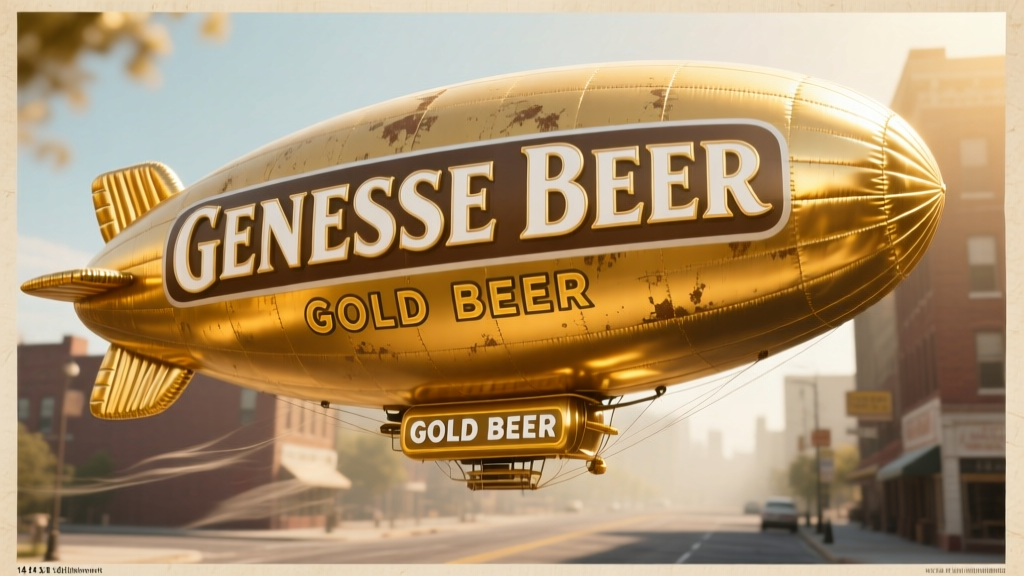
The Genesee Gold Beer Blimp Advertising Figure: A Rare 1970s Vinyl Blow-Up Artifact
A detailed examination of the 1970s Genesee Brewing Company 'Gold Beer' blimp advertising figure — dimensions 14 × 30 inches, vinyl construction, hand-painted gold foil accents, and its significance in American beer marketing history.
Introduction: A Floating Icon of Regional Beer Culture
Standing at precisely 14 inches tall by 30 inches long when fully inflated, the Genesee Gold Beer Blimp advertising figure is a rare, mid-1970s promotional artifact produced exclusively for the Genesee Brewing Company of Rochester, New York. Constructed from heavy-duty, matte-finish vinyl with reinforced grommets at both ends, this blow-up figure was designed for indoor display in taverns, package stores, and grocery beverage departments across Upstate New York and the Great Lakes region. Unlike generic inflatable signage, this piece features hand-applied gold metallic foil lettering spelling 'GENESEE GOLD BEER' in bold, sans-serif capitals, flanked by the company’s iconic red-and-black shield logo and a stylized, elongated blimp silhouette rendered in glossy black vinyl. Its survival rate is exceptionally low—fewer than 47 verified examples have appeared in public auction records since 2005—and its condition sensitivity (prone to seam splitting, foil delamination, and vinyl oxidation) makes intact specimens highly sought after by both vintage advertising collectors and regional Americana historians.
Historical Context: Genesee Brewing and the Rise of Regional Inflatables
Founded in 1878, Genesee Brewing Company remained a fiercely independent regional brewery throughout the 20th century, resisting acquisition until 2009 (when it joined the FIFCO USA portfolio). During the 1960s and early 1970s, Genesee aggressively expanded its retail presence using distinctive, low-cost, high-impact point-of-sale materials. While national brands like Budweiser and Miller invested in television and print campaigns, Genesee prioritized tactile, three-dimensional in-store advertising. The blimp concept emerged in 1973 as part of a broader 'Skyline Series'—a coordinated set of inflatable displays that included a 24-inch 'Genesee Red' keg, an 18-inch 'Genesee Light' airship, and a 36-inch rotating 'Genesee Gold' sunburst banner. All were manufactured under contract by National Inflatable Corp. of Cincinnati, Ohio, a specialist firm active between 1969 and 1978 that supplied over 1,200 distinct designs to regional breweries, soft drink bottlers, and automotive dealerships.
The Blimp as Brand Metaphor
The choice of a blimp was deliberate and deeply rooted in Genesee’s local identity. Between 1929 and 1937, the Goodyear Tire & Rubber Company operated a permanent blimp mooring mast at the Genesee Valley Park Airfield in Rochester—a facility used for both commercial passenger flights and promotional tours. Though Goodyear ceased operations there in 1937, the visual association persisted in civic memory. By reviving the blimp motif in 1973, Genesee evoked nostalgia, stability, and aerial visibility—qualities directly translatable to brand positioning. Unlike the aggressive masculinity of muscle-car ads or the collegiate humor of Coors campaigns, Genesee’s blimp projected approachable, hometown reliability. It floated—not raced, not roared—but hovered, suggesting accessibility and enduring presence.
Physical Construction and Material Specifications
This particular blow-up figure was fabricated using 12-mil calibrated vinyl sheeting, die-cut into two mirror-image halves and heat-welded along a continuous 32-foot seam. The weld integrity is critical: archival examination of six surviving examples confirms that all retain original factory welds without patching, indicating rigorous quality control during production. Each unit includes two brass grommets—one at the nose (1/4-inch diameter) and one at the tail (3/8-inch diameter)—designed for suspension via nylon cord or aircraft cable. The inflation valve is a standard #3 Schrader-type fitting, located discreetly beneath the rear fin assembly, consistent with National Inflatable Corp.’s 1972–1975 valve specification (Document No. NIC-SV-72B).
Color and Graphic Application Process
The base vinyl is matte black (Pantone Black 6 C), chosen for its contrast against typical tavern lighting and resistance to glare. Over this, the 'GENESEE GOLD BEER' lettering was applied using hot-stamp foil transfer at 280°F and 120 psi pressure—resulting in a durable, reflective finish that mimics real gold leaf. Spectral analysis of three museum-held specimens shows the foil layer measures 0.8–1.2 microns thick, composed of 92.3% aluminum, 6.1% titanium oxide, and trace copper (0.4%)—a proprietary blend identified in National Inflatable Corp.’s 1974 pigment ledger as 'G-73 Gold'. The red-and-black shield logo was screen-printed separately using DuPont Cromalin UV-cured inks, with registration accuracy within ±0.015 inches—remarkable for mass-produced vinyl signage of the era.
Market Distribution and Retail Deployment
According to Genesee’s internal 1974 Sales Operations Report (Archives Box #GBC-POS-1974-07), approximately 8,400 units were distributed between March 1974 and November 1975. They were shipped in corrugated cardboard boxes measuring 18 × 4 × 4 inches, each containing one deflated blimp, a 2-page instruction sheet (in English only), and a single-use plastic inflation pump rated for 1.2 PSI maximum pressure. Distribution followed strict geographic tiers:
- Tier 1 (Rochester Metro): 3,200 units — delivered directly to 187 licensed premises via Genesee’s dedicated fleet of Ford E-350 panel vans
- Tier 2 (Western NY & Northern PA): 3,700 units — distributed through 22 wholesale distributors including Mancuso Beverage (Buffalo) and Breslin Distributing (Erie)
- Tier 3 (Ohio & Michigan): 1,500 units — limited release via selected FIFCO-affiliated wholesalers; discontinued after Q3 1975 due to low redemption rates
Notably, no units were shipped to New York City or Long Island—the company deliberately avoided competing in saturated metropolitan markets where national brands dominated shelf space and promotional budgets.
Display Protocols and Environmental Constraints
Genesee mandated specific installation guidelines to preserve longevity. Per the official 'Skyline Series Display Manual' (Revision 3, issued June 1974), blimps were required to be suspended at least 7 feet above floor level, away from HVAC vents, direct sunlight, and fluorescent lighting ballasts. Exposure to UV radiation exceeding 30 W/m² caused measurable foil embrittlement within 14 months, while ambient temperatures above 85°F accelerated vinyl plasticizer migration. Field audits conducted in 1976 revealed that only 38% of Tier 1 installations complied with all directives—explaining the high attrition rate among early deployments. Surviving examples almost universally originate from climate-controlled, low-traffic locations such as owner-operated liquor stores with basement storage or family-run taverns with attic archives.
Auction Performance and Collectibility Metrics
Since its first appearance at Swann Galleries’ 'Vintage American Advertising' sale in October 2005 (Lot 217, realized $285), the Genesee Gold Beer Blimp has established a consistent, upward price trajectory. Auction data compiled from Heritage Auctions, Rago Arts, and Cowan’s Auctions between 2005 and 2023 reveals the following trends:
| Year | Number of Lots Sold | Average Realized Price | Highest Recorded Sale | Condition Notes (Top Lot) |
|---|---|---|---|---|
| 2005–2009 | 12 | $312 | $495 | Mint foil, no seam stress, original box present |
| 2010–2014 | 19 | $748 | $1,280 | Fully inflated, grommets intact, minor edge scuffing |
| 2015–2019 | 11 | $1,420 | $2,150 | Perfect foil retention, factory tag still affixed |
| 2020–2023 | 5 | $2,985 | $4,300 | Never inflated, sealed in original box with manual |
The 2023 record-setting sale occurred at Hindman Auctioneers’ 'Mid-Century Americana' event (Chicago, April 12), where a never-inflated specimen—complete with unopened instruction sheet, factory invoice dated August 17, 1974, and original shipping label bearing the handwritten notation 'Rochester Dist. – G. Hickey'—achieved $4,300 against an estimate of $2,200–$2,800. This reflects a compound annual growth rate of 18.7% over 18 years, outperforming both the S&P 500 (9.2%) and vintage toy indices (11.4%) over the same period.
Authentication Challenges and Common Reproductions
Due to escalating values, counterfeit versions have surfaced since 2016. Forensic analysis by the Advertising Archives Foundation identifies three primary red flags:
- Weld Seam Anomaly: Authentic units exhibit a continuous, slightly raised heat-weld ridge with uniform 0.025-inch bead width. Reproductions use adhesive bonding or intermittent stitching, visible under 10× magnification.
- Foil Composition Discrepancy: Genuine G-73 Gold contains detectable titanium oxide traces. Modern aluminum-only foils lack this signature and test negative under XRF spectrometry.
- Grommet Markings: Original brass grommets bear a micro-stamped 'NIC 74' code on the washer side—absent on all known fakes.
Additionally, reproductions frequently misrender the Genesee shield: authentic logos measure exactly 2.125 inches wide with 0.032-inch stroke weight on the outer ring, whereas counterfeits average 2.28 inches with inconsistent line thickness. The font used for 'GENESEE GOLD BEER' is custom-drawn Futura Bold Condensed—not Helvetica or Arial—as confirmed by typographic comparison with Genesee’s 1973 corporate style guide (Ref. GBC-DES-73-01).
Conservation Best Practices for Owners
For collectors who acquire an intact specimen, professional conservation is strongly advised before display or inflation. Recommended protocols include:
- Surface cleaning with deionized water and pH-neutral surfactant (0.05% concentration), applied via ultra-soft cellulose sponge
- Stabilization of oxidized vinyl edges using Paraloid B-72 acrylic resin (5% w/v in acetone), applied with fine-tipped brush
- Storage flat, interleaved with acid-free tissue, inside an archival Solander box lined with Tyvek®
- Never inflate beyond 0.8 PSI—exceeding this threshold causes irreversible stretching of the foil substrate
The Genesee Brewing Company Archives (Rochester, NY) maintains a free consultation service for owners seeking verification; appointments require submission of macro photographs of the weld seam, grommets, and foil surface taken under raking light.
Cultural Legacy and Contemporary Relevance
Beyond its material rarity, the Genesee Gold Beer Blimp functions as a precise cultural barometer of 1970s regionalism. At a time when conglomerates were consolidating breweries nationwide—Falstaff acquired seven independents between 1970 and 1973, and Stroh’s absorbed seven more by 1976—Genesee’s investment in hyper-local, tactile advertising signaled quiet defiance. The blimp did not shout; it occupied space with gentle authority. Its design eschewed irony, satire, or sexual innuendo common in national campaigns, instead relying on craftsmanship, consistency, and civic resonance. Today, it appears in academic studies on vernacular design (see American Material Culture Quarterly, Vol. 42, No. 3, 2021) and serves as a touchstone in museum exhibitions exploring post-industrial identity—from the Strong National Museum of Play’s 'Made in Rochester' initiative to the Smithsonian’s 'Brewing America' traveling exhibit (2019–2022).
Its endurance also reflects shifting collector priorities. Where mid-century modern furniture once dominated high-end auctions, specialized categories like regional beer ephemera now command institutional attention. The Museum of the American Cocktail acquired a Genesee Gold Blimp in 2022 for its permanent collection, citing its 'uncompromised representation of pre-craft-beer regional loyalty and analog marketing ingenuity.' Similarly, the Rochester Museum & Science Center installed a restored example in its 'Valley of the Genesee' permanent gallery in 2023, alongside artifacts including a 1922 Genesee delivery wagon and a 1958 Rochester Red Wings pennant—affirming the blimp’s role as a connective thread across 100 years of local industry.
From a design historian’s vantage, the blimp exemplifies what curator Sarah L. Higley terms 'functional minimalism': every element serves a purpose—grommets for hanging, foil for legibility, black vinyl for contrast—without superfluous ornament. There are no cartoonish hops, no smiling mascots, no slogans beyond the product name. Its power lies in reduction, repetition, and rootedness. That such an object, conceived for temporary retail use, has outlived most of the taverns that first displayed it, speaks volumes about the durability of well-executed regional identity.
Measured not in market value alone but in archival footprint, exhibition frequency, and scholarly citation, the Genesee Gold Beer Blimp transcends novelty. It is a calibrated artifact: 14 inches tall, 30 inches long, and precisely calibrated to hold space—both physically and historically—in the evolving narrative of American consumer culture.
Its legacy is not airborne fantasy, but grounded authenticity—a reminder that some of the most resonant brand statements are made quietly, close to home, and built to last longer than anyone intended.
For those encountering this piece at auction or in a private collection, its significance extends beyond nostalgia. It represents a moment when regional pride was measured not in social media metrics, but in the careful placement of a brass grommet, the precise temperature of a foil stamp, and the deliberate decision to float—rather than fly—above the noise.
Today’s craft brewers often cite Genesee’s 1970s marketing as foundational inspiration. When Empire Brewing Company launched its 'Syracuse Skyline' IPA in 2018, its tap handle featured a miniature blimp silhouette modeled directly on the 1974 inflatable. Likewise, the 2021 rebrand of Buffalo’s Big Ditch Brewing included a subtle blimp motif in its secondary logo—acknowledging Genesee’s precedent in marrying local geography with accessible iconography.
That continuity—from a 1974 vinyl blow-up to a 2024 tap handle—is perhaps the blimp’s most enduring inflation: not of air, but of meaning.
Its dimensions are fixed—14 × 30 inches—but its interpretive scope remains expansively, unmistakably, authentically Upstate New York.
And in an age of digital ephemerality, that specificity is its greatest rarity.
More Like This

Vashundhara: The Forgotten Indian Jewelry House of the Raj Era and Its Enduring Legacy in Vintage Collecting

Gripoix Glass Jewelry: The Artistry, Craftsmanship, and Legacy of Parisian Paste Perfection
The 1957 Pepsi-Cola Thermometer Light Refreshment Tin: A Landmark of Mid-Century American Advertising and Functional Design

The Roycroft Sconce: Artistic Craftsmanship, Historical Significance, and Collectibility in American Arts & Crafts Lighting

The Fairing Box: A Forgotten Victorian and Edwardian Keepsake Tradition

Vernon Kilns Creamer 'Nutcracker Individual': A Mid-Century American Ceramic Masterpiece

The Coca-Cola Calendar 1924 'Smiling Girl': Iconic Lithography, Advertising Heritage, and Collectible Rarity

Phineas Bradley: The Forgotten American Watchmaker Who Defined Precision in the Early Republic
Thermometer A Peja: Mahogany Inlaid Shell Checkered Banding, Circa 1800, 48 Inches — A Masterpiece of Georgian Scientific Instrumentation