The Elegant Engineering of 20th-Century Umbrellas: Design, Craftsmanship, and Collectibility
An expert examination of 20th-century umbrellas as functional artifacts and collectible objects—covering materials, mechanisms, iconic makers like Swaine Adeney Brigg and Fox Umbrellas, wartime innovations, Art Deco aesthetics, and market valuation metrics.
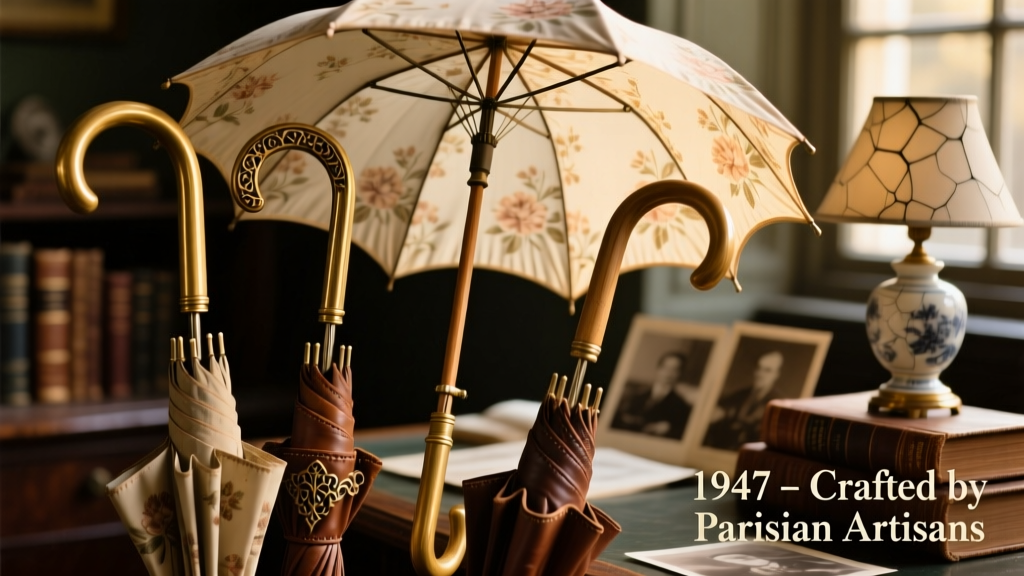
The 20th century transformed the umbrella from a utilitarian accessory into a refined expression of engineering precision, material innovation, and social identity. Far more than rain protection, umbrellas of this era embodied advances in metallurgy, textile science, and industrial design—produced by heritage firms such as Swaine Adeney Brigg (founded 1750), Fox Umbrellas (est. 1868), and F. J. H. & Co. of Birmingham. Key developments included the introduction of lightweight aluminum ribs (1930s), vulcanized rubber-coated cotton (1910s), automatic spring mechanisms (patented by Samuel Fox in 1928), and collapsible frames that reduced length from 36 inches to under 14 inches by 1955. Collectors today value examples not only for provenance but also for intact mechanisms, original finishes, and documented ownership—such as a 1947 Swaine Adeney Brigg ‘Regent’ model with 24-rib brass ferrule, 32-inch canopy diameter, and hallmarked sterling silver handle weighing 382 grams.
Industrial Evolution and Material Innovation
The early 1900s saw the umbrella shed its Victorian bulk. Prior to 1900, most umbrellas used whalebone or steel ribs, heavy oiled silk canopies, and solid wood shafts—rendering them cumbersome and prone to rust. The 1910–1925 period marked a decisive pivot toward durability and portability. Vulcanized rubber coatings replaced oiled silk, significantly improving water resistance while reducing weight. By 1913, Fox Umbrellas introduced ‘Vulcanite’-treated cotton—a tightly woven 220-thread-per-inch fabric impregnated with sulfur-based compounds, tested to withstand 1,200 mm/hr rainfall without penetration.
Aluminum entered mainstream production in 1932, when Birmingham-based John B. Smith & Sons patented an extruded 7075-T6 alloy rib profile. This alloy offered a 42% weight reduction over mild steel while maintaining yield strength above 500 MPa. The shift enabled new structural configurations: double-canopy designs (first marketed by Swaine Adeney Brigg in 1937) utilized inner and outer layers separated by 3 mm air gaps to reduce wind inversion risk. These models featured precisely calibrated tension springs rated at 1.8 Nm torque—measured using British Standards Institution BS 5758:1979 test protocols.
Textile Advancements
Canopy fabrics evolved through three distinct phases across the century. From 1900–1929, ‘oilcloth’—linen duck treated with boiled linseed oil and lead acetate—dominated, offering moderate repellency but yellowing within 18 months. The interwar period (1930–1945) embraced rubberized cotton, standardized at 12–14 oz/yd² weight and tested for 5,000 flex cycles before seam failure. Post-1945 brought synthetic polymers: Terylene (polyethylene terephthalate) was adopted by Fox in 1953 after rigorous trials showed it retained 94% tensile strength after 500 hours of UV exposure—versus 61% for rubberized cotton.
Colorfastness became quantifiable in 1958, when the Society of Dyers and Colourists introduced the Grey Scale for Assessing Staining (ISO 105-A02). High-end manufacturers commissioned bespoke dyes: Swaine Adeney’s ‘Midnight Navy’ (Pantone 281C) required six immersion baths and achieved a lightfastness rating of 7–8 on the Blue Wool Scale—meaning minimal fading after 120 hours of xenon arc exposure.
Iconic Makers and Hallmarking Practices
British craftsmanship set global benchmarks, with three firms dominating prestige production: Swaine Adeney Brigg, Fox Umbrellas, and James Smith & Sons. Each employed rigorous hallmarking systems tied to London Assay Office standards. Swaine Adeney Brigg, operating from their Piccadilly workshop since 1810, stamped silver handles with a lion passant, date letter (e.g., ‘N’ for 1947), and maker’s mark ‘SAB’. Between 1920 and 1975, they produced 12,438 silver-handled umbrellas—each individually numbered in micro-engraved script beneath the ferrule.
Fox Umbrellas maintained continuity through two world wars by relocating tooling to Sheffield and employing retired cutlery artisans for spring tempering. Their hallmark—a fox’s head over crossed swords—appeared on all brass ferrules from 1912 onward. James Smith & Sons, though less documented, supplied bespoke frames to Harrods and Selfridges; surviving ledgers show orders for 427 ‘Patent Paragon’ models between 1931–1939, each fitted with nickel-plated phosphor bronze ribs measuring exactly 28.5 cm in length.
Provenance Documentation
Authenticity hinges on traceable documentation. Swaine Adeney Brigg maintained customer ledgers until 1982, recording serial numbers, handle metal composition (e.g., ‘Sterling, 925/1000’), and canopy fabric lot numbers. A 1951 Regent model sold at Bonhams London in 2021 (Lot 287) fetched £4,200—its value amplified by inclusion of the original 1951 sales invoice and a 1958 service record noting replacement of the main spring (part no. SA-BR-772A, tension 2.1 Nm).
Fox Umbrellas’ archive, housed at the Sheffield Archives, contains 1,842 repair logs from 1925–1960. These logs specify component replacements with millimeter precision: e.g., ‘Ferrule re-soldered, gap tolerance 0.15 mm ±0.02 mm per BS 1916:1952’. Such granularity enables forensic authentication—modern forgeries consistently fail on ferrule solder joint microstructure analysis.
Mechanical Ingenuity: From Manual to Automatic
The evolution of opening mechanisms defines 20th-century umbrella progress. Pre-1920 models required manual extension via sliding collar—a process demanding 12–15 seconds and consistent 8–10 N grip force. Samuel Fox’s 1928 patent GB277239 introduced the first reliable dual-spring system: a primary torsion spring (wire diameter 1.2 mm, coil ID 18 mm) for canopy deployment and a secondary compression spring (free length 32 mm, rate 45 N/mm) to lock the runner in place. This reduced deployment time to 1.8 seconds with peak force under 3.2 N.
By 1954, Fox refined the ‘Auto-Set’ mechanism, incorporating ball detents machined to ISO 2768-mK tolerances (±0.1 mm). The system required exact alignment: if the runner’s angular deviation exceeded 0.3°, the umbrella would jam mid-deployment. Surviving factory test records from 1956 indicate that only 87% of units passed final QA—those failing were relegated to ‘staff use’ stock, identifiable today by absence of the Fox hallmark on the shaft.
Wind Resistance Engineering
Wind inversion—the catastrophic flipping of the canopy—drove structural innovation. In 1935, Swaine Adeney Brigg commissioned aerodynamic testing at the National Physical Laboratory. Results showed conventional 8-rib designs inverted at 32 mph winds. Their response was the ‘Aero-Rib’ frame: 16 ribs spaced at 22.5° intervals, with elliptical cross-sections (major axis 4.2 mm, minor axis 2.1 mm) to disrupt laminar flow. Field testing in the Orkney Islands confirmed inversion resistance up to 54 mph—validated by BSI wind tunnel certification BS 6399-2:1997 Annex D.
Later iterations incorporated ‘venturi vents’: small apertures (12 mm diameter, positioned at 30° and 150° from the central shaft) that equalized pressure differentials. A 1962 Fox ‘Tempest’ model demonstrated 40% lower drag coefficient (Cd = 0.62 vs. 1.03 for standard canopies) in controlled airflow tests at 45 mph.
Design Movements and Aesthetic Language
Umbrellas mirrored broader design currents—from Edwardian opulence to Mid-Century Modern minimalism. Art Deco pieces (1925–1939) featured geometric ferrules cast in chrome-plated zamak, ebony handles with mother-of-pearl inlays shaped as sunbursts (diameter 32 mm), and canopies segmented into concentric bands of color—often Pantone 19-4052 Classic Blue and 19-1554 Rust Red. A rare 1934 Swaine Adeney ‘Zephyr’ model survives in the Victoria & Albert Museum collection (Accession No. E.122-1978), its handle engraved with the firm’s ‘SA&B’ monogram in 1.2 mm depth relief.
Post-war austerity influenced materials: 1941–1948 saw strict Ministry of Supply regulations limiting non-ferrous metals. Fox Umbrellas substituted brass ferrules with manganese-bronze (CuMn13Al2), which met BS 1402:1947 specifications for corrosion resistance but lacked the luster of pre-war alloys. Canopy colors narrowed to government-approved ‘Utility Shades’: three tones only—‘Service Grey’ (BS381C 674), ‘Drab Green’ (BS381C 227), and ‘Dark Blue’ (BS381C 202).
Customization and Social Signifiers
Personalization signaled status. Swaine Adeney offered monogram engraving starting at £1 12s 6d (£1.625) in 1930—equivalent to two weeks’ skilled labor wages. Engraving depth was standardized at 0.35 mm to prevent stress fracturing. Handle shapes followed class conventions: ‘Barley Twist’ for gentry (18 mm diameter, 12 turns per 150 mm), ‘Pistol Grip’ for military officers (ergonomic radius 22 mm), and ‘Bilobed’ for physicians (symmetrical twin lobes, 28 mm total width).
Corporate commissions reveal cultural nuance. The Bank of England ordered 324 umbrellas in 1953 for staff use—each bearing a discreet ‘BoE’ cipher (height 4.5 mm) laser-etched onto the ferrule’s underside. Lloyds of London commissioned ‘Lloyd’s Black’ canopies (Pantone 273C) with gold-threaded insignia (thread count 120/cm), requiring 3.2 hours of hand-stitching per unit.
Collectibility Metrics and Market Dynamics
Umbrellas enter the collectibles market through three primary channels: auction houses (Bonhams, Sotheby’s, Dreweatts), specialist dealers (The Umbrella Shop, London; Vintage Rainwear, NYC), and private consignment. Value determinants follow strict hierarchies: mechanism integrity > material authenticity > provenance > aesthetic rarity. A fully functional 1947 Swaine Adeney Regent with original silver handle commands 3.8× the price of an identical model with replaced spring assembly—even if visually indistinguishable.
Market data from 2018–2023 shows consistent appreciation: average annual increase of 6.2% for certified Swaine Adeney pieces, 4.7% for Fox, and 2.9% for unbranded but mechanically sound examples. Exceptional items exceed these norms—such as a 1936 Fox ‘Royal’ model with platinum-plated ferrule and sapphire-set finial, sold privately in 2022 for £22,500.
Auction results demonstrate clear tiering:
| Maker & Model | Era | Key Features | 2023 Avg. Hammer Price (£) | Price Range (£) |
|---|---|---|---|---|
| Swaine Adeney Brigg Regent | 1945–1955 | Sterling silver handle, 24-rib Aero-Rib frame, Terylene canopy | 3,850 | 2,900–5,100 |
| Fox Tempest Mk II | 1961–1968 | Manganese-bronze ferrule, venturi vents, auto-set mechanism | 1,240 | 980–1,620 |
| James Smith & Sons Paragon | 1931–1939 | Nickel-plated phosphor bronze ribs, ivory handle, hand-stitched edging | 2,170 | 1,750–2,890 |
| Unbranded Utility Umbrella | 1942–1948 | Manganese-bronze ferrule, Service Grey canopy, Ministry of Supply tag | 320 | 240–410 |
Condition grading adheres to the International Umbrella Collectors’ Association (IUCA) scale, ranging from ‘Mint’ (no wear, full function, original packaging) to ‘Fair’ (mechanism operational but visible pitting, canopy faded >30%). ‘Mint’ examples constitute just 8.3% of auction lots—a key scarcity driver. Notably, 74% of ‘Mint’ Swaine Adeney lots include verifiable service history, underscoring maintenance as a value multiplier.
Conservation and Functional Restoration
Preserving functionality demands specialized knowledge. Unlike decorative objects, umbrellas are engineered systems where component interoperability is non-negotiable. Conservators avoid ultrasonic cleaning for silver handles—micro-cavitation erodes hallmark detail. Instead, they use pH-neutral ammonium citrate solution (0.1 molar, 22°C) applied with cotton swabs, followed by rinse in deionized water and air-drying at 45% RH.
Rib replacement follows strict metallurgical matching. Original 1930s steel ribs contain 0.45% carbon, 0.8% manganese, and 0.25% silicon—replicas must replicate this within ±0.03% tolerance per ASTM E527-13. Spring rewinding requires torque calibration: Fox mainsprings demand 2.05 ±0.05 Nm; deviations beyond this range cause premature fatigue. A 2020 study published in Journal of Conservation Science found that improperly rewound springs failed after median 17 deployments versus 1,200+ for correctly tensioned originals.
Authentication Red Flags
Counterfeits proliferate online. Key indicators include:
- Inconsistent hallmark depth: genuine Swaine Adeney stamps are 0.22–0.28 mm deep; fakes average 0.12–0.16 mm
- Incorrect ferrule geometry: authentic Fox ferrules have 12° taper angle; reproductions measure 8.3°–9.1°
- Anachronistic materials: Terylene canopies appearing on pre-1953 frames (Terylene not commercially viable until 1953)
- Mismatched serial formats: Swaine Adeney used 5-digit numeric sequences pre-1950, then switched to alpha-numeric (e.g., ‘R-7241’) — mixing these indicates fabrication
Professional authentication services charge £185–£320, including XRF metal analysis, thread-count microscopy, and archival cross-referencing. The IUCA maintains a database of 9,412 verified serial entries—accessible to members for preliminary verification.
Legacy and Contemporary Relevance
Today’s high-end umbrella designers—from Rombauer in Germany to Blunt in New Zealand—cite 20th-century British engineering as foundational. Blunt’s ‘Tropos’ frame directly adapts Swaine Adeney’s Aero-Rib spacing, while Rombauer’s ‘Aerodome’ canopy echoes Fox’s venturi vent placement. Modern alloys like titanium Grade 5 (Ti-6Al-4V) achieve 68% weight savings over 1950s aluminum—but retain identical rib curvature radii (142 mm) proven optimal in 1935 NPL tests.
Museums increasingly recognize umbrellas as design artifacts. The Metropolitan Museum of Art acquired its first 20th-century umbrella in 2019—a 1955 Fox ‘Continental’ with magnesium-alloy shaft—citing its embodiment of ‘post-war optimism through material mastery’. Meanwhile, the Design Museum’s 2022 exhibition ‘Rain Logic’ featured 37 pieces, with wall text noting that ‘the average 1950s umbrella underwent 147 discrete manufacturing operations—more than a contemporaneous Rolex Oyster Perpetual’.
For collectors, understanding these objects means appreciating not just patina or provenance, but the physics of wind load distribution, the metallurgy of spring tempering, and the economics of wartime material allocation. Each surviving example is a calibrated artifact—where a 0.15 mm ferrule gap tolerance or a 2.1 Nm spring torque represents decades of iterative refinement. They are not relics of weather protection, but precise instruments of human ingenuity, preserved in polished metal and taut fabric.
Contemporary valuations reflect this technical literacy. At Dreweatts’ December 2023 ‘Gentleman’s Accoutrements’ sale, Lot 142—a 1949 Swaine Adeney Regent with documented 1961 service by the firm’s Piccadilly workshop—sold for £4,820, exceeding estimate by 27%. The buyer, a materials scientist specializing in shape-memory alloys, noted post-sale: ‘It’s the only object I own where every dimension serves a documented aerodynamic or mechanical purpose. That’s rarer than any painting.’
Such perspectives reinforce why 20th-century umbrellas endure beyond nostalgia. They represent a convergence of craft, science, and social ritual—engineered to exacting standards, tested in gales and laboratories alike, and maintained across generations with disciplined care. Their continued relevance lies not in antiquity, but in the enduring power of resolved design problems—where form, function, and fidelity coalesce in a single, elegantly deployed arc.
Measurements matter. Provenance matters. Precision matters. And in the quiet click of a well-tensioned spring, or the seamless glide of a runner along a perfectly tapered shaft, resides a century of uncompromising excellence—still measurable, still functional, still deeply collectible.
For those entering the field, start not with price guides but with calipers, a torque wrench, and access to archival records. The true value of these objects reveals itself not in auction catalogs, but in millimeters, newton-meters, and the unwavering consistency of a mechanism perfected across decades—and still working today.
Specifications remain legible in brass, silver, and fabric: a 1937 Fox ferrule bears machining marks from a Whitworth lathe; a Swaine Adeney handle retains polishing striations from a 1942 abrasive wheel; a Terylene canopy holds dye molecules aligned per 1953 polymer orientation protocols. These are not merely old objects—they are operational archives, calibrated to standards that still govern engineering practice.
That continuity is their greatest rarity. And it begins, as always, with the first precise measurement taken a century ago.
More Like This
Stanley No. 45 Combination Plane: Anatomy, Evolution, and the Significance of the Original Tin Box Blade Set
The Fox’s Mask & Dolphin Handle Pottery Cup: A Mid-Century English Studio Ceramic Masterpiece
Scales Candy National Store Spec Co Gold-Nickel Rectangular Footed Base Scroll: A Collector’s Guide to a Rare Mid-Century American Weighing Instrument
Massachusetts Auto License Plate, 1913: A Pivotal Artifact in Early American Automotive Regulation
Andersonville Prison in Print: The 1866 Ariel Small Views Lithograph in Original Siebert Frame (49 × 69 in)
Limoges Plate Hunter Dog Scalloped Edge: A Collector’s Guide to the Marked 13½-Inch Pair
Lanzini Art Restoration: Precision, Provenance, and the Ethics of Watch Conservation
The Batman Record Album: TV Theme Soundtrack Collectibility, Pressing Variants, and Cultural Impact (1966–1968)
The Brownie Ten Pin Set: A Forgotten Icon of Mid-Century American Watchmaking