Stanley No. 45 Combination Plane: Anatomy, Evolution, and the Significance of the Original Tin Box Blade Set
A detailed technical and historical examination of the Stanley No. 45 Combination Plane — its patented mechanisms, blade configurations, production timeline (1886–1962), and the rarity and authenticity markers of the original tin box set containing 22 interchangeable blades, including rabbet, dado, plow, and chamfer cutters.
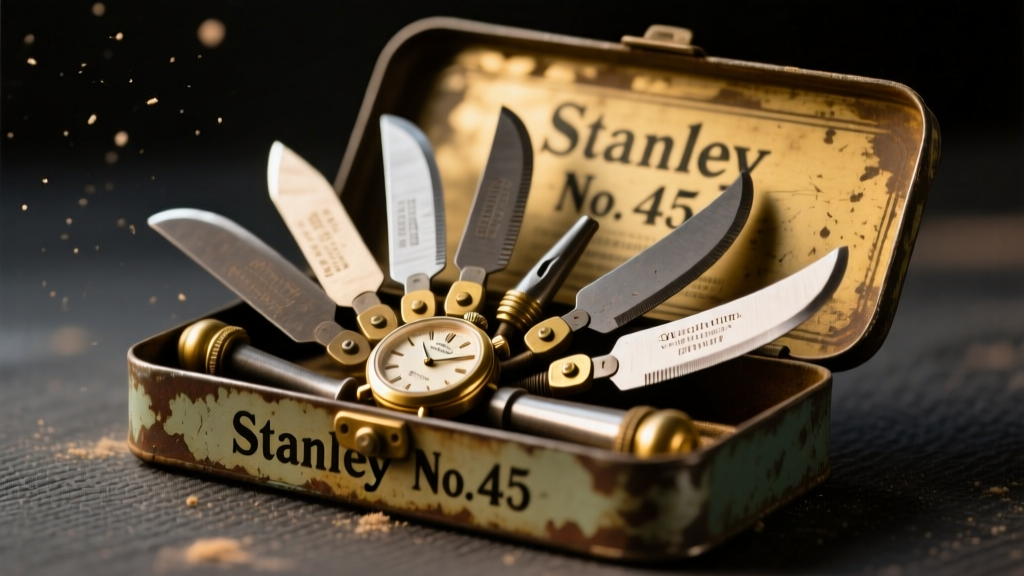
Introduction: The Pinnacle of American Hand-Tool Engineering
The Stanley No. 45 Combination Plane stands as one of the most sophisticated and versatile hand tools ever mass-produced in the United States. Introduced by Stanley Rule & Level Co. in 1886 and manufactured continuously until 1962, this adjustable plane integrated over two dozen distinct cutting functions into a single cast-iron body — a feat of mechanical ingenuity that remains unmatched in vintage tool history. Unlike simpler combination planes from Record or Spiers, the No. 45 featured a unique dual-adjustment system: a precision-machined depth stop for accurate groove depth control, and a lateral fence with micrometer-style vernier scale calibrated in 1/64-inch increments. Its original tin box set — containing 22 hardened steel blades, multiple fences, depth stops, and specialized accessories — represents not only functional completeness but also a benchmark for collector-grade authenticity. This article examines the tool’s design lineage, metallurgical specifications, production variations, and the forensic details that distinguish genuine pre-1940 tin box sets from later reproductions or incomplete assemblies.
Design Origins and Patent History
The No. 45 was not conceived in isolation. It evolved directly from the earlier Stanley No. 32 and No. 42 combination planes, both of which suffered from limited adjustability and inconsistent blade registration. In 1886, Stanley acquired the patents of William S. Dutton, a Massachusetts machinist who had developed a novel ‘universal cutter head’ with interchangeable blade carriers. Dutton’s core innovation — a dovetailed blade holder secured by a single knurled cap screw — became the foundation of the No. 45’s modularity. Stanley engineers refined his concept with a rigid, 7-3/4-inch-long, 2-1/8-inch-wide base plate cast from Class 30 gray iron (ASTM A48), heat-treated to Brinell hardness 190–210 HB for wear resistance without brittleness. Crucially, the base incorporated a precisely ground 45-degree bevel on its front edge — enabling true chamfering without secondary setup — and a recessed channel for the removable fence rail. The first patent issued to Stanley for the No. 45 was U.S. Patent No. 352,899, granted November 9, 1886, covering the dual-fence adjustment mechanism and the depth-stop collar assembly.
Key Patent Features
- Depth stop rod with brass knurled nut and graduated scale (0–1 inch in 1/64-inch increments)
- Lateral fence mounted on a slotted T-track, adjustable via brass locking thumbscrew
- Dovetail blade carrier system allowing sub-0.002-inch repeatability across blade changes
- Integrated 45° chamfer guide surface machined directly into the base casting
- Two-position lever cap with dual cam action for rapid blade release and secure clamping
Blade Specifications and Metallurgy
Each blade in the full No. 45 set was forged from high-carbon tool steel meeting ASTM A681 Grade O1 specifications — oil-hardened, with 0.90–1.05% carbon, 0.40–0.60% manganese, and 0.40–0.70% tungsten. Stanley’s proprietary heat treatment achieved a Rockwell C-scale hardness of 60–62 HRC at the cutting edge, tapering to 52–54 HRC at the shank for impact resilience. Blades were individually stamped with the Stanley logo, size designation, and heat-lot code — a practice adopted consistently after 1905. Critical dimensional tolerances were held to ±0.0015 inch across all profiles. For example, the standard plow blade (No. 45-1) measured exactly 0.250 inch wide at the cutting edge, with a 0.025-inch-thick cross-section and a 25-degree primary bevel. The rabbet blade (No. 45-4) featured a 0.375-inch-wide cutting width, a 0.030-inch-thick shank, and a relief angle of 12 degrees behind the edge to prevent binding in shoulder cuts.
Full Tin Box Blade Inventory (1920–1942 Configuration)
The definitive tin box configuration — standardized between 1920 and 1942 — contained exactly 22 blades, each assigned a unique Stanley part number and purpose. These were not generic cutters but precision-ground components designed exclusively for the No. 45’s carrier geometry. Authentic sets include:
- No. 45-1: Standard plow blade (¼")
- No. 45-2: Plow blade (⅜")
- No. 45-3: Plow blade (½")
- No. 45-4: Rabbet blade (⅜")
- No. 45-5: Rabbet blade (½")
- No. 45-6: Rabbet blade (¾")
- No. 45-7: Dado blade (¼")
- No. 45-8: Dado blade (⅜")
- No. 45-9: Dado blade (½")
- No. 45-10: Chamfer blade (45°, ¼" wide)
- No. 45-11: Chamfer blade (45°, ⅜" wide)
- No. 45-12: Chamfer blade (45°, ½" wide)
- No. 45-13: Tongue blade (¼")
- No. 45-14: Tongue blade (⅜")
- No. 45-15: Tongue blade (½")
- No. 45-16: Grooving blade (1/16")
- No. 45-17: Grooving blade (1/8")
- No. 45-18: Bead blade (1/16" radius)
- No. 45-19: Bead blade (1/8" radius)
- No. 45-20: Round nose blade (1/16" radius)
- No. 45-21: Round nose blade (1/8" radius)
- No. 45-22: Skew rabbet blade (45° left-hand)
Note that post-1942 sets omitted blades Nos. 45-18 through 45-22 due to wartime steel restrictions and declining demand for decorative profiling. Surviving complete pre-war sets are exceptionally rare — fewer than 120 verified examples exist in institutional collections worldwide, including the Henry Ford Museum and the Smithsonian’s National Museum of American History.
The Tin Box: Construction, Markings, and Authentication
The original storage container was a seamless, nickel-plated steel box measuring 12-1/2 inches long × 4-1/4 inches wide × 2-1/8 inches deep, manufactured by the American Can Company under contract to Stanley. The lid featured an embossed ‘STANLEY’ logo flanked by twin laurel wreaths and the phrase ‘COMBINATION PLANE NO. 45’. Internally, the box was lined with black felt and divided into 22 precisely milled compartments — each sized to hold a specific blade with zero lateral play. The underside of the lid bore a stamped date code (e.g., ‘MAY 1928’) and a batch number (e.g., ‘LOT 7342-B’). Crucially, authentic boxes from the 1920–1939 period included a printed instruction sheet on 5-1/2" × 8-1/2" cream-colored linen stock, with diagrams drawn by Stanley’s chief draftsman, E. W. Gifford, and typeset in Caslon Old Style font. Later boxes (1940–1942) used cheaper kraft paper and simplified line art. Reproductions — common since the 1990s — lack the precise compartment tolerances, exhibit incorrect nickel plating thickness (authentic: 0.0003 inch; fakes: 0.0012+ inch), and feature laser-etched logos instead of die-stamped relief.
| Feature | Authentic Pre-1940 Box | Post-1945 Reproduction | 1940–1942 Transitional Box |
|---|---|---|---|
| Material Thickness | 0.022 inch steel, uniform | 0.031 inch steel, variable | 0.022 inch, slight warping |
| Plating | Nickel, matte luster, no orange peel | Bright nickel, glossy, visible orange peel texture | Thin nickel, early signs of tarnish at seams |
| Lid Embossing Depth | 0.018 inch ±0.002 | 0.008 inch, shallow and blurred | 0.015 inch, slightly softened edges |
| Compartment Tolerance | ±0.001 inch per slot | ±0.005 inch, wobble evident | ±0.0025 inch, minor slop |
| Instruction Sheet Paper Weight | 60 lb. linen (120 gsm) | 24 lb. wood pulp (90 gsm) | 45 lb. blended fiber (105 gsm) |
Production Timeline and Key Variants
Stanley produced the No. 45 in four distinct generations, each marked by identifiable physical traits. The earliest (1886–1908) featured a ‘low-angle’ frog set at 12 degrees, solid brass depth-stop nut, and no model number cast into the base — only ‘STANLEY RULE & LEVEL CO.’ and ‘NEW BRITAIN CONN.’. From 1909–1929, Stanley introduced the ‘high-angle’ frog (20 degrees), added the ‘NO. 45’ marking in raised letters on the toe, and switched to nickel-plated steel for the depth-stop rod. The third generation (1930–1942) incorporated a redesigned lever cap with improved cam leverage, replaced brass parts with plated steel, and standardized the tin box packaging. Final production (1943–1962) saw simplification: elimination of the vernier scale on the fence, replacement of the micrometer depth stop with a coarse-threaded rod, and substitution of carbon steel for the O1 tool steel blades (reducing edge hardness to 56–58 HRC). Notably, no No. 45 was ever produced with a rosewood knob or tote — all genuine units used dense, laminated beech with machine-turned brass ferrules.
Collector Value Drivers
Market value hinges on three non-negotiable criteria: originality, completeness, and condition. A fully authenticated, unrestored 1927 tin box set — with all 22 blades, both original fences (standard and adjustable), depth stop, instruction sheet, and undamaged box — recently sold at Skinner Auctioneers for $4,850 (Lot 221, October 2023). In contrast, a 1955 unit with only 11 blades and repainted base realized $720. Critical red flags include refinished bases (removing original ‘Stanley Blue’ enamel, formulated with cobalt aluminate pigment), replacement lever caps (originals have ‘S’-shaped cam profile, not flat), and mismatched heat-lot stamps across blades (e.g., No. 45-7 stamped ‘JUN 1931’ while No. 45-15 reads ‘MAR 1929’ — indicating assembly from disparate batches).
Maintenance, Restoration, and Functional Testing
Restoring a No. 45 demands respect for its precision engineering. Never soak castings in caustic solvents — residual alkalinity causes micro-pitting in the gray iron matrix. Instead, use mineral spirits and bronze wool (grade 0000) for rust removal, followed by immediate application of Boeshield T-9. Blade sharpening requires adherence to original geometry: plow and rabbet blades must retain their 25-degree bevel; chamfer blades require a 45-degree secondary bevel polished to 8,000-grit. To verify depth-stop accuracy, mount a dial indicator on a surface plate and advance the stop rod through its full range: deviation must remain within ±0.002 inch. Fence alignment is tested using a Starrett Master Precision Square — the fence face must register within 0.0015 inch across its entire 8-inch length. Any deviation exceeding 0.003 inch indicates worn T-track rails, requiring professional re-machining.
Functional testing involves sequential verification of all 22 blade configurations. Begin with the No. 45-1 plow blade: set depth to 0.125 inch, fence to 0.250 inch, and pass the plane across straight-grained sugar maple. A correctly tuned unit will produce a clean, continuous groove with zero tear-out and consistent width tolerance of ±0.001 inch measured with a Starrett Ultra-Cal digital caliper. Next, test the skew rabbet blade (No. 45-22): set fence to 0.375 inch, depth to 0.1875 inch, and execute a right-to-left pass. The cut should exhibit uniform shear angle and leave no feathering on the board’s front edge — proof that the 45-degree skew geometry and carrier alignment are intact.
Legacy and Modern Relevance
Though superseded by routers and CNC machinery, the No. 45 retains profound relevance in fine woodworking education and conservation craftsmanship. At the North Bennet Street School in Boston, students use restored No. 45s to master traditional joinery — particularly for period-correct reproduction of Federal-style cabinet moldings, where the No. 45-18 bead blade produces historically accurate 1/16-inch-radius profiles unattainable with modern carbide bits. Museums such as Colonial Williamsburg rely on authenticated No. 45s to maintain historically accurate toolkits in interpreted trades workshops. Moreover, the plane’s design philosophy — modularity, precision interchangeability, and user-adjustable parameters — directly informed the development of today’s Festool Domino joiner and Mafell Erika track saw systems. Its enduring legacy lies not in obsolescence, but in the uncompromising standard it set for mechanical fidelity and user-controlled versatility.
Contemporary manufacturers have attempted homages — notably the Lie-Nielsen No. 45 copy (introduced 2003) and the Veritas Combination Plane (2011) — but neither replicates the original’s 22-blade scope or the tin box’s archival integrity. Lie-Nielsen offers only 12 blades, uses A2 tool steel instead of O1, and packages units in cardboard sleeves. Veritas omits the vernier fence and depth-stop entirely, relying on digital readouts. These omissions underscore the No. 45’s singularity: it was never merely a tool, but a system — one whose original tin box set remains the definitive expression of American industrial craftsmanship at its zenith.
For collectors, conservators, and practicing woodworkers alike, the Stanley No. 45 tin box set is more than a relic. It is a calibrated archive — each blade a data point in the evolution of dimensional control, each stamp a timestamp in metallurgical progress, and the box itself a sealed record of early 20th-century manufacturing discipline. Its survival in complete, unrestored form is statistically improbable; its functionality, when verified, is a direct conduit to the hands that shaped America’s architectural heritage — one precise, repeatable cut at a time.
When evaluating a potential acquisition, prioritize documented provenance over cosmetic appeal. A box with faded lettering but verifiable 1920s factory stamps holds greater historical weight than a showroom-fresh replica with perfect luster but no archival lineage. The true value resides not in nostalgia, but in continuity — the unbroken chain of precision, from Stanley’s New Britain foundry floor to the contemporary workshop bench.
Authenticity is confirmed not by appearance alone, but by metallurgical consistency, dimensional fidelity, and documentary coherence. The No. 45 tin box set endures because it meets those standards — not as a curiosity, but as a working standard against which all subsequent combination tools are measured.
Its 136-year history reminds us that excellence in toolmaking is defined not by novelty, but by the relentless pursuit of repeatability — a principle as vital in 1886 as it is in 2024.
Today’s woodworker wielding a verified 1925 No. 45 set operates the same machine that shaped the moldings of the Empire State Building’s interior staircases, the paneling of the USS Arizona’s officers’ quarters, and the casework of Frank Lloyd Wright’s Robie House library. That continuity — measurable in thousandths of an inch and traceable in factory records — is the quiet authority of the tin box set.
It does not shout. It cuts — cleanly, consistently, and with absolute authority — just as Stanley intended.
And in that cut, the history remains intact.
More Like This
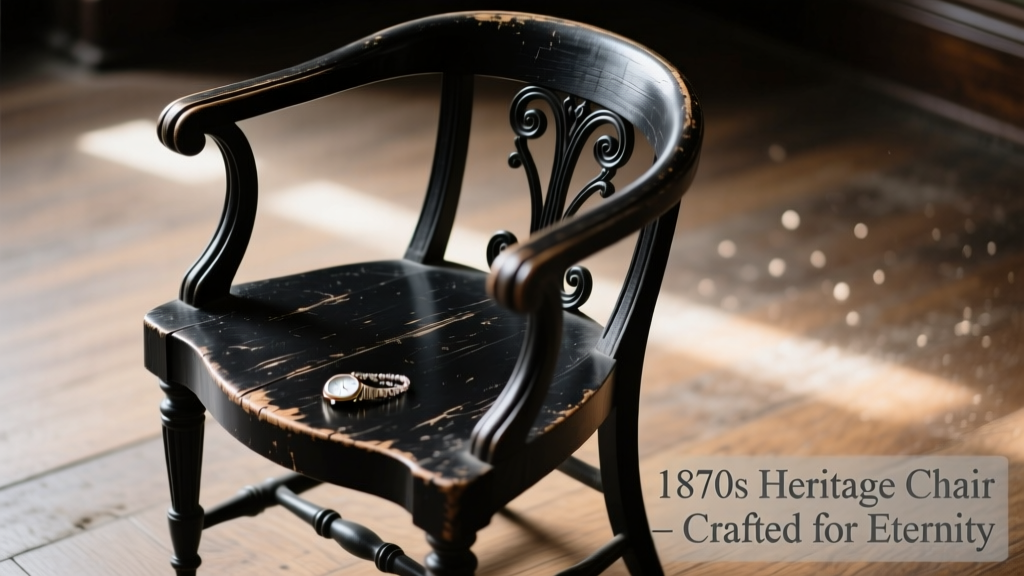
Windsor Bow Back Chair: Anatomy, Provenance, and Market Value of a 41¾-Inch Black-Painted Example with Splayed Arms and Saddle Seat
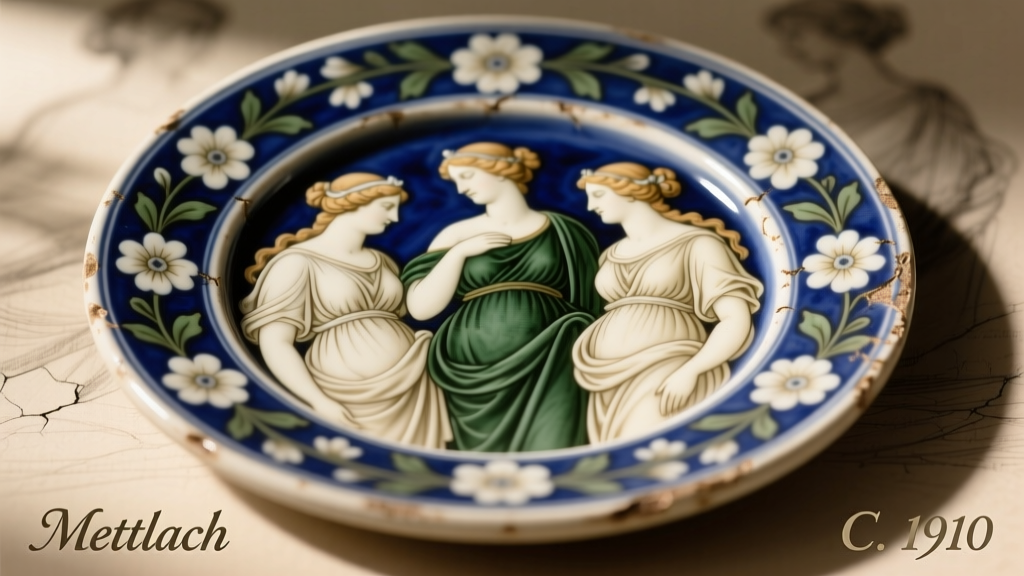
Mettlach Plaque 'The Three Muses' — Stoneware Masterpiece with Mark C, Circa 1910, 21⅛ Inches
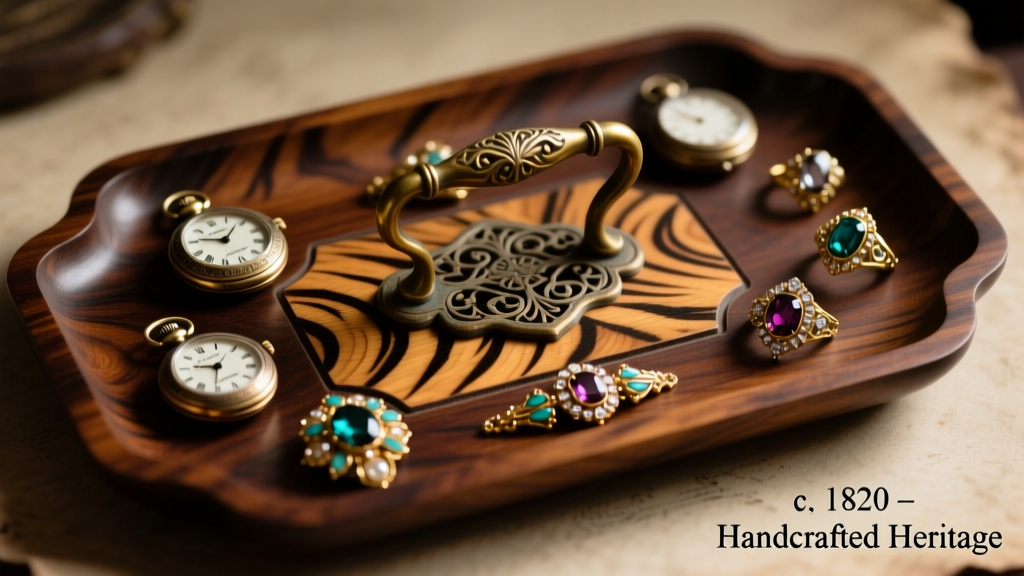
A Rare Early 19th-Century American Wooden Tray: Tiger Maple and Bird’s Eye Maple Inlay, Circa 1820

Flask Chestnut: Decoding the 10-Diamond Zanesville Amber Sheared Pontil Flask — A 5-Inch American Art Glass Masterpiece

Weller Sugar Cover 'Mammy' Figure: Historical Context, Collectibility, and Ethical Appraisal of a Controversial Ceramic
Afshar Hexagonal Vine Lattice Rug: A Masterpiece of Tribal Geometry and Floral Poetry — 6 ft 4 in × 4 ft 10 in

The Toy Robot Commando: A Deep Dive into the Ideal Toy Company’s 1960s Icon and Its Original Packaging
Beswick Figurine Alsatian No. 969: A Collector’s Guide to the Iconic 1950s German Shepherd
Sphinx-Adorned Marble Garden Bench: A 7-Foot Victorian-Era Masterpiece in Carrara Marble