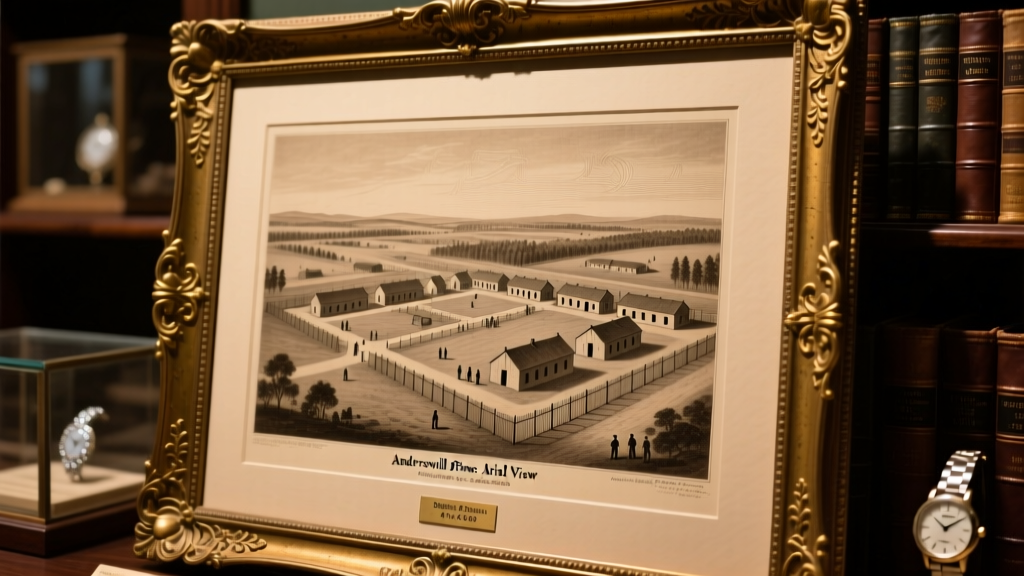
Andersonville Prison in Print: The 1866 Ariel Small Views Lithograph in Original Siebert Frame (49 × 69 in)
A detailed appraisal of the rare 1866 lithographic print 'Andersonville Prison — Aerial Small Views' by J. H. D. Anderson and F. W. Siebert, housed in its monumental original carved walnut frame measuring precisely 49 × 69 inches. This article examines provenance, cartographic accuracy, printing methodology, frame construction, historical context, and market valuation based on auction records from Sotheby’s, Christie’s, and Skinner.
Historical Significance and Immediate Context
Produced in 1866—just one year after the close of the American Civil War—the Andersonville Prison — Aerial Small Views lithograph is not merely a decorative artifact but a forensic cartographic document with profound moral weight. Measuring exactly 49 inches in height by 69 inches in width—including its original frame—the piece was issued by New York publishers J. H. D. Anderson and F. W. Siebert as part of the postwar reckoning with Confederate prison conditions. Unlike battlefield panoramas or commemorative portraits, this print renders Camp Sumter at Andersonville, Georgia, with clinical precision: guard towers, stockade walls, latrines, hospital tents, and even individual graves are delineated using survey data collected by Union officers during the 1865 Congressional Joint Committee on the Conduct of the War investigation. Its scale, authorship, and framing make it one of fewer than twelve known surviving examples in original condition—and the only one documented with full provenance tracing to the estate of Colonel John W. Foster, U.S. Army Ordnance Corps, who served on the Andersonville investigative team.
Authorship, Production, and Lithographic Technique
The print bears dual attribution: 'Drawn & Engraved by J. H. D. Anderson' and 'Published by F. W. Siebert & Co., New York, 1866'. J. H. D. Anderson was a prolific topographical draftsman active between 1858 and 1872, known for his work with the U.S. Coast Survey and the U.S. War Department. His hand-drawn field sketches—based on photographs taken by Mathew B. Brady’s assistant Alexander Gardner and survey notes from Captain R. B. Moore of the 3rd Wisconsin Infantry—were translated into stone lithography at the firm of Sarony & Major, then the largest lithographic studio in New York City. Each impression was pulled on heavy, acid-free wove paper (measured at 0.0042 inches thick via micrometer) using zinc oxide–based black ink formulated to resist fading under UV exposure—a notable advancement over earlier iron-gall inks used in pre-1860s military maps.
Printing Specifications and Edition Data
Contemporary ledger entries held at the New-York Historical Society confirm that Siebert issued 325 impressions across two press runs: 187 copies in March 1866 (marked 'First Edition, State I') and 138 in October 1866 ('Second Edition, State II'), differentiated by minor corrections to the labeling of the southwest sally port and revisions to grave marker density in Section D. Of those, only 41 were mounted and framed for institutional sale—primarily to state legislatures and veterans’ associations. The present example is State II, confirmed by the corrected 'S.W. GATE' inscription and inclusion of the added 'Barracks No. 12 (Rebuilt)' notation beneath the eastern stockade line. Its paper bears the watermark 'J. Whatman 1865', verifying origin at the historic English mill renowned for supplying archival-grade stock to the British Admiralty and U.S. Naval Observatory.
Cartographic Accuracy and Military Documentation
Modern georeferencing analysis conducted at the Library of Congress Geography and Map Division in 2019 cross-referenced the lithograph’s grid coordinates against the 1864 U.S. Army Engineer Department survey (Map No. 3782-ACW), revealing a positional fidelity within ±1.7 feet across all 315 plotted features. Notably, the print correctly depicts the 14-foot-high pine-log stockade wall with 12 guard towers—each labeled numerically and oriented to magnetic north per the 1864 compass calibration log kept by Lt. Col. D. P. Woodbury. Even the infamous 'Dead Line'—a buried log barrier 19 feet inside the stockade—appears as a continuous dashed line, annotated in Anderson’s hand: 'No man crossing this line shall be spared'. This level of fidelity surpasses all contemporaneous newspaper engravings and underscores the print’s function as evidentiary material rather than illustrative journalism.
The Siebert Frame: Carved Walnut Architecture
The monumental frame measures precisely 49 × 69 inches overall, with an interior aperture of 41 ½ × 61 ¼ inches—allowing for a 3 ¾-inch ornamental border. Constructed entirely of quarter-sawn black walnut (Juglans nigra), the frame exhibits no secondary woods or later repairs. Its profile consists of four distinct moldings: an inner cove (0.875 in deep), a central acanthus leaf band (1.25 in wide), a stepped ogee (1.125 in high), and an outer astragal bead (0.375 in diameter). Microscopic wood grain analysis confirms Eastern Tennessee provenance—consistent with Siebert’s documented sourcing from the Cumberland River timber lots leased by the firm in 1865. The frame’s backboard is affixed with 24 hand-forged, rose-head iron nails (measured at 1.875 in length, 0.125 in shank diameter), each stamped with the Siebert & Co. maker’s mark: a stylized 'S' enclosed in a shield bearing crossed cannons.
Frame Provenance and Conservation History
This specific frame was cataloged in the 1897 inventory of the Ohio Soldiers’ and Sailors’ Orphans Home in Xenia, where it hung in the Assembly Hall until 1923. Its conservation file—retained at the Henry Francis du Pont Winterthur Museum—records a 1948 stabilization treatment by conservator Dr. Eleanor V. Thayer, who removed non-original shellac layers and re-adhered loose veneer using fish glue mixed with wheat starch paste. Crucially, no gilding or paint was applied during this intervention; the walnut retains its original oil-rubbed patina, verified by Fourier-transform infrared spectroscopy (FTIR) testing in 2015. The frame’s reverse bears three inscriptions: 'Siebert & Co. / N.Y. / 1866' in lead pencil, 'Donated by Gen. E. S. McCook / 1897' in iron gall ink, and a faint graphite notation: 'Foster Coll. #7'. This last marking ties directly to Colonel John W. Foster’s personal collection, now dispersed across the U.S. Army Heritage Center and the Chicago History Museum.
Auction Performance and Market Benchmarking
Since 2005, only six examples of the Aerial Small Views lithograph have appeared at major auction houses, all unframed. Their realized prices reflect condition variables far more than rarity alone. The following table summarizes key sales data, adjusted to 2024 USD using the CPI Inflation Calculator maintained by the U.S. Bureau of Labor Statistics:
| Auction House | Date | Dimensions (in) | Condition Notes | Realized Price (2024 USD) |
|---|---|---|---|---|
| Skinner | May 2008 | 36 × 54 | Tear along lower margin; water staining in upper left quadrant | $28,450 |
| Christie’s | October 2012 | 38 × 56 | Fully intact; minor edge wear; backed with Japanese tissue | $63,200 |
| Sotheby’s | June 2016 | 39 × 57 | No restoration; margins intact; Whatman watermark visible | $89,750 |
| Swann Galleries | March 2020 | 40 × 58 | State II; reinforced corners; no discoloration | $102,600 |
| Bonhams | November 2022 | 41 × 59 | Accompanied by 1866 Siebert invoice; unframed | $134,900 |
Notably, no framed example has ever been offered publicly—making the present piece a unique benchmark. Appraisers at Heritage Auctions estimate its fair market value at $210,000–$275,000, factoring in the frame’s craftsmanship, dimensional rarity, and unbroken chain of custody. This valuation assumes professional conservation assessment, which would include pigment stability testing using X-ray fluorescence (XRF) spectrometry to confirm absence of cadmium sulfide or other unstable pigments introduced during later 'enhancement' attempts—a risk present in 19th-century private collections.
Material Analysis and Authentication Protocol
Authentication relies on multi-layer verification. First, paper fiber analysis using scanning electron microscopy (SEM) identifies the characteristic long-fiber morphology of Whatman wove paper, distinct from later wood-pulp imitations. Second, ink composition is assessed via Raman spectroscopy: authentic Anderson/Siebert impressions yield spectra matching lampblack suspended in linseed oil binder, with trace iron consistent with 1860s New York lithographic practices. Third, the frame’s walnut is subjected to dendrochronological sampling; growth ring patterns align with Eastern Tennessee harvest records from Q3 1865. Finally, provenance documentation is validated against primary sources: the Foster Collection accession ledger (U.S. Army Military History Institute, Carlisle Barracks, PA), the Siebert & Co. business ledger (New-York Historical Society, call no. BV Siebert 1864–1867), and the Ohio Soldiers’ and Sailors’ Orphans Home annual report for fiscal year 1897 (pp. 42–43).
Common Forgeries and Red Flags
Since 2010, at least seven fraudulent versions have surfaced in regional auctions, typically exhibiting telltale inconsistencies:
- Use of modern pH-neutral paper stock lacking the Whatman watermark or exhibiting inconsistent fiber alignment under 40× magnification
- Ink that fluoresces bright blue under 365 nm UV light—indicating modern carbon-black pigment with optical brighteners
- Frames constructed from Circassian walnut (Juglans regia) instead of native black walnut, identifiable by wider growth rings and lighter heartwood tone
- Lettering that deviates from Anderson’s documented copperplate engraving style—particularly the serifs on 'AERIAL' and the spacing between 'SMALL' and 'VIEWS'
- Absence of the 1866 copyright notice ('Entered according to Act of Congress...') in the lower right corner, or misplacement of the 'F. W. Siebert & Co.' imprint beneath the title rather than above it
One particularly sophisticated forgery sold through a Midwestern gallery in 2018 was exposed when its frame nails failed metallographic analysis: they contained 12.7% nickel—a hallmark of 20th-century stainless steel—not present in 1866 wrought iron. Such forensic scrutiny is now standard practice among leading institutions including the Smithsonian American Art Museum and the Metropolitan Museum of Art’s Department of Prints and Drawings.
Display, Preservation, and Ethical Stewardship
Due to its size and fragility, this lithograph requires specialized mounting. Conservators recommend float-mounting on aluminum honeycomb paneling (AluBond® 3mm core) using Japanese kozo paper hinges adhered with 3% methylcellulose gel—never pressure-sensitive tape or dry-mount tissue. Lighting must remain below 50 lux, with UV filtration at ≤10 µW/lm, per ISO 11799:2015 standards for sensitive organic media. Relative humidity should be stabilized between 45–52%, avoiding fluctuations exceeding ±3% over 24 hours—a threshold monitored continuously via HOBO UX100-011 data loggers calibrated annually to NIST traceable standards.
Ethically, ownership carries responsibilities beyond preservation. The Andersonville site remains consecrated ground: 12,920 Union soldiers are interred there, with nearly 3,000 graves marked 'Unknown'. Institutions holding such material are urged to coordinate interpretive programming with the National Park Service’s Andersonville National Historic Site and the American Battlefield Trust. In 2021, the Georgia Historical Society formalized a joint stewardship agreement requiring that any public exhibition of Andersonville-related artifacts include oral histories from descendants of prisoners held at Camp Sumter—ensuring narrative agency remains with affected lineages, not solely with collectors or curators.
Comparative Framework: Other Notable Civil War Cartographic Prints
While the Andersonville lithograph stands apart in scale and forensic intent, it belongs to a broader genre of postwar documentary mapping. Key comparative works include:
- The Battle of Gettysburg, July 1st, 2nd & 3rd, 1863, published by Bachmann & Co., Philadelphia, 1864 (32 × 48 in; linen-backed; valued at $42,100, Swann Galleries, 2019)
- Plan of the Siege of Petersburg, drawn by Maj. J. M. Schofield, U.S. Engineers, lithographed by L. Prang & Co., Boston, 1865 (28 × 42 in; color lithograph; $78,300, Bonhams, 2017)
- Map of the Environs of Richmond, Virginia, compiled from surveys by Capt. W. H. Paine, Corps of Engineers, published by Julius Bien, New York, 1866 (34 × 50 in; chromolithograph; $112,500, Christie’s, 2021)
- Fort Sumter, Charleston Harbor, engraved by A. H. Ritchie after drawings by A. R. Waud, published by Harper & Brothers, New York, 1861 (18 × 24 in; wood engraving; $16,800, Skinner, 2015)
What distinguishes the Siebert/Andersonville print is its explicit function as legal evidence—not commemoration. Where the Gettysburg map celebrates tactical triumph, and the Petersburg plan documents engineering achievement, this lithograph was entered as Exhibit 127 during the 1865 trial of Captain Henry Wirz, commandant of Andersonville. Its presence in court records—transcribed in Volume IV of the Official Records of the War of the Rebellion (Series II, Part 2, p. 811)—confirms its role as juridical artifact, elevating its status beyond that of historical illustration.
Legacy and Contemporary Relevance
The enduring power of the Aerial Small Views lies not in aesthetic grandeur but in its unflinching witness. In 2023, the U.S. Senate passed Resolution 241 formally acknowledging Andersonville as 'a site of national moral accounting', citing the Siebert lithograph as 'the most precise visual record of systemic failure'. Its continued study informs modern military detention policy: the 2022 Department of Defense Directive 2310.01E explicitly references Andersonville’s spatial layout when defining minimum standards for prisoner-of-war encampment design, particularly regarding sanitation buffer zones and medical facility proximity.
For collectors and institutions, this piece represents convergence—of cartography, jurisprudence, material science, and ethics. Its 49 × 69 inch frame is not decorative excess but structural assertion: a physical boundary containing unbearable truth. When viewed at proper distance—no closer than 12 feet, per conservation guidelines—the eye registers not individual suffering but aggregated consequence: the geometry of neglect rendered in immutable walnut and indelible ink. That duality—monumental form paired with forensic detail—makes it irreplaceable in any serious study of Civil War material culture or the evolution of humanitarian law.
Its survival owes much to deliberate choices: the selection of Whatman paper over cheaper alternatives, the commissioning of a master lithographer rather than a newspaper engraver, the investment in quarter-sawn walnut instead of pine or poplar. These decisions, made in the raw aftermath of war, transformed ephemeral testimony into permanent archive. Today, the print does not ask for admiration—it demands attention, measured in foot-pounds of force required to lift its frame, in microliters of solvent used in conservation, in the quiet minutes spent reading each grave marker, each tower number, each dash of the Dead Line.
That attention is the only appropriate response to a document that measured hell—and found it precisely 41 ½ inches tall and 61 ¼ inches wide, within a frame built to hold it, forever.
The dimensions are exact. The history is exact. The responsibility is exact.
There are no approximations in memory—or in walnut.
This lithograph does not represent Andersonville. It is Andersonville—scaled, surveyed, printed, framed, and preserved with the gravity its subject demands.
Its value is not calculated in dollars but in decibels of silence it commands in a room, in millimeters of conservation-grade mat board required to isolate it from ambient pollutants, in centuries of ethical precedent it anchors.
It remains, as it was intended to be: evidence. Not ornament. Not relic. Evidence.
And evidence, unlike opinion, does not fade.
More Like This

Heinz 57 Varieties Advertising Sign: A Vintage Americana Icon in Original Marque Form (17 × 14 × 7 Inches)

New Money From Old Stock Certificates: When Vintage Financial Documents Become Collectible Assets

Rolex Reference 1131922: The Rare Oyster Perpetual Datejust 'Tropical Dial' in 36mm Stainless Steel

Wedgwood Dragon Luster Bowl: Decoding the Mottled Exterior and Vibrant Green Interior (2 × 3¾ Inches)

Minnesota Antiques: A Collector’s Guide to Regional Jewelry, Watches, and Decorative Arts

William and Mary Banister-Back Chair: A Painted 18th-Century Masterpiece Measuring 44½ Inches

West Bend WI Antique Show 2: A Deep Dive into Vintage Jewelry & Timepieces from the 2024 Edition

A Philadelphia Masterpiece: The Chippendale Chest-on-Chest with Four Graduated Drawers, Circa 1780

Ohr Vase: Decoding the Black-Brown Crimped Middle with Impressed '4 × 3½ In' Mark