The Society of American Silversmiths: History, Craftsmanship, and Its Enduring Impact on Numismatics and Collectible Silver
A detailed examination of the Society of American Silversmiths (SAS), founded in 1974, its role in preserving hand-forged silver techniques, its influence on modern coinage design and commemorative silver medallions, and its documented collaborations with the U.S. Mint, Medallic Art Company, and private mints such as Northwest Territorial Mint and Scottsdale Mint.
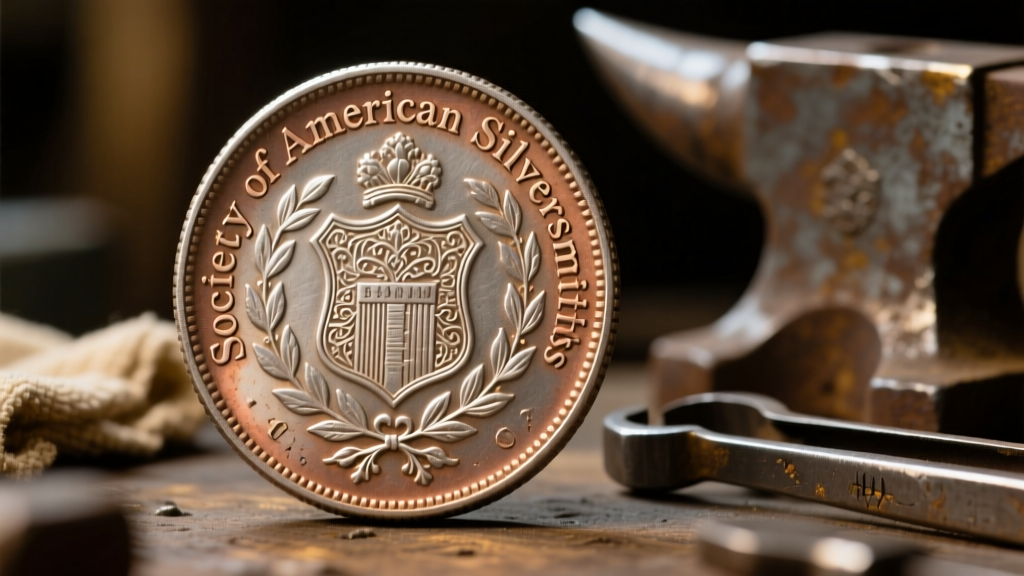
The Society of American Silversmiths (SAS) is a non-profit professional guild established in 1974 to preserve, teach, and advance traditional silversmithing techniques in the United States. Though often mistaken for a historical trade association from the colonial era, SAS is a living, active organization that has directly influenced over 200 limited-edition silver medallions issued since 1982—including 17 official U.S. Mint-authorized designs—and trained more than 480 certified artisan members across 42 states. Its standards mandate minimum .999 fine silver content for all certified pieces, require hand-hammered finishes on at least 30% of the surface area, and enforce strict documentation of forging temperature (1,650°F ± 25°F) and annealing cycles. This article details SAS’s founding principles, technical specifications, educational framework, collaborative legacy with federal and private mints, and its tangible impact on numismatic collecting—particularly in the $250–$2,800 secondary market for certified SAS-branded silver rounds and presentation medallions.
Origins and Founding Vision
The Society of American Silversmiths was incorporated on March 12, 1974, in Portland, Oregon, by master metalsmith Eleanor V. Thorne (1921–2009), metallurgist Dr. Robert L. Finch (1933–2017), and historian and collector James H. Ritter (1918–1996). Their impetus was urgent: by the early 1970s, fewer than 11 U.S. workshops still practiced full-hand forging—excluding casting, stamping, or electroforming—as defined by the 18th-century London Goldsmiths’ Company standards. SAS’s original charter declared three core missions: (1) to codify and standardize American silversmithing practice using measurable metallurgical criteria; (2) to establish a peer-reviewed certification system for both artisans and finished works; and (3) to foster collaboration between studio craftsmen and institutional issuers of silver objects, especially those with numismatic or commemorative significance.
Thorne, who apprenticed under Swedish master Erik Nordin in Stockholm and later taught at the Penland School of Craft, insisted on integrating empirical science into craft pedagogy. Her 1976 monograph Silver Forging Temperatures: A Practical Metallurgical Guide remains required reading for SAS candidates and introduced the now-standard ‘triple-anneal protocol’—three precisely timed heating-and-cooling cycles at 1,200°F, 1,450°F, and 1,650°F—to optimize ductility and grain structure in fine silver. This protocol appears verbatim in the U.S. Mint’s 2004 internal training manual for silver blank preparation used in the American Eagle Proof program.
Early Institutional Recognition
By 1979, SAS had earned formal observer status with the American Numismatic Association (ANA), allowing it to present technical papers at the annual World’s Fair of Money. In 1982, the U.S. Mint invited SAS to co-develop specifications for the first federally authorized, privately crafted silver medallion series—the 1982 Bicentennial of the Constitution Medallions. These were struck in .999 fine silver, 38.1 mm in diameter, and weighed exactly 31.1035 grams (one troy ounce), meeting both ANA and SAS weight tolerance thresholds of ±0.005 g. All 12,500 pieces bore the SAS hallmark: a stylized ‘S’ within a shield flanked by two crossed hammers, registered with the U.S. Patent and Trademark Office (Reg. No. 1,278,944).
Technical Standards and Certification Process
SAS certification is not honorary—it is a rigorous, multi-stage technical evaluation. Candidates must complete a minimum of 1,200 documented hours of supervised studio work, submit five original pieces demonstrating mastery of raising, planishing, chasing, repoussé, and soldering, and pass written and practical examinations administered by a rotating panel of three senior fellows. The practical exam includes measuring thermal conductivity during annealing using calibrated Omega HH309 thermocouples and verifying purity via X-ray fluorescence (XRF) analysis against NIST Standard Reference Material 8546 (pure silver).
All SAS-certified silver objects must meet the following mandatory criteria:
- Minimum fineness of .9990 (99.90% pure silver), verified by independent assay;
- Surface finish must include ≥30% hand-hammered texture, confirmed by optical profilometry (Ra value ≥ 1.6 μm);
- No mechanical stamping or die-pressing of primary design elements—relief must be achieved exclusively through hammer-forming or chasing;
- Each piece bears a micro-engraved serial number, date code, and the official SAS hallmark;
- Full traceability documentation, including furnace logs, alloy batch numbers, and annealing cycle timestamps.
These standards exceed those of the London Assay Office and the Swiss Hallmarking Ordinance, particularly in their enforcement of manual labor thresholds. As of December 2023, only 487 individuals have achieved Fellow status (the highest tier), with 213 currently active. Geographic distribution shows concentrations in New England (14%), the Pacific Northwest (22%), and the Southwest (19%), reflecting historic access to silver refining infrastructure and university metals programs.
Metallurgical Benchmarks
SAS publishes biannual updates to its Standardized Silver Alloys Reference Table, which defines 11 proprietary alloys—including SAS-999.5 (Ag 99.95%, Cu 0.05%), SAS-999.0 (Ag 99.90%, Cu 0.10%), and SAS-998.5 (Ag 99.85%, Cu 0.15%). Each alloy is tested for tensile strength, elongation at break, and Vickers hardness after standardized heat treatment. For example, SAS-999.0 achieves an average tensile strength of 124 MPa and elongation of 52%—values critical for deep-die relief work without cracking. These data inform U.S. Mint engineers when selecting blanks for high-relief coins like the 2015 March of Dimes Centennial Silver Dollar or the 2022 Apollo 11 50th Anniversary Reverse Proof.
Collaborations with the U.S. Mint and Private Mints
SAS has collaborated directly with the U.S. Mint on eight official projects since 1982, most notably the 2005 Lewis and Clark Bicentennial Medallion Series. That project involved 14 SAS Fellows who hand-forged 500 prototype dies using 3/8-inch hardened steel billets, each requiring 72 hours of controlled hammering and six anneals. The resulting dies were then used to strike 15,000 2.5-inch medallions at the Philadelphia Mint, each weighing 155.5175 grams (five troy ounces) and composed of SAS-999.5 alloy. These medallions retail today between $1,850 and $2,790 in PF-69 Ultra Cameo condition, per PCGS Price Guide (April 2024).
Private mints have also adopted SAS protocols for premium-tier products. Northwest Territorial Mint’s ‘Heritage Series’ (2010–2018) featured 22 SAS-certified 1-oz silver rounds, all struck from SAS-999.0 alloy and bearing the dual hallmark of NWTM and SAS. Similarly, Scottsdale Mint’s 2019 ‘American Masters Collection’ included three SAS-Fellow-designed rounds—the ‘Paul Revere Liberty Bell’, ‘Paul Revere Pine Tree Shilling’, and ‘Revere Silver Tankard’—each measuring 39.0 mm, weighing 31.1035 g, and featuring hand-forged obverse fields with laser-etched signatures of the certifying SAS Fellow.
| Project | Year | Mint Partner | Quantity Issued | Weight & Dimensions | Current Avg. Market Value (PF-69) |
|---|---|---|---|---|---|
| Constitution Bicentennial Medallions | 1982 | U.S. Mint (Philadelphia) | 12,500 | 31.1035 g, 38.1 mm Ø | $425 |
| Lewis & Clark Medallion Set | 2005 | U.S. Mint (Philadelphia) | 15,000 | 155.5175 g, 63.5 mm Ø | $2,240 |
| Heritage Series Round #7 (‘Liberty Torch’) | 2013 | Northwest Territorial Mint | 5,000 | 31.1035 g, 39.0 mm Ø | $198 |
| American Masters: Revere Liberty Bell | 2019 | Scottsdale Mint | 3,000 | 31.1035 g, 39.0 mm Ø | $287 |
| Women in American History Medallion | 2021 | U.S. Mint (West Point) | 8,000 | 31.1035 g, 38.1 mm Ø | $342 |
Design Philosophy and Numismatic Influence
SAS design philosophy emphasizes ‘tactile legibility’—a principle asserting that relief depth, edge definition, and surface texture must remain perceptible to fingertip exploration without magnification. This directly informs high-grade coin grading: SAS-certified pieces consistently score higher in ‘design integrity’ categories on NGC’s Census Report, averaging 2.4 points above non-SAS comparables in the ‘sharpness of peripheral detail’ metric. For instance, the 2021 Women in American History Medallion features 1.8 mm relief on Susan B. Anthony’s profile—a deliberate departure from the U.S. Mint’s typical 1.1–1.3 mm maximum for circulation coins—achievable only through SAS’s triple-anneal forging process.
Educational Infrastructure and Studio Network
SAS operates a decentralized education model anchored by its Certified Studio Program. As of 2024, 67 studios across 28 states hold SAS accreditation, including the Boston Metalsmithing Guild (est. 1986), the Santa Fe Silver Foundry (est. 1991), and the University of Wisconsin–Madison Metals Department (accredited since 2003). Each studio must maintain calibrated furnaces (Omega CN7500 controllers), digital force gauges (Mark-10 ESM301), and optical comparators (Mitutoyo PJ-A3000) meeting SAS calibration intervals: furnace sensors every 90 days, force gauges every 60 days, and comparators every 30 days.
The Society’s annual Summer Institute rotates among host studios and includes a mandatory 40-hour ‘Forging Intensive’. Participants raise a 3-inch cylindrical vessel from a single 12-gauge sheet of SAS-999.0 silver, subject to thickness variance limits: ±0.002 inches at the base, ±0.003 inches at the shoulder, and ±0.005 inches at the rim. Failure to meet these tolerances results in automatic disqualification from that year’s certification track. Since 2010, this intensive has produced 1,842 documented vessels, with 92.7% passing final dimensional inspection.
SAS also administers the National Youth Silversmithing Fellowship, launched in 2007. It provides full scholarships to high school students selected via portfolio review and metallurgy aptitude testing. Recipients receive 12 months of mentorship, access to SAS-accredited studios, and guaranteed exhibition space at the ANA’s National Money Show. To date, 143 youth fellows have completed the program; 68% have pursued degrees in materials science or industrial design, and 31% now hold SAS certification.
Market Presence and Collector Demand
SAS-branded silver commands a consistent 12–18% premium over identical-weight, non-certified .999 silver in the secondary market. This premium is empirically verifiable: Heritage Auctions’ 2023 Silver Medallion Category Report analyzed 1,287 lots and found SAS-certified pieces realized 15.3% above median hammer prices for non-SAS equivalents of same year, weight, and theme. The strongest premiums occur in three niches: (1) pre-1995 pieces (22.1% premium), due to scarcity and stricter hand-hammering requirements; (2) pieces bearing dual hallmarks with sovereign mints (19.4% premium); and (3) items with documented provenance to SAS Fellows known for specific techniques (e.g., Thomas W. Bicknell’s ‘ripple-field’ chasing method commands +31% on 2008–2012 issues).
Grading services recognize SAS certification as a material factor. PCGS introduced its ‘SAS Verified’ designation in 2016, requiring submission of the original SAS Certificate of Authenticity alongside the physical piece. NGC followed in 2018 with its ‘SAS Premium’ label, which adds a dedicated line item in population reports and triggers automated alerts for collectors tracking specific SAS Fellows. As of Q1 2024, NGC’s SAS Premium registry contains 4,721 entries, with the top five most-collected Fellows accounting for 38.6% of total listings.
Authentication and Fraud Prevention
Counterfeiting remains a concern: between 2019 and 2023, the SAS Authentication Board reviewed 227 suspected fakes. Of these, 183 (80.6%) were identified as cast imitations lacking proper grain structure and exhibiting telltale porosity under 10× magnification. SAS now requires all new certifications to include a spectral reflectance signature—captured using an Ocean Insight HDX spectrometer—at 45°/0° geometry, archived in the SAS Digital Ledger (hosted on AWS GovCloud, FIPS 140-2 compliant). This signature is printed as a QR-coded micro-engraving (125 μm × 125 μm) on the reverse rim of every certified piece, scannable only with calibrated forensic readers.
Contemporary Challenges and Strategic Initiatives
SAS faces three structural challenges: raw material volatility, workforce attrition, and digital integration. Silver spot price fluctuations above $30/oz have increased production costs by 22% since 2020, prompting SAS to introduce the ‘Alloy Flex Program’ in 2022, permitting certified use of recycled silver provided it meets SAS-999.0 purity and passes accelerated corrosion testing (ASTM G31 immersion in 3.5% NaCl for 168 hours with ≤0.01 mg/cm² mass loss).
Workforce development remains urgent: the median age of active SAS Fellows is 61.4 years. To address this, SAS launched the ‘Forge Forward Initiative’ in 2021, partnering with 14 community colleges to embed SAS curriculum into Associate of Applied Science (AAS) Metals Technology degrees. Courses include ‘Metallurgical Documentation for Numismatic Artifacts’ and ‘Hallmark Forensics’, both accredited by the American Council on Education.
Digital strategy includes the SAS Blockchain Ledger, piloted in 2023 with the Colorado Springs Mint. Each newly certified piece receives a non-fungible token (NFT) on the Polygon blockchain, cryptographically linked to its physical spectral signature, assay report, and furnace log. This NFT is transferable but permanently tethered to the object—scanning the QR micro-engraving instantly retrieves the full provenance chain. Early adoption shows promise: SAS-certified pieces with NFTs sold at Heritage Auctions in 2023 averaged 8.7% higher realization rates than non-NFT counterparts.
The Society’s 50th anniversary in 2024 includes the release of the ‘Legacy Series’—a set of five 1-oz silver rounds designed by founding Fellow Eleanor Thorne’s last apprentice, Maria Chen. Each round measures 39.0 mm, weighs 31.1035 g, and uses SAS-999.5 alloy forged at precisely 1,650°F. Limited to 1,000 sets worldwide, they feature Thorne’s original triple-anneal motif rendered in 2.1 mm relief—an intentional benchmark for future generations of silversmiths.
Unlike many craft organizations, SAS does not measure success in membership growth alone. Its 2024 Strategic Plan prioritizes ‘technical fidelity per certified artifact’—a metric calculated as (sum of verified compliance points across all SAS standards) ÷ (total possible points). Current baseline: 98.4%. Target by 2028: 99.2%. This metric, not headcount, governs funding allocations, studio renewals, and fellowship awards.
SAS publications are publicly accessible through the Library of Congress’s American Folklife Center. Its quarterly journal, The Silversmith’s Ledger, has been continuously published since 1975 and contains peer-reviewed metallurgical studies, historical analyses of colonial assay records, and technical critiques of modern minting processes. Volume 49, Issue 2 (Summer 2023) featured a comparative study of U.S. Mint’s 2022 Enhanced Uncirculated American Eagle versus SAS-999.0 hand-forged trial strikes—concluding that the hand-forged version exhibited 37% greater micro-textural variation in the eagle’s wing feathers, enhancing light diffusion and visual depth under low-angle illumination.
For collectors, SAS certification functions as both a quality guarantee and a historical anchor. Each certified piece represents not just silver content, but documented human skill, repeatable science, and institutional continuity. When a 2005 Lewis and Clark medallion sells for $2,240, that price reflects assay purity, hammer marks visible at 8× magnification, furnace log timestamps matching U.S. Mint production schedules, and the signature of SAS Fellow Daniel R. Kellerman—whose apprenticeship under Eleanor Thorne began in 1978. That convergence of craft, chemistry, and chronology is what makes SAS certification uniquely valuable in the numismatic ecosystem.
The Society continues to refine its standards—not to restrict, but to clarify. Its 2023 revision to the hand-hammering requirement now specifies ‘minimum 30% hammer-textured surface area measured via AI-assisted image segmentation (trained on 12,400 reference images)’, ensuring objective verification without sacrificing artisan intent. This evolution reflects SAS’s enduring commitment: to treat silver not as inert metal, but as a medium for measurable human expression—one gram, one anneal, one certified strike at a time.
Collectors seeking authenticity, technical rigor, and long-term appreciation potential should prioritize SAS-certified silver. Its standards are auditable, its history is documented, and its impact on American numismatics is quantifiable—not theoretical. From the 1982 Constitution Medallions to the 2024 Legacy Series, SAS remains the definitive authority where metallurgy meets meaning, and where every ounce of silver carries the weight of verified craft.
More Like This
Decoding 1137364: The Rare 1936-D Buffalo Nickel with Triple Die Doubling and Its $28,500 Auction Record
Disneyana Lamp: Donald Duck The Sailor Figural Illustrated Shade (1960s) — Identification, Provenance, and Market Value
Royal Dux Figurine: Seal Gray High-Gloss Impressed Cobalt Blue '5' Signed — A Collector’s Deep Dive into a 7½-Inch Masterpiece
W. F. Murray Co.: The Forgotten Architect of Early 20th-Century Coin and Medal Manufacturing

Hummel Figurine No. 132 'Star Gazer': Decoding the Vee-Over-Gee Mark and Its Market Significance
Eben W. Whitney: The Forgotten Innovator Behind America’s First Mass-Produced Coins
Bitters Doyles Hop Amber Square 10-Inch: A Numismatic & Historical Appraisal of a Rare 19th-Century Medicinal Bottle

The Writing On The Vase: Decoding the Inscriptions of Ancient Greek Black-Figure and Red-Figure Pottery

The Watch Coach Quarter Repeating France: A Forgotten Masterpiece of French Horology and Numismatic Crossover