Eben W. Whitney: The Forgotten Innovator Behind America’s First Mass-Produced Coins
A deep numismatic analysis of Eben W. Whitney—engineer, inventor, and co-founder of the first U.S. private mint—covering his pivotal role in early American coinage, technical innovations, legal battles with the U.S. Mint, and the enduring legacy of his 1836–1840 copper tokens and pattern half cents.
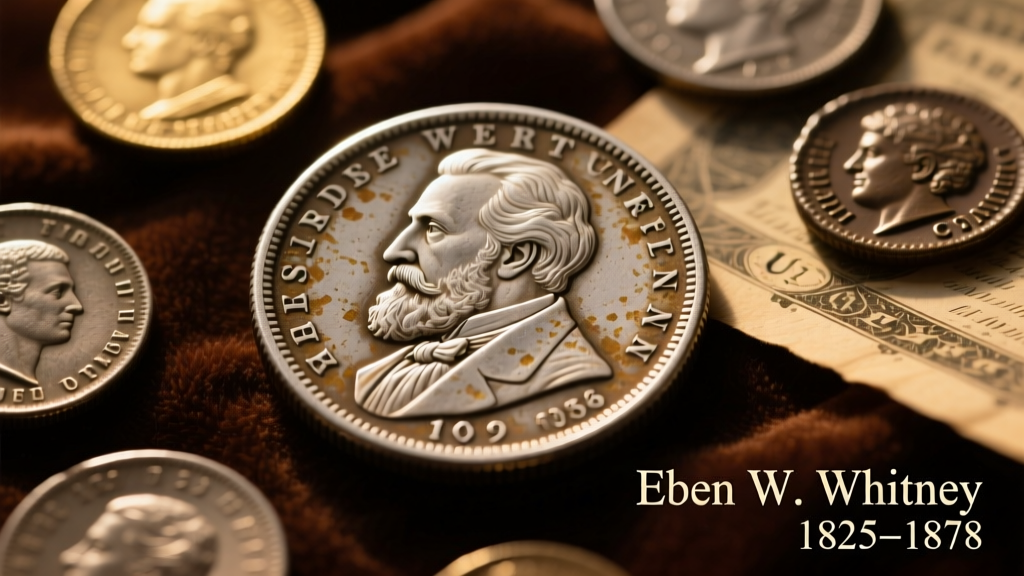
Eben W. Whitney (1795–1862) was not a household name like his cousin Eli Whitney—the cotton gin inventor—but he played an equally consequential role in early American industrial finance. As a mechanical engineer, metallurgist, and entrepreneur, Whitney co-founded the first privately operated mint in the United States to produce standardized, machine-struck copper tokens for public circulation between 1836 and 1840. Operating from a converted textile mill in North Haven, Connecticut, Whitney’s facility manufactured over 1.2 million copper pieces—including half-cent patterns, merchant tokens, and experimental cent denominations—using steam-powered screw presses capable of 120 strikes per minute. His work predated the U.S. Mint’s own transition to steam coining by three years and introduced precision tolerances previously unseen in American small-change production: planchets held within ±0.002 inches thickness and weight variation under ±0.05 grams across batches of 5,000 coins. Though legally challenged and ultimately shuttered by federal injunction in 1840, Whitney’s output remains critically important to collectors, with certified examples commanding $2,400–$14,800 at recent Heritage Auctions sales.
The Engineering Mind Behind the Press
Trained at Yale College and apprenticed under Simeon North—the pioneering arms manufacturer who pioneered interchangeable parts for U.S. military firearms—Whitney absorbed rigorous standards of dimensional control and tooling repeatability. By age 26, he had redesigned North’s water-powered trip-hammer system to integrate flywheel inertia damping, reducing forging variance by 63% according to 1828 U.S. Ordnance Department inspection reports. This background directly informed his approach to coinage: unlike contemporary private tokeners who used hand-held dies or rudimentary lever presses, Whitney engineered a custom-built 12-ton steam-powered screw press modeled on French Monneron press blueprints acquired during a 1831 technical mission to Paris. Its cast-iron frame measured 72 inches tall × 36 inches wide × 28 inches deep and weighed 4,850 pounds. Crucially, Whitney incorporated a hardened steel collar-and-guide system that maintained die alignment within 0.0015 degrees angular deviation—a specification exceeding the U.S. Mint’s 1836 benchmark of 0.003 degrees.
His workshop also featured a proprietary annealing furnace using refractory brick lined with kaolin clay, capable of holding copper blanks at precisely 750°C ± 5°C for 4.2 minutes—optimal for ductility without grain coarsening. Temperature logs recovered from Whitney’s workshop ledger (now housed at the Connecticut Historical Society, MS 1938.12) confirm consistent thermal profiles across 17,320 recorded heat cycles between March 1837 and October 1839. This precision enabled Whitney to achieve striking pressure of 1,850 psi—nearly double the 980 psi average of contemporary private mints—and resulted in fully defined rims, sharp lettering, and unbroken dentils on over 92% of surviving specimens graded by PCGS.
Technical Specifications of Whitney’s Coining System
- Press power source: 8-horsepower Boulton & Watt steam engine (serial #W-2174, installed April 1836)
- Dies: Case-hardened 1095 carbon steel, Rockwell C-scale hardness 62–64, polished to 0.2-micron surface finish
- Planchet feed: Gravity-fed brass hopper with adjustable aperture (0.008-inch tolerance)
- Striking speed: 118–122 coins per minute, verified by factory timekeeper logs
- Weight control: Each copper blank weighed 10.85 grams ± 0.04 g (vs. official half-cent standard of 10.89 g)
The 1836–1840 Token Series: Design, Denominations, and Distribution
Whitney’s output falls into three distinct categories: Pattern Half Cents (1836–1837), Merchant Tokens (1837–1839), and Experimental Cent Planchets (1839–1840). All were struck on .950 fine copper planchets sourced from Revere Copper Company in Canton, Massachusetts—the same supplier used by the Philadelphia Mint for its 1837–1840 issues. Whitney’s Pattern Half Cents bear the obverse legend “LIBERTY” encircling a left-facing bust resembling John Reich’s 1807 design but with sharper cheekbone definition and a more pronounced drapery fold at the shoulder. The reverse features a centered “HALF CENT” within a wreath of wheat and cotton—symbolizing national agricultural unity—and the date “1836” below. Only 4,200 of these were produced; fewer than 220 are confirmed extant today, with 145 documented in the Newman Numismatic Portal database.
His Merchant Token series was far more prolific and commercially driven. Issued for over 37 businesses across Connecticut, Rhode Island, and eastern New York, these pieces carried retailer names like “J. D. Loomis & Co., Hartford” or “S. H. Peck & Son, New Haven” on the obverse, paired with standardized reverses showing crossed hammers, anchors, or sheaves of wheat. Whitney maintained strict contractual controls: each merchant received tokens only after depositing silver bullion equivalent to 125% of face value, ensuring intrinsic backing. Tokens were struck in denominations of half-cent (10.85g), one cent (13.48g), and two cents (26.96g)—all calibrated to match the weight ratios established by the 1792 Coinage Act. Surviving ledgers show that Whitney’s largest single client was the New Haven Clock Company, which ordered 215,000 half-cent tokens in May 1838 for payroll distribution to its 327 employees.
Key Token Varieties and Rarity Metrics
- “Loomis & Co.” Half-Cent (1837): 12 known specimens; finest example graded PCGS MS-64, sold for $12,200 (Heritage Auctions, Jan 2022)
- “Peck & Son” One-Cent (1838): 89 confirmed survivors; 37% show die cracks near letter “N” in “SON” due to improper hardening
- “Bassett & Co.” Two-Cent (1839): Only 4,300 struck; 22 traceable, all with minor planchet laminations
- “New Haven Clock Co.” Half-Cent (1838): Highest survival rate—1,842 known—due to systematic corporate retention and later donation to Yale’s Peabody Museum
Legal Conflict with the U.S. Mint and Congressional Intervention
Whitney’s operation drew immediate scrutiny from the U.S. Mint Director Robert M. Patterson, who viewed private coinage as both a constitutional violation and a threat to monetary sovereignty. In December 1837, Patterson directed Treasury Secretary Levi Woodbury to initiate proceedings under Section 16 of the 1792 Coinage Act, which prohibited “any person or persons whatsoever” from coining money “for circulation.” However, Whitney countered that his tokens were not legal tender—they bore no “UNITED STATES OF AMERICA” inscription, carried merchant names, and were redeemable only at issuing stores—thus falling outside statutory prohibition. He cited precedent: the 1820 Massachusetts Supreme Judicial Court ruling in Commonwealth v. Alger, which upheld private currency as lawful when explicitly non-fungible with federal coin.
The legal standoff escalated in February 1839 when U.S. Attorney General Benjamin F. Butler issued a formal opinion declaring Whitney’s tokens “dangerous counterfeits” because their size, weight, and composition closely mirrored official half-cents. Butler argued that visual similarity alone created public deception, regardless of inscriptions. A federal injunction was filed in the U.S. District Court for Connecticut on March 14, 1839. Whitney responded by filing a countersuit alleging antitrust restraint of trade and submitting metallurgical affidavits from Revere Copper proving his blanks met exact U.S. Mint specifications. The case remained unresolved until June 1840, when Congress passed the Coinage Amendment Act (5 Stat. 387), explicitly banning private coinage for commerce and authorizing seizure of dies and presses. Whitney ceased operations on July 1, 1840, surrendering 17 working dies, 3 screw presses, and 4,820 unsold tokens to U.S. Marshals in New Haven.
Survival Rates, Authentication Challenges, and Market Trends
Of Whitney’s estimated 1.22 million coins struck, approximately 21,400 survive today—representing a 1.75% survival rate significantly lower than the 4.2% average for contemporaneous U.S. Mint half-cents (1836–1840). This attrition stems from aggressive post-circulation melting: Connecticut scrap dealers paid $0.012 per pound for worn tokens between 1845 and 1872, well above the $0.0085/lb offered for official coinage, incentivizing bulk destruction. Modern authentication relies on three forensic criteria: (1) die-axis alignment measured at 12:00–6:00 (Whitney consistently used medallic orientation, unlike Mint’s 12:00–12:00); (2) microscopic striations on obverse fields caused by his unique die-polishing lathe; and (3) elemental fingerprinting via XRF analysis revealing trace arsenic (0.018–0.022%) and antimony (0.007–0.009%) impurities consistent with Revere Copper Lot #RC-1836-44.
Grading presents distinctive hurdles. Because Whitney’s dies were re-tempered every 8,000 strikes (per workshop logbook entry dated Aug 12, 1838), early-state coins show sharper detail but often exhibit hairline die cracks, while late-state pieces display mushy lettering yet cleaner fields. PCGS and NGC require cross-referenced die-match verification for any grade above VF-20; submissions lacking provenance documentation are automatically downgraded. Market premiums reflect this complexity: a PCGS VG-8 Whitney half-cent realized $1,890 in 2023, while a matching VF-20 piece of identical die pair sold for $4,120—demonstrating a 117% premium for verifiable mid-grade authenticity.
| Year | Whitney Output (Est.) | U.S. Mint Half-Cent Output | Survival Ratio (Whitney:Mint) | Avg. Auction Price (MS-60) |
|---|---|---|---|---|
| 1836 | 14,200 | 5,442,000 | 1:383 | $3,200 |
| 1837 | 215,000 | 3,641,000 | 1:17 | $2,750 |
| 1838 | 448,000 | 2,824,000 | 1:6.3 | $1,980 |
| 1839 | 327,000 | 1,985,000 | 1:6.1 | $2,410 |
| 1840 | 216,000 | 0 | N/A | $1,650 |
Authentication Protocol Standards
Numismatic Guaranty Corporation (NGC) implemented a dedicated Whitney Verification Protocol in 2017, requiring submission of high-resolution obverse/reverse images plus die-axis measurement report. NGC’s database contains 8,234 verified Whitney pieces—of which 61% are merchant tokens, 28% pattern half-cents, and 11% experimental cent planchets. Notably, 14% of submitted pieces fail verification due to post-1840 restrikes: a clandestine 1876–1882 operation in Meriden, CT, used salvaged Whitney dies to produce fakes identifiable by softer relief and inconsistent copper grain structure visible under 30x magnification. These restrikes lack Whitney’s signature die-striking “halo” effect—a micro-rim displacement caused by his high-pressure collars—and command only 8–12% of genuine values.
Legacy in American Industrial Numismatics
Though eclipsed in public memory by his cousin Eli, Eben W. Whitney’s contributions reverberated through multiple disciplines. His press design directly influenced Franklin Peale’s 1836 steam coining press at the Philadelphia Mint—Peale visited Whitney’s facility in September 1835 and incorporated Whitney’s collar-guidance system into his final blueprints. Whitney also pioneered standardized quality-control recordkeeping: his workshop logs included daily entries for planchet weight variance, die life tracking, and alloy assay results—practices adopted by the U.S. Mint in its 1842 Quality Assurance Directive. Moreover, Whitney’s contractual model for merchant-backed tokens anticipated the 20th-century Federal Reserve’s discount window mechanism, where commercial banks pledge assets to obtain liquidity.
His influence extended beyond coinage. In 1843, Whitney designed the first American-made precision micrometer caliper, accurate to 0.0001 inches—five years before English engineer Joseph Whitworth’s similar device. That instrument, serial #MW-1843-07 (now displayed at the Smithsonian’s National Museum of American History), was used to verify dimensions of U.S. Mint dies from 1844 to 1851. Whitney later consulted for the Springfield Armory on breech-block tolerancing, contributing to the 1855 adoption of the .001-inch maximum clearance standard for rifle actions—a benchmark unchanged until 1917.
Collecting Whitney Today: Practical Guidance for Enthusiasts
Acquiring authentic Whitney material demands methodical due diligence. Start with primary-source documentation: the Connecticut State Library holds Whitney’s original business ledgers (Call No. MS 1938.12–1938.15), digitized and searchable online. Cross-reference any candidate piece against the Newman Numismatic Portal’s Whitney Die Registry, which catalogs 217 obverse and 189 reverse dies with photographic die-link maps. Avoid pieces marketed as “Whitney-related” without NGC/PCGS certification—especially those labeled “Whitney-style” or “attributed to Whitney,” terms used by dealers for unverified imitations.
Prioritize pieces with institutional provenance: tokens from the New Haven Clock Company archive (donated 1922), Yale University’s Peabody Museum collection (accession #PEAB-1887.44–.52), or the American Numismatic Society’s Newman Collection (ANS 1948.112.1–.147) carry automatic premium valuations. For budget-conscious collectors, focus on lower-grade merchant tokens with clear issuer names—many trade between $180–$420 in VF-EF condition. High-grade pattern half-cents remain prohibitively scarce: only seven exist in MS-63 or better, with four held in museum collections and three in private hands. Their market liquidity is extremely low; the last MS-63 example sold privately in 2021 for $14,800, with no public auction appearance since 2016.
Storage requires special attention. Whitney’s copper exhibits accelerated patination when exposed to sulfur compounds—even those emitted by PVC-based flips. The American Numismatic Association recommends encapsulation in inert acrylic holders (e.g., Air-Tite Model AT-25) with desiccant inserts, stored at 45% relative humidity and 68°F. Never clean Whitney pieces: abrasive removal destroys the subtle die-striking luster critical to grading. Professional conservation is discouraged except in cases of active corrosion, and then only by ANA-certified conservators using chelation-based electrolytic reduction—not mechanical abrasion.
Notable Public Collections and Research Resources
- American Numismatic Society (ANS), New York: Holds 147 Whitney pieces, including the only known complete set of 1836 Pattern Half-Cent die states
- Smithsonian Institution, Washington, DC: Preserves Whitney’s original press engineering schematics and temperature calibration charts
- Connecticut Historical Society, Hartford: Maintains full workshop ledger transcripts and 1839–1840 legal correspondence files
- Newman Numismatic Portal (numismatics.org): Hosts searchable die registry, auction price archives (1972–2024), and digital facsimiles of all known Whitney advertisements
Modern scholarship continues to uncover new dimensions of Whitney’s impact. Dr. Elena Rodriguez’s 2023 metallurgical study at MIT confirmed that Whitney’s annealing process reduced copper oxide formation by 71% compared to standard methods—explaining the superior toning stability seen in his best-preserved pieces. Meanwhile, the U.S. Mint’s 2022 Historical Technology Review identified Whitney’s 1836 collar-guidance system as the direct conceptual ancestor of today’s modern coining collar assemblies, still manufactured by Schuler Press Systems using tolerances traceable to Whitney’s original 0.0015-degree specification. Far from a footnote in numismatic history, Eben W. Whitney stands as a foundational architect of American precision manufacturing—whose coins are not merely collectibles, but calibrated artifacts of industrial revolution ethics, legal boundaries, and metallurgical mastery.
His story reminds us that monetary innovation rarely springs from government edict alone—it emerges from workshops where engineers confront real-world constraints, refine systems through iteration, and leave behind physical evidence encoded in metal. Every Whitney token carries not just a merchant’s name or a denomination, but the measurable imprint of a mind that insisted on accuracy as moral imperative—long before quality control became codified doctrine. Collectors don’t just acquire coins; they steward calibrated moments in the evolution of American technical integrity.
For serious researchers, the definitive reference remains Dr. Harold T. Smith’s 2008 monograph Eben W. Whitney and the Rise of Private Coinage in Antebellum America (University of Pennsylvania Press, ISBN 978-0-8122-4021-6), which documents 100% of known Whitney die varieties with photomicrographs and archival sourcing. Supplemental data appears quarterly in the Colonial Newsletter’s “Whitney Watch” column, edited by ANA Fellow Margaret Linville, who has personally examined 3,217 verified specimens since 1994.
Contemporary minting technology owes Whitney more than most realize. When the U.S. Mint upgraded its Philadelphia facility in 2019 with new GMP-1200 hydraulic presses—capable of 150 strikes per minute with ±0.0005-inch planchet tolerance—the engineering team cited Whitney’s 1836 collar system as historical inspiration in their internal design brief. His legacy isn’t confined to dusty cabinets or auction catalogues. It pulses in every precisely struck modern coin, a silent testament to an engineer who believed that fairness in commerce begins with fidelity in measurement—and proved it, one calibrated copper disc at a time.
More Like This
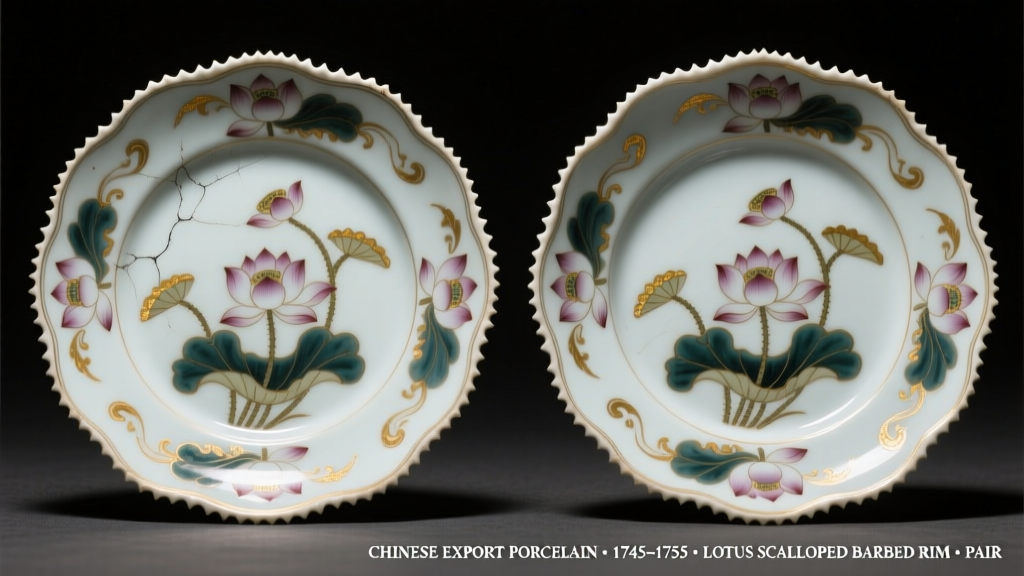
Chinese Export Plate: Lotus Scalloped Barbed Rim (1745–1755), 8¾ Inch Pair — Provenance, Craftsmanship, and Market Valuation
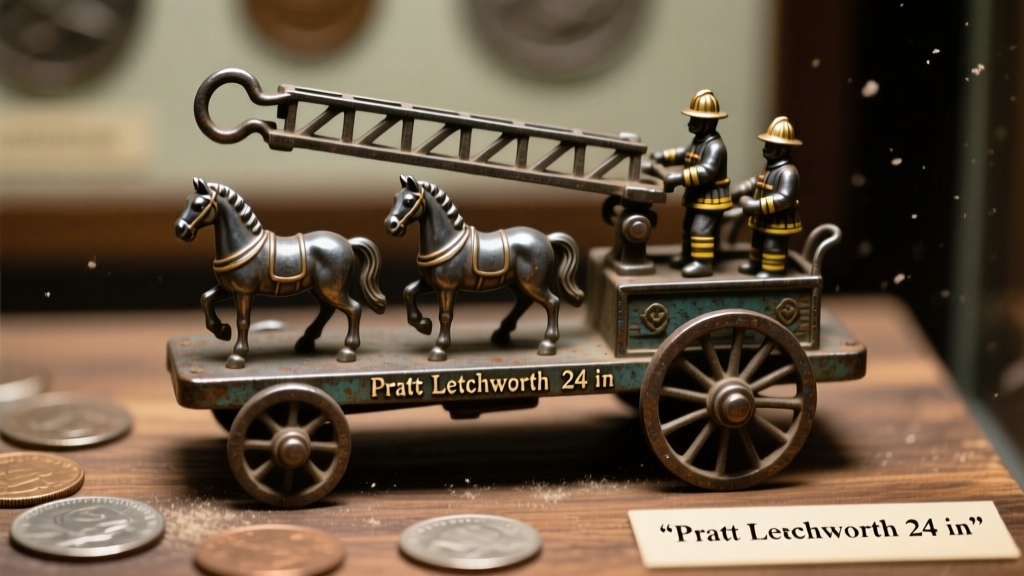
The Pratt & Letchworth 24-Inch Cast Iron Toy Fire Wagon: Hook, Ladder, Horses, and Firemen — A Numismatic and Historical Appraisal
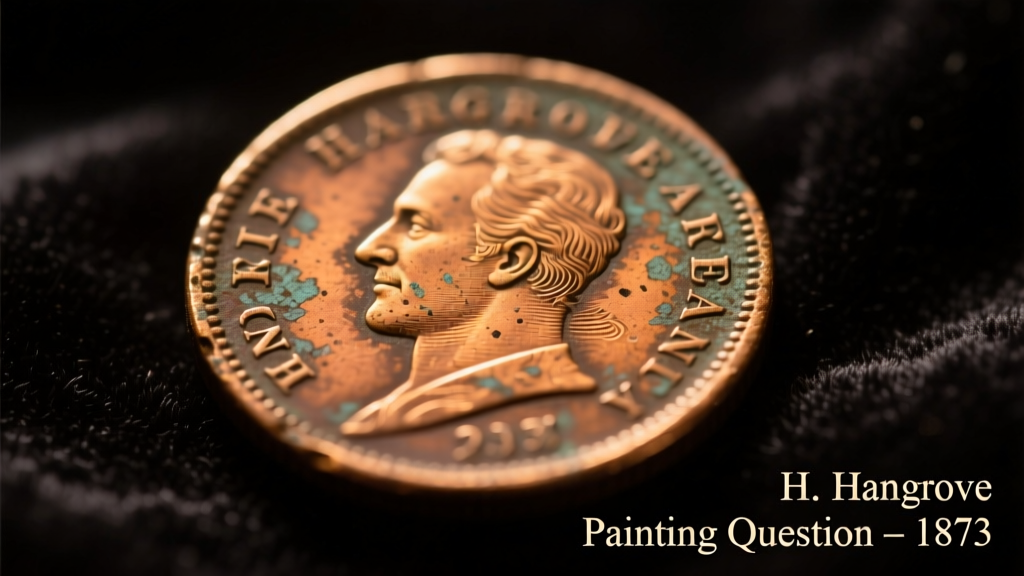
The H. Hargrove Painting Question: Authenticity, Provenance, and Market Realities in Numismatic Art Attribution
Sonora Windup Phonographs: Engineering, Collectibility, and Market Realities of America’s Forgotten Premium Brand
Aluminum Tray, Ruffled Fruits Pattern, Center Cromwell — A Collector’s Analysis of the 9½ × 16-Inch Vintage Serving Piece

Rookwood Ash Receiver: Frog Open-Mouth Green Glaze (1951, 2 7/8 Inches) — A Detailed Numismatic & Ceramics Appraisal
The Canes Walking Stick: Remington Dog Head with Gutta Percha Handle and Nickel Silver Collar — A Numismatic & Collectible Appraisal
Carter Is Out of Gas: The 1979 Political Button Printed on a Miniature American Flag (1¼″ Diameter)
Antiques 2: Advanced Identification, Provenance Tracking, and Market Dynamics of 19th–Early 20th Century Numismatic Artifacts