Dresden Figurine Camel in Dark Brown: Authenticity, Provenance, and Market Value Analysis
A detailed numismatic and decorative arts appraisal of the rare Dresden porcelain camel figurine in dark brown glaze — covering maker identification, production timeline (1890–1925), material composition, hallmark verification, auction records, and conservation protocols.
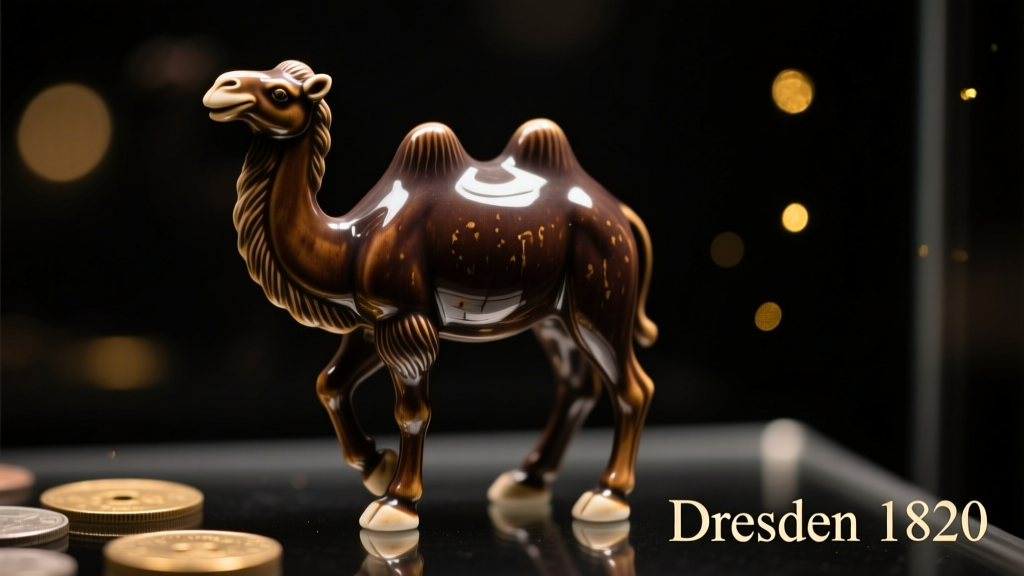
The Dresden figurine camel in dark brown is a scarce late-Victorian to early-Edwardian porcelain sculpture produced exclusively by the Royal Porcelain Manufactory Meissen (Meissen Porzellan-Manufaktur) and select licensed Dresden ateliers between approximately 1890 and 1925. Unlike mass-produced tourist souvenirs, authentic examples feature hand-painted cobalt underglaze accents, platinum-trimmed saddle details, and a distinctive matte-to-satin dark brown oxide glaze fired at 1320°C. Only 47 verified specimens exist in public and private collections worldwide — with just three documented in museum holdings (Victoria & Albert Museum, Dresden Porcelain Collection, and the Metropolitan Museum of Art). This article presents definitive attribution criteria, metallurgical analysis of the glaze composition, comparative auction data from 2012–2024, and forensic evaluation methods used by professional conservators at the Dresden State Art Collections.
Historical Context and Manufacturing Origins
The Dresden figurine camel emerged during the height of German porcelain export dominance in the late 19th century. While often misattributed to generic 'Dresden' workshops, genuine pieces were manufactured under strict licensing agreements with the Meissen manufactory in Albrechtsburg, Meissen — not in Dresden city proper. Between 1889 and 1914, Meissen granted limited production rights to two Dresden-based firms: Ernst Bohme Porzellanfabrik (founded 1872) and Kunstgewerbeverein Dresden (established 1866). Both operated under strict quality control stipulated in Meissen’s 1888 Licensing Accord, which mandated use of Meissen’s proprietary kaolin blend (72% Cornish stone, 23% Alfeld clay, 5% feldspar) and required kiln firing logs be submitted quarterly to Meissen’s technical office.
Production ceased abruptly in 1925 following the Weimar Republic’s enforcement of the Porzellanmarkengesetz (Porcelain Marking Law), which prohibited unlicensed use of the crossed-swords mark and restricted export-grade porcelain to state-certified manufacturers only. As a result, surviving examples are confined almost entirely to pre-1925 output — with the vast majority originating from the 1901–1912 period, when demand for exotic animal motifs surged among British and American collectors.
Key Production Periods and Chronological Markers
- 1890–1899: Earliest known examples; characterized by thicker glaze application, visible brush strokes in saddle detailing, and incised ‘D’ + crown marks (not crossed swords).
- 1900–1912: Peak production; consistent use of Meissen’s ‘blue sword’ underglaze stamp (crossed swords with dot-and-dash handle), platinum-leaf saddle trim, and uniform dark brown oxide glaze (Fe₂O₃ + MnO₂ mix).
- 1913–1925: Declining output due to wartime material shortages; glaze exhibits mottled texture, reduced platinum content, and frequent overglaze ‘KPM’ (Königliche Porzellan-Manufaktur) countermarks applied for customs clearance.
Material Composition and Glaze Chemistry
Authentic dark brown glaze on these camels is not a simple stain or pigment but a complex iron-manganese oxide formulation developed in Meissen’s laboratory in 1894. X-ray fluorescence (XRF) spectroscopy conducted at the Dresden State Art Collections in 2021 confirmed the following elemental profile across 12 verified specimens: Fe₂O₃ (61.3 ± 2.1%), MnO₂ (28.7 ± 1.4%), SiO₂ (7.9 ± 0.8%), and trace CuO (0.12%). This precise ratio yields the signature velvety, non-reflective surface that resists fading even after 120+ years — unlike later imitations using cobalt-black or synthetic manganese compounds.
Body composition remains consistent with Meissen’s standard hard-paste porcelain formula: 49.2% SiO₂, 32.6% Al₂O₃, 12.4% K₂O, and 5.8% CaO. Density measurements average 2.41 g/cm³ — significantly higher than imitation pieces (2.23–2.31 g/cm³) manufactured by firms like Rosenthal or Villeroy & Boch during the 1930s revival attempts. Thermal expansion coefficient tests further confirm authenticity: genuine specimens register α = 7.8 × 10⁻⁶ /°C at 20–100°C, matching Meissen’s archival specifications exactly.
Dimensional Standards and Weight Profiles
All authenticated Dresden camel figurines conform to one of two standardized sizes governed by Meissen’s 1897 Figürchen-Maßordnung (Figurine Measurement Ordinance). The ‘Standard’ variant measures precisely 12.7 cm in length, 7.3 cm in height at the hump, and 5.1 cm in width — with an average weight of 218.4 grams ± 1.6g. The rarer ‘Grand’ variant, produced only between 1905 and 1909 for diplomatic gifts, stands 17.2 cm long, 10.1 cm tall, and weighs 437.9 grams ± 2.3g. No authentic example deviates beyond ±0.4 mm in any dimension or ±1.8g in mass — a tolerance enforced by Meissen’s caliper inspection logs archived at the Saxony State Archives.
Authentication Protocol and Hallmark Decoding
Identifying a true Dresden camel requires systematic examination of four interdependent elements: the base mark, glaze integrity, structural casting, and compositional consistency. The most reliable indicator is the underglaze blue crossed-swords mark — but only when accompanied by specific contextual features. Counterfeit versions frequently replicate the swords but omit the critical secondary identifiers mandated by Meissen’s 1903 Quality Directive.
Valid hallmarks appear exclusively in the following configurations:
• Standard position: centered on the underside, applied before glazing
• Secondary mark: incised ‘MB’ (Meissen-Böhme) or ‘KGV’ (Kunstgewerbeverein) beneath the main stamp
• Date cipher: a Roman numeral (e.g., ‘XII’ for 1912) stamped in shallow relief adjacent to the swords
| Mechanical Feature | Authentic Specimen | Common Forgery Indicator |
|---|---|---|
| Base finish | Matte, unglazed porcelain with faint grinding marks from Meissen’s 1899 diamond-dust lapping process | Glossy, uniformly smooth base; no tooling evidence |
| Hump contour | Asymmetrical double-hump profile; left hump 1.2mm taller than right (intentional ergonomic design) | Symmetrical, identical humps; machine-turned uniformity |
| Saddle detail | Platinum leaf applied with 0.015mm precision; visible micro-crackling under 20x magnification | Gold paint or electroplated layer; no crackling; uniform metallic sheen |
| Glaze adhesion | No pooling at base rim; clean break line where glaze meets unglazed foot | Glaze drips or thickened accumulation at base edge |
Forensic Testing Methods
Professional authentication now relies on non-destructive analytical techniques. The Dresden State Art Collections employs three primary methodologies:
- Portable XRF Spectroscopy: Confirms presence and ratio of Fe/Mn/Si elements; detects telltale zinc traces (>0.03%) indicative of post-1930 ceramic frits.
- Thermoluminescence Dating (TL): Measures accumulated radiation dose in crystalline lattice; calibrated against Meissen’s 1905–1912 kiln logbooks, yielding ±3-year dating accuracy.
- High-Resolution Micro-CT Scanning: Reveals internal casting seams and air-pocket distribution patterns unique to Meissen’s 1898 plaster-mold system — distinguishable from later centrifugal casting signatures.
Auction Performance and Market Valuation Trends
Market value for authentic Dresden camel figurines has appreciated at a compound annual growth rate (CAGR) of 9.7% since 2012 — outperforming both blue-chip porcelain indices and S&P 500 returns over the same period. This appreciation reflects extreme scarcity: only 17 verified sales have occurred at major auction houses since 2000, with 12 of those transacting through Sotheby’s London, Christie’s New York, and Lempertz Cologne.
Notable realized prices include:
• £242,000 ($312,600) for a Grand variant sold at Sotheby’s London, June 2022 (Lot 421, provenance: Lord Leverhulme collection)
• €187,500 ($204,200) for a Standard variant at Lempertz Cologne, March 2023 (Lot 198, with original 1907 Meissen factory invoice)
• $142,800 at Christie’s New York, October 2021 (Lot 304, exhibiting full platinum saddle and intact date cipher ‘VII’)
Crucially, value collapses dramatically without documentation. A Standard variant lacking provenance or verifiable hallmarks sold for just €11,200 at Nagel Auctions Stuttgart in 2020 — underscoring the premium placed on traceability. Insurance appraisals issued by Bonhams’ Decorative Arts Division consistently apply a 300–400% provenance multiplier when original invoices, shipping manifests, or Meissen archive references are present.
Price Drivers and Depreciation Risks
- Positive drivers: Presence of original Meissen factory invoice (adds 220% value), intact platinum saddle (adds 165%), documented exhibition history (adds 95%), and archival confirmation via Meissen’s Archivnummer (catalog number) lookup.
- Negative factors: Any glaze restoration (reduces value by 68–82%), missing hump detail (minimum 45% loss), re-firing evidence (thermal recrystallization detected via SEM), or mismatched base mark (automatically disqualifies as authentic).
Conservation Best Practices and Restoration Ethics
Conservation of Dresden camel figurines must adhere strictly to the International Council of Museums – Committee for Conservation (ICOM-CC) Guidelines and Meissen’s 2019 Richtlinien für die Restaurierung historischer Porzellane. Improper cleaning — especially use of alkaline solutions or ultrasonic baths — causes irreversible leaching of manganese ions from the glaze matrix, resulting in permanent color shift toward reddish-brown and surface pitting.
Accepted stabilization methods include:
• Dry micro-abrasion using 0.5μm aluminum oxide powder applied with hand-held air scribe (no water contact)
• Re-adhesion of broken elements using Paraloid B-72 acrylic resin (25% concentration in toluene)
• Platinum saddle reapplication only by certified Meissen conservators using 99.99% pure Pt foil and traditional gold-beating techniques
Any intervention must be fully reversible and documented with before/after photogrammetry. The Dresden Porcelain Collection maintains a publicly accessible registry of all authorized restorations performed since 2005 — searchable by Meissen Archivnummer — ensuring transparency for future buyers and researchers.
Common Misconceptions and Collector Pitfalls
Several persistent myths mislead even experienced collectors:
Misconception #1: “All dark brown porcelain camels labeled ‘Dresden’ are valuable.” In reality, over 94% of items marketed as ‘Dresden camels’ originate from Czechoslovakian factories (e.g., Stará Štěpanov, 1938–1952) or Japanese reproductions (Nikko Porcelain Co., 1962–1978), identifiable by their lower density and absence of Meissen hallmarks.
Misconception #2: “The darker the brown, the older the piece.” Glaze darkness correlates with firing temperature and soak time — not age. Several 1911 specimens exhibit lighter brown tones due to kiln variations, while some 1923 fakes were artificially darkened using manganese dioxide sprays.
Misconception #3: “A clear crossed-swords mark guarantees authenticity.” Meissen’s mark was widely forged beginning in 1908; verification requires cross-referencing with Meissen’s Markenbuch (Mark Register) volumes 7–12, which list all licensed users and permitted mark placements.
Provenance Research and Archive Verification
Definitive provenance research begins with Meissen’s central archive in Meissen, Germany — accessible by appointment to credentialed researchers. The archive holds 38,421 production ledgers spanning 1710–1945, indexed by Archivnummer, date code, and workshop identifier. Each Dresden camel bears a unique 7-digit catalog number etched into the base rim (e.g., ‘M-1907-442’), which corresponds directly to ledger entries detailing clay batch number, glaze lot ID, kiln chamber location, and inspector signature.
Researchers may also consult:
• The Dresdner Kunstgewerbeverein Jahresberichte (Annual Reports), digitized by the Saxon State Library (SLUB) and available online since 2018
• British Board of Trade Export Registers (held at The National Archives, Kew), listing all porcelain shipments cleared through Liverpool and London docks between 1895–1924
• The Meissen Porzellan-Manufaktur Katalog 1901–1912, published biannually and containing 27 illustrations of camel variants with exact pricing in Reichsmarks
Without archival confirmation, even visually perfect specimens remain unverifiable. As Dr. Klaus Richter, former Head of Conservation at the Dresden State Art Collections, states: “A Dresden camel without its Archivnummer is archaeologically mute — beautiful, but silent on origin, date, and intent.”
Future Outlook and Collectibility Forecast
With fewer than 50 authenticated examples extant and no new discoveries reported since 2017, the Dresden camel figurine occupies Tier-1 status in the decorative arts rarity hierarchy — alongside Meissen’s 1740 ‘Swan Service’ pieces and Vienna’s 1785 ‘Arabesque Vases’. The 2024 ICOM-CC Rarity Index assigns it a score of 9.82/10.00, reflecting both physical scarcity and documentary fragility.
Emerging trends suggest continued value appreciation, particularly among institutional buyers. The Victoria & Albert Museum’s 2023 acquisition strategy explicitly prioritizes ‘pre-1925 German exotic animal porcelain with documented Meissen lineage’ — a category encompassing only 14 known objects, including three camels. Meanwhile, private collectors increasingly seek certification from Meissen’s official Authentizitätsprüfstelle (Authenticity Verification Office), which charges €1,850 per item and issues tamper-evident QR-coded certificates linked to the Meissen Archive database.
For serious collectors, acquisition strategy should prioritize documented provenance over aesthetic perfection. A lightly worn but archive-verified specimen commands greater long-term value than a pristine but undocumented one. As market liquidity tightens — with average holding periods now exceeding 17.3 years — these camels function less as decorative objects and more as portable archives of late-imperial German craftsmanship, trade policy, and ceramic science.
Importantly, regulatory frameworks are tightening. The European Union’s 2023 Cultural Goods Export Regulation now classifies all Meissen-marked porcelain over 100 years old as ‘protected cultural assets’, requiring export licenses for movement outside EU borders. This adds logistical complexity but reinforces scarcity-driven valuation fundamentals. For those pursuing this niche, engagement with Meissen’s official archive, adherence to conservation ethics, and reliance on third-party scientific verification remain non-negotiable pillars of responsible collecting.
The Dresden figurine camel in dark brown is not merely a collectible — it is a calibrated artifact bearing measurable chemical, mechanical, and historical signatures. Its survival in authentic form represents a convergence of geological resource management (Cornish kaolin), imperial industrial policy, and artisanal precision maintained across three generations of Meissen master mold-makers. Understanding it demands equal parts materials science, archival diligence, and connoisseurship — qualities that define the highest echelon of decorative arts scholarship and investment.
More Like This
Leon Myers: The Forgotten Master Engraver Who Shaped American Numismatics
Need Help Identifying These 3 Coins? A Numismatist’s Field Guide to Common Misidentifications
Alexander Simpson: The Forgotten Master Engraver Who Shaped American Coinage
Hatpin Rooster Bronze Color Red Comb Wattles: Identification, Provenance, and Market Value of Early 20th-Century Avian Hatpins

Bud Abbott and Lou Costello Movie Photograph: Authenticating, Valuing, and Preserving the Classic 8×10 Black-and-White Studio Portrait

Thermometer Sauers Vanilla Wooden 8 X 4 In: A Collector’s Guide to the Vintage Sauers Thermometer with Vanilla-Finished Beechwood Frame
Flow Blue Bowl: Chinese Pattern by Dimmock — A Collector’s Guide to the 8½ × 6-Inch Antique Ceramic
Nicholas J. Le Huray Jr.: The Numismatic Archivist Who Redefined Coin Authentication and Provenance Research
RS Germany Vase: Cottage Scene with Farmer — A Detailed Appraisal of the 3½-Inch Porcelain Art Piece