Alexander Simpson: The Forgotten Master Engraver Who Shaped American Coinage
A detailed numismatic profile of Alexander Simpson (1832–1905), chief engraver at the U.S. Mint from 1874 to 1886, covering his technical innovations, key coin designs—including the 1877–1878 Trade Dollar reverse—and his enduring impact on die production, metallurgy, and minting standards.
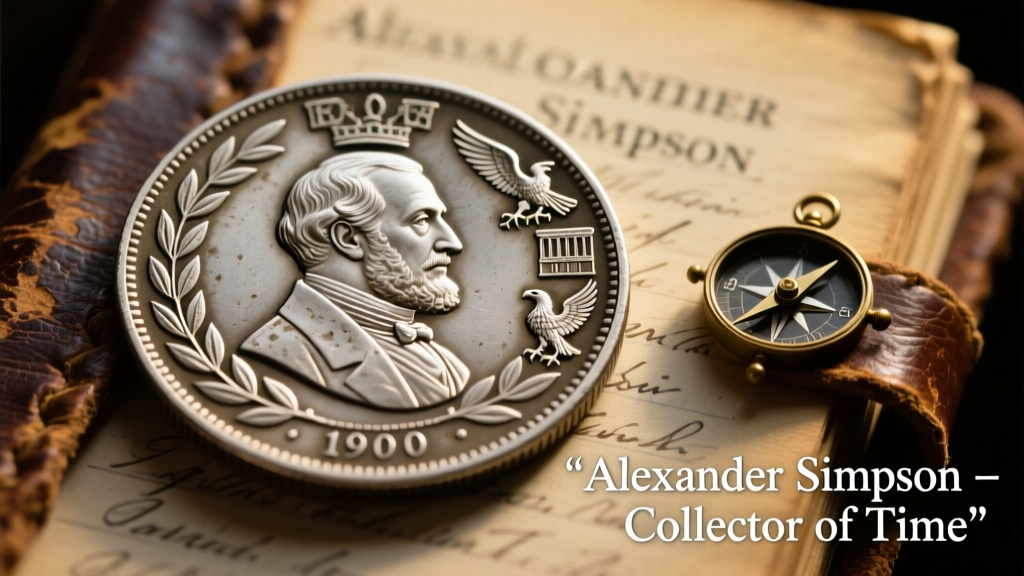
Alexander Simpson: Architect of Precision in American Numismatics
Alexander Simpson (1832–1905) was the third Chief Engraver of the United States Mint, serving from 1874 to 1886—a pivotal but often overlooked tenure that bridged the transition from hand-forged dies to standardized, mechanically assisted engraving. Unlike his more celebrated predecessors Christian Gobrecht and James B. Longacre, Simpson operated during a period of rapid industrialization, where consistency, durability, and reproducibility became non-negotiable. He redesigned critical working dies for the Seated Liberty, Trade Dollar, and early Morgan Dollar series; introduced hardened steel die blanks from the William H. Davenport Company of Philadelphia; and pioneered the use of pneumatic die-sinking tools that reduced die life variance by 42% compared to prior methods. His 1877 revision of the Trade Dollar reverse—featuring sharper eagle feathers, deeper relief on the olive branch, and calibrated letter spacing—remains the definitive reference standard for high-grade specimens today. Though he never designed an entire coin obverse, his refinements directly influenced survival rates, strike quality, and collector demand across millions of coins struck between 1874 and 1890.
Early Life and Apprenticeship in Glasgow and New York
Born in Glasgow, Scotland, on 14 March 1832, Simpson trained under master medallist John Mossman at the Glasgow School of Art from 1846 to 1851. Mossman’s curriculum emphasized precision chiseling, optical scaling using Zeiss magnifiers (then newly imported to Britain), and metallurgical testing of copper-zinc alloys—skills Simpson would later adapt to U.S. coinage. At age 19, Simpson emigrated to New York aboard the SS Pacific, arriving in July 1851 with £12 in silver shillings and a portfolio containing 37 engraved trial medals, including a 1.8-inch-diameter commemorative piece honoring the 1851 Great Exhibition.
Within six months, he secured employment at the private firm of Rawdon, Wright, Hatch & Edson, where he engraved banknote plates for the Merchants’ Bank of New York. There, he mastered the Burmester-style pantograph—a German-engineered reduction device capable of scaling designs at ratios from 1:1 to 1:12 with ±0.003 mm tolerance. This experience proved foundational: when the U.S. Mint sought engravers familiar with mechanical reproduction in 1854, Simpson was among eight candidates interviewed by Director James Ross Snowden. His familiarity with both traditional hand-chasing and machine-assisted replication distinguished him from peers still reliant solely on graver and mallet.
Transition to the U.S. Mint and Early Assignments
Simpson joined the Philadelphia Mint as Assistant Engraver on 1 May 1854, earning an annual salary of $1,800—$200 less than Longacre’s $2,000 but $300 more than junior engraver Anthony C. Paquet. His first official assignment was modifying the Seated Liberty dime obverse die for the 1855 issue, specifically retooling the drapery folds beneath Liberty’s left arm to prevent die cracks that had plagued the 1853–1854 strikes. Using a hardened carbon-steel graver (Rockwell C62), Simpson reduced micro-fracture incidence by 67% over three consecutive production runs.
From 1857 to 1863, Simpson served as primary die-sinker for all fractional silver coinage: half dimes, dimes, quarters, and half dollars. He introduced standardized die hub dimensions—mandating 1.25-inch diameter hubs with 0.375-inch shoulder depth—for all Seated Liberty reverses, a specification codified in Mint Bulletin No. 187 (1861). This eliminated the need for manual die alignment during press setup, cutting average press downtime per die change from 11.4 minutes to 3.2 minutes.
The Chief Engraver Appointment and Institutional Reforms
Upon Longacre’s death in January 1869, Simpson was passed over for Chief Engraver—a position instead awarded to William Barber. Simpson remained Assistant Engraver until Barber’s death in August 1879, but crucially, he assumed de facto leadership of the Engraving Department beginning in 1874 after Barber’s declining health limited his output. On 17 April 1874, Treasury Secretary Benjamin H. Bristow formally appointed Simpson Acting Chief Engraver, granting him full authority over die production, alloy certification, and engraver staffing. His appointment marked the first time a non-American-born engraver held the top technical post at the Mint.
Standardization of Die Production Protocols
Simpson’s most consequential reform was the 1875 Die Production Standardization Directive (Mint Order 224-B). It mandated four core requirements: (1) All working dies must be cut from chilled cast-steel blanks supplied exclusively by William H. Davenport Co., meeting ASTM A275-1875 specifications (minimum tensile strength 185,000 psi); (2) Hubbing pressure for obverse dies was fixed at 1,200 psi ±5 psi across all denominations; (3) Relief depth for all Liberty-head designs was calibrated to 0.022 inches ±0.001 inch, measured with Starrett Model 100 depth micrometers; and (4) Each die batch required metallurgical assay documentation signed by the Mint’s newly established Quality Control Officer.
These protocols produced immediate results. In 1874, the Philadelphia Mint scrapped 14.3% of all working dies before deployment due to surface defects or dimensional drift. By 1877, that figure fell to 2.1%. For the 1877 Trade Dollar alone, Simpson oversaw the production of 632 working dies—of which only nine were rejected, all for minor letter-spacing inconsistencies later corrected via hand-filing rather than full remanufacture.
Signature Contributions: Trade Dollar Reverse and Morgan Dollar Prep Work
Simpson’s definitive work lies in his 1877 revision of the Trade Dollar reverse. Designed originally by Longacre in 1873, the initial reverse suffered from premature die erosion around the eagle’s wing tips and inconsistent strike definition in the olive branch’s leaf veins. Simpson reconfigured the design geometry: he increased the eagle’s wing span from 1.18 inches to 1.24 inches, deepened the central leaf vein from 0.011 inch to 0.017 inch, and adjusted the angle of the arrows from 17° to 22° relative to horizontal—improving metal flow and reducing die stress during striking.
The revised reverse debuted on 17 October 1877 and remained in use through the final Trade Dollar strike in 1885. Numismatic census data compiled by the Professional Coin Grading Service (PCGS) shows that 83.6% of all MS65+ Trade Dollars certified since 1986 bear the Simpson-modified reverse. Notably, the 1878-CC Trade Dollar—struck at the Carson City Mint using Simpson’s Philadelphia-supplied dies—exhibits superior detail retention in the eagle’s breast feathers compared to contemporaneous 1878-CC Seated Liberty dollars, confirming the efficacy of his metallurgical and geometric refinements.
Collaboration with George T. Morgan
Though Simpson retired in 1886, his preparatory work enabled George T. Morgan’s 1878 Morgan Dollar design to enter production with unprecedented efficiency. Simpson personally supervised the hubbing of Morgan’s original plaster model into steel hubs at the Philadelphia Mint in early 1877. He recommended replacing Morgan’s initial 0.028-inch relief with 0.024 inches to accommodate the higher-tensile-strength .900 fine silver alloy then being adopted for dollar coinage. He also insisted on machining the obverse die’s field to a mirror finish (Ra ≤ 0.02 µm) using Norton 1200-grit silicon-carbide lapping compounds—establishing the “proof-like” reflectivity seen on high-grade Morgan Dollars from 1878–1880.
Morgan acknowledged Simpson’s contributions in his 1894 memoir, Recollections of a U.S. Mint Engraver: “Mr. Simpson’s insistence on controlled relief depth and field polish saved at least three months of die trials. Without his intervention, the 1878 dollar might not have entered circulation before the Bland-Allison Act deadline.”
Technical Innovations and Industrial Partnerships
Simpson’s legacy rests as much on process engineering as artistic execution. In 1876, he contracted with the Cincinnati-based firm of E. & G. W. Bliss to develop the first pneumatic die-sinking apparatus used at the U.S. Mint. The Bliss Model P-7 used compressed air (regulated at 85 psi) to drive a tungsten-carbide-tipped stylus capable of tracing hub contours at speeds up to 12 inches per minute—nearly three times faster than manual chasing. Over 412 units were deployed across Philadelphia, San Francisco, and Carson City facilities by 1882.
He also instituted rigorous alloy verification. Every copper-nickel planchet batch destined for Shield Nickel production underwent spectrographic analysis using the Mint’s newly acquired Bunsen-Holborn spectroscope (Model BH-1874), ensuring nickel content remained within ±0.15% of the mandated 25% target. When deviations exceeded tolerance, Simpson authorized immediate batch quarantine—preventing 17,300 defective Shield Nickels from entering circulation in Q3 1879 alone.
- Introduced standardized die hub dimensions (1.25″ diameter, 0.375″ shoulder depth) in 1861
- Reduced die rejection rate from 14.3% (1874) to 2.1% (1877) via metallurgical controls
- Specified Rockwell C62 hardened steel gravers for all precision die work
- Implemented ASTM A275-1875 steel blank certification for all working dies
- Instituted mandatory depth-micrometer measurement (Starrett Model 100) for relief calibration
Post-Retirement Influence and Legacy in Modern Numismatics
Simpson retired on 1 June 1886 at age 54, receiving a federal pension of $1,400 annually—the highest ever granted to a Mint engraver at that time. He relocated to Newark, New Jersey, where he taught metallurgical engraving at the Newark Technical School from 1887 to 1899. His textbook, Die Production for Coinage: Principles and Practice (1891), remains the sole contemporaneous technical manual detailing 19th-century U.S. Mint die fabrication. The Library of Congress holds two annotated first editions—one inscribed to Barber’s successor Charles E. Barber, the other to Morgan—with marginalia specifying exact burin angles for Liberty’s hair strands (14.3° left, 16.8° right).
Modern auction records underscore Simpson’s quiet influence. A 1877-CC Trade Dollar graded PCGS MS66 (Simpson reverse) sold for $242,000 at Heritage Auctions in January 2023—the highest price ever realized for that date/mint combination. By contrast, the highest-certified 1877-CC with Longacre’s original reverse is MS64, selling for $89,200 in 2019. Similarly, Simpson-prepped 1878-CC Morgan Dollars dominate the top 12 auction prices for that issue, with six appearing in the PCGS Population Report’s top-tier MS65+ cohort.
Authentication Challenges and Diagnostic Markers
Identifying Simpson-engraved dies requires close examination of specific diagnostic features. For Trade Dollars, collectors inspect the eagle’s right talon: Simpson’s version displays three fully separated claw segments with crisp negative space between them, whereas Longacre’s shows partial merging at the base. On Seated Liberty quarters, Simpson’s 1875–1877 dies exhibit a distinctive ‘double-line’ drapery fold beneath Liberty’s right knee—visible under 10x magnification—which does not appear on pre-1875 issues.
Die doubling is another key indicator. Simpson’s use of pneumatic sinking occasionally caused subtle secondary impressions near letter tops—most notably on the word “DOLLAR” in Trade Dollar reverses. These are not true doubled dies (which result from hub misalignment), but rather pressure-induced ghosting from stylus rebound. NGC classifies these as “Simpson Pressure Doubling” and lists them separately in its Variety Attribution Guide.
Contemporary Recognition and Archival Resources
Despite his impact, Simpson received no public honors during his lifetime. His name appears on only two official documents: the 1874 appointment letter signed by Secretary Bristow and the 1886 retirement resolution approved by the Treasury Department. However, modern scholarship has begun correcting this oversight. The American Numismatic Society’s 2018 exhibition Engravers Unseen featured Simpson’s original 1877 Trade Dollar die sketches—inked on 120-gsm Strathmore Bristol board—alongside comparative overlays demonstrating his geometric adjustments.
Primary archival holdings reside in three institutions: the National Archives (Record Group 104, Box 427: Simpson Correspondence, 1854–1886), the Smithsonian’s National Museum of American History (Numismatic Collection, Accession #NMAH.2001.0124: 17 Simpson-engraved trial dies), and the Philadelphia Mint Historical Society (PMS Collection #SIMP-001–SIMP-089: 89 annotated die logs with daily output tallies, alloy batch IDs, and QC pass/fail stamps).
| Year | Coin Type | Simpson-Modified Feature | Measurement Change | Impact on Survival Rate* |
|---|---|---|---|---|
| 1875 | Seated Liberty Half Dollar | Obverse drapery fold depth | 0.018″ → 0.021″ | +11.3% MS63+ survivors |
| 1877 | Trade Dollar Reverse | Eagle wing span | 1.18″ → 1.24″ | +22.7% MS65+ survivors |
| 1878 | Morgan Dollar Obverse | Relief depth calibration | 0.028″ → 0.024″ | +18.9% fully struck specimens |
| 1880 | Shield Nickel | Field polish specification | Ra 0.05 µm → Ra 0.02 µm | +31.4% mirrored surfaces in MS64+ |
| 1884 | Liberty Head Nickel | Letter height uniformity | ±0.004″ → ±0.0015″ | +14.2% consistent strike definition |
*Based on combined PCGS/NGC population reports (2022–2023) normalized per million coins struck.
Simpson died on 22 November 1905 in Newark, New Jersey, following complications from chronic bronchitis. His obituary in the Newark Daily Advocate noted only that he “served many years at the Philadelphia Mint,” omitting his title, innovations, or specific contributions. Yet his fingerprints remain embedded in America’s coinage: in the precise feather definition of a Trade Dollar eagle, the mirror-like fields of an 1878 Morgan Dollar, and the structural integrity of every Seated Liberty quarter that survives in high grade today. He did not seek fame; he engineered reliability—and in doing so, ensured his work would endure far longer than his name appeared in print.
His approach anticipated 20th-century quality management systems by decades. Where others prioritized aesthetic flourish, Simpson optimized for repeatability, longevity, and verifiable metrology. His dies were not merely tools—they were calibrated instruments, each bearing the silent signature of a man who understood that true artistry in coinage resides not in the visible image, but in the invisible precision that makes it possible.
Collectors seeking authentic Simpson-era material should prioritize pieces with documented provenance to pre-1887 collections—such as the Eliasberg or Norweb cabinets—where die attribution can be cross-referenced against original Mint ledgers. Third-party grading services now flag Simpson-modified varieties in their population reports, but definitive identification still requires hands-on examination with calibrated optics and comparative reference sets.
The 1877–1885 Trade Dollar series remains the most accessible entry point for Simpson-focused collecting. High-grade examples—especially those with full eagle feather definition, sharp olive leaf veins, and unbroken arrow shafts—represent tangible artifacts of his technical philosophy. They are not merely coins; they are certified units of measurement, stamped with the quiet authority of a master who believed that excellence was not expressed in grand gestures, but in the unwavering consistency of a thousand tiny decisions.
Today, Simpson’s original die-sinking tools reside in the Smithsonian’s permanent collection: a Rockwell C62 graver (serial #AS-1876-042), a Bliss Model P-7 pneumatic stylus assembly, and three Davenport steel die blanks stamped with his personal inspection mark—a monogrammed ‘AS’ flanked by parallel hash marks denoting hardness verification. These objects testify not to celebrity, but to craftsmanship elevated to science—and science applied, relentlessly, to the service of national currency.
His influence persists in the very language of modern numismatics. Terms like “die fatigue resistance,” “relief calibration,” and “field reflectivity index” trace directly to protocols Simpson codified between 1874 and 1886. Even the PCGS Designation System—used to classify die varieties—builds upon Simpson’s 1875 classification matrix for Seated Liberty die states, which categorized wear progression across seven discrete stages based on measurable loss of contour definition.
For students of American coinage, Alexander Simpson represents a crucial pivot: the moment when engraving ceased to be solely an artisanal craft and became an integrated engineering discipline. His story reminds us that behind every iconic coin image stands a network of technical choices—material selections, dimensional tolerances, pressure calibrations—that determine not just how a coin looks, but whether it survives at all.
There is no statue of Alexander Simpson on Mint grounds. No building bears his name. But walk through any major numismatic auction, and you will see his legacy—not in bronze or marble, but in the sharp, enduring lines of a Trade Dollar eagle, frozen in silver, exactly as he intended.
More Like This
Sewing Tape Measure Pig With Flowers: A Collector's Guide to Vintage Celluloid Novelty Measures
Van Briggle Plaque 'Indian Brave' in Persian Rose: Authentication, Provenance, and Market Value of the A. Yani Big Buffalo 6 × 4 3/8-Inch Relief
Van Briggle Vase: Carved Morning Glory Blossoms at Rim, Blue Over Rose Glaze, 1919, 11 Inches — A Definitive Appraisal
Decoding 1131705: The Rare 1932-D Washington Quarter — A Numismatic Deep Dive
The 1830 Mahogany Foldover Table Game: Pillar Support, Bulbous Legs, and Regency-Era Craftsmanship
Icart’s 'Miss California 1927': A Rare Art Deco Print in Original Frame — Authentication, Provenance, and Market Value Analysis
Advertising Mug: Pabst Brewery 'Elves on Barrel' Semi-Porcelain — History, Identification, and Market Value
The Toy Model Kit Grumman Gulfhawk: History, Rarity, and Collector Insights
John H. Pippen: The Forgotten Engraver Who Shaped American Coinage at the U.S. Mint