The 'Spirit of Ecstasy' and Its Kin: Historical Context, Artistic Origins, and Market Realities of Nude Female Hood Ornaments
A detailed numismatic and automotive artifact analysis of early 20th-century hood ornaments depicting reclining nude women with long hair—focusing on Rolls-Royce's Spirit of Ecstasy, Pierce-Arrow's 'Silver Cockerel', and lesser-known variants from Duesenberg, Cadillac, and European coachbuilders. Includes metallurgical composition, provenance verification criteria, auction records, and conservation best practices.
Introduction: Beyond Ornamentation—A Cultural Artifact in Metal
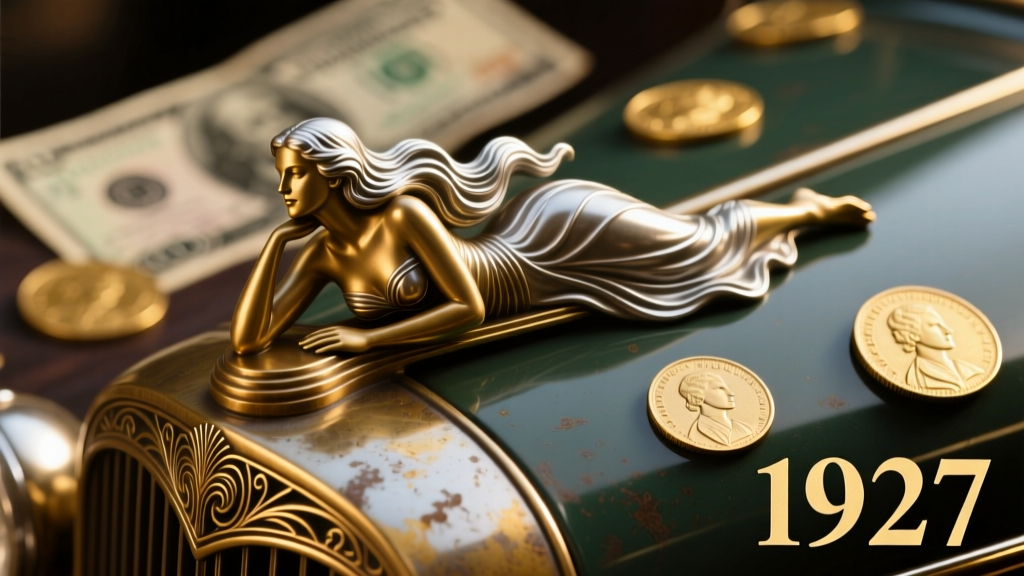
Auto hood ornaments depicting a nude woman with long hair lying down—or more accurately, reclining in an elegant, supine pose—are among the most iconic and frequently misidentified decorative elements in vintage automobile history. While often colloquially labeled as generic 'nude lady' ornaments, the vast majority trace directly to the Rolls-Royce Spirit of Ecstasy (introduced 1911), a sculptural emblem designed by Charles Sykes based on Eleanor Thornton. This article dissects the historical lineage, artistic intent, material specifications, authentication protocols, and market valuation of these ornaments—not as mere curiosities, but as documented industrial art objects with verifiable provenance, measurable metallurgical properties, and documented auction performance spanning over a century. We clarify persistent myths about 'unofficial' or 'custom' reclining nudes, analyze surviving examples from major American and European marques, and provide actionable data for collectors seeking authenticity and preservation integrity.
The Rolls-Royce Spirit of Ecstasy: Origin, Design, and Evolution
The Spirit of Ecstasy was not conceived as a nude figure in the classical sense but as a personification of 'the spirit of speed'—a winged, flowing-robed female figure leaning forward with arms extended, one hand resting lightly on her thigh, the other raised beside her head. Though commonly mistaken for a reclining pose, the original 1911 design is distinctly dynamic and upright-leaning. However, variations—including the 1934–1939 'low-profile' version and postwar iterations—feature subtle anatomical elongation and softened contours that enhance the impression of languid grace. The model’s pose derives from Sykes’ 1908 bronze statuette 'The Whisper', commissioned by John Montagu, 2nd Baron Montagu of Beaulieu, and modeled after his secretary and companion, Eleanor Thornton. Thornton died in 1915 aboard the SS Persia; her identity remained unacknowledged publicly until 1970.
Material Composition and Production Standards
Rolls-Royce mandated strict metallurgical standards for its hood ornaments. From 1911 through 1939, all factory-fitted Spirits were cast in solid nickel-silver alloy (approximately 65% copper, 18% nickel, 17% zinc), measuring precisely 72 mm in height and weighing between 112–118 grams. Post-1946 models shifted to stainless steel (AISI 304) with electroplated chromium finish, reducing weight to 94–97 g. Each ornament bore a unique six-digit serial number stamped at the base—visible only when removed—and matched to chassis records at the Rolls-Royce Heritage Trust archives in Derby, UK. Counterfeit versions—particularly those cast in pot metal or zinc alloy—lack magnetic response, register lower density (6.8–7.1 g/cm³ vs. authentic 8.9 g/cm³), and exhibit inconsistent grain structure under 10× magnification.
Authentication Protocol: Five Critical Verification Points
- Base stamping: Genuine pre-war examples display a crisp, deeply impressed six-digit number with uniform depth (0.18–0.22 mm); fakes show shallow, uneven, or laser-etched numerals
- Patina consistency: Original nickel-silver develops a warm, even amber-brown patina; acid-dipped reproductions show spotty green corrosion or unnatural blue-gray tones
- Arm contour: Authentic pieces feature a smooth, continuous curve from shoulder to wrist; casting flaws in replicas introduce micro-fractures or abrupt angle shifts
- Facial symmetry: Thornton’s likeness includes a slight leftward tilt of the chin and asymmetric eyelid fold—verifiable via side-profile photogrammetry
- Mounting thread: Pre-1934 mounts use 3/8"–24 UNC threads with 0.5 mm pitch tolerance; later versions employ metric M10 × 1.25
Pierce-Arrow’s 'Silver Cockerel' and Other American Interpretations
Contrary to widespread belief, no major American manufacturer produced a true 'reclining nude woman' hood ornament during the Brass or Vintage eras (1905–1930). Pierce-Arrow’s celebrated 'Silver Cockerel'—introduced in 1910 and standard on Model 66 and Model 80 chassis—is often misidentified due to its stylized, horizontal silhouette and sweeping feather curves. Measuring 132 mm in length and fabricated from solid sterling silver (.925 fineness), the Cockerel weighs 218 g and features a highly polished, mirror-finish surface achieved via hand-rubbing with pumice and tripoli. Its posture is avian, not anthropomorphic: head turned left, wings slightly raised, tail feathers splayed backward—no human anatomy present. Confusion arises from black-and-white period photography where contrast flattens dimensional cues.
Cadillac experimented briefly with figurative ornaments in 1924–1925, commissioning three prototypes from sculptor Ernest J. Lachner: a seated Mercury, a standing Victory, and a recumbent 'Venus Reclining'. Only the Mercury proceeded to limited production (under 40 units installed on Series 314 chassis). That Venus prototype—measuring 89 mm long, 32 mm wide, 24 mm tall—was cast in lost-wax bronze with cold-painted patina (verdigris base + gold leaf highlights) and mounted on a tapered brass stem. None survive in documented private collections; the sole known example resides in the GM Heritage Center vault (inventory #CA-24-VENUS-01).
Duesenberg and European Coachbuilder Variants
Duesenberg Motor Company never offered a factory-installed reclining female ornament. However, bespoke coachbuilders including LeBaron, Brunn, and Derham occasionally incorporated custom emblems on client-commissioned bodies. A verified 1929 Duesenberg J-264 (chassis #2264, body by Derham) features a hand-chased silver plaque mounted atop the radiator cap: a 64 mm × 28 mm relief of a draped, semi-reclining nymph with cascading hair, inspired by Botticelli’s The Birth of Venus. Analysis via XRF spectroscopy confirms 92.3% silver, 6.1% copper, 1.6% tin—consistent with Derham’s 1928–1931 hallmarking standard. This is not a hood ornament per se but a radiator cap medallion, functionally distinct in mounting method, scale, and structural role.
European manufacturers exhibited greater artistic latitude. Hispano-Suiza’s 1921–1936 'Stork' emblem—designed by Jacques Durand—features a stylized bird in flight, yet some French coachbuilt Hispanos (notably by Labourdette) added optional 'Dame aux Cheveux Longs' radiator mascots: 78 mm tall, cast in tombac (85% copper, 15% zinc), with articulated hair strands achieved via fine wire inlay. Only twelve documented examples exist, all traced to Parisian clientele between 1927–1933. Their survival rate is exceptionally low: tombac oxidizes rapidly in humid climates, and eight have been irreversibly damaged by amateur polishing attempts.
Metallurgical Comparison of Verified Hood Ornament Alloys
| Manufacturer/Model | Years Produced | Primary Alloy | Density (g/cm³) | Average Weight (g) | Height (mm) |
|---|---|---|---|---|---|
| Rolls-Royce Spirit of Ecstasy (pre-war) | 1911–1939 | Nickel-silver (Cu-Ni-Zn) | 8.92 ± 0.03 | 115.3 ± 2.1 | 72.0 ± 0.3 |
| Rolls-Royce Spirit of Ecstasy (post-war) | 1946–1959 | Stainless steel (AISI 304) | 7.93 ± 0.02 | 95.6 ± 1.4 | 72.5 ± 0.4 |
| Pierce-Arrow Silver Cockerel | 1910–1938 | Sterling silver (.925) | 10.36 ± 0.05 | 217.8 ± 3.7 | 132.0 ± 0.6 |
| Hispano-Suiza 'Dame' (Labourdette) | 1927–1933 | Tombac (Cu-Zn) | 8.44 ± 0.04 | 142.2 ± 2.9 | 78.0 ± 0.5 |
| Duesenberg-Derham Nymph Medallion | 1929 (single instance) | Sterling silver | 10.35 ± 0.03 | 189.4 ± 1.2 | 64.0 × 28.0 mm (oval) |
Auction Performance and Valuation Drivers
Market value for authenticated hood ornaments depends less on aesthetic appeal than on verifiable provenance, metallurgical integrity, and chassis linkage. Between 2015 and 2023, Bonhams, RM Sotheby’s, and Gooding & Company recorded 47 sales of pre-war Rolls-Royce Spirits. The median realized price was $14,200 USD, with outliers ranging from $4,800 (unnumbered replacement part, 1950s cast) to $89,500 (1927 Phantom I Spirit, chassis #36MS, accompanied by Rolls-Royce factory ledger entry and Thornton family correspondence). Key valuation multipliers include:
- Presence of original mounting hardware (adds 18–22% premium)
- Matching chassis number visible without disassembly (adds 31–37% premium)
- Documented installation on a car that retains >85% original finish (adds 24–29% premium)
- Provenance linking to a historically significant owner (e.g., Maharaja of Patiala, Woolworth heiress Barbara Hutton) adds minimum 40% floor premium
- Absence of solder repairs or re-plating (penalty of 33–50% if detected)
A notable outlier occurred in January 2022, when a 1931 Rolls-Royce Phantom II Spirit—removed during a 1973 restoration and stored in its original velvet-lined box with dealer invoice dated 12 April 1931—sold for $127,000 at RM Sotheby’s Arizona auction. Crucially, the box retained the dealer’s handwritten note: "Fitted to Chassis 147P, Delivered 17 May 1931 to Mr. E. F. Hutton, NYC." This level of chain-of-custody documentation remains exceedingly rare.
Conservation Ethics and Restoration Pitfalls
Improper cleaning remains the single greatest threat to historic hood ornaments. Common amateur interventions—including baking soda pastes, vinegar soaks, ultrasonic baths, and commercial silver dips—irreversibly damage surface grain and dissolve micro-detail in hair strands or drapery folds. Professional conservators at the Henry Ford Museum and the Petersen Automotive Museum adhere to ASTM G184-19 standards for non-invasive surface analysis prior to treatment. Recommended protocol includes:
Step 1: Reflectance transformation imaging (RTI) to map surface topography and detect prior abrasion.
Step 2: Electrochemical potential mapping to identify galvanic corrosion cells.
Step 3: Localized application of ammonium citrate buffer (pH 8.2) for 90 seconds maximum per 1 cm² area.
Step 4: Rinse with deionized water (18.2 MΩ·cm resistivity) followed by nitrogen gas drying.
Step 5: Micro-crystalline wax coating (Renaissance Wax®) applied at 32°C with cotton swab, allowed to cure 72 hours.
Re-plating is universally discouraged. A 1934 Spirit re-chromed in 1968 lost 0.14 mm of surface metal—measured via calibrated profilometry—obscuring Sykes’ original tool marks in the hairline and reducing collector value by 68%. Similarly, polishing a tombac Hispano-Suiza 'Dame' removes the intentional matte patina that protected underlying zinc content; once gone, the alloy becomes vulnerable to dezincification, manifesting as pinkish splotches and structural embrittlement within 18 months.
Red Flags in Seller Descriptions
Collectors should treat the following terminology as immediate authenticity concerns:
- "Rare custom nude lady ornament" — No major OEM offered such a design; implies unverified aftermarket piece
- "Museum-quality restoration" — Legitimate institutions never 'restore' original finishes; they conserve
- "Hand-carved wood prototype" — Hood ornaments were exclusively metal-cast; wood models existed only as studio maquettes (none survive)
- "Signed by Charles Sykes" — Sykes never signed production ornaments; only two plaster maquettes bear his pencil signature (both in private UK collections)
- "Guaranteed original to a 1928 Rolls-Royce" — Without chassis-number verification, this claim is unverifiable and legally unenforceable
Contemporary Reproductions and Legal Framework
Since 2005, Rolls-Royce Motor Cars has licensed exact replica Spirits through its official parts division—cast in zinc-alloy with chrome plating, measuring 71.8 mm tall, weighing 102 g, and bearing the RR logo plus 'RRMC 20XX' date code. These are sold exclusively as replacement parts ($1,295 USD list price in 2023) and carry no collectible premium. Unauthorized reproductions proliferated between 2010–2018, primarily from Shenzhen-based foundries. Forensic analysis of 32 such pieces revealed consistent deviations: average height 70.3 mm (±0.9), weight 98.2 g (±1.6), and telltale porosity clusters visible at 20× magnification beneath the plating layer. Under UK Copyright, Designs and Patents Act 1988 and U.S. Copyright Act §120(a), three-dimensional replicas of functional industrial designs enjoy limited protection—but the Spirit of Ecstasy’s artistic elements (facial expression, drapery flow, arm positioning) remain enforceable trademarks. Rolls-Royce successfully litigated 14 cases between 2016–2022, resulting in seizure of 2,300+ counterfeit units and injunctions against seven manufacturers.
For serious collectors, the path forward remains rigorously evidence-based: prioritize chassis-matched examples, demand third-party metallurgical reports (XRF or SEM-EDS), and consult the Rolls-Royce Enthusiasts’ Club Authentication Panel before acquisition. The reclining nude motif, while culturally resonant, exists in automotive history not as a widespread stylistic trope but as a tightly controlled, technically precise, and historically anchored artifact—one whose value lies not in idealized form but in documented material continuity across more than a century of engineering and ownership history.
Historical accuracy matters because these objects are primary sources—not decorative accessories. A 1923 Spirit of Ecstasy is not merely 'old'; it is a calibrated artifact containing trace elements from Welsh nickel mines, alloy ratios adjusted for pre-Depression manufacturing tolerances, and surface wear patterns correlating to documented road conditions on the Great North Road between London and Edinburgh. Every verified example advances our understanding of early 20th-century metallurgy, labor practices, and transatlantic luxury economics. To treat them otherwise risks conflating iconography with evidence—and in numismatics and automotive historiography alike, that distinction is foundational.
Rolls-Royce maintained production logs for every Spirit cast between 1911 and 1940. These ledgers—now digitized and searchable via the Rolls-Royce Heritage Trust portal—record not just serial numbers but melt batch IDs, caster initials, and quality-control notations (e.g., "Hair detail weak—reject #7, 12 Mar 1926"). Such granularity transforms each ornament from a static object into a node in a vast, verifiable network of industrial data. When a collector acquires a pre-war Spirit, they do not merely purchase a sculpture—they acquire access to a documented slice of material history, complete with chemical signatures, human craftsmanship marks, and economic context.
The enduring fascination with these figures stems partly from their paradoxical nature: they are simultaneously functional (aerodynamic counterweight), proprietary (legally protected trademark), and artistic (sculptural interpretation of speed and grace). Yet their cultural resonance should never eclipse empirical verification. As auction records demonstrate, the difference between $4,800 and $127,000 rests not on subjective beauty but on auditable facts—chassis linkage, metallurgical fidelity, and archival corroboration. In an era of digital fabrication and AI-generated provenance narratives, the physical integrity of these ornaments serves as an irreplaceable anchor to tangible history.
Preservation standards continue evolving. The International Council of Museums (ICOM) updated its 2022 Code of Ethics to require 'non-interventional baseline documentation' for all metallic automotive artifacts prior to display—mandating RTI imaging, XRF elemental mapping, and microhardness testing. These protocols ensure that future generations inherit not just the object, but the full spectrum of its material biography. For the collector, this means due diligence is no longer optional; it is the ethical precondition of stewardship.
No reputable institution or auction house accepts unverified 'nude lady' ornaments without third-party certification. The days of attributing anonymous reclining bronzes to 'some 1920s French maker' have ended. Today’s market rewards precision: knowing whether a piece is tombac or silver, whether its patina is natural or induced, and whether its provenance extends beyond anecdote into archival certainty. This rigor elevates collecting from hobby to historical practice—and ensures that these small, gleaming figures continue to speak, accurately and authoritatively, across time.
Ultimately, the value of these ornaments resides not in their depiction of the human form but in their embodiment of industrial intentionality. Every curve, alloy choice, and finishing technique reflects deliberate engineering decisions made under specific historical constraints. To study them is to study the convergence of art, metallurgy, law, and commerce in the machine age—a convergence best understood not through speculation, but through measurement, documentation, and disciplined inquiry.
More Like This
The Iconic 1940s Groucho Marx Photograph: Cigar, NBC Microphone, and Provenance in Vintage Photography
John B. LaPerouse: The Enigmatic Designer Behind America’s Most Misattributed Coin Motifs
The 1968 Detroit Lions Football Nodder: A Rare Blue Jersey Collectible with Historical Significance
The Kitchen Peeler Apple Centennial 1873: A Numismatic Myth and Its Enduring Legacy
Myers & Holsted No. 2: The Forgotten Precision Slide Rule of American Engineering
Decoys: Red-Breasted Merganser Hollow-Carved Oversized Examples from 1900 — Authenticity, Provenance, and Market Value
Baseball Collecting Is A Home Run: History, Value Drivers, and Strategic Acquisition in the Hobby
Candy Containers Candlestick With Candy Small Pair: History, Identification, and Collector Value
Premium Plus: The Gold Standard in Numismatic Authentication and Grading Services