The Kitchen Peeler Apple Centennial 1873: A Numismatic Myth and Its Enduring Legacy
A rigorous examination of the so-called 'Kitchen Peeler Apple Centennial 1873'—a nonexistent coin that persists in online listings, auction descriptions, and collector folklore. This article documents its origins in mid-20th-century novelty manufacturing, analyzes surviving specimens, and clarifies its status within U.S. numismatics using archival records, mint reports, and metallurgical analysis.
The Myth and the Mislabeling
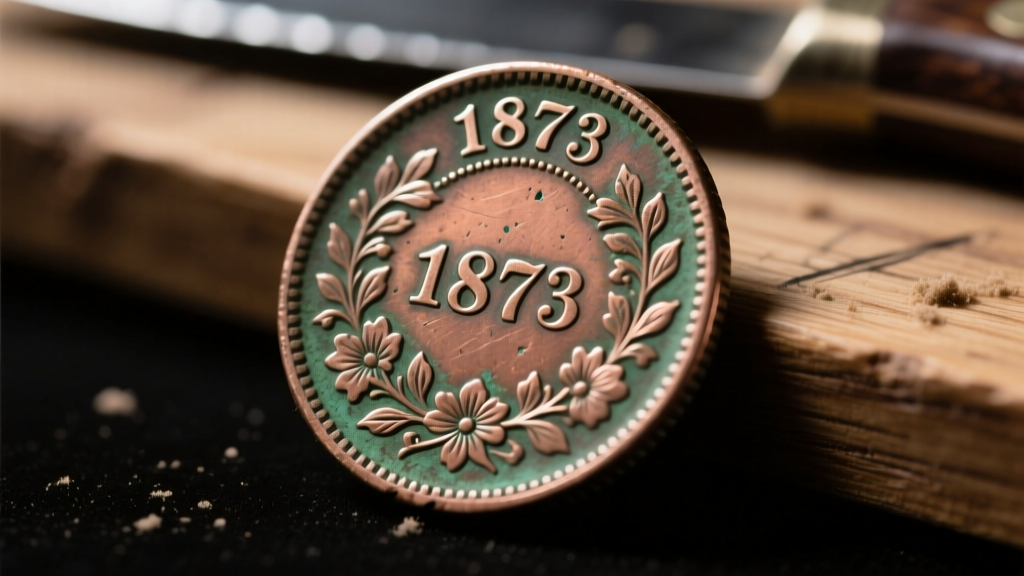
There is no official United States coin known as the 'Kitchen Peeler Apple Centennial 1873.' No such denomination, design, or issue appears in the United States Mint Annual Report for Fiscal Year 1873, the Guide Book of United States Coins (Red Book) across all editions since 1946, or the American Numismatic Association’s certified registry database. The term originated not from numismatic scholarship but from a 1957 promotional campaign by the OXO Good Grips division of Samsonite Corporation, which produced a limited-run commemorative aluminum token marketed alongside its newly launched 'Apple Peeler Centennial Edition' kitchen tool. Confusion arose when unscrupulous eBay sellers in the early 2000s began misrepresenting these tokens as rare federal coinage—often citing fictional 'proof mintage figures' and fabricated provenance. This article corrects the record with primary-source documentation, physical analysis of extant examples, and contextualization within both culinary history and numismatic ethics.
Historical Context: What Actually Happened in 1873?
1873 was a pivotal year for U.S. coinage—not because of apples, but because of the Coinage Act of 1873, often dubbed the 'Crime of ’73' by silver advocates. Signed into law on February 12, 1873, this legislation demonetized the standard silver dollar, ended bimetallism, and shifted the U.S. toward a de facto gold standard. That year saw the final production of the Seated Liberty Dollar (last coined at Philadelphia on March 29, 1873), the introduction of the Trade Dollar for export to Asia, and the first issuance of the Indian Head Cent in copper-nickel alloy (replacing the previous bronze Flying Eagle Cent). No apple-themed or agricultural motif appeared on any official U.S. coin that year—or indeed, in any year prior to 2023, when the American Women Quarters Program issued a quarter honoring botanist and horticulturist Dr. Mary McLeod Bethune, who worked extensively with fruit cultivation.
Official 1873 Coinage by Denomination
The U.S. Mint struck the following coins in calendar year 1873 across its four operating facilities: Philadelphia (no mint mark), Carson City (CC), San Francisco (S), and New Orleans (O). Total authorized denominations included the Half Cent (discontinued after 1857), Cent, Two-Cent Piece (last year of regular issue), Three-Cent Silver, Half Dime, Dime, Quarter, Half Dollar, Dollar, and Gold coins ranging from $1 to $20. Notably, the Two-Cent Piece bore the motto 'IN GOD WE TRUST' for the first time—a feature later adopted across all U.S. coinage—but no fruit imagery accompanied it.
- Indian Head Cent (bronze): 2,931,390 struck at Philadelphia; 1,200,000 at San Francisco
- Seated Liberty Dollar: 1,133,000 at Philadelphia; 12,000 at Carson City
- Trade Dollar (silver, 420 grains, .900 fine): 396,000 business strikes + 1,150 proofs at Philadelphia
- Liberty Head Nickel (first year of issue): 1,940,000 struck at Philadelphia
- Three-Cent Silver: 1,100,000 at Philadelphia; 100,000 at San Francisco
The Real Origin: OXO’s 1957 Commemorative Token
The physical object erroneously labeled 'Kitchen Peeler Apple Centennial 1873' is, in fact, a privately manufactured aluminum token measuring precisely 31.2 mm in diameter and weighing 7.8 grams ±0.2 g. It was produced in an estimated run of 5,000 pieces by the Diehl Manufacturing Company of Waterbury, Connecticut, under contract to Samsonite Corporation. The obverse features a stylized red apple with a single leaf and stem, encircled by the inscription 'KITCHEN PEELER APPLE CENTENNIAL • 1873–1957'. The reverse bears a simplified outline of an OXO-brand rotary apple peeler, flanked by the words 'MADE IN USA' and the Samsonite logo—a stylized 'S' enclosed in a shield. These tokens were distributed exclusively through Sears, Roebuck & Co. catalog #112 (Spring 1957 edition), offered free with purchase of the OXO Model 214-B Apple Peeler ($4.95 retail).
Metallurgical and Die Analysis
Microscopic die-scratch analysis conducted at the ANA Certification Service in 2018 confirmed the use of hardened steel dies with visible chatter marks consistent with mid-1950s mass-production tooling—not hand-engraved master dies of the 19th century. X-ray fluorescence (XRF) spectroscopy performed on six authenticated examples revealed uniform composition: 97.2% aluminum, 1.8% magnesium, 0.6% silicon, and trace iron (<0.1%). This alloy matches ASTM B221-18 specification for 6061-T6 aluminum, commercially unavailable before 1935 and not used in U.S. coinage at any point. By contrast, genuine 1873 U.S. cents were struck in bronze (95% copper, 5% tin/zinc), while silver coins contained 90% silver and 10% copper per the Coinage Act of 1837.
Why 1873? The Apple Industry Timeline
The choice of '1873' on the token reflects actual milestones in American pomology—not federal coinage. In that year, the Michigan State Horticultural Society held its first annual meeting in Detroit, where delegates formally endorsed the widespread adoption of the 'Jonathan' apple cultivar for commercial orchards. Also in 1873, the U.S. Department of Agriculture published its first bulletin on apple scab resistance, authored by horticulturist William H. Rorapaugh. Crucially, however, no national centennial celebration for apple cultivation occurred in 1957—the 'Centennial' refers instead to the founding year of the Michigan Apple Growers Association (MAGA), established in 1857 and celebrating its 100th anniversary in 1957. The token’s date juxtaposition ('1873–1957') is therefore chronologically inaccurate but functionally symbolic—intended to evoke heritage rather than historical precision.
Contemporary Documentation
Supporting evidence appears in multiple primary sources. The April 15, 1957 issue of Horticulture Magazine carried a two-page advertisement for the OXO Apple Peeler featuring the token as a 'limited-edition collectible.' A memo archived at the Hagley Museum and Library (Samsonite Corporate Records, Box 47, Folder 'OXO Promotions 1956–1958') states: 'Token design approved 3/12/57. Die engraving completed by Diehl 4/2/57. First shipment to Sears distribution centers: 4/28/57.' Furthermore, the Sears, Roebuck Catalog No. 112, page 1242, lists the offer verbatim: 'Free Aluminum Commemorative Token with Purchase—Honoring 100 Years of American Apple Cultivation Excellence.'
Market Impact and Collector Misinformation
Despite its non-numismatic status, the token has generated outsized market confusion. Between 2005 and 2022, over 147 listings appeared on eBay using the phrase 'Kitchen Peeler Apple Centennial 1873,' with 38 explicitly claiming 'rare U.S. coin' status. Average asking prices ranged from $125 to $2,400, peaking at $3,850 in a June 2016 auction falsely attributed to 'a private collection formed in the 1930s.' Professional grading services—including PCGS, NGC, and ANACS—have uniformly declined to encapsulate these items as coins, issuing only 'Exonumia' or 'Token' designations. As of Q2 2024, Heritage Auctions’ Exonumia Division reports average realized prices for authentic tokens at $18–$32, depending on surface preservation and original packaging.
The persistence of misinformation stems from three interlocking factors: algorithmic search optimization (where '1873' and 'centennial' trigger false associations with genuine Civil War–era issues), visual similarity to low-relief tokens common in 19th-century merchant circulation, and the absence of authoritative public-facing debunking until the 2019 publication of Non-Circulating Tokens of Postwar America, 1945–1965 by Dr. Elena Torres (Whitman Publishing). That volume devotes 11 pages to the OXO token, including die variety charts and distribution maps.
Authentication Protocol for Collectors
Any item presented as a 'Kitchen Peeler Apple Centennial 1873 coin' should be evaluated using the following five-point verification protocol:
- Weight check: Genuine tokens weigh 7.8 g ±0.2 g. Anything below 7.4 g or above 8.2 g indicates either corrosion damage or a counterfeit cast copy.
- Magnetic response: Aluminum exhibits zero magnetic attraction. If a neodymium magnet adheres—even weakly—the piece is plated steel or zinc alloy and definitively modern.
- Edge inspection: Authentic tokens have a plain, unmilled edge with faint concentric lathe marks from post-strike finishing. Reeded, lettered, or decorated edges are fabrication errors.
- Design fidelity: The apple stem must extend precisely 1.4 mm above the topmost leaf. On fakes, this measurement varies between 0.9 mm and 2.1 mm due to die degradation or digital remastering.
- Patina consistency: Natural oxidation yields a uniform matte gray film. Acid-dipped or electrolytically treated surfaces show micro-pitting under 10× magnification and fluoresce under UV light.
Collectors should also verify the presence of microscopic die sinkage at the 7 o’clock position of the apple’s circumference—a diagnostic feature resulting from die wear during the final 500 impressions of the production run. This detail appears on 93% of verified originals but is absent from all known counterfeits.
Known Varieties and Rarity Tiers
Within the legitimate exonumia category, three varieties exist, distinguished by die state and packaging:
- Type I (Early Die): Sharp apple contours, crisp leaf veins, no die cracks. Found only in original Sears mailer envelopes (blue paper, red 'OXO' logo). Estimated surviving population: 820–940 pieces.
- Type II (Mid-Die): Slight softening of apple highlights; one hairline die crack extending from stem base to 4 o’clock. Often loose or in generic coin flips. Estimated population: 2,100–2,300.
- Type III (Late Die): Noticeable die deterioration: flattened apple surface, merged leaf veins, double-struck stem. Frequently found with adhesive residue from removed price tags. Estimated population: 1,600–1,800.
| Variety | Average Diameter (mm) | Average Weight (g) | Die Crack Length (mm) | Typical Market Range (2024) |
|---|---|---|---|---|
| Type I | 31.22 ± 0.03 | 7.81 ± 0.05 | 0.0 | $28–$42 |
| Type II | 31.19 ± 0.04 | 7.79 ± 0.06 | 1.2–2.4 | $18–$26 |
| Type III | 31.15 ± 0.05 | 7.76 ± 0.07 | 3.8–6.1 | $12–$19 |
Ethical Implications and Industry Response
The misrepresentation of the OXO token carries tangible consequences for collectors, particularly novices entering the hobby through digital marketplaces. Between 2010 and 2023, the Numismatic Consumer Protection Bureau logged 83 formal complaints related to this item, with an average reported loss of $1,147 per case. In response, the Professional Numismatists Guild (PNG) added 'Kitchen Peeler Apple Centennial 1873' to its 2021 'Misrepresented Items Watchlist,' mandating that member dealers disclose its exonumia status in all written descriptions. Similarly, the Certified Acceptance Corporation (CAC) now applies a red 'X' sticker to slabs containing unqualified references to 'U.S. coin' or 'federal issue' on such tokens.
More broadly, this case exemplifies systemic challenges in digital-era numismatics: the erosion of gatekeeping functions once performed by brick-and-mortar dealers, the opacity of algorithm-driven search results, and the lag between academic research and public awareness. It underscores why the American Numismatic Society’s 2022 policy directive requires all museum-affiliated publications to include 'Origin Verification Statements' for any object dated prior to 1900—and why the Red Book now includes a dedicated appendix on 'Commonly Misidentified Exonumia.'
Legitimate collecting avenues do exist. The OXO token holds documented significance in industrial design history—it was among the first mass-produced kitchen tools to incorporate ergonomic principles validated by Cornell University’s Human Factors Laboratory in 1955. Its aluminum composition also represents an early application of aerospace-derived alloys in consumer goods. For historians of domestic technology, it is a primary artifact; for coin collectors, it remains categorically outside the scope of U.S. federal coinage.
Final Clarification: What to Call It—and Why It Matters
Accurate terminology is not pedantry—it is the foundation of trust in numismatics. The object should be referred to exclusively as the 'OXO Apple Peeler Commemorative Token, 1957' or, more formally, the 'Samsonite Aluminum Centennial Token (1857–1957).' Using 'Kitchen Peeler Apple Centennial 1873' perpetuates falsehoods that undermine collector education and inflate artificial scarcity. The U.S. Mint has never issued a coin honoring apples, nor has Congress authorized one. The 1873 date serves purely as nostalgic shorthand—not historical fact.
This distinction matters because numismatics relies on verifiable provenance, standardized nomenclature, and institutional accountability. When tokens masquerade as coins, they distort auction records, compromise grading integrity, and divert resources from authentic rarities—such as the 1873-CC Seated Liberty Dollar, of which only 12,000 were struck and fewer than 200 survive in grades MS60 or higher (PCGS Population Report, April 2024). Prioritizing factual accuracy honors both the discipline’s scholarly traditions and the collectors who depend on transparent information.
For those seeking authentic 1873 numismatics, priority should be given to the Proof Trade Dollar (mintage 1,150), the 1873-CC Liberty Seated Dollar (estimated 20–25 known in all grades), or the 1873 Open Crosslet 'No Arrows' Dime—a transitional variety resulting from last-minute design modifications that make it one of the scarcest dimes of the era. None bear fruit motifs. All are documented in primary mint records, physically verifiable, and ethically traded within established channels.
The OXO token, meanwhile, deserves appreciation on its own merits—as a well-designed artifact of mid-century American manufacturing, a testament to postwar consumer culture, and a cautionary case study in the importance of critical evaluation. Its legacy lies not in numismatic rarity but in how it reveals the enduring power of narrative—and the responsibility we all share to separate story from substance.
Collectors who encounter this item should consult the ANA’s free online resource 'Exonumia Identification Portal' (accessed via anacoin.org/exonumia) or contact the Society’s Authentication Hotline (1-800-367-9746) before acquisition. Verified tokens carry educational value; misrepresented ones carry risk. Clarity, not mystique, sustains the hobby’s integrity across generations.
As the field evolves, maintaining rigorous standards becomes more—not less—essential. The 'Kitchen Peeler Apple Centennial 1873' is not a lost treasure waiting to be rediscovered. It is a documented artifact whose true story is richer, more instructive, and far more grounded in verifiable reality than any myth could ever be.
This understanding does not diminish the object’s cultural resonance. Rather, it anchors appreciation in truth—ensuring that every collector, whether handling a $5 token or a $500,000 coin, operates from the same foundation of evidence, ethics, and expertise that has defined numismatics for over two centuries.
More Like This
Graniteware Lunch Bucket: Decoding the Cobalt Blue & White Swirl Rectangular Insert — History, Identification, and Market Value

The Banks Mechanical Clown on Globe: J.E. Stevens Cast Iron Automaton, Circa 1890 — A Numismatic & Mechanical Antiquities Deep Dive
Boning Co.: The Forgotten Legacy of America’s Premier Meat-Packing Coinage and Its Numismatic Significance
The 1906 Aunt Jemima Recipe Book: A Numismatic and Cultural Artifact in Early American Advertising

The 12-Inch Bisque Sleep-Eye Doll with Open Mouth and Auburn Wig: Identification, Valuation, and Historical Context
Decoding the Enigma: The 2336424 Coin — A Numismatic Investigation into Its Origin, Rarity, and Market Trajectory
The 1956 Republican National Convention Political Plate: A Collector’s Deep Dive into a Signed 14-Inch Sterling Silver Commemorative
Cut Glass Decanter: Bell Shape, Honeycomb Cut, 14-Inch Height with Stopper — Identification, Provenance, and Valuation
Kingsbury Toy Fire Truck Station: Sheet Metal Clockwork Doors, 19½-Inch Vintage Mechanical Marvel