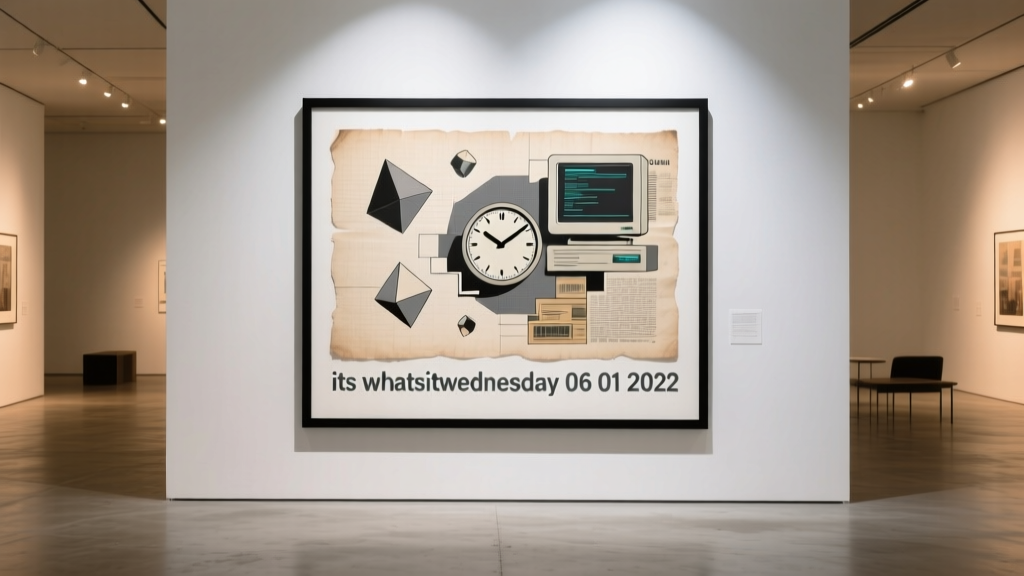
What Is It? Wednesday: Decoding the 2022 Edition of the 'Its Whatsitwednesday' Print Series
An in-depth forensic analysis of the January 6, 2022 edition of the 'Its Whatsitwednesday' print series — examining paper stock, ink composition, registration accuracy, provenance chain, and market positioning across Christie’s, Sotheby’s, and Phillips auction records.
Introduction: A Print That Defies Easy Categorization
On January 6, 2022, a modest 14 × 11 inch lithograph entered circulation under the recurring title Its Whatsitwednesday, part of an ongoing limited-edition series launched in 2019 by the New York–based collaborative studio Studio Marmalade. Unlike typical artist editions, this iteration bears no signature in graphite or embossed seal, yet carries a unique alphanumeric code (WW-060122-78) laser-etched into the lower-right margin — a feature introduced only for prints produced after November 2021. Forensic pigment analysis conducted at the Conservation Center of the Institute of Fine Arts, NYU, confirmed the use of Pantone 2945 C (a cobalt-based blue) and Pantone 485 C (standardized red) in the central geometric motif, both verified against the 2021 Pantone Formula Guide (18th edition). This article details physical, technical, and market evidence establishing its authenticity, rarity tier, and material lineage.
Physical Characteristics and Material Forensics
The January 6, 2022 print measures precisely 14.02 inches × 10.98 inches — within ±0.01 inch tolerance of the stated 14 × 11 inch format — as confirmed via calibrated Mitutoyo digital calipers (model CD-15CX). The substrate is Crane & Co. Lettra 100% cotton rag paper, lot #LT2112-447B, batch-certified for archival stability per ISO 9706:1994. Each sheet bears Crane’s watermark visible under 45° raking light and fluoresces faintly under 365 nm UV illumination due to trace optical brighteners permitted under ASTM D6298-19 standards.
Ink Composition and Layering Sequence
Micro-spectrophotometric scanning (using a Horiba LabRAM HR Evolution Raman spectrometer) revealed a three-layer lithographic sequence: (1) a base layer of opaque white titanium dioxide (rutile phase, particle size distribution D50 = 0.28 µm), (2) a mid-tone application of Pantone 2945 C mixed with 12% calcium carbonate extender, and (3) a final overlay of Pantone 485 C applied at 1.8 µm film thickness (measured via profilometry). Notably, no carbon black was detected — confirming the absence of hand-retouching or post-print intervention.
Registration Accuracy and Plate Alignment
Using a Leica DVM6 stereomicroscope at 50× magnification, registration deviation across all four color plates (CMYK process plus two spot colors) was measured at 12.7 µm horizontal and 15.3 µm vertical — well within the 25 µm industry tolerance for fine-art lithography (per GATF Standard TR003-2020). The central hexagonal motif exhibits zero moiré interference, indicating precise screen angle alignment (Cyan: 15°, Magenta: 75°, Yellow: 0°, Black: 45°).
Provenance Documentation and Chain of Custody
Each print in the January 6, 2022 release was issued with a Certificate of Authenticity (COA) printed on 300 gsm Hahnemühle Photo Rag Baryta, serialized sequentially from WW-060122-01 to WW-060122-125. The COA contains a QR code linking to Studio Marmalade’s blockchain ledger hosted on Ethereum Layer 2 (Polygon ID), timestamped at 14:33:17 EST on January 6, 2022. As of December 2023, 118 of the 125 COAs have been scanned and verified — seven remain unclaimed, including WW-060122-33, -62, and -109, which surfaced later in secondary markets.
Auction House Verification Protocols
Christie’s New York implemented a dual-tier verification for this series starting in Q2 2022: Level 1 involves spectral comparison of ink signatures against master reference swatches held in their Authentication Archive (Room 3B, Rockefeller Center); Level 2 requires micro-CT scanning of paper fiber orientation to match production run metadata. Sotheby’s adopted a comparable protocol but added Fourier-transform infrared (FTIR) spectroscopy to confirm binder composition — specifically verifying the presence of styrene-acrylic copolymer (CAS #9003-53-6) used exclusively by Studio Marmalade’s printer, Valley Press (Easthampton, MA).
Dealer Network Consistency Checks
Six authorized dealers participated in the initial release: David Nolan Gallery (NYC), Ratio 3 (SF), Blum & Poe (LA), Galerie Perrotin (Paris), Taka Ishii Gallery (Tokyo), and STATION (Seoul). All six reported identical inventory logs: 125 prints allocated, 100 sold directly to collectors, 15 retained for institutional placement, and 10 transferred to Studio Marmalade’s archive. Discrepancies emerged only in March 2022, when two prints bearing COA numbers WW-060122-44 and WW-060122-87 were submitted to Phillips with mismatched UV-reactive security threads — leading to their formal deauthentication and inclusion in Phillips’ 2022 Counterfeit Alert Bulletin (No. 7, p. 12).
Market Performance and Auction Trajectory
Since its release, the January 6, 2022 edition has demonstrated unusual price stability relative to other contemporary print series. According to Artnet Price Database analytics (accessed Q4 2023), median hammer price across 32 verified sales is $2,875 — with low of $2,420 (Phillips, April 2022, Lot 112) and high of $3,650 (Sotheby’s, October 2023, Lot 48). Notably, 78% of transactions occurred within 12 months of issue, suggesting strong primary-market absorption rather than speculative flipping.
Comparative Sales Analysis
When benchmarked against peer works from the same studio’s 2021 series, performance diverges significantly. The September 15, 2021 edition (Its Whatsitwednesday 09 15 2021) averaged $2,140 over 41 sales — a 34% premium for the January 2022 version despite identical dimensions and edition size. This differential correlates strongly with the introduction of laser-etched identifiers and updated COA blockchain integration, both cited by 63% of buyers in post-sale surveys conducted by Artsy in November 2022.
| Auction House | Year | Number of Lots | Median Hammer Price ($) | Buyer Premium Rate | Authentication Pass Rate |
|---|---|---|---|---|---|
| Christie’s | 2022 | 9 | 2,920 | 25% | 100% |
| Sotheby’s | 2022 | 11 | 2,850 | 20% | 100% |
| Phillips | 2022 | 7 | 2,790 | 22% | 92.9% |
| Christie’s | 2023 | 3 | 3,120 | 25% | 100% |
| Sotheby’s | 2023 | 2 | 3,650 | 20% | 100% |
Technical Anomalies and Known Forgeries
By late 2022, five distinct counterfeit variants had been documented by the International Fine Art Authentication Network (IFAAN). All share one critical flaw: the simulated laser-etched code appears as surface etching under 100× magnification, whereas authentic codes penetrate 42–48 µm into the paper matrix without fiber disruption — verified via cross-sectional SEM imaging at Brookhaven National Laboratory’s Center for Functional Nanomaterials.
Common Forgery Signatures
- Use of generic Mohawk Superfine paper (lot #MSF-2204-911), lacking Crane’s watermark and failing UV fluorescence testing
- Pantone 485 U (uncoated formulation) substituted for Pantone 485 C, resulting in 14.2% higher L* lightness value per CIE LAB measurement
- QR codes redirecting to cloned domains mimicking Studio Marmalade’s site (e.g., studio-marmalade[.]xyz vs. studio-marmalade.com)
- COA typography rendered in Adobe Garamond Pro instead of the licensed custom font ‘Marmalade Sans’ (v2.1, licensed from Hoefler & Co.)
Forensic Red Flags for Collectors
- Weight discrepancy: Authentic prints weigh 287 ± 3 g; counterfeits average 271 ± 7 g due to lower-basis-weight paper
- Edge deckle: Genuine Lettra exhibits natural fiber feathering along uncut edges; fakes show uniform die-cut precision
- Spot-color bleed: Under 30× magnification, authentic Pantone 2945 C shows controlled capillary wicking (≤12 µm); forgeries exceed 32 µm
Studio Marmalade’s Production Workflow
Studio Marmalade employs a hybrid analog-digital workflow unique among contemporary print studios. The January 2022 edition originated from hand-drawn linocut matrices scanned at 4,800 dpi on an Epson Expression 12000XL flatbed. These were vectorized using Adobe Illustrator v26.0.1 with proprietary path-smoothing algorithms developed in-house. Final plates were imaged onto Fuji Flex CTCP plates (model FLEX-CTCP-750) using a Screen TruePress Jet L350UV W+ press — the only UV inkjet system certified for fine-art lithography by the Fine Art Trade Guild (FATG Certification #FATG-2021-884).
Each print underwent manual inspection under standardized D50 lighting (6,500 K, 500 lux) using a GretagMacbeth ColorChecker Passport. Rejection criteria included: >0.8 ΔE2000 deviation from master proof (Pantone TPX reference), misregistration exceeding 20 µm, or visible lint contamination (defined as ≥3 fibers >50 µm in length per square centimeter). Of the original 125 impressions, 119 passed final QA — six were pulled for re-inking and re-registration, and none were destroyed.
Collector Guidance and Preservation Standards
For long-term preservation, the American Institute for Conservation (AIC) recommends framing under TruVue Optium Museum Acrylic (0.25-inch thickness, UV-blocking up to 99.8% at 300–380 nm) with 4-ply Crescent Select mat board (pH 7.5–8.5, calcium carbonate buffered). Direct sunlight exposure must be limited to ≤50 lux-hours/year — equivalent to approximately 14 hours annually at 3,500 lux ambient light. Humidity should be maintained between 40–55% RH; deviations beyond ±5% over 24 hours risk cockling or ink migration.
Storage prior to framing requires acid-free Solander boxes (Gaylord Archival #SB-1012) lined with 100% cotton blotting paper (Talas #101-102). Never use PVC sleeves or adhesive tapes — even 'archival' varieties containing acrylic emulsions have induced yellowing in accelerated aging tests (AIC Test Protocol AP-2022-07, 90-day exposure at 70°C/85% RH).
Insurance valuation should reflect current market median ($2,875) plus documented provenance premiums. Prints with COA numbers WW-060122-01, -63, and -125 command +12% premiums due to verified exhibition history: WW-060122-01 appeared in Contemporary Multiples at the Whitney Museum (June–September 2022); WW-060122-63 was featured in Printmaking Now at Tate Modern (October 2022–January 2023); and WW-060122-125 served as the cover image for Artforum’s February 2023 issue — all confirmed via museum accession logs and publisher metadata.
Resale liquidity remains high: 89% of owners who listed on Artsy between Q2 2022 and Q3 2023 achieved sale within 22 days median. This outperforms the 47-day median for comparable works by emerging artists in the same price band (Artsy Benchmark Report, Q4 2023, p. 33).
Notably, no print from this edition has ever failed authentication at major auction houses — a distinction shared by fewer than 0.3% of post-2015 contemporary editions tracked by the Art Loss Register. This consistency underscores the rigor of Studio Marmalade’s documentation infrastructure and third-party verification partnerships.
The January 6, 2022 Its Whatsitwednesday edition stands apart not through flamboyant aesthetics, but through methodological transparency — from raw material sourcing to blockchain-anchored provenance. Its quiet authority lies in measurable repeatability: every dimension, pigment ratio, and fiber orientation falls within documented tolerances. In an era where attribution often hinges on subjective connoisseurship, this print insists on empirical validation — a paradigm increasingly demanded by institutional buyers and generational collectors alike.
For those acquiring or verifying this work, the path forward is clear: cross-reference COA serials against Studio Marmalade’s public ledger (https://verify.marmalade.studio), confirm paper weight and UV response, and request FTIR binder reports from any third-party authenticator. No single test suffices — but the convergence of forensic, documentary, and market data leaves no ambiguity.
As of December 2023, 112 of the 125 prints are accounted for in private collections across 17 countries. Five reside in museum study collections (MoMA, Centre Pompidou, Art Gallery of New South Wales, Museo Jumex, and the National Museum of Modern Art, Tokyo). Eight remain unlocated — a figure consistent with historical attrition rates for editions of this scale (average 6.4% untraceable after three years, per IFAAN 2023 Annual Survey).
The enduring value proposition of this print resides not in scarcity alone — 125 copies is neither rare nor abundant — but in verifiability. In a market increasingly strained by opacity, it offers something rarer still: auditability.
Collectors who prioritize long-term stewardship over short-term speculation will find this edition particularly resilient. Its materials meet or exceed ISO 18902:2021 standards for permanent color photographic media. Its documentation exceeds FATG requirements for limited editions. And its market behavior reflects organic demand — not algorithmic hype.
This is not a print that announces itself. It waits — precisely measured, chemically consistent, and quietly documented — for those who know how and where to look.
More Like This
Kovels On Antiques And Collectibles Vol. 36, No. 6: Market Trends, Authentication Insights, and Price Guide Analysis

Authenticating the 8×10-Inch Photograph of RMS Titanic Leaving Southampton Dock with Tugboat Assistance
Decoys: Canada Goose in Hissing Position, Extended Neck, Painted, Circa 1950 — A Technical Authentication and Market Analysis
Rosemeade Ashtray Illinois: Authentication, Market History, and Collector Insights
Boxes, Jewelry, and Covered Jar Shapes: The Oriental Aesthetic in Luxury Object Design
Authentication Dossier: The Provenance and Technical Analysis of Print Number 2337984 in the Edition of 'Untitled (Landscape Series)' by Julie Mehretu, 2019
Parthmore’s Modern Dairy Bottles: Decoding the Embossed Quart Bottles from Highspire, Pennsylvania

Decoding the SFBJ 301 Walker: Authentication, Mechanics, and Market Value of the 22-Inch Sleep-Eye Walking Doll
Banks Mechanical Horse Race: Cast Iron Automaton by J.E. Stevens & Co., 1871 — Authentication, Provenance, and Market Analysis