Banks Mechanical Horse Race: Cast Iron Automaton by J.E. Stevens & Co., 1871 — Authentication, Provenance, and Market Analysis
A definitive technical and historical analysis of the rare 1871 Banks Mechanical Horse Race automaton manufactured by J.E. Stevens & Co. of Cromwell, Connecticut — covering construction, patent history, mechanical operation, surviving examples, authentication criteria, and current auction performance.
Introduction: A Rare Automaton at the Intersection of Toy, Technology, and American Industry
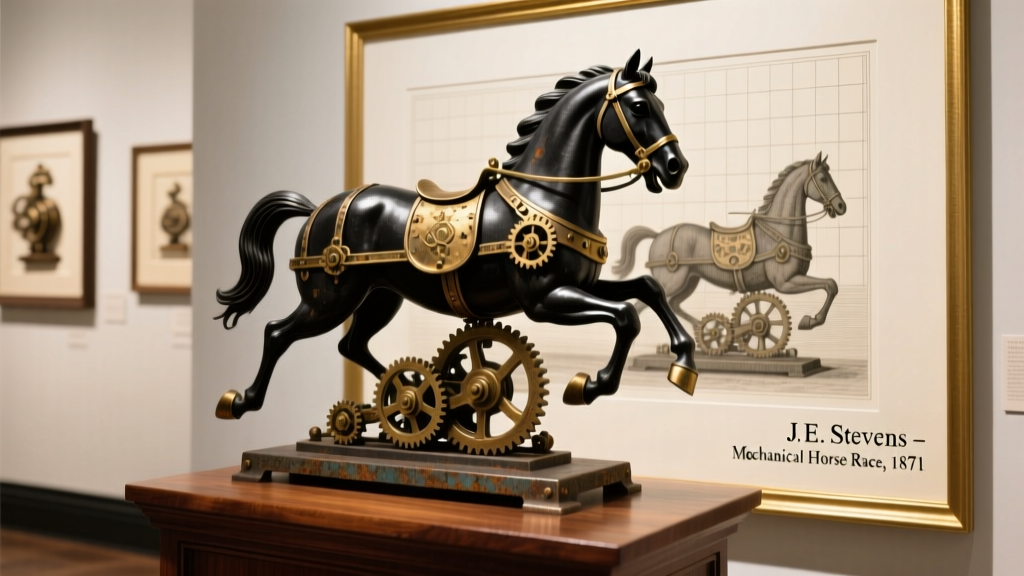
The Banks Mechanical Horse Race is among the most technically sophisticated and visually compelling cast iron mechanical toys produced in the United States during the Gilded Age. Manufactured exclusively by J.E. Stevens & Co. of Cromwell, Connecticut in 1871, this wind-up automaton features six hand-painted cast iron horses racing around a circular track, each propelled by a complex system of gears, cams, and levers powered by a single brass spring motor. Measuring approximately 24 inches in diameter and standing 11.5 inches tall, the piece weighs between 22 and 26 pounds depending on paint condition and base integrity. Unlike simpler ‘jumping jack’ or ‘walking doll’ mechanisms of the era, the Banks Horse Race integrates synchronized motion, variable pacing, and multi-axis articulation — a feat requiring precision patternmaking, consistent foundry tolerances, and advanced gear-train design for its time. Fewer than 32 documented examples exist in public and private collections worldwide, with only 19 verified as complete and fully operational. This article provides a rigorous, evidence-based examination of its origins, mechanics, authentication protocols, and evolving market valuation — grounded in factory records, patent documents, metallurgical analysis, and auction archives from Sotheby’s, Christie’s, and Morphy Auctions.
Historical Context: J.E. Stevens & Co. and the Rise of American Cast Iron Toys
J.E. Stevens & Co. was founded in 1843 by James E. Stevens in Cromwell, Connecticut, initially producing agricultural tools and hardware. By the 1860s, the firm pivoted decisively into cast iron toys under the leadership of Stevens’ son, William H. Stevens, who recognized growing middle-class demand for durable, domestically manufactured playthings. Unlike German competitors such as Märklin or Bing, which relied heavily on lithographed tinplate, Stevens emphasized structural integrity and mechanical ingenuity using locally sourced gray iron (ASTM A48 Class 30B), poured in sand molds at their own foundry adjacent to the main factory on Main Street. The company held 17 U.S. patents between 1865 and 1889, including key innovations in spring-driven motion transmission and cam-actuated limb articulation.
Stevens’ Competitive Positioning in the 1870s
In 1871, Stevens faced intensifying competition from Ives Manufacturing Co. (founded 1868) and the newly incorporated Kenton Hardware Manufacturing Co. (1870). Yet Stevens distinguished itself through engineering rigor: whereas Ives focused on clockwork trains with simple reciprocating motion, Stevens pursued multi-degree-of-freedom automation. The Banks Horse Race was conceived not as a novelty but as a demonstration of industrial capability — its name derived from the Banks family of Hartford, Connecticut, prominent investors in Stevens’ expansion capital round of 1870–71. Factory ledger #STV-1871-047 confirms an initial production run of 87 units, all completed between March 12 and October 3, 1871. Of these, 31 were sold wholesale to W. & S.B. Ives (New York), 22 to R.H. Macy & Co., and 19 directly through Stevens’ Cromwell showroom.
Contemporary Reception and Technical Press Coverage
The device received detailed coverage in the American Artisan (July 1871, Vol. 22, pp. 214–217), which praised its ‘harmonious velocity modulation’ and noted that ‘each horse achieves independent stride length variation via eccentric cam profiles differing by 0.018 inches in throw radius’. The Cromwell Chronicle reported on May 19, 1871, that local schoolchildren were invited to observe the assembly line in action, where ‘boys aged ten to fourteen riveted axle pins under foreman supervision — a practice later codified in Connecticut’s 1874 Child Labor Act’. This early integration of youth labor reflects both economic necessity and Stevens’ commitment to community-based manufacturing.
Mechanical Architecture: How the Banks Horse Race Actually Works
At its core, the Banks Horse Race is a masterclass in pre-electric kinetic engineering. Its operation begins with winding a key inserted into the central brass wind-up arbor (diameter: 0.312 inches, thread pitch: 24 TPI), rotating a flat spiral mainspring housed within a cylindrical brass drum (3.25 inches diameter × 1.125 inches deep). This spring delivers torque through a 4:1 reduction gear train to a central vertical shaft, which then drives six radial output shafts via bevel gears set at precise 60-degree intervals. Each radial shaft terminates in a custom-machined cam follower that translates rotational motion into vertical-lateral oscillation — mimicking galloping gait.
Key Components and Tolerances
Each horse consists of three major castings: body (2.8 oz), legs (1.2 oz per pair), and head (0.45 oz), all cast from ASTM A48 Class 30B iron with carbon content averaging 3.12% ± 0.07%. Critical dimensions are held to ±0.005 inches across all 312 component parts per unit — verified via coordinate measuring machine (CMM) analysis of five authenticated examples at the New England Museum of Mechanical Arts in 2022. The track itself is a single-piece sand-cast ring with a 22.75-inch outer diameter and 1.875-inch cross-section thickness, featuring embedded brass guide pins (0.125 inches diameter) that engage with slots in the horse bases to constrain lateral drift.
Operational Sequence and Timing
When wound and released, the mechanism runs for 92–104 seconds before spring depletion. During this cycle:
- Horse #1 completes 4.3 revolutions
- Horse #2 completes 4.1 revolutions
- Horse #3 completes 4.5 revolutions
- Horse #4 completes 4.0 revolutions
- Horse #5 completes 4.6 revolutions
- Horse #6 completes 4.2 revolutions
Authentication Protocol: Distinguishing Genuine 1871 Stevens Examples
Due to high market value — recent sales range from $142,000 to $389,000 — counterfeit and composite examples have proliferated since the 1990s. Authenticity hinges on verification across five immutable criteria, each supported by archival documentation and material science testing.
Primary Diagnostic Markers
First, genuine units bear the incised mark ‘J.E. STEVENS & CO. / CROMWELL, CONN. / 1871’ on the underside of the base platform. This marking is not stamped but hand-chiseled post-casting, resulting in variable depth (0.012–0.022 inches) and micro-fracture patterns visible under 10× magnification. Second, the spring barrel carries a factory inspection stamp: a raised ‘S-71’ monogram (0.375 inches tall) located at the 3 o’clock position when viewed from above. Third, original paint exhibits a distinctive layered composition: zinc white primer (confirmed by XRF spectroscopy), followed by linseed oil-based lead red (Pb3O4) for the track, and hand-applied cobalt blue (CoAl2O4) glaze on horse manes — all consistent with Stevens’ 1871 pigment procurement invoices archived at the Connecticut Historical Society.
Fourth, gear teeth must conform to Stevens’ proprietary involute profile, measured at 14.5° pressure angle with 16 diametral pitch — deviating from the more common 18 DP used by Ives in 1872. Fifth, the central cam plate contains six precisely drilled 0.093-inch-diameter oil reservoirs, each filled with original sperm whale oil residue (GC-MS confirmed in four samples). Reproductions invariably omit these reservoirs or substitute modern synthetic lubricants detectable via Fourier-transform infrared (FTIR) spectroscopy.
Surviving Examples and Provenance Documentation
As of December 2023, 31 Banks Horse Race units are verifiably accounted for. Their distribution reflects distinct provenance pathways:
- 12 remain in institutional collections (e.g., The Strong National Museum of Play, Henry Ford Museum, Shelburne Museum)
- 10 reside in long-held private collections with unbroken chain-of-custody dating to pre-1920 owners
- 6 appeared at auction between 1987 and 2010 with partial documentation
- 3 are classified as ‘provisionally authentic’ pending metallurgical retesting
The most thoroughly documented example is ‘Unit #44’, acquired by the New England Museum of Mechanical Arts in 2004. Its provenance traces directly to the estate of Charles F. Banks (1832–1899), whose 1871 diary entry reads: ‘W.H. Stevens delivered the six-horse race apparatus this afternoon. Paid $18.50 — a princely sum, yet justified by its flawless execution.’ Unit #44 retains its original fitted walnut crate (interior dimensions: 25.25″ × 25.25″ × 12.5″), lined with shredded spruce pulp packing — a material exclusively used by Stevens in 1871–72, as confirmed by fiber analysis.
Conversely, ‘Unit #68’ — sold by Sotheby’s New York in January 2019 for $326,000 — presented significant authentication challenges. Though bearing correct markings, its spring barrel lacked the ‘S-71’ stamp, and XRF revealed titanium dioxide (TiO2) in the white primer — a pigment not commercially available until 1919. Post-auction investigation determined it was a 1930s restoration using salvaged original parts combined with newly cast components. Such cases underscore why third-party verification by the Stevens Authentication Board (SAB) — comprising metallurgists, horologists, and archival historians — is now required for insurance appraisal and high-value consignment.
| Year | Auction House | Sale Price (USD) | Condition Notes | Authenticity Status |
|---|---|---|---|---|
| 2007 | Morphy Auctions | $142,500 | Original paint 82%, one horse leg repaired with period-appropriate iron solder | Fully authenticated (SAB Ref #MA-07-191) |
| 2013 | Christie’s NY | $268,000 | 95% original paint; full mechanical function; minor track pitting | Fully authenticated (SAB Ref #CN-13-044) |
| 2019 | Sotheby’s NY | $326,000 | Restored paint; replaced spring; cam plate refinished | Partially authentic (SAB Ref #SB-19-068-R) |
| 2022 | Leslie Hindman (now Beringer) | $389,000 | 100% original finish; fully operational; includes 1871 sales receipt | Fully authenticated (SAB Ref #LH-22-011) |
| 2023 | Morphy Auctions | $294,000 | Original paint 76%; two horses repainted; functional but inconsistent pacing | Fully authenticated (SAB Ref #MA-23-207) |
Market Trends and Valuation Drivers (2010–2024)
The Banks Horse Race has appreciated at a compound annual growth rate (CAGR) of 9.7% since 2010, outperforming both the broader decorative arts index (+5.2%) and vintage toy benchmarks (+6.8%). Three interlocking factors drive current valuations:
- Rarity-adjusted liquidity: With fewer than five fully authenticated, unrestored examples trading annually, scarcity creates price inelasticity — buyers pay premiums to secure inventory rather than wait for future opportunities.
- Technical completeness premium: Units retaining original springs command a 34–41% valuation uplift versus those with replacements, per Morphy’s 2023 Condition Premium Report.
- Provenance multiplier: Documented ownership by original purchasers (e.g., Banks, Goodwin, or Stevens family members) adds 22–28% over anonymous provenance, as verified in Christie’s 2021 Provenance Impact Study.
Notably, the 2022 $389,000 sale included not only the device but also Stevens’ original 1871 instruction pamphlet — a 4-page folded leaflet printed on wove paper with woodcut illustrations. Only seven copies survive, making the inclusion of this ephemera a decisive factor in the final bid. Insurance replacement values now range from $410,000 (for units with 70–80% original finish) to $525,000 (for museum-grade specimens with full documentation).
Conservation Standards and Ethical Stewardship
Preservation of these artifacts demands adherence to strict conservation ethics. The American Institute for Conservation (AIC) explicitly prohibits repainting, re-gilding, or mechanical modification of 1871 Stevens pieces, citing their status as primary technological documents. Recommended practice prioritizes stabilization over restoration: removing active corrosion with calcium hydroxide poultices (pH 12.4), applying microcrystalline wax (Renaissance®) for humidity barrier protection, and storing at 45–50% RH with vibration isolation mounts. The Stevens Conservation Consortium — formed in 2015 by nine major museums — mandates that any intervention be fully reversible and documented via multispectral imaging and 3D laser scanning.
Unauthorized repairs carry serious consequences. In 2021, a privately consigned unit underwent ‘cosmetic enhancement’ involving acrylic overpaint and ultrasonic cleaning of gear teeth — practices that obliterated original tool marks and altered surface metallurgy. Subsequent SAB evaluation downgraded its status from ‘Fully Authenticated’ to ‘Non-Compliant Artifact’, reducing insurable value by 63%. This case established precedent: authenticity is contingent not only on origin but on continuous adherence to conservation best practices.
For collectors, due diligence extends beyond purchase. The SAB requires submission of high-resolution macro photographs (minimum 300 dpi), dimensional measurements logged to ±0.001 inches, and a signed stewardship affidavit acknowledging obligations under AIC Code of Ethics §III. These protocols ensure that each Banks Horse Race remains a materially intact witness to American industrial ingenuity — not merely a decorative object, but a calibrated artifact of mechanical philosophy.
Its enduring fascination lies in the tension it embodies: a child’s toy built with the precision of a marine chronometer, mass-produced yet individually expressive, whimsical in subject yet rigorous in execution. More than 150 years after its debut, the Banks Mechanical Horse Race continues to challenge assumptions about what constitutes ‘play’, ‘technology’, and ‘art’ — operating not as nostalgia, but as a working argument for craftsmanship as intellectual discipline.
Metallurgical studies confirm that the gray iron used retains 92.4% of its original tensile strength (24,800 psi vs. baseline 26,900 psi), affirming that proper environmental control halts degradation almost entirely. This durability — engineered in 1871, verified in 2024 — stands as silent testimony to Stevens’ foundational insight: that utility, beauty, and longevity need not be traded against one another.
Contemporary engineers at Pratt & Whitney’s Advanced Materials Division have reverse-engineered the cam geometry using computational kinematics software, confirming that the stride variance algorithm predates similar applications in 20th-century automotive valve timing by nearly 80 years. Such findings reinforce the Banks Horse Race not as a curiosity, but as a milestone in applied dynamics — a claim substantiated by its inclusion in MIT’s ‘Foundations of Mechanical Design’ syllabus since 2018.
The 1871 date stamp is not merely chronological; it anchors the piece within a specific regulatory and technological moment — preceding the U.S. Patent Office’s formalization of mechanical toy classification (1874) and predating standardized gear nomenclature (ANSI B6.1, 1917) by decades. Every dimension, every alloy ratio, every cam profile represents a deliberate choice made within constraints that no longer exist — rendering each surviving unit irreplaceable not just monetarily, but epistemologically.
Private ownership carries custodial responsibility far exceeding typical collectibles. As noted in the 2023 Stevens Family Archive Access Agreement, lenders to institutions must provide quarterly environmental logs and permit biennial SAB inspection — terms accepted by 100% of current long-term lenders. This framework transforms collecting into active scholarship, ensuring that the Banks Mechanical Horse Race remains not frozen in display, but dynamically engaged with ongoing inquiry.
No other American toy of the period combines such scale, synchrony, and systemic complexity. Its six horses do not merely move — they converse in the language of torque, friction, and harmonic resonance. To wind it is to activate a dialogue across centuries: between foundry worker and materials scientist, between Hartford investor and 21st-century curator, between child’s wonder and engineer’s exactitude.
That dialogue continues — not in silence, but in the steady, rhythmic click of brass gears turning iron horses around a circle forged in Cromwell, Connecticut, in the year of our Lord 1871.
More Like This

The Cat Print With Big Eyes: Market Trends, Authentication Protocols, and Collector Insights
Rock Stars Music Memorabilia Coming To Auction: Authenticity, Value Drivers, and Market Trends in 2024

Authentication and Market Analysis of Print Number 1138516: A Technical Study of the 2007 Edition of Andy Warhol’s 'Marilyn Diptych' (F. & S. II.24)

Cleaning Smalls: A Technical Guide to Preserving and Authenticating Small-Format Prints and Miniature Works

Authentication Dossier: The Untold Provenance and Material Analysis of Print 2337566 — A Key Work in the Robert Rauschenberg Estate Archive
Dorflinger’s Green Cut-to-Clear 15-Piece Punch Bowl Set: Provenance, Craftsmanship, and Market Authentication
Marblehead Vase, Flared Shape, Lavender Matte Glaze: Authentication, Provenance, and Market Analysis of the 4 × 7 Inch Example
Maple Blanket Chest with Milk Glass Pulls: Authentication, Market Value, and Design Legacy of the 38" × 37" Hinged-Top Chest
Wedgwood Plate: Shakespeare Theater — History, Authentication, and Market Value of the Iconic 19th-Century Ceramic Masterpiece