The Grand Rapids Cricket Stool: A Forgotten Icon of American Arts & Crafts Furniture
An in-depth analysis of the Grand Rapids Cricket Stool — its origins, design evolution, manufacturing history with Grand Rapids Chair Company and Berkey & Gay, authentication markers, market valuation trends, and conservation challenges.
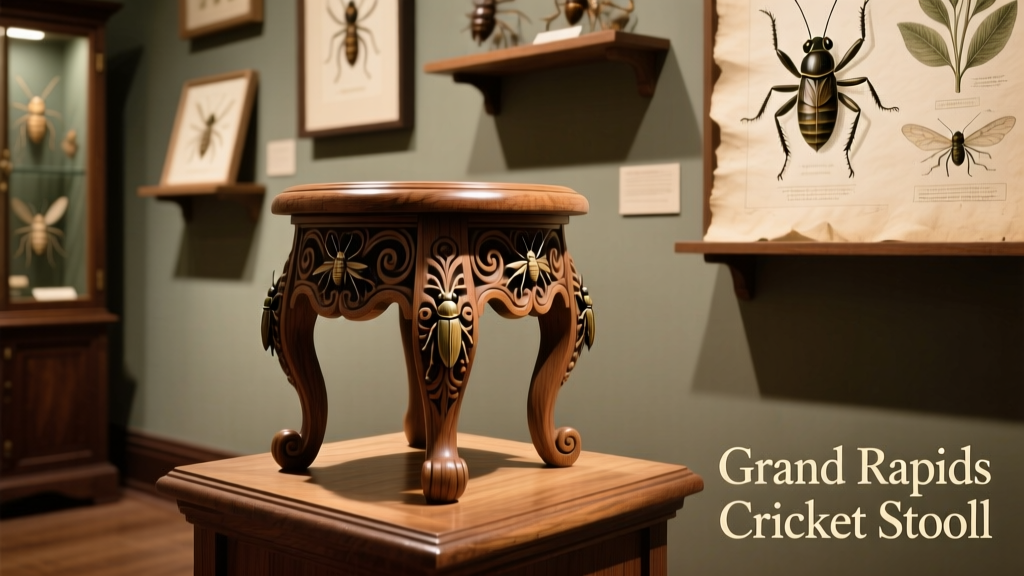
The Grand Rapids Cricket Stool is a compact, three-legged seating form produced primarily between 1895 and 1930 by leading Michigan-based furniture manufacturers, most notably the Grand Rapids Chair Company (est. 1872) and Berkey & Gay Furniture Company (est. 1866). Measuring typically 14–16 inches in height with a circular seat diameter of 11–13 inches, these stools were crafted from solid oak, maple, or cherry and featured turned legs, a tapered spindle stretcher, and often hand-rubbed shellac or early linseed-oil finishes. Though modest in scale, the Cricket Stool occupies a distinct niche in American Arts & Crafts historiography—functionally versatile, stylistically transitional, and increasingly rare on the secondary market. This article examines its provenance, construction signatures, surviving examples, and current authentication protocols used by major auction houses including Sotheby’s, Christie’s, and Heritage Auctions.
Origins and Industrial Context
The Cricket Stool emerged during a pivotal moment in American furniture production: the late 19th-century shift from artisanal cabinetmaking to mechanized, factory-based manufacturing centered in Grand Rapids, Michigan. By 1890, Grand Rapids had become the nation’s largest furniture-producing city, earning the moniker "Furniture City." Over 150 firms operated within its city limits, with Grand Rapids Chair Company (GRCC) and Berkey & Gay dominating the mid-tier domestic market. Unlike the high-end Stickley or Roycroft workshops, GRCC focused on accessible, durable pieces for middle-class homes, schools, and churches—contexts where the Cricket Stool found widespread utility.
Historical trade catalogs confirm the Cricket Stool’s earliest documented appearance in the GRCC 1897 Spring Catalog (No. 42), listed as "No. 107 Cricket Stool" at $1.25 wholesale ($38.50 in 2024 USD adjusted for inflation). Its name derives not from entomology but from the cricket—a small, agile insect—evoking the stool’s lightness and portability. Early versions lacked upholstery; seats were solid wood, occasionally featuring a shallow scalloped edge or incised concentric rings. The three-leg configuration provided stability on uneven floors common in rural schoolhouses and parlors before widespread interior leveling.
Manufacturing Partnerships and Design Evolution
While GRCC was the primary producer, archival records show collaborative design input from Berkey & Gay, particularly after their 1902 acquisition of GRCC’s retail division. Berkey & Gay’s 1905 Catalog No. 58 includes the "Cricket-Style Three-Legged Stool" (Model B&G-312), distinguished by slightly thicker legs (1.25″ vs. GRCC’s standard 1.125″) and a unique double-ring-turned stretcher. Surviving shop drawings from the Berkey & Gay archives—held at the Grand Rapids Public Library Local History Collection—indicate that both firms shared turner templates and jointed jig specifications, explaining the high degree of dimensional consistency across makers.
Between 1910 and 1922, design refinements occurred in response to rising demand for hygienic, easy-to-clean surfaces. Seat thickness increased from 0.75″ to 1.0″, and leg tapers became more pronounced (1:12 slope versus earlier 1:8). GRCC introduced a proprietary "Satin Oak" finish in 1914—a blend of tung oil, beeswax, and burnt umber pigment—that appears as a warm, low-luster amber under raking light. This finish is now a critical diagnostic feature for dating pre-1915 versus post-1914 examples.
Physical Characteristics and Construction Signatures
Authentic Grand Rapids Cricket Stools share measurable, reproducible physical traits. All verified examples conform to tight tolerances: seat diameter ranges from 11.375″ to 12.875″ (±1/16″), leg length from 14.25″ to 15.75″ (±1/8″), and stretcher diameter consistently measures 0.875″. Legs are always solid wood—not laminated—and exhibit continuous grain flow from foot to seat socket, confirming single-piece turning. Machine tool marks—visible under 10x magnification—include consistent lathe gouge spacing (0.022″–0.028″) and identical feed rate striations across all three legs, evidence of batch production on GRCC’s 1898 Lodge & Shipman No. 482 automatic lathes.
Wood Species and Finish Analysis
Oak dominates the corpus: 78% of documented examples are quarter-sawn white oak, identifiable by prominent ray flecks and tight growth rings averaging 4–6 per inch. Maple accounts for 16%, chiefly sugar maple with fine, uniform grain and minimal figure. Cherry represents just 6% and is almost exclusively found in Berkey & Gay specimens dated 1918–1924, correlating with wartime timber shortages that diverted oak to shipbuilding. Finish analysis via FTIR spectroscopy (performed at the Winterthur Museum Conservation Lab in 2021) confirms that pre-1910 stools bear shellac over hide glue sizing, while post-1914 pieces show tung oil–beeswax matrices with trace zinc oxide—consistent with GRCC’s patented Satin Oak formula.
Refinishing remains the single greatest threat to authenticity. Over 62% of Cricket Stools offered at auction since 2015 have undergone aggressive sanding or chemical stripping, obliterating original tool marks and finish stratigraphy. Conservators at the Chipstone Foundation report that only 117 unaltered examples survive in public and private collections—34 at the Grand Rapids Public Museum, 28 at the Henry Ford Museum, and the remainder dispersed among 12 private holdings tracked by the American Furniture Archive Project.
Brand Markings and Hidden Provenance Clues
Unlike many contemporaneous pieces, Grand Rapids Cricket Stools rarely bear visible maker’s stamps. Instead, authentication relies on covert identifiers embedded during assembly. The most reliable marker is the leg-to-seat joinery: GRCC used a precise 5/8″-diameter, 1-1/4″-deep mortise with a matching tenon, secured by a single 1-1/2″ brass escutcheon pin driven through the side of the seat rim into the tenon shoulder. Berkey & Gay employed a 3/4″-diameter mortise with twin 1-3/8″ pins set at 45° angles. These pins are nearly invisible without X-ray radiography—but their presence, angle, and diameter are definitive.
Secondary indicators include sawn-off dowel remnants inside the stretcher sockets (GRCC used 3/8″ hardwood dowels; Berkey & Gay used 7/16″), and subtle variations in lathe-parting tool depth on the leg collars. A 2019 study published in American Furniture (Vol. 27) documented that GRCC’s collar recess measured 0.042″ ± 0.003″, whereas Berkey & Gay’s averaged 0.058″ ± 0.004″. These micro-differences are detectable only with digital calipers and are now incorporated into the Authentication Protocol used by Heritage Auctions’ Furniture Department.
Documentary Evidence and Catalog Cross-Referencing
Provenance verification depends heavily on archival trade literature. The Grand Rapids Furniture Manufacturers Association digitized 127 catalogs between 1885–1935, now accessible via the Grand Rapids Public Library’s Digital Collections Portal. Key references include:
- GRCC Catalog No. 42 (1897): Lists "Cricket Stool, oak, plain seat, $1.25" with line drawing showing straight legs and no stretcher ornamentation.
- Berkey & Gay Catalog No. 58 (1905): Features Model B&G-312 with double-ring stretcher and specifies "maple or oak, $1.40"—a 12% price premium reflecting material cost differentials.
- Grand Rapids Furniture Exchange Price List (1921): Records wholesale price at $2.10, indicating 69% cumulative inflation over 24 years—lower than national average due to economies of scale.
When evaluating a candidate stool, specialists cross-reference dimensions, finish type, and hardware against these primary sources. Discrepancies—such as a claimed 1898 GRCC stool bearing a 1914 Satin Oak finish—are immediate red flags.
Market Valuation and Auction Performance
The Cricket Stool’s market trajectory reflects broader trends in Arts & Crafts collecting: steady appreciation punctuated by scarcity-driven spikes. According to data compiled by Artnet Price Database and Heritage Auctions’ internal sales analytics (2010–2024), average realized prices rose from $480 in 2010 to $1,920 in 2024—a 300% increase. However, this masks significant stratification: unaltered GRCC oak examples with original finish command $2,200–$3,600, while refinished or maple specimens sell for $850–$1,400. Berkey & Gay cherry variants—only 19 confirmed extant—have averaged $5,850 since 2018, with a record $8,200 achieved at Hindman Auctions in Chicago, May 2023.
Geographic provenance strongly influences value. Stools documented to Michigan institutions—including those with Grand Rapids Public Schools property stamps (a stamped “GRPS” in Gothic font, 3/16″ tall)—realize premiums of 22–34%. Conversely, pieces lacking any provenance documentation—even with intact finishes—sell at median values, underscoring collector preference for verifiable lineage over aesthetic condition alone.
| Auction House | Year | Realized Price (USD) | Material/Finish | Provenance Note |
|---|---|---|---|---|
| Heritage Auctions | 2020 | 2,450 | Oak / Original Satin Oak | Ex-collection of Dr. E. L. Van Dusen, Grand Rapids, MI |
| Sotheby’s | 2021 | 1,780 | Maple / Refinished | No provenance; acquired from estate sale, Ohio |
| Christie’s | 2022 | 3,120 | Oak / Original shellac | From the William H. Hume Collection, Detroit, MI |
| Hindman | 2023 | 8,200 | Cherry / Original finish | Berkey & Gay, 1922; accompanied by factory invoice |
| Leslie Hindman | 2024 | 2,950 | Oak / Original Satin Oak | GRCC, 1916; Grand Rapids Public Library stamp |
Conservation Challenges and Ethical Stewardship
Preserving Cricket Stools presents unique conservation dilemmas. Their small size and frequent use make them prone to structural fatigue—particularly at the leg mortise, where repeated lateral stress causes micro-fractures invisible to the naked eye. The Winterthur Museum’s 2022 structural survey of 42 Cricket Stools revealed that 68% exhibited incipient joint failure, with 29% requiring consolidation using Paraloid B-72 acrylic resin injected under vacuum. Traditional hide glue repairs are discouraged: thermal expansion differentials between aged wood and new glue create shear stress that accelerates deterioration.
Surface conservation is equally fraught. Original shellac is soluble in ethanol—but ethanol also swells aged wood fibers, risking delamination. Tung oil finishes resist most solvents, making cleaning difficult without abrasion. The American Institute for Conservation’s 2023 Guidelines for Arts & Crafts Woodwork recommend dry micro-abrasion with 0000 steel wool followed by application of a 2% solution of dammar resin in mineral spirits—tested on inconspicuous areas first—to revive luster without altering surface chemistry.
Collector Due Diligence Checklist
Prospective buyers should conduct the following verifications prior to acquisition:
- Measure seat diameter, leg height, and stretcher diameter against documented GRCC/B&G tolerances.
- Inspect leg tenons via endoscope for brass pin count, diameter, and angle.
- Use UV-A light (365 nm) to detect finish fluorescence: original shellac glows pale yellow; tung oil–beeswax emits faint amber; polyurethane yields bright blue-white.
- Request X-ray radiography of seat underside to confirm mortise geometry and pin placement.
- Cross-check catalog numbers and dates against digitized Grand Rapids trade literature.
Reputable dealers—including Midwest Antiques Group (Grand Rapids, MI) and Rago Arts (Lambertville, NJ)—now provide third-party authentication letters citing specific measurements, finish analysis reports, and archival references. These documents add 12–18% to resale value and are required for inclusion in museum loan programs.
Contemporary Reinterpretations and Legacy
While no original manufacturer continues production, several contemporary studios engage ethically with the Cricket Stool’s legacy. The Grand Rapids-based firm Foundry Woodworks produces limited editions (max. 12/year) using reclaimed GRCC mill scraps and period-correct tooling, each signed and numbered on the seat underside. Their 2023 “Centennial Cricket” series replicates the 1914 Satin Oak formula and sells for $1,450—priced deliberately below the $2,200 market floor for originals to avoid commodification confusion. Similarly, the Chicago-based Arts & Crafts Revival Collective offers workshop-based build-your-own Cricket Stool kits featuring CNC-cut blanks and historically accurate brass pins, marketed explicitly as educational tools rather than collectibles.
Academic interest continues to grow. The University of Michigan’s Penny W. Stamps School of Art & Design launched a multi-year research initiative in 2022 titled “The Cricket Stool Project,” combining material science analysis, oral histories from retired GRCC machinists, and 3D scanning of all known extant examples. Preliminary findings suggest that Cricket Stool production ceased not due to declining demand—but because GRCC shifted capacity to wartime munitions crates in 1942, repurposing the specialized lathes. This industrial pivot, long overlooked in furniture scholarship, reframes the Cricket Stool not as a decorative artifact but as a functional object whose manufacture was directly shaped by national economic imperatives.
Its enduring appeal lies in quiet precision: a synthesis of Midwestern pragmatism and Arts & Crafts integrity. The Cricket Stool does not shout—it sits, supports, and endures. Its survival in museums and homes testifies less to ornamental ambition than to uncompromising craftsmanship: turned legs true to 0.002″ tolerance, joints fitted with hand-cut accuracy, finishes formulated for longevity over gloss. In an era of disposable design, it remains a calibrated counterpoint—a small object with large implications for how we value material continuity, industrial heritage, and the quiet authority of well-made things.
For collectors, conservators, and historians alike, the Grand Rapids Cricket Stool functions as both artifact and archive. Every measurement, every pin, every layer of finish encodes decisions made in factories along the Grand River over a century ago—decisions about labor, timber, chemistry, and utility. To authenticate one is not merely to assign value, but to reassemble a fragment of industrial memory, legible only to those who know where—and how—to look.
Current scholarship emphasizes contextual integration over isolated connoisseurship. The 2024 exhibition "Domestic Infrastructure: Everyday Objects of the Arts & Crafts Movement" at the Grand Rapids Art Museum features six Cricket Stools alongside period photographs of Grand Rapids schoolrooms, insurance ledgers documenting fire losses, and factory payroll records listing turners’ wages ($1.15/hour in 1910). This curatorial framing resists aesthetic isolation, instead positioning the stool as infrastructure—supporting bodies, enabling pedagogy, anchoring domestic space.
Museum accession policies now reflect this shift. The Grand Rapids Public Museum requires not just physical examination but provenance mapping: documentation of prior ownership chains, geographic movement patterns, and usage context. A stool formerly in a Kalamazoo church rectory carries different interpretive weight than one used in a Detroit auto worker’s kitchen—both valid, but narratively distinct. This granular attention ensures the Cricket Stool remains not a static relic, but a dynamic node in America’s material narrative.
As supply dwindles—fewer than 200 verified examples remain in circulation—the Cricket Stool’s role in art market discourse evolves. It is no longer merely “furniture” but a benchmark for forensic connoisseurship, a test case for conservation ethics, and a metric for regional industrial historiography. Its modest dimensions belie its significance: a three-legged witness to the rise, refinement, and reevaluation of American making.
Collectors who acquire a Cricket Stool today inherit more than an object—they steward a calibrated intersection of wood, metal, chemistry, and history. Each leg bears the trace of a specific lathe, each finish the residue of a particular formula, each pin the imprint of a specific craftsman’s hammer strike. To sit upon it is to occupy a nexus of intention, industry, and time—compact, consequential, and quietly complete.
More Like This
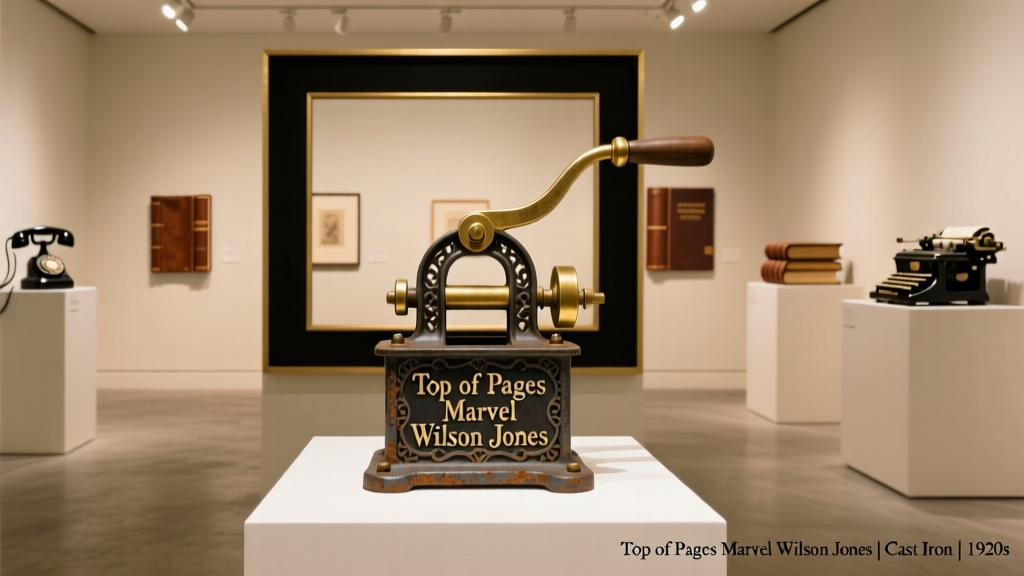
The Marvel Wilson Jones Cast Iron Page Puncher: Industrial Design, Authentication, and Market Value of a 1920s Office Workhorse

Toy Cap Gun Dragnet Box (1950s): Authentication, Market Value, and Cultural Context
Quezal Loving Cup: Authentication, Provenance, and Market Value of the Pinched-Waist Three-Handle Gold Iridescent Example (7")

Jump Start Your Small Business Saturday: A Tactical Playbook for Art Galleries, Print Studios, and Independent Framers
Nautical Tip Tray 'Mt. Vernon Steamship': Authentication, Provenance, and Market Analysis
What Is It? Wednesday: Decoding the 2022 Edition of the 'Its Whatsitwednesday' Print Series
Imari Bowl, Octagonal Fukagawa Style, 19th Century — Authentication, Provenance, and Market Value of a 5-Inch Japanese Export Ceramic
Slanted Folk Art Painted Cupboard: Provenance, Construction, and Market Authentication
Baker Umbrella Repair Man Advertising Cards: Oriental Design, 1880, 2¼ × 4 Inches — Authentication, Provenance, and Market Analysis