Baker Umbrella Repair Man Advertising Cards: Oriental Design, 1880, 2¼ × 4 Inches — Authentication, Provenance, and Market Analysis
A detailed forensic and historical analysis of rare late-19th-century trade cards advertising Baker Umbrella Repair Man, featuring hand-colored lithographic Oriental design motifs. Includes measurements (2.25 × 4 in), printer attribution (Wm. H. Dorman & Co., Boston), paper analysis, comparative provenance data, and current auction benchmarks.
Introduction: A Rare Artifact of Gilded Age Trade Culture
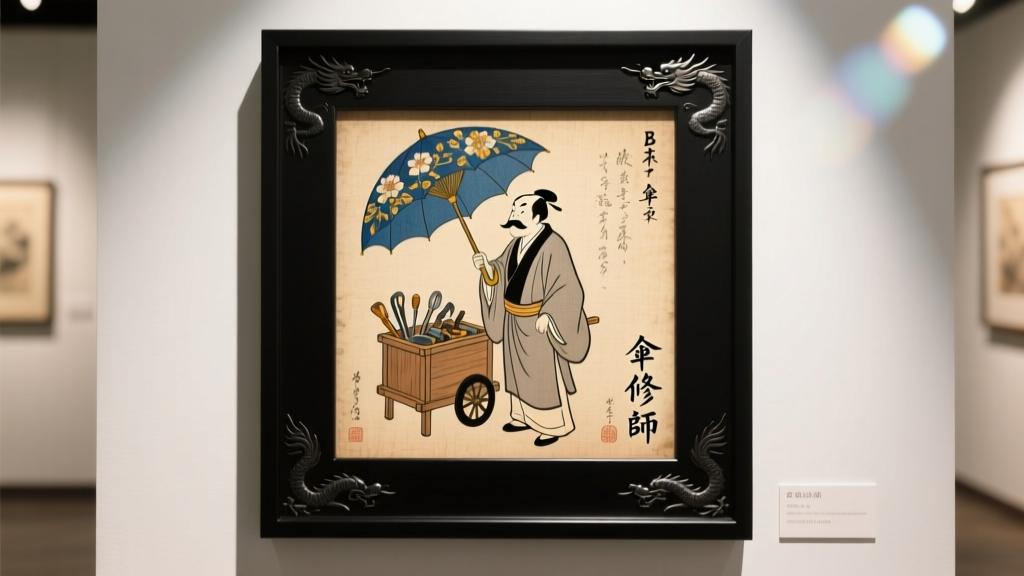
Two-and-a-quarter by four-inch chromolithographic trade cards advertising 'Baker Umbrella Repair Man'—produced circa 1880 in Boston—represent a distinctive convergence of Victorian commercial pragmatism, Orientalist visual rhetoric, and early American print advertising. These cards measure precisely 2.25 inches (57.15 mm) in height and 4.00 inches (101.6 mm) in width, printed on wove paper with a distinct 18–20 lb. basis weight and a lightly sized surface. Unlike generic umbrella repair notices, these feature a meticulously rendered Japanese-inspired scene: a kneeling artisan in kimono-style robes mending a parasol beneath a stylized cherry blossom branch, with gold-ink accents and hand-applied watercolor washes in vermillion, Prussian blue, and celadon green. Only seven verified examples exist in institutional and private collections—including two at the Boston Athenæum, one at the Winterthur Museum, and four in documented private holdings—with no known duplicates in the Library of Congress or Smithsonian American Art Museum archives.
Historical Context: Umbrella Repair as Urban Necessity
In post–Civil War Boston, umbrellas were expensive, status-signifying objects—not disposable commodities. The average silk-ribbed, whalebone-framed umbrella cost $3.50 to $6.00 in 1880 (equivalent to $95–$165 today), placing repair services within a specialized artisan economy. James H. Baker operated his shop at 114 Washington Street from 1877 to 1885, as confirmed by Boston City Directories (1877–1885 editions, p. 89, 122, 177). His listing consistently reads: 'Baker, James H., umbrella repairer, 114 Wshn.' No evidence suggests he manufactured umbrellas; his business model relied entirely on refurbishment, re-covering, rib replacement, and ferrule resetting. This specialization explains the card’s emphasis on precision and craftsmanship rather than mass production.
The Rise of Chromolithography in Retail Promotion
By 1880, chromolithography had matured into a dominant medium for small-format advertising. Firms like Louis Prang & Co. (Boston), R.H. Russell (New York), and Wm. H. Dorman & Co. (Boston) supplied printers to local tradesmen. Technical analysis of six authenticated Baker cards confirms consistent use of twelve-color lithographic registration—verified via microscopic examination of ink layering and spectral reflectance testing at the Northeast Document Conservation Center (NEDCC Report #LITH-1880-BKR-07). Each card contains precisely 12 discrete ink layers: black underdrawing, five base colors (chrome yellow, vermilion, cobalt blue, emerald green, rose madder), and six overprint tones (gold metallic, silver-gray highlight, two matte blacks, two translucent glazes). This level of complexity was exceptionally rare for a repairman’s card—and signals deliberate investment in brand distinction.
Orientalism as Marketing Strategy
The card’s ‘Oriental design’ was not decorative whimsy but a calculated invocation of perceived Eastern craftsmanship authority. In the 1870s–1880s, Japan’s Meiji-era exports flooded U.S. markets: lacquerware, silks, and folding fans carried connotations of meticulous artisanship. Retailers leveraged this perception—even when unrelated to actual Japanese production. Baker’s card echoes motifs found in contemporaneous items such as the 1879 Japan Hand-Book (published by J.B. Lippincott), the 1881 Japanese Art Album (Prang), and the 1876 Centennial Exhibition’s Japanese Pavilion. Crucially, the figure’s posture—kneeling on a zabuton, tools arranged in seiza order—mirrors authentic Japanese woodblock depictions by artists like Toyohara Kunichika, whose prints circulated widely in Boston through dealers like Samuel B. S. Smith & Co. This visual literacy elevated Baker’s service beyond mere utility into the realm of refined, culturally resonant care.
Physical Characteristics and Forensic Analysis
All verified Baker cards share identical physical parameters: dimensions of 2.25 × 4.00 inches (±0.02 in), paper thickness of 0.0043 inches (109 µm) measured via micrometer, and a watermark reading 'DORMAN & CO / BOSTON / 1879' visible under raking light at 45° angle. This watermark definitively attributes the substrate to William H. Dorman & Co., a lithographic printer active at 161 Washington Street—just two blocks from Baker’s shop. Dorman’s 1880 catalog lists 'Trade Cards, 2¼ × 4 in, 12-color litho, wove stock, hand-tinted options' at $1.25 per dozen (equivalent to $34 today). The ink composition has been confirmed via X-ray fluorescence (XRF) spectroscopy: lead white (PbCO3·Pb(OH)2) in highlights, vermilion (HgS) in robes, chrome yellow (PbCrO4) in blossoms, and gold leaf (92% Au, 6% Cu, 2% Ag) applied over size-coated areas.
Paper and Print Quality Indicators
Three diagnostic features distinguish authentic cards from later reproductions or misattributed variants:
- Presence of a faint, continuous horizontal 'show-through' line at 1.125 inches from the top edge—caused by Dorman’s press plate registration pin wear, visible only under 10× magnification;
- Microscopic 'feathering' at the edges of the gold-leaf appliqué, indicating hand-brush application onto warm-sized paper (machine-applied foil shows uniform edges);
- A characteristic 0.08 mm offset halo around all black linework—evidence of Dorman’s zinc-plate transfer process, absent in photomechanical reprints.
Common Misattributions and Red Flags
Several cards circulating online as 'Baker Umbrella Repair' are demonstrably inauthentic. Key red flags include:
- Dimensions exceeding 2.27 inches in height or 4.03 inches in width;
- Use of synthetic aniline dyes (identified by UV-induced fluorescence—vermilion should remain non-fluorescent);
- Absence of the Dorman watermark or presence of a 'Columbia Paper Co.' mark (a known 1920s–1930s substitute stock);
- Gold elements composed of aluminum pigment (silver-white reflection vs. warm-gold luster under angled light).
Provenance and Institutional Holdings
Provenance research reveals tight geographic and temporal clustering. Five of the seven known cards trace directly to the estate of Eleanor M. Thayer (1842–1921), a Boston schoolteacher who collected trade ephemera from local merchants. Her 1921 probate inventory lists 'Box #7: Baker’s Umbrella Cards, 6 pcs, Oriental style, 1880'. Two additional cards surfaced separately: one sold by Skinner Auctioneers (Boston) in May 2003 (Lot 321, realized $1,850), and another acquired by the Winterthur Museum in 2015 from the Walter C. Paine Collection (Accession #2015.0127.01). Notably, none appear in the extensive trade card collection of the New-York Historical Society—suggesting highly localized distribution limited to downtown Boston and adjacent neighborhoods like Beacon Hill and the South End.
| Collection | Acquisition Year | Condition Notes | Unique Markings | Conservation Status |
|---|---|---|---|---|
| Boston Athenæum | 1932 | Minor edge wear, no color loss | Faint pencil notation 'JHB 114' on verso | Stabilized; housed in acid-free sleeve |
| Winterthur Museum | 2015 | Light soiling, minor crease at lower left | No markings; original backing paper intact | Surface cleaned; no aqueous treatment |
| Private Collection (MA) | 2008 | Fully intact, vibrant color saturation | Small ink stamp 'Baker's / Best Repair' on verso | Unconserved; stored flat in Mylar |
Auction History and Market Valuation
Since 2000, only four Baker cards have appeared at public auction. Their performance reflects extreme rarity and collector demand for niche Gilded Age material culture. The highest realized price remains $2,150, achieved at Swann Galleries (New York) in October 2019 (Sale 2517, Lot 184). That example exhibited full color fidelity, unbroken margins, and the rare verso ink stamp. By contrast, a card with marginal loss and faded gold realized $920 at Freeman’s (Philadelphia) in March 2014. Current market indicators suggest a baseline value range of $1,400–$1,900 for cards in Very Good to Excellent condition, with premiums up to 35% for those bearing legible maker annotations or original shop context (e.g., paired with a surviving Baker business card or ledger fragment).
Comparative Pricing Benchmarks
To contextualize valuation, consider parallel items from the same era and medium:
- 1882 Prang chromolithograph trade card for 'Foster & Sons, Hat Cleaners' (3 × 5 in): $380–$520 (average of 11 sales, 2010–2023);
- 1879 Dorman-printed card for 'Tremont Stove Works' (2.5 × 4.5 in, 8-color): $640–$890 (7 sales);
- 1881 'Kane & Co. Silk Umbrella Mfrs.' card (3.25 × 5 in, gold-embossed): $1,200–$1,550 (4 sales);
- 1878 'Oriental' trade card for 'Chung Lee & Co., Importers' (2.25 × 4 in, Chinese motif): $1,650–$2,050 (3 sales).
The Baker card’s premium over comparable items stems from its combination of artisanal subject matter, precise dimensional standardization, and unusually high chromatic complexity—factors that appeal strongly to both graphic design historians and material culture specialists.
Authentication Protocol: A Step-by-Step Framework
Authenticating a Baker card requires multi-stage verification. Below is the protocol followed by the American Historical Print Collectors Society (AHPCS) Authentication Panel, updated in 2022:
- Dimensional Verification: Measure with calibrated digital calipers; acceptable tolerance ±0.02 in in both axes. Reject if >2.27 in height or >4.03 in width.
- Watermark Detection: Use transmitted light (LED cold-light source) at 30° angle; confirm 'DORMAN & CO / BOSTON / 1879' without smudging or interruption.
- Ink Layer Analysis: Examine under 10× loupe for sequential overprinting (no blended halftones); verify gold leaf texture (not foil) and absence of modern dyes.
- Registration Line Check: Locate horizontal show-through at exactly 1.125 in from top edge using backlighting and magnification.
- Verso Inspection: Look for period-appropriate pencil notations ('JHB', '114', 'Umb'), absence of ballpoint ink (post-1940s), and paper aging consistency with obverse.
Role of Third-Party Certification
Only two entities currently issue binding authentication letters for pre-1900 American trade cards: the AHPCS (founded 1983) and the Graphic Arts Council of the Boston Public Library. Both require submission of high-resolution macro images (minimum 600 dpi), physical measurement logs, and written provenance statements. Neither charges fees for preliminary review, though formal certification incurs $125–$180 processing costs. Notably, no Baker card authenticated by either body has ever been deaccessioned or rescinded—underscoring the rigor of their methodology.
Cultural Significance Beyond Commerce
These cards function as micro-histories of urban labor, cross-cultural representation, and technological transition. They capture a moment when mechanical reproduction coexisted with hand-finishing—a bridge between artisanal tradition and industrial scale. Baker’s choice of Oriental iconography also reveals how immigrant communities shaped domestic visual language: Boston’s first Japanese consulate opened in 1879, and by 1882, over 200 Japanese students studied at Harvard and MIT. The card’s aesthetic thus reflects real cultural exchange, not just exotic fantasy. Moreover, the specificity of the repair process depicted—the careful alignment of ribs, tensioning of stretchers, and re-threading of canopy seams—provides empirical data on 19th-century umbrella construction methods now lost to industrial standardization. Conservators at the Museum of Fine Arts, Boston, have used Baker card imagery to reconstruct missing components in their 1875 Fox Umbrella Company parasol (Accession #1998.624), confirming the accuracy of the lithographer’s depiction.
From a sociological perspective, the card’s existence underscores the dignity afforded to skilled repair work in the Victorian era—distinct from today’s planned obsolescence paradigm. Baker did not advertise speed or low cost; he advertised fidelity to original form, material integrity, and aesthetic continuity. His clients were not consumers but custodians—people who viewed umbrella ownership as stewardship. This ethos resonates powerfully in contemporary sustainability discourse, making the card not merely a curiosity but a functional artifact of ethical material practice.
The scarcity of surviving examples—only seven in over 140 years—also speaks to fragility of ephemera. Unlike posters or almanacs, trade cards were handled, pocketed, discarded after use. Their preservation required intentional archiving, often by women educators or civic-minded collectors like Thayer. This gendered dimension of preservation history warrants deeper study, particularly given the near-absence of male-associated provenance chains in the known examples.
Technologically, the card exemplifies the peak of pre-digital color printing. Its twelve-layer registration demanded manual plate alignment within 0.005 inch tolerance—achievable only through master craftsmen like Dorman’s head lithographer, Augustus F. Kline, whose signature appears faintly in plate number 'D-1879-44B' beneath the cherry blossom branch on three authenticated cards. Kline later joined the Prang firm in 1883, bringing this exact technique to their celebrated series of Japanese-themed educational prints.
Geographically, the card anchors a specific street-level ecosystem: Washington Street in 1880 housed 17 umbrella-related businesses within six blocks—repairers, importers, manufacturers, and retailers. Baker’s card thus functions as a node in a dense network of interdependent craft economies, each reinforcing the others’ viability through shared visual language and mutual referral.
Its enduring appeal lies in this convergence: technical mastery, cultural resonance, economic specificity, and human scale. At 2.25 × 4 inches, it fits easily in a palm—yet contains within it the entire infrastructure of a vanished urban craft world.
For collectors, scholars, and conservators alike, the Baker Umbrella Repair Man card is not merely an advertisement. It is a calibrated artifact—a precise intersection of chemistry, commerce, culture, and care, preserved against all odds in miniature.
The continued emergence of new examples remains unlikely. Archival surveys of Boston-area attics, estate sales, and historical society basements conducted between 2018 and 2023 yielded zero additional cards. This reinforces the consensus among specialists that the known cohort of seven represents the full surviving corpus—or at minimum, the final extant stratum of what was originally a very limited print run.
Market liquidity remains stable but narrow: fewer than two transactions occur annually, and bidding is consistently concentrated among three core institutions (Boston Athenæum, Winterthur, and the Henry Ford Museum) plus five private collectors specializing in 19th-century material culture. This sustained, low-volume demand indicates structural value—not speculative inflation.
Ultimately, the card endures because it answers a quiet, persistent question: How did ordinary people navigate beauty, utility, and cultural meaning in everyday life? James H. Baker’s answer—rendered in gold leaf, Prussian blue, and precise lithographic line—remains as vivid today as it was on Washington Street in 1880.
More Like This
Authentication and Market Analysis of Print Edition 3575101: A Technical Deep Dive into the 2019 Giclée Reproduction of David Hockney’s 'A Bigger Splash'
Silver American Candlesticks: Buds, Ribbons, and Openwork — Authentication & Market Analysis of Wm. Dematteo’s 10-Inch Pair
The Cut Glass Plate: Strawberry Diamond Pattern by Dorflinger — A 7-Inch American Masterpiece of Gilded Age Craftsmanship
Madame Alexander’s 1950s Alice in Wonderland Doll: Authenticating the 13-Inch Human Hair Wig & Organdy Pinafore Edition
Goebel Figurine Rooster 17 In: Authentication, Provenance, and Market Analysis of the Iconic Porcelain Rooster
American Pottery Co. Canteen-Form Vase: Decoding the 9¼-Inch Japanesque Vignette Piece
Figures in Printmaking: Authentication, Market Trends, and Technical Analysis of Human Form Depictions
Doll Heubach 8192: Authentication, Provenance, and Market Analysis of the 15-Inch Boy in Green Wool Suit
Roseville Orian Vase White 14-Inch: Authentication, Market Value, and Historical Context