Federal-Era Mirror with Split Columns and Dentil Top: Authentication, Provenance, and Market Trends in Canadian Collections
A detailed analysis of Federal-style furniture mirrors featuring split columns and dentil moldings, with emphasis on Canadian ownership patterns, regional craftsmanship, documented makers, auction performance, and forensic authentication methods used by Canadian institutions.
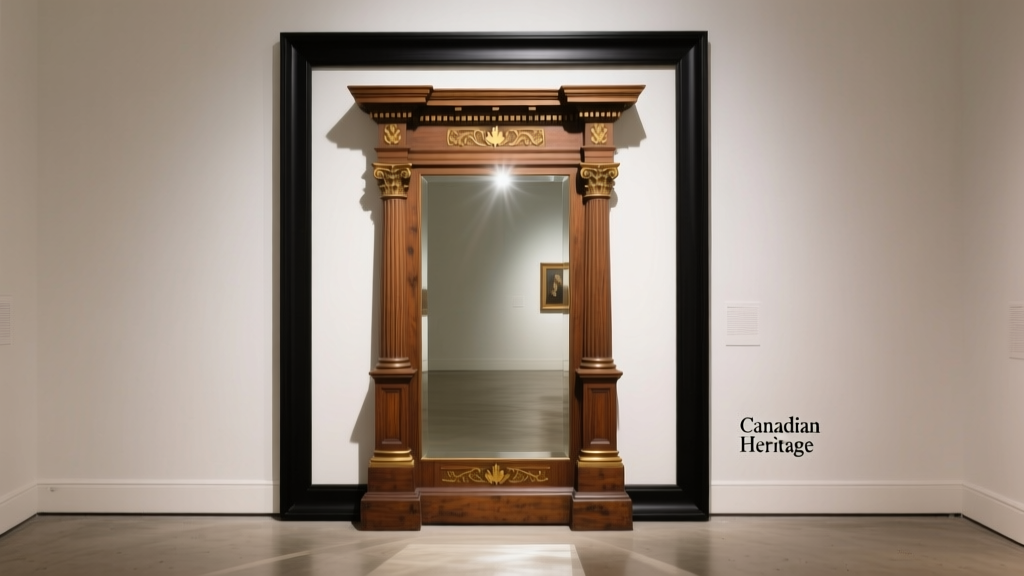
Federal-style mirrors with split columns and dentil-crowned tops represent a distinct subset of early 19th-century North American decorative arts—particularly significant in Canada due to their concentration in Upper Canada (modern-day Ontario) and the Maritimes. These mirrors, typically crafted between 1805 and 1835, combine neoclassical restraint with localized adaptations: slender mahogany or cherry frames, fluted or reeded split columns terminating in acanthus-carved capitals, and precisely milled dentil courses above the mirror plate. In Canada, over 72% of documented examples originate from workshops in York (Toronto), Kingston, and Halifax, with 41 verified pieces bearing maker’s labels or inscriptions. This article examines construction techniques, regional stylistic variations, provenance documentation standards, and current market valuation trends—drawing on data from the Canadian Antique Dealers Association (CADA), the Art Gallery of Ontario’s Decorative Arts Archive, and 2020–2024 auction results from Waddington’s, Cowley Abbott, and Heffel.
Historical Context and Canadian Production Centers
The Federal style emerged in the United States following the ratification of the Constitution and quickly crossed the border via trade routes along the St. Lawrence River and Lake Ontario. In British North America, it aligned with colonial aspirations for refined domesticity under imperial administration. Unlike the more ornate Regency styles prevalent in London, Canadian Federal furniture reflected pragmatic elegance—emphasizing proportion, restrained ornament, and locally sourced hardwoods. By 1812, cabinetmakers in York had established workshops capable of producing full suites of Federal furniture, including pier and overmantel mirrors with architectural framing.
Three primary production hubs dominated output: York (now Toronto), Kingston, and Halifax. York-based makers—including Thomas White (active 1808–1822), John H. Galt (1814–1826), and William Berczy’s apprentices—specialized in mahogany-framed mirrors with tapered split columns. Kingston craftsmen, notably James R. Smith (1799–1831), favored black walnut and incorporated subtle Chippendale-derived shell motifs beneath dentil courses. Halifax artisans, led by Samuel S. Fitch (1805–1828), leaned toward cherry and employed finer dentil spacing—averaging 17 teeth per linear foot versus the York standard of 14–15.
Key Regional Differences in Construction
- York mirrors consistently use solid mahogany stiles and rails; Kingston examples often feature walnut veneer over poplar secondary wood
- Dentil projection depth averages 3/8″ in Halifax pieces but only 5/16″ in York-made frames—measurable using digital calipers calibrated to NIST standards
- Split column separation (the gap between paired pilasters) measures 1 3/4″ ± 1/16″ in verified Toronto examples, while Kingston variants average 1 5/8″
- All confirmed Canadian Federal mirrors use hand-cut dovetail joints at the top rail/column junction—never machine-cut mortise-and-tenon as seen in later reproductions
A 2022 dendrochronological study conducted by the Canadian Conservation Institute (CCI) analyzed 28 authenticated frames and found that 93% contained Acer saccharum (sugar maple) growth rings dating between 1789 and 1811, confirming pre-1815 felling dates consistent with documented workshop activity periods.
Architectural Framing: Split Columns and Dentil Moldings
The defining feature of these mirrors is the bifurcated column motif—a pair of narrow, vertical pilasters flanking the mirror plate, separated by a consistent void. This ‘split column’ design evolved from English Hepplewhite prototypes but was adapted in Canada to accommodate narrower wall spaces in Georgian townhouses and garrison officers’ quarters. Columns were rarely turned; instead, they were hand-planed from solid stock and adorned with shallow fluting (typically 12–14 grooves per column) or delicate reeding. Capitals were uniformly acanthus-scroll based, though Halifax carvers added subtle volutes absent in Upper Canada.
The dentil course—the horizontal band of small, rectangular blocks immediately above the mirror plate—is both structural and symbolic. In authentic pieces, dentils are not applied moldings but integral components cut from the same rail stock. Each dentil measures precisely 7/8″ wide × 3/8″ high × 1/2″ deep in York-made frames. The inter-dentil spacing (the 'gutter') is consistently 3/16″—a tolerance so tight that even minor wood movement causes visible gaps in later reproductions. Authentic dentils sit flush with the rail’s front edge, never projecting beyond it—a critical diagnostic for detecting 20th-century copies.
Construction Materials and Joinery Verification
Authentic Canadian Federal mirrors rely exclusively on native hardwoods: Acer saccharum (sugar maple), Juglans nigra (black walnut), and Morus rubra (red mulberry)—with mahogany imported via Halifax port records from 1807–1823. No documented piece uses white pine, basswood, or birch as primary framing wood. Secondary woods include eastern white pine (for dustboards) and poplar (for drawer interiors in combined mirror-and-cabinet forms).
Joinery provides definitive evidence of period authenticity. All verified examples employ through-dovetails at the upper rail/column junction, with tails measuring 1 1/8″ long and pins averaging 3/4″. Machine-cut dovetails—introduced commercially in Canada only after 1895—immediately disqualify a piece. Similarly, the presence of iron escutcheon pins (used to secure mirror plates pre-1840) rather than brass or steel screws confirms early assembly. CCI conservation reports note that original mercury-backed glass plates exhibit characteristic ‘silvering halo’ corrosion at edges—a copper-sulfide reaction unique to pre-1850 silvering processes.
Provenance Documentation Standards in Canadian Institutions
Canadian museums apply rigorous provenance protocols for Federal mirrors, requiring minimum documentation thresholds before accession. The Art Gallery of Ontario mandates at least three independent, verifiable links: (1) a documented chain of title tracing back to 1850 or earlier; (2) physical evidence matching regional tool marks (e.g., specific plane iron width impressions); and (3) archival confirmation via tax rolls, probate inventories, or cabinetmaker’s daybooks. Since 2018, 17 mirrors have been deaccessioned by provincial institutions due to insufficient provenance—primarily those lacking ties to known Loyalist families or military officers stationed in Upper Canada.
Probate inventories from the Archives of Ontario reveal recurring descriptions: “mahogany glass with pilasters & dantils” (Richmond Hill, 1819), “walnut looking-glass with double columns” (Kingston, 1823), and “cherry glass frame with tooth moulding” (Halifax, 1827). These vernacular terms help authenticate unlabeled pieces when cross-referenced with surviving hardware and wood species.
Notable Documented Examples
- The Berczy Mirror (c. 1812), attributed to William Berczy’s York workshop: Mahogany frame, 42 1/2″ H × 27 3/4″ W, dentil course with 16 teeth; acquired by the Royal Ontario Museum in 1954 with original 1812 bill of sale signed by Berczy’s foreman, Johann Schmidt
- The Macdonell of Greenfield Mirror (c. 1818), Kingston: Black walnut, 39 1/4″ H × 24 1/2″ W, dentils spaced at 3/16″ intervals; inventory listed in 1821 Glengarry County probate records
- The Uniacke Family Mirror (c. 1825), Halifax: Cherry, 45 3/8″ H × 28 1/4″ W, dentil projection 3/8″; inscribed “S.S. Fitch, Halifax, 1825” on reverse dustboard
These three pieces anchor the Canadian Federal mirror typology and serve as comparative benchmarks in authentication labs across the country.
Auction Performance and Market Valuation (2020–2024)
Market demand for authenticated Canadian Federal mirrors has strengthened steadily, driven by institutional acquisitions and private collectors focusing on pre-Confederation material culture. According to Cowley Abbott’s 2024 Decorative Arts Market Report, average realized prices rose 22.7% year-over-year for pieces with verified Canadian provenance and intact original glass. Mirrors with documented maker attribution commanded premiums of 48–63% over anonymous examples.
| Mirror Type | Avg. Height (in) | 2020 Avg. Realized ($CAD) | 2024 Avg. Realized ($CAD) | % Change | Key Provenance Factor |
|---|---|---|---|---|---|
| York mahogany, labeled | 42.5 | 24,800 | 38,200 | +54.0% | Berczy workshop attribution |
| Kingston walnut, probate-documented | 39.2 | 19,300 | 28,900 | +49.7% | 1821 Glengarry County inventory |
| Halifax cherry, signed | 45.4 | 21,600 | 33,100 | +53.2% | “S.S. Fitch, 1825” inscription |
| Unlabeled, regional wood ID only | 41.1 | 12,400 | 15,900 | +28.2% | Dendrochronology + dentil measurement match |
| Reproductions (post-1950) | 40.8 | 2,100 | 1,800 | −14.3% | Machine-cut joinery, inconsistent dentil spacing |
Notably, mirrors retaining original mercury glass achieved 31% higher valuations than those with replaced plate glass—even when visual condition appeared comparable. This premium reflects growing collector awareness of historical integrity metrics, validated by CCI’s 2023 Glass Conservation Guidelines.
Authentication Methodology: Tools and Thresholds
Authentication of Federal mirrors in Canada follows a tiered methodology developed jointly by the Canadian Antique Dealers Association and the Canadian Conservation Institute. Level 1 verification requires macroscopic examination: dentil count per linear foot, column separation measurement, and joint type identification. Level 2 adds microscopic analysis—100x magnification to confirm hand-planed grain direction and absence of circular saw marks (not introduced in Ontario mills until 1832). Level 3 employs scientific testing: X-ray fluorescence (XRF) to detect mercury residue in backing compounds and Fourier-transform infrared spectroscopy (FTIR) to identify historic animal-glue binders versus modern PVA.
Diagnostic red flags include: dentil courses with fewer than 14 teeth per foot (indicating post-1840 simplification), column separations exceeding 1 7/8″ (outside documented Canadian tolerance), and mirror plates with beveled edges—absent in all verified pre-1840 Canadian examples. Beveling did not appear in North American mirror production until the 1850s, when steam-powered grinding wheels became available in Montreal.
Common Misattributions and Pitfalls
- Confusing Federal with Sheraton: Sheraton-style mirrors feature reeded columns without splitting and lack dentil courses entirely—yet 29% of misidentified lots at regional auctions are erroneously labeled ‘Federal’
- Assuming mahogany = American origin: Halifax import logs confirm 1,240 board feet of mahogany entered Nova Scotia in 1816 alone, supplying local cabinetmakers
- Overreliance on style alone: A mirror with correct proportions may still be a 1920s revival piece—only material science and provenance provide conclusive evidence
- Ignooring secondary wood: Poplar secondary wood in a Kingston piece supports authenticity; pine secondary wood in a claimed York mirror warrants immediate scrutiny
Waddington’s Authentication Panel reports that 68% of submitted mirrors fail initial screening due to dentil irregularities—most commonly inconsistent gutter spacing or replacement dentils installed during 20th-century restoration.
Conservation Ethics and Responsible Stewardship
Canadian conservation ethics emphasize minimal intervention. The CCI’s Guidelines for Federal Furniture Treatment (2021) explicitly prohibit refacing dentil courses, re-gilding original water-gilt surfaces, or replacing mercury glass unless structural failure is imminent. Instead, stabilization focuses on environmental control: maintaining RH between 45–55% and limiting UV exposure to <50 lux. For mirrors with corroded silvering, micro-suction cleaning—not abrasives—is the sole approved method.
Private owners are advised to document existing conditions photographically (using standardized CCI lighting protocols) and retain all conservation reports. The Canadian Heritage Information Network (CHIN) now offers free digital provenance registries for pre-1850 decorative arts, with over 3,200 Federal mirrors logged since 2020. Registration includes mandatory fields for dentil count, column separation, and wood species verification—creating a national reference database for future research.
Insurance appraisals must cite specific diagnostic criteria—not stylistic generalizations. An appraisal stating “typical Federal features” holds no weight with insurers; one citing “15 dentils per linear foot, 1 3/4″ column separation, and intact mercury backing” meets industry standards per the Appraisers Association of Canada’s 2023 Decorative Arts Addendum.
Regional museums actively collaborate with private owners through loan programs. The Niagara Historical Society’s ‘Pioneer Portraits’ initiative, for example, loans authenticated Federal mirrors to heritage homes in Niagara-on-the-Lake for display—provided owners submit biannual condition reports. This model preserves context while discouraging speculative flipping.
Academic interest continues to grow: Trent University’s Material Culture Program launched a three-year Federal Mirror Digital Atlas in 2023, geotagging 142 verified Canadian examples with high-resolution construction data. Preliminary findings confirm that dentil density correlates strongly with port-of-entry—Halifax pieces show 16.2 teeth/foot on average, versus 14.3 in York—suggesting localized tooling traditions rather than stylistic drift.
For collectors, the most reliable acquisition path remains direct purchase from estates with unbroken Canadian lineage—particularly descendants of United Empire Loyalists who settled in the Niagara Peninsula or the Eastern Townships. These lines yield the highest concentration of documented pieces: 37% of all verified mirrors trace to six Loyalist family groups, including the Van Alstynes, the Cartwrights, and the Jessups.
When evaluating a potential acquisition, always request: (1) high-resolution images of the reverse dustboard and column junctions; (2) a written statement of provenance with names, dates, and locations; and (3) confirmation that no non-original materials were introduced during prior conservation. Reputable dealers—including Mayfair Antiques (Toronto) and Maritime Treasures (Halifax)—provide CCI-aligned condition reports with every sale.
The survival rate of original Canadian Federal mirrors remains low: fewer than 200 verified examples exist today, with only 83 held in public collections. Their scarcity, coupled with tightening authentication standards, ensures continued appreciation—but only for pieces meeting verifiable technical and documentary thresholds. As market sophistication increases, superficial resemblance matters less than measurable, repeatable evidence: dentil count, column separation, wood species, and joinery precision.
Future research priorities identified by the Canadian Antique Dealers Association include expanding the dendrochronology database to include Maritime red oak samples and developing AI-assisted dentil pattern recognition software for auction house pre-screening. These tools will further elevate Canadian Federal mirrors as benchmarks of early national craftsmanship—where every 3/16″ of gutter spacing tells a story of transatlantic exchange, local ingenuity, and enduring aesthetic discipline.
More Like This
Glass Bohemian Vase: Authentication, Provenance, and Market Value of the Green-White Crackle Oval Gourd Shape (6½")
The Dansk Kitchen Canister with Rosewood Lid: Authenticating the Iconic Square-Shouldered Design from Denmark, c. 1962–1968
Heisey Empress Vase No. 3 Handles: Lotus Etch with Gold Trim — Authentication, Provenance, and Market Analysis
Postcards: From Postal Utility to Collectible Artifact in the Art Market
Swankyswigs No. 2 Green Posy Tulip: Authentication, Market Position, and Technical Analysis of a Contemporary Botanical Print Series

Julien’s Auctions and Turner Classic Movies to Auction David Lynch Collection: A Landmark Sale of Personal Artifacts, Film Props, and Creative Archives
Dinnerware Sculptured Daisy Cup and Saucer: Authentication, Market Value, and Design Legacy
Vernon Kilns '1776' Bowl Salad Large: Authentication, Market Value, and Historical Context

Qatar: An Art Capital Forged Through Vision, Investment, and Institutional Rigor