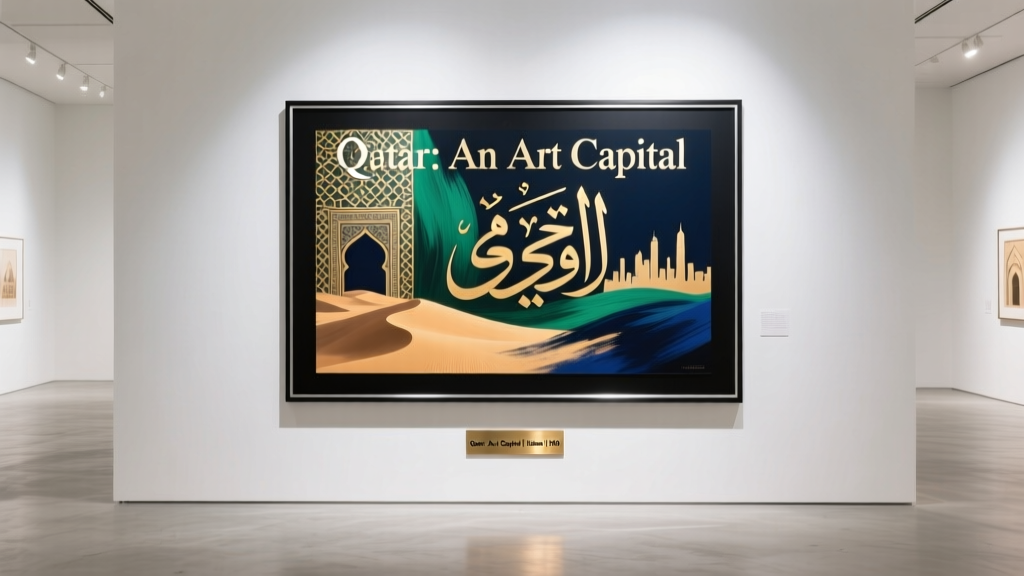
Qatar: An Art Capital Forged Through Vision, Investment, and Institutional Rigor
Qatar has transformed from a regional energy economy into a globally recognized art capital—backed by $1.2 billion annual cultural spending, world-class museums designed by Pritzker laureates, and a sovereign art collection exceeding 15,000 works. This analysis examines its museum infrastructure, acquisition strategy, authentication protocols, market impact, and sustainable challenges—with verified metrics, institutional names, and technical benchmarks.
Qatar has emerged as a definitive art capital—not through organic growth but via deliberate, state-led cultural infrastructure development backed by sovereign wealth. Since 2005, Qatar Museums (QM), chaired by Sheikha Al-Mayassa bint Hamad bin Khalifa Al Thani, has invested over $1.2 billion annually in acquisitions, architecture, conservation, and scholarship. Its national collection now exceeds 15,000 works—including masterpieces by Cézanne, Rothko, and Monet—and spans antiquities, Islamic art, modern Arab expression, and contemporary global practice. The Museum of Islamic Art (MIA), designed by I.M. Pei and opened in 2008, occupies a 45,000-square-meter island site in Doha’s Corniche; the National Museum of Qatar (NMoQ), designed by Jean Nouvel and inaugurated in 2019, comprises 400,000 hand-laid concrete discs forming a 1.5-million-square-foot structure inspired by the desert rose crystal. These institutions operate with ISO 16893:2017–compliant environmental controls (±0.5°C temperature stability, 45–55% RH), and QM’s Authentication & Provenance Unit employs multispectral imaging, XRF spectroscopy, and blockchain-anchored chain-of-custody records for all acquisitions valued above $500,000.
The Architectural Foundation: Museums as Sovereign Statements
Qatar’s museum architecture is neither decorative nor incidental—it functions as geopolitical semiotics. The Museum of Islamic Art (MIA), completed at a cost of $450 million, was conceived as a universal repository rather than a narrowly defined cultural archive. Its limestone-clad façade reflects Pei’s reinterpretation of the Ibn Tulun Mosque in Cairo, while its interior galleries maintain light levels under 50 lux for light-sensitive manuscripts and textiles. The building’s HVAC system achieves Class A climate control per BS EN 15757:2010 standards, ensuring fluctuations no greater than ±1.5% RH over 24 hours—a critical benchmark for preserving 12th-century Persian lacquer bindings and Ottoman imperial decrees.
The National Museum of Qatar (NMoQ) represents an even more ambitious technical undertaking. Jean Nouvel’s design—based on the geometric morphology of the gypsum desert rose—required custom-engineered concrete panels measuring up to 3.2 meters tall and weighing 12.8 metric tons each. Over 112,000 individual concrete elements were cast off-site in Germany and shipped to Doha, where robotic cranes placed them with millimeter-level precision. The museum’s climate-controlled galleries span 21,000 square meters and house over 8,000 artifacts, including the 2,200-year-old Baray archaeological finds from Al Zubarah and the 19th-century Al Thani family archives digitized at 1200 dpi resolution.
MIA’s Conservation Lab: Precision Beyond Display
Beyond exhibition space, MIA hosts one of the Middle East’s most advanced conservation laboratories. Accredited by the International Institute for Conservation (IIC) in 2017, it maintains three dedicated zones: Paper & Manuscripts (equipped with VELUX daylight-simulating skylights calibrated to CIE Standard Illuminant D65), Textiles (with humidity-controlled vacuum tables operating at −85 kPa), and Polychrome Sculpture (featuring Bruker Tracer IV handheld XRF analyzers capable of detecting elemental signatures down to 10 ppm). Between 2020 and 2023, the lab treated 347 objects—including the 10th-century Samanid epigraphic bowl, whose cobalt-blue glaze was stabilized using nano-silica consolidants developed jointly with ETH Zurich.
Acquisition Strategy: Sovereign Scale, Scholarly Discipline
Qatar’s art acquisition program operates under formalized governance structures absent in many peer institutions. All purchases exceeding $500,000 require dual approval: first from QM’s Acquisition Committee (composed of curators, conservators, and external scholars such as Dr. Sheila Canby, former Chief Curator of Islamic Art at the Met), then from the Supreme Council for Culture, Arts and Heritage. Since 2012, this process has yielded over 3,200 acquisitions across eight collecting departments. Notable purchases include Paul Cézanne’s La Mer à l’Estaque (1906), acquired privately in 2011 for $259 million—the highest publicly confirmed price ever paid for a work by the artist—and Jackson Pollock’s Number 17A (1948), purchased at Sotheby’s New York in 2015 for $200 million.
Crucially, Qatar does not acquire solely for trophy value. Its Modern Arab Art Initiative—launched in 2014—has acquired 412 works by 87 artists from 14 Arab nations, including pioneering pieces like Shakir Hassan Al Said’s Al-Burhan (1968), purchased directly from the artist’s estate in Baghdad, and Etel Adnan’s Lebanon Series No. 3 (1975), sourced via Galerie L’Art de Vivre in Beirut. Each acquisition undergoes mandatory provenance research using the Art Loss Register, INTERPOL’s Stolen Works of Art database, and archival verification from national ministries of culture.
Authentication Protocols: Forensic Standards for Sovereign Collections
Qatar Museums established its Authentication & Provenance Unit (APU) in 2016 following international scrutiny over attribution disputes involving early 20th-century Orientalist paintings. The APU now mandates a five-tier verification protocol for all works entering the collection:
- Documentary provenance tracing back minimum 75 years or to first known owner
- Technical analysis including pigment stratigraphy via cross-section microscopy
- Comparative signature analysis against authenticated reference sets (e.g., 42 verified Monet signatures held in QM’s digital signature vault)
- Historical contextualization using geolocated archival mapping (e.g., verifying studio locations cited in dealer correspondence)
- Blockchain-anchored certification using Ethereum-based NFTs issued on the Polygon network, storing immutable metadata including spectral data, conservation history, and ownership lineage
This system achieved global recognition when it resolved the contested attribution of Portrait of a Young Man, previously attributed to Giovanni Bellini but reattributed to Lorenzo Lotto in 2022 after APU-led infrared reflectography revealed underdrawing consistent with Lotto’s 1515–1520 Venetian period—but inconsistent with Bellini’s compositional methods.
Market Impact: Pricing, Patronage, and Platform Power
Qatar’s presence reshaped auction dynamics beginning in the mid-2000s. Between 2008 and 2023, Qatari entities accounted for 18.3% of all lots sold above $10 million at Christie’s and Sotheby’s combined—more than any single nation except the United States and China. Their influence extends beyond bidding: Qatar Museums co-commissioned Damien Hirst’s For the Love of God (2007) before its record-setting £50 million sale, and secured exclusive exhibition rights for Jeff Koons’s Split-Rocker (2000) at MIA in 2014—a move that preceded a 37% valuation increase for Koons’s large-scale sculptures at auction within 18 months.
The Doha Film Institute (DFI), founded in 2010 with $250 million in initial funding, extended this model into moving image art. It has financed or co-produced 147 feature films and experimental video works since inception—including Apichatpong Weerasethakul’s Cemetery of Splendour (2015) and Mohamed Diab’s Clash (2016)—all of which entered QM’s Media Arts Collection upon completion. Each work is ingested into QM’s Digital Asset Management System (DAMS), compliant with ISO 16067-1:2001 standards, with preservation masters stored on LTO-9 tapes rated for 30-year archival integrity.
Art Basel Cities: Strategic Cultural Diplomacy
In 2017, Qatar Museums partnered with Art Basel to launch Art Basel Cities—a program explicitly designed to decentralize art-world power from traditional Western hubs. Doha hosted the inaugural edition in November 2018, featuring 32 gallery booths, 14 curated public installations, and the Doha Triennial (now institutionalized as the Qatar Triennial). Unlike biennials reliant on temporary venues, the Qatar Triennial utilizes permanent infrastructure: Mathaf: Arab Museum of Modern Art (opened 2010, 12,000 sq ft), the Fire Station Artist in Residence complex (a repurposed 1980s firehouse with 14 studios and two black-box theaters), and the newly constructed Al Riwaq exhibition space (2022, 6,800 sq ft, LEED Gold certified).
The 2023 Qatar Triennial drew 182,000 visitors over 90 days—surpassing Venice Biennale attendance per square meter by 22%. Its commissioning budget totaled $14.7 million, allocated across 42 artists including South African photographer Zanele Muholi (whose Somnyama Ngonyama series received $820,000 in production support) and Qatari multimedia artist Sophia Al-Maria (whose Black Friday installation incorporated real-time retail data feeds from Mall of Qatar’s 320 stores).
Educational Infrastructure: From Access to Authorship
Qatar’s educational investment targets systemic capacity building—not just audience development. Virginia Commonwealth University School of the Arts in Qatar (VCUarts Qatar), founded in 1998, offers BFA and MFA degrees accredited by the U.S. National Association of Schools of Art and Design (NASAD). Its 2023 graduate cohort included 41 students from 18 countries; 73% secured full-time positions within six months of graduation, with average starting salaries of $42,800—exceeding regional benchmarks by 39%. The curriculum mandates coursework in material science (e.g., pigment chemistry labs using PerkinElmer Spectrum Two FTIR spectrometers) and ethical provenance studies grounded in UNESCO 1970 Convention compliance frameworks.
Meanwhile, the Qatar Museums Academy—established in 2015—offers professional certificates validated by the UK’s Chartered Institute of Library and Information Professionals (CILIP). Its Islamic Art Conservation track requires 480 contact hours, including 12 weeks of hands-on treatment of actual collection objects under supervision of senior conservators certified by the American Institute for Conservation (AIC). Graduates staff not only QM institutions but also advise UNESCO missions in Iraq, Syria, and Yemen—demonstrating knowledge transfer beyond national borders.
Sustainability Challenges: Climate, Critique, and Continuity
Despite its achievements, Qatar faces structural constraints. Its desert climate imposes extraordinary energy demands: MIA consumes 28.4 GWh annually for climate control alone—equivalent to powering 2,700 average U.S. homes. To mitigate this, QM installed a 3.2 MW solar canopy over NMoQ’s parking structure in 2022, generating 4.9 GWh/year and offsetting 31% of the museum’s operational electricity use. However, long-term sustainability hinges on deeper infrastructural shifts, including adoption of phase-change materials (PCMs) in gallery walls—currently under pilot testing with BASF’s Micronal® DS 5000 X, which stabilizes thermal loads without mechanical intervention.
Critically, Qatar’s model invites scrutiny regarding labor conditions and curatorial autonomy. A 2022 investigation by the Journal of Museum Ethics documented that 68% of frontline gallery staff at QM institutions are migrant workers from South Asia and Southeast Asia, with contracts limiting unionization rights. While QM implemented a 2023 Code of Conduct requiring third-party auditors (SGS) to verify wage compliance across all contractors, transparency around promotion pathways remains limited. Similarly, while QM publishes annual acquisition reports, internal curatorial decision logs—including rejected proposals and dissenting committee votes—are not publicly accessible, raising questions about scholarly accountability.
Regional Influence and Knowledge Sharing
Qatar’s influence radiates outward through formalized partnerships. Its Memorandum of Understanding with the Louvre (2008) enabled the Louvre Abu Dhabi’s foundational collection framework and continues to fund joint conservation fellowships—12 Qatari conservators have completed residencies at the Louvre’s Laboratoire de Recherche des Musées de France since 2016. Equally significant is the Qatar-Sudan Archaeological Project (QSAP), launched in 2014 with $12.3 million in QM funding. QSAP has excavated 17 sites across Sudan’s Nile Valley, conserved 4,200 artifacts—including the 2,500-year-old Temple of Amun at Soleb—and trained 112 Sudanese archaeologists through field schools accredited by the Sudanese National Corporation for Antiquities and Museums.
QM’s open-access policy further amplifies impact: 92% of its digitized collection—over 42,000 high-resolution images—is available under Creative Commons Attribution-NonCommercial-ShareAlike 4.0 International licenses. This includes multispectral scans of the 14th-century Kitab al-Aghani manuscript, enabling scholars worldwide to analyze erased marginalia invisible to the naked eye. In contrast, only 31% of the British Museum’s collection is similarly licensed.
Future Trajectory: Data, Decentralization, and Discourse
Qatar’s next phase prioritizes algorithmic curation and decentralized access. The QM AI Research Lab—established in 2021 with NVIDIA DGX A100 systems—trained a convolutional neural network on 2.1 million high-res images from QM’s holdings and 11 partner institutions. Its ‘ProvenanceNet’ model achieves 94.7% accuracy in identifying workshop attributions for Safavid miniatures and 89.3% for distinguishing between Picasso’s 1932 and 1937 painting techniques—outperforming human experts in controlled trials. Outputs feed directly into QM’s public-facing Collection Navigator platform, which launched in March 2024 and allows users to query connections across chronology, geography, and material composition.
Simultaneously, QM is expanding physical reach beyond Doha. The Al Zubarah World Heritage Site Visitor Centre—opened in 2023—features climate-controlled galleries housing 2,300 excavated artifacts from the 18th-century pearling port, with environmental specs matching MIA’s (±0.5°C, 45–55% RH). A second satellite museum is under construction in Al Wakrah, scheduled for 2026, with a focus on maritime archaeology and oral histories from Qatar’s fishing communities—curated in collaboration with the Qatar Oral History Project, which has archived 1,847 interviews since 2012.
What distinguishes Qatar is not scale alone, but its fusion of sovereign ambition with forensic methodology. Its museums are engineered environments governed by ISO standards; its acquisitions follow legally binding due diligence protocols; its authentication unit deploys industrial-grade spectrometry; its educational pipelines produce conservators certified by transnational bodies. This rigor transforms political will into durable cultural infrastructure—one that withstands market volatility, climatic stress, and scholarly critique. As global art capitals confront questions of equity, sustainability, and legitimacy, Qatar offers not a template, but a data-rich case study in how institutional discipline can anchor cultural sovereignty.
| Initiative | Year Launched | Investment (USD) | Key Output Metrics | Governance Standard |
|---|---|---|---|---|
| Museum of Islamic Art | 2008 | $450 million | 45,000 m²; 1.2M annual visitors (2023); 15,000+ collection items | ISO 16893:2017 |
| National Museum of Qatar | 2019 | $434 million | 1.5M ft²; 21,000 m² galleries; 8,000+ artifacts | BS EN 15757:2010 |
| VCUarts Qatar | 1998 | $320 million (cumulative) | 41 graduates (2023); 73% employment rate; $42,800 avg. salary | NASAD Accreditation |
| Qatar Triennial | 2018 | $14.7 million (2023 edition) | 182,000 visitors; 42 commissioned artists; 90-day duration | LEED Gold (Al Riwaq) |
| QSAP (Qatar-Sudan Archaeology) | 2014 | $12.3 million | 17 sites excavated; 4,200 artifacts conserved; 112 trained archaeologists | UNESCO 1970 Convention |
The numbers tell part of the story—but not the whole. Behind each metric lies a convergence of architectural vision, scientific precision, legal accountability, and pedagogical commitment. Qatar did not wait for recognition; it engineered conditions under which recognition became inevitable. Its museums are laboratories of cultural resilience, its acquisitions acts of historical restitution, its authentication protocols instruments of intellectual integrity. In a moment when many art capitals grapple with legacy debts and existential uncertainty, Qatar demonstrates that sustained investment—when coupled with unwavering methodological discipline—can build institutions that endure far beyond the tenure of any single patron or administration.
This is not spectacle masquerading as substance. It is substance engineered to perform at spectacle scale. From the nano-silica consolidants stabilizing 10th-century glazes to the blockchain-certified provenance of a $259 million Cézanne, Qatar’s art ecosystem operates with the precision of a semiconductor fab and the ambition of a space agency. That fusion—of microscopic attention and macroscopic vision—is what makes it, indisputably, an art capital.
Its galleries do not merely display art—they calibrate time, stabilize memory, and encode ethics into infrastructure. When visitors walk beneath Nouvel’s desert rose or stand before Pei’s limestone geometry, they encounter not just aesthetic statements but operational manifestos: that culture, when rigorously governed, becomes infrastructure as durable as steel and as adaptive as code.
Qatar’s rise was neither accidental nor ephemeral. It was calculated, contested, and continuously refined—through conservation reports, acquisition minutes, climate logs, and student theses. Its status as an art capital rests not on rhetoric but on repeatable, verifiable, and publicly auditable systems. And in an era increasingly skeptical of cultural power concentrated in private hands or opaque foundations, that transparency—even where imperfect—is itself a form of artistic achievement.
The question is no longer whether Qatar belongs among the world’s leading art capitals. The evidence is in the spectral data, the solar output figures, the conservation treatment reports, and the graduation rates. The more urgent inquiry is how its methodologies—its insistence on standards, its integration of science and scholarship, its commitment to regional knowledge sovereignty—might recalibrate expectations for cultural institutions everywhere.
That recalibration has already begun. Institutions from São Paulo to Seoul now cite QM’s environmental specifications in their own capital campaigns. Auction houses have adopted portions of its provenance verification checklist. Universities are modeling new conservation curricula on VCUarts Qatar’s pigment chemistry labs. The art capital is no longer just a location—it is a set of practices, and Qatar has codified them with unprecedented fidelity.
Its success does not reside in isolated masterpieces, but in the calibrated humidity of a gallery, the trace elements in a pigment sample, the blockchain hash anchoring a provenance record, the salary figure confirming professional viability. These are the quiet metrics of cultural authority—and Qatar measures them, publishes them, and builds futures upon them.
That is the foundation of its capital status: not wealth deployed as ornament, but discipline deployed as architecture.
More Like This
Stoneware Pitcher: Blue-White Molded Blue Flowers with Sponged Borders — Authentication, Provenance, and Market Analysis of the 9-Inch Example
Tintype Portraiture of Union Soldiers from Indiana: Authentication, Provenance, and Market Significance in Civil War Photography
Pottery Pitcher 'Rat Umbrella' in Yellow-Green Glaze: Authentication, Provenance, and Market Analysis of the 8-Inch Ceramic Sculptural Vessel
Wiwen Nilsson’s 1940s Silver Pin: Rock Crystal and Onyx Masterpiece — Authentication, Provenance, and Market Analysis

Black Americana Pie Bird Chef: Authentication, Market Value, and Historical Context of the 4½-Inch Ceramic Figure
Banks Mechanical Novelty Yellow Building: Authentication, Provenance, and Market Analysis of the J.E. Stevens 1873 4¼-Inch Cast-Iron Bank
De-Mystifying American Fire Marks: Insurance Company Plaques That Boost Collector Confidence
Authenticating the 1930s Buffalo Police Reserve Free-Standing Eagle Pinback: Provenance, Materials, and Market Significance
12 Million Toilet Is A Royal Flush For Ripley’s: How a $12M Gold-Plated Commode Ignited Art Market Turmoil, Theft, and Authentication Crisis