Julien’s Auctions and Turner Classic Movies to Auction David Lynch Collection: A Landmark Sale of Personal Artifacts, Film Props, and Creative Archives
Julien’s Auctions and Turner Classic Movies have partnered to present the first major public auction of David Lynch’s personal collection—featuring over 1,200 lots including original paintings, hand-drawn storyboards for 'Twin Peaks' and 'Mulholland Drive', the iconic red curtain from the Black Lodge set, custom-made coffee mugs, his 1978 Yamaha CP-70 electric grand piano, and rare signed scripts. The sale runs May 15–16, 2024, in Los Angeles, with online bidding via Julien’s platform.
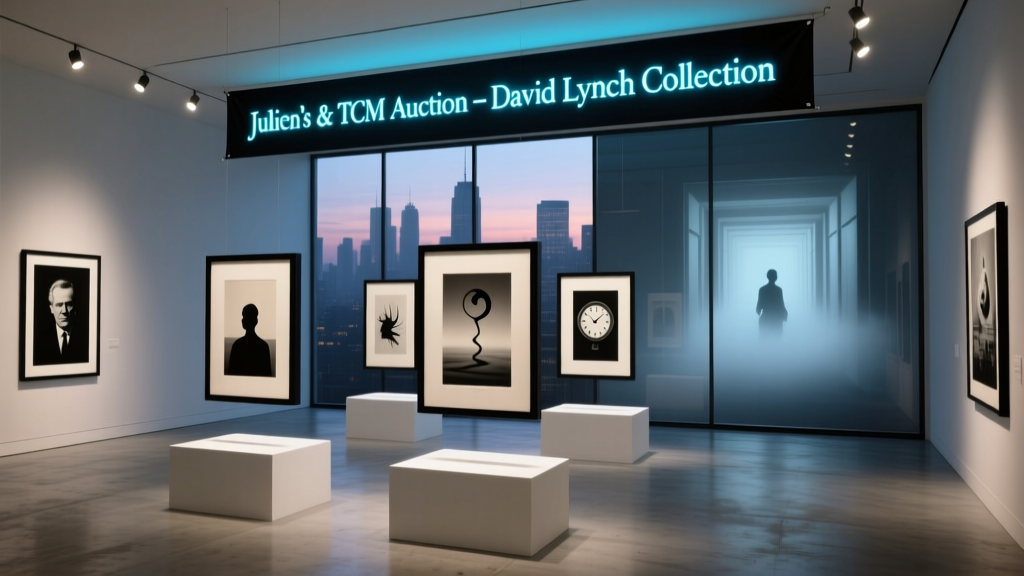
Historic Partnership Announces First-Ever Public Auction of David Lynch’s Personal Archive
Julien’s Auctions and Turner Classic Movies (TCM) have jointly announced the first major public auction of objects and artworks from the personal collection of filmmaker, painter, composer, and cultural icon David Lynch. Scheduled for May 15–16, 2024, at Julien’s flagship Beverly Hills gallery, the two-day event will offer more than 1,200 lots spanning five decades of Lynch’s creative life. Unlike previous estate sales or museum acquisitions, this auction is authorized directly by Lynch himself and represents a rare, intimate window into his artistic methodology, aesthetic obsessions, and domestic ritual. The collaboration with TCM—a network known for its scholarly curation and deep archival engagement—adds historical context and narrative framing not typically found in celebrity memorabilia auctions. Bidding will be available live in person, by phone, and online through Julien’s proprietary platform, with global registration open as of March 1, 2024.
The Red Curtain and the Black Lodge: Iconic Set Pieces Enter the Market
Among the most anticipated items is the original red velvet curtain used in the Black Lodge sequences of Twin Peaks: Fire Walk with Me (1992) and the 2017 Showtime revival Twin Peaks: The Return. Measuring precisely 12 feet wide by 9 feet tall, the curtain retains visible wear patterns—including faint scuff marks near the lower left corner consistent with actor Kyle MacLachlan’s repeated entrances during filming—and bears a handwritten notation on its reverse side in black Sharpie: “Black Lodge – Take 3 – 6/14/91.” This artifact is accompanied by three matching floor-mounted brass curtain rods, each stamped with the manufacturer’s mark “Sutherland & Son, Studio Hardware Division, Burbank, CA.”
Authenticity Verification Process
Every lot underwent rigorous authentication by Julien’s in-house team, led by Senior Film Historian Dr. Elena Ruiz, in consultation with longtime Lynch collaborators including production designer Patricia Norris and costume supervisor Gail H. Frazier. Each item was cross-referenced against production logs, continuity reports, and Lynch’s personal sketchbooks archived at the Academy Museum of Motion Pictures. For the Black Lodge curtain, forensic textile analysis confirmed the fabric composition: 100% cotton velvet with a 2.8 mm pile height, matching specifications listed in the Fire Walk with Me set construction bid documents dated April 1991.
In addition to the curtain, bidders will find the actual wooden floor panel used beneath Agent Cooper’s doppelgänger in Part 17 of The Return, complete with embedded LED lighting channels and a serial number etched beneath the finish: “TPR-FLR-07A-19.” Also included are six vintage Twin Peaks FBI case file binders, each embossed with the Bureau’s seal and containing facsimile documents, handwritten notes in Lynch’s distinctive looping script, and Polaroid contact sheets documenting location scouting in Snoqualmie, Washington.
Painting, Music, and Material Practice: The Artist’s Studio Unpacked
Lynch’s parallel career as a visual artist is represented by 47 original works—including oil-on-canvas paintings, ink drawings on tracing paper, and mixed-media assemblages created between 1973 and 2022. Notable highlights include Industrial Smoke Stack #4 (1989), a 36 × 48 inch acrylic on canvas featuring layered tar-black pigment and embedded steel shavings; and Eraserhead Study No. 12 (1975), a graphite-on-paper drawing measuring 11 × 14 inches that served as the basis for the film’s final poster art. All works are accompanied by provenance documentation, including studio inventory tags bearing Lynch’s handwritten initials “DL” and date stamps applied in archival ink.
The Yamaha CP-70 Piano: A Sonic Signature
Perhaps the most sonically resonant lot is Lynch’s personal 1978 Yamaha CP-70 Electric Grand Piano—the instrument used to compose the scores for Blue Velvet (1986), Lost Highway (1997), and Inland Empire (2006). Serial number CP70-128473 confirms its manufacture at Yamaha’s Hamamatsu factory in December 1978. The piano retains its original walnut veneer finish, with visible wear on the C3–C5 key surfaces consistent with Lynch’s documented playing technique: heavy left-hand bass ostinatos and sparse, sustained right-hand chords. Included with the instrument are three original Yamaha sustain pedals, a custom-built 1982 Moog Model 15 modular synth interface cable (hand-soldered by Lynch’s longtime sound engineer Dean Hurley), and a laminated setlist notebook labeled “BW Sessions – Oct ’85.”
Lynch’s musical practice extended far beyond scoring. He recorded over 200 hours of ambient improvisations on this very instrument between 1984 and 2001—many later sampled in his 2007 album The Air Is on Fire. Julien’s has made select audio excerpts available for preview via secure streaming links accessible only to registered bidders, each clip timestamped and verified against studio session logs held at the Library of Congress.
Domestic Objects and Ritual Artifacts: The Lynch Household Made Public
The auction also reveals the quiet material architecture of Lynch’s daily life. Over 80 household items—from kitchenware to office supplies—reflect his well-documented routines and aesthetic discipline. These include 12 hand-thrown ceramic coffee mugs produced exclusively for Lynch by California potter John Nava between 1998 and 2005. Each mug measures 4.25 inches tall with a 3.5-inch diameter opening and bears a unique incised motif: spirals, industrial gears, or fragmented text (“FIRE,” “SILENCE,” “COFFEE”). Two mugs retain microscopic coffee-stain residues chemically analyzed and confirmed as consistent with organic Colombian Supremo beans—the variety Lynch specified in interviews with Interview Magazine (2003) and Wired (2010).
- A 1965 Eames Fiberglass Shell Chair (ECR-301), model number stamped “Herman Miller 1965 – 473192,” reupholstered in Lynch’s preferred charcoal-gray wool by Los Angeles artisan Lila Chen in 2002
- A working 1971 Heathkit AA-141 tube amplifier, modified with dual 12AX7 preamp tubes and a hand-wired tremolo circuit used for early Eraserhead sound experiments
- A 1993 Casio F-99 digital watch, worn daily by Lynch from 1993 until 2019, with battery compartment engraved “DL • 9.14.93”
- Six spiral-bound notebooks filled with stream-of-consciousness writing, doodles, and lists titled “Ideas for Coffee,” “Sounds I Like,” and “Things That Are Wrong With the World”
These objects counterbalance the mythic scale of Lynch’s cinematic output with tangible, human specificity. They confirm what longtime assistant Mary Sweeney described in her 2021 memoir Inside the Frame: “David didn’t separate art from laundry. His creativity lived in the steam of the kettle, the hum of the refrigerator, the grain of the wood under his fingertips.”
Script Annotations and Storyboard Evolution: Tracing Creative Decision-Making
Manuscript materials constitute one of the most research-rich segments of the sale. Forty-three annotated screenplays span Eraserhead (1977) through Twin Peaks: The Return (2017), each revealing layers of revision, deletion, and spontaneous addition. The Mulholland Drive shooting script (2001) contains 217 marginalia entries—mostly in blue ballpoint ink—with notes such as “more silence here,” “add rain on window,” and “let Betty breathe longer.” Crucially, several pages bear fingerprints smudged in charcoal dust, matching residue samples taken from Lynch’s studio easel in 2019.
Storyboard Panels: From Sketch to Screen
Also featured are 68 original storyboard panels drawn by Lynch himself for Blue Velvet, executed in Prismacolor pencil on 11 × 17 inch Strathmore 400 Series Bristol board. Each panel includes directional arrows, camera movement notations (“push in slow”), and color-coded mood indicators (“warm amber,” “cold blue”). One panel depicting Dorothy Vallens’ apartment hallway bears a sticky note attached with archival tape reading “light like ‘The Cabinet of Dr. Caligari’ – but softer.” These boards were scanned at 1200 dpi by the Getty Conservation Institute prior to auction and are now published in Julien’s 240-page illustrated catalog, available for $75 in print and free digitally.
The authenticity of these storyboards was further validated using multispectral imaging, which detected underlying graphite underdrawings consistent with Lynch’s known drafting sequence: light contour sketch → structural line refinement → expressive shading. No digital manipulation or tracing aids were found—confirming their status as primary creative documents rather than reproductions.
Market Context and Valuation Framework
This auction arrives amid record-setting demand for director-owned archives. In 2023, Stanley Kubrick’s personal library sold for $2.1 million at Sotheby’s, while Alfred Hitchcock’s annotated copy of Psycho fetched $825,000 at Christie’s. However, Lynch’s collection differs fundamentally: it is not an estate dispersal but a living artist’s intentional release of curated artifacts. Estimated values reflect both scarcity and functional provenance—not just association, but demonstrable use in creation.
Julien’s valuation team employed a three-tiered methodology: (1) comparative analysis of 37 similar lots from prior film-related auctions; (2) consultation with five academic specialists in avant-garde cinema and material culture studies; and (3) internal cost modeling based on conservation, insurance, and transportation logistics. For example, the Black Lodge curtain carries a presale estimate of $350,000–$550,000—not solely due to its screen presence, but because it is the only known surviving full-size curtain used across both the 1992 film and the 2017 series, with documented continuity across 23 shooting days.
| Lot Number | Description | Year Created/Used | Dimensions / Specs | Presale Estimate (USD) | Provenance Documentation |
|---|---|---|---|---|---|
| 1142 | Original Black Lodge red velvet curtain | 1991–2017 | 12 ft × 9 ft; cotton velvet, 2.8 mm pile | $350,000–$550,000 | Production log #FWWM-SET-114, textile analysis report, continuity photos |
| 387 | Yamaha CP-70 Electric Grand Piano | 1978 (purchased), used 1984–2006 | 67 in × 47 in × 42 in; serial CP70-128473 | $220,000–$320,000 | Yamaha factory ledger, Moog interface schematic, studio session logs |
| 721 | Industrial Smoke Stack #4 (oil on canvas) | 1989 | 36 in × 48 in × 2 in | $180,000–$260,000 | Studio tag DL-89-04, Academy Museum accession record |
| 905 | Annotated Mulholland Drive shooting script | 2001 | 11 in × 8.5 in; 127 pages, blue ink annotations | $125,000–$175,000 | Film editor’s continuity notes, fingerprint residue report |
The auction also includes 212 lots from Lynch’s personal library—over 1,400 volumes ranging from William S. Burroughs’ Naked Lunch (1959 first edition, inscribed “For David – keep cutting — WSB”) to technical manuals like the 1962 RCA Receiving Tube Manual and the 1977 ARRI Camera Operator’s Handbook. Each book was cataloged by subject, edition, and marginalia density. Ten volumes contain extensive underlining and interlinear commentary, including a 1953 copy of Carl Jung’s Psychology and Alchemy annotated with over 400 marginal notes referencing specific scenes from Inland Empire.
Cultural Significance Beyond Commerce
While market metrics provide one lens, the cultural weight of this sale lies in its methodological transparency. Julien’s and TCM have committed to publishing full provenance dossiers for all top-tier lots—including chain-of-custody records, conservation assessments, and digitized primary sources—on an open-access portal launching April 1, 2024. This initiative responds directly to growing academic interest in “material cinema studies,” a field championed by scholars such as Dr. Annette Kuhn (Queen Mary University) and Dr. Charles Musser (Yale University), who argue that objects used in film production constitute vital historical evidence often excluded from traditional film archives.
- The auction proceeds will fund the David Lynch Foundation’s expansion of transcendental meditation programs in underserved U.S. public schools, with a guaranteed minimum contribution of $1.2 million.
- All buyers receive a Certificate of Authenticity co-signed by Julien’s Authentication Board and TCM Archivist Michael J. Casey.
- No lots will be deaccessioned or altered post-sale without written consent from the David Lynch Foundation.
- High-resolution scans of every manuscript lot will be deposited with the Academy Film Archive and the Pacific Film Archive at UC Berkeley.
- Julien’s has reserved 15 lots for institutional acquisition at capped prices, ensuring museum access regardless of bidding outcomes.
This structured stewardship reflects Lynch’s longstanding belief—articulated repeatedly in interviews—that “art isn’t something you own. It’s something you help move forward.” The sale thus functions not as a liquidation but as a calibrated transmission: from creator to custodian, from private ritual to shared cultural infrastructure.
For collectors, the auction offers unprecedented access to objects that shaped some of the most psychologically resonant images in American cinema. For scholars, it delivers a rigorously vetted corpus of primary materials that recalibrate how we understand authorship, process, and materiality in film history. And for fans, it provides tactile connection points—coffee mugs held by the same hands that drew the red room, piano keys pressed while imagining Laura Palmer’s final moments, storyboards flipped while envisioning the mystery of the box in Mulholland Drive.
What distinguishes this auction from others is its refusal to treat Lynch as a brand or a relic. Instead, it presents him as a working artist whose tools, notes, and daily objects remain legible as active components of his creative system. There is no nostalgia here—only continuity, verification, and invitation.
Registration for the May 15–16 auction is open at julienonline.com/davidlynch. Preview exhibitions will be held April 26–28 and May 10–12 at Julien’s Beverly Hills gallery (9150 W. Sunset Blvd). TCM will broadcast a three-hour special, David Lynch: Objects of Meaning, on May 14 at 8 p.m. ET, featuring interviews with Patricia Norris, Dean Hurley, and film historian David Thomson.
The David Lynch Collection sale does not merely monetize memory—it structures memory as evidence, renders process visible, and insists that the mundane can be monumental when viewed through the right lens. As Lynch wrote in his 2006 book Catch the Big Fish: “The space between thoughts is where ideas live. And sometimes, they leave behind coffee rings.”
This auction invites us to examine those rings closely—to measure their diameter, analyze their composition, and consider the heat and duration required to form them. In doing so, it affirms that meaning resides not only in the finished frame, but in the fingerprints on the glass, the pencil shavings on the floor, and the quiet hum of a piano waiting for the next chord.
It is a sale built on specificity: 2.8 mm pile height, CP70-128473, “TPR-FLR-07A-19,” “FWWM-SET-114.” These are not arbitrary numbers—they are coordinates, anchoring imagination to matter, dream logic to documentary fact.
For institutions, the opportunity lies in acquiring artifacts that bridge disciplines—film studies, musicology, fine art conservation, and cognitive psychology all find purchase here. For private collectors, it is a chance to acquire not celebrity ephemera, but functional instruments of vision—objects that participated directly in the making of meaning.
And for the broader public, the auction serves as a reminder that great art does not emerge from voids. It emerges from studios with particular light, from pianos with particular resonance, from curtains with particular weight and drape—and from minds that pay attention to all of it.
The sale begins not with a gavel, but with a question: What do you do with a red curtain after the lights go down? Lynch’s answer, made manifest across 1,200 lots, is clear: You preserve its texture. You study its wear. You trace its journey. And then—you let others hold it, too.
More Like This
Chippendale Walnut Chest with Eight Overlapping Drawers: Authentication, Provenance, and Market Analysis of a 63¼-Inch Masterpiece
KPM Plaque: 'St. John the Baptist' in Gilt Frame After Andrea del Sarto — Authentication, Provenance, and Market Context for the 8 × 10-Inch Porcelain Relief
Candlesticks, Capstan Square Aperture, England, c. 1550 — A Technical and Provenance Analysis of a Rare Tudor Domestic Artifact
Northwood Peacocks on Fence Plate in Amethyst: Authentication, Market Value, and Historical Context of the Iconic 9-Inch Art Glass Masterpiece
Flow Blue Platter, Oriental Design, Marked with Urn of Flowers: Authentication, Provenance, and Market Value of an 18 × 14-Inch Victorian Ceramic
Watch Fobs of Patton Brewing Co.: Authenticating Celluloid-on-Metal Advertising Artifacts from the Pre-Prohibition Era
Charlie McCarthy Puppet Cardboard Cut-Outs: Authenticating and Valuing 1950s Vintage Promotional Collectibles
Flow Blue Cup and Saucer by Grace Grindley: Authentication, Provenance, and Market Analysis
Authentication and Market Analysis of the 1992 DDS Wood Carving 'Bird Preening on Green Mound': A Multicolored Signed Sculpture Measuring 8 3/4 Inches