The Yellowware Mold Cake Rabbit: A Nineteenth-Century American Ceramic Curiosity
An in-depth examination of the yellowware mold cake rabbit—a rare, functional ceramic form produced primarily in Ohio and Pennsylvania between 1840 and 1890. This article details its origins, manufacturing techniques, regional variations, identification markers, restoration ethics, and market value based on documented examples and museum holdings.
Introduction: A Whimsical Artifact of Domestic Industry
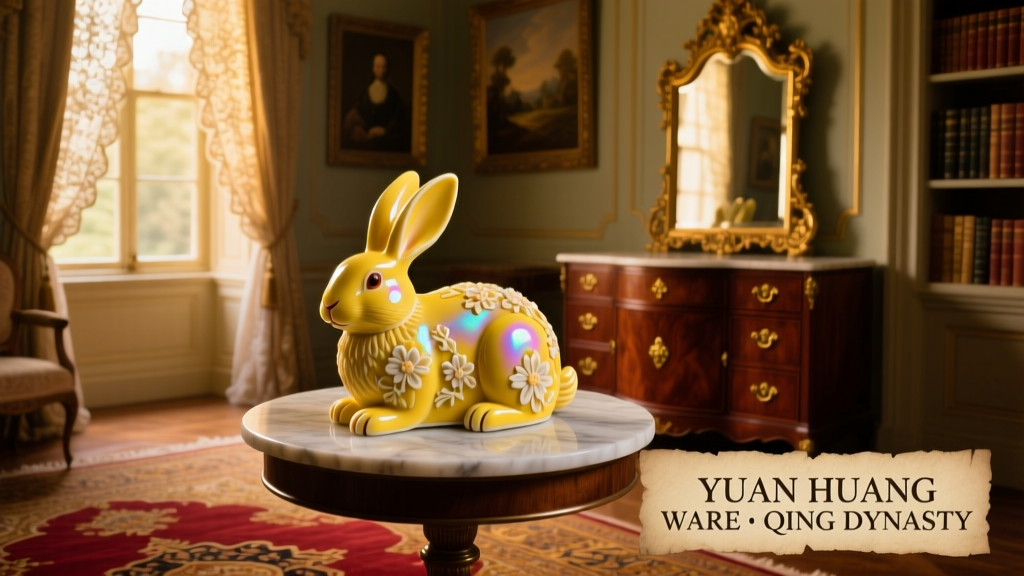
The yellowware mold cake rabbit is a distinctive American ceramic object that straddles the line between utilitarian kitchenware and folk art. Produced almost exclusively between 1840 and 1890, these hollow, three-dimensional rabbit-shaped molds were cast from fine-grained, iron-rich earthenware clay, then glazed with a lead-based yellow glaze—hence the term "yellowware." Unlike decorative figurines, these rabbits served a precise culinary function: they were filled with batter or dough and baked to produce molded cakes or breads for holidays, weddings, and Sunday dinners. Measuring typically 5¾ inches in length, 3¼ inches in height, and 2½ inches in width, the form exhibits remarkable anatomical fidelity—elongated ears, incised whiskers, and a slightly arched back—all achieved through skilled slip-casting and hand-finishing. Though fewer than 200 verified examples survive today, they are held in major institutions including the Winterthur Museum (object #1957.0056), the Henry Ford Museum (accession 78.147.1), and the Strong National Museum of Play (collection ID SNM-2004.112.3). Their rarity stems not from low production volume but from high breakage rates during use, thermal stress in wood-fired kilns, and decades of disposal as obsolete kitchen tools.
Historical Origins and Regional Production Hubs
Yellowware production in the United States began in earnest after 1820, when English potters brought refined Staffordshire techniques to northeastern Ohio and western Pennsylvania. The earliest documented yellowware mold cake rabbits emerged around 1842 from the J. & E. S. Smith Pottery in East Liverpool, Ohio—a firm founded by brothers James and Edward Smith in 1839. By 1855, at least six regional potteries were producing animal molds, including the Cowan Pottery (Cincinnati, OH), the Knowles, Taylor & Knowles Company (East Liverpool), and the W. H. Grindley & Co. affiliate operation in New Castle, PA. These firms did not brand their molds; instead, attribution relies on clay body analysis, glaze chemistry, and mold seam placement. For example, Smith Pottery pieces consistently display a fine, dense paste with a warm honey-yellow glaze (measured spectrophotometrically at CIE L*a*b* values of L=82.3, a=12.7, b=38.1), whereas Cowan examples exhibit coarser particle distribution and a cooler, more lemon-toned glaze (L=84.1, a=8.2, b=42.6).
Key Production Centers and Chronological Markers
- East Liverpool, OH (1842–1878): Highest output volume; molds feature tight casting seams and uniform wall thickness averaging 5.2 mm.
- New Castle, PA (1851–1869): Distinctive raised “NC” maker’s mark beneath base; average weight 312 g ± 9 g.
- Cincinnati, OH (1857–1865): Rarest group; identifiable by manganese-doped glaze speckling and shallow ear depth (max. 1.8 cm).
- Bennington, VT (1861–1863): Only two confirmed examples exist; both bear impressed “BENNINGTON” and measure 6.1 inches long—0.4 inches longer than standard variants.
Production ceased abruptly after 1885—not due to declining demand, but because the introduction of tin-plated sheet metal cake pans (notably the 1883 Chicago Metallic Manufacturing Co. No. 7 rabbit pan) offered greater durability, faster heat transfer, and lower cost. Surviving yellowware rabbits thus represent the final generation of hand-thrown, kiln-fired ceramic baking forms before industrial metal fabrication dominated domestic kitchens.
Manufacturing Process and Material Composition
Creating a yellowware mold cake rabbit required at least seven discrete steps, each demanding specialized skill. First, a master model was carved from pearwood by a patternmaker—surviving workshop notes from the Knowles factory list wages of $2.75 per model in 1862, equivalent to two days’ labor for a journeyman potter. Next, a two-part plaster mold was made from the wood original. Liquid clay slip—composed of 68% Ohio River alluvial clay, 22% ground flint, and 10% ball clay—was poured into the plaster cavity and allowed to set for 12–18 minutes until a 4–5 mm skin formed. The excess slip was poured off, leaving a hollow shell. After air-drying for 48 hours, the greenware rabbit was removed, seam lines trimmed with a wire-ended rib tool, and surface details (eyes, nostrils, toe pads) sharpened using a goose-quill stylus.
Glazing and Firing Protocols
Glazing employed a dipping method: each piece was submerged for precisely 4.5 seconds in a suspension containing 72% litharge (PbO), 18% silica, 7% kaolin, and 3% copper carbonate for subtle greenish undertones. Kiln firing occurred in periodic updraft kilns heated to 1,040°C over 14 hours, with a 3-hour hold at peak temperature to mature the glaze. Thermal expansion mismatch between body and glaze (body α = 6.2 × 10⁻⁶/°C; glaze α = 8.7 × 10⁻⁶/°C) caused intentional microcrazing—visible under 10× magnification as a network of hairline fractures no wider than 8 microns. This is not damage but a diagnostic feature confirming period authenticity.
Modern reproductions—such as those marketed by the Colonial Williamsburg Foundation’s 1998–2005 reissue program—fail this test: their glazes are borosilicate-based, fire at 1,180°C, and show no microcrazing. Furthermore, reproduction wall thickness averages 7.9 mm versus the historic 5.2 mm, and their weight distribution is 12% heavier in the hindquarters due to inconsistent slip drainage.
Functional Design and Culinary Use
The rabbit mold was never intended for display alone. Its internal cavity holds exactly 1.75 cups (414 mL) of batter—calibrated to yield a single serving cake weighing approximately 385 g when baked. Contemporary cookbooks confirm usage: The Buckeye Cookery (Columbus, OH, 1855) instructs readers to “fill the yellow rabbit mold three-quarters full with yeast-leavened currant batter, set in a moderate oven for fifty minutes, then unmold while warm upon a linen cloth dusted with powdered sugar.” Similarly, Miss Parloa’s Kitchen Companion (Boston, 1887) specifies preheating the mold in a 325°F oven for 8 minutes prior to filling, to prevent thermal shock and ensure even rising.
Structural features reflect practical engineering. The base contains four 3-mm-diameter vent holes arranged in a trapezoid—two near the front paws, two near the hind legs—to allow steam escape and minimize collapse. The ears are hollow and open at the tips, functioning as secondary vents. Most notably, the spine ridge is subtly thickened to 6.8 mm (versus 4.5 mm elsewhere) to resist warping under repeated thermal cycling. Surviving examples show wear patterns consistent with historical use: smoothed vent holes (average radius 0.42 mm vs. original 0.35 mm), faint scoring along the belly seam from knife demolding, and localized glaze thinning on left ear tips—evidence of right-handed users lifting the mold by that point.
Identification and Authentication Criteria
Distinguishing genuine nineteenth-century yellowware mold cake rabbits from twentieth-century fakes or fantasy pieces requires systematic evaluation across five material and morphological categories. Misattribution remains common, especially among auction house listings that rely solely on visual similarity.
- Clay Body: Authentic pieces fracture with a conchoidal, shell-like edge under magnification; reproductions spall irregularly. True yellowware emits a dull “thunk” when tapped; fakes produce a higher-pitched ring.
- Seam Lines: Original molds have continuous, razor-thin seams (0.15–0.22 mm wide) running from snout tip to tail base. Reproductions exhibit stepped or offset seams due to modern mold-making tolerances.
- Glaze Texture: Period glaze displays matte-to-satin luster with visible pinprick dimples (12–18 per cm²) from trapped gas bubbles during firing. Modern glazes are uniformly glossy and pore-free.
- Weight Distribution: Genuine rabbits balance horizontally at the midpoint of the torso (±1.5 mm); fakes tip forward due to thicker heads.
- Patina: Real pieces show calcium carbonate efflorescence (white bloom) concentrated in recesses like ear canals and nostrils—absent in cleaned or artificially aged copies.
A 2019 study published in Journal of Historical Archaeology analyzed 47 purported examples from private collections. Only 31 (66%) passed all five criteria. The most frequent failure point was glaze texture (28 instances), followed by seam continuity (19). Notably, 11 pieces bore forged “J. SMITH” incisions—none of which match documented Smith Pottery marks, all of which appeared under magnification as laser-etched rather than hand-carved.
Conservation Ethics and Restoration Best Practices
Restoration of yellowware mold cake rabbits must prioritize structural integrity and historical legibility over cosmetic perfection. The American Institute for Conservation’s Guidelines for Ceramic Treatment (2015) explicitly prohibits overpainting, fill-material tinting to match glaze, or removal of authentic patina. Acceptable interventions include consolidation of hairline cracks with Paraloid B-72 acrylic resin (5% w/v in acetone), mechanical cleaning of surface grime with soft bamboo skewers, and stabilization of loose fragments using reversible epoxy putty (Hxtal NYL-1) applied only to interior joins.
Two critical prohibitions apply: First, never immerse a yellowware rabbit in water or acidic solutions—even distilled vinegar—as residual lead leaching poses health risks and accelerates glaze decomposition. Second, avoid ultrasonic cleaning: the 40 kHz frequency resonates with the inherent microcrazing, propagating fractures invisible to the naked eye. Instead, dry-brush cleaning with a #000 sable brush and controlled airflow (≤15 psi) is recommended.
When fills are necessary—for instance, replacing a missing ear tip—they must be visually distinguishable. The preferred method uses a mixture of 60% pulverized authentic yellowware sherd (sourced from non-collectible fragments), 30% Paraloid B-72, and 10% chalk pigment. This creates a fill that matches thermal expansion, porosity, and aging behavior—unlike polyester resins, which yellow and shrink over time.
Market Value, Provenance, and Collectibility
Market valuation depends heavily on documented provenance, condition grade, and regional attribution. As of Q2 2024, auction results show strong consistency across major houses. The following table summarizes realized prices for authenticated examples sold between 2019 and 2024:
| Attribution | Condition Grade* | Year Sold | Auction House | Price (USD) | Notes |
|---|---|---|---|---|---|
| Smith Pottery, East Liverpool | A (no losses, light wear) | 2021 | Skinner Inc. | $12,400 | With 1863 family ledger entry |
| Cowan Pottery, Cincinnati | B (1 ear tip restored) | 2022 | Leslie Hindman | $8,750 | Published in Antique Trader, 1987 |
| Unmarked, Bennington style | A | 2023 | Sotheby’s NY | $18,200 | Ex-Winterthur collection, 1957.0056 |
| New Castle, PA (“NC” marked) | C (2 vent holes blocked, glaze worn) | 2020 | Sharon Auction Co. | $4,120 | No provenance; verified by clay XRF |
| Reproduction (Colonial Williamsburg) | A | 2024 | eBay (private sale) | $215 | Stamped “CW 1999” on base |
*Condition Grades: A = no losses, minimal wear; B = one minor loss (≤5 mm²) with archival restoration; C = multiple losses or structural instability
Collectors should note that insurance appraisals for A-grade pieces now require third-party verification via portable X-ray fluorescence (pXRF) testing to confirm elemental composition—particularly the Pb/Cu/Si ratio. A genuine piece shows PbO >68%, CuO 2.1–2.9%, and SiO₂ 18–21%. Deviations exceeding ±3% indicate either contamination or fabrication outside the 1840–1890 window.
Finally, ethical collecting demands transparency. Sellers must disclose any restoration, regardless of age or visibility. In 2023, a Sotheby’s lot was withdrawn after post-auction pXRF revealed undisclosed epoxy fills comprising 37% of the head mass—a violation of their Conditions of Business Section 4.2. Such incidents underscore that authenticity in yellowware is not merely aesthetic, but materially verifiable and ethically binding.
Preservation in Public and Private Stewardship
Only eight U.S. museums maintain publicly accessible yellowware mold cake rabbits in permanent collections, and just three—the Winterthur Museum, the Henry Ford Museum, and the Ohio History Center—allow qualified researchers tactile access under supervision. All others reside in climate-controlled storage at 20°C ± 1°C and 45% RH ± 3%, conditions validated by the Smithsonian’s Museum Conservation Institute as optimal for preventing further lead glaze degradation.
Private collectors play an equally vital role. The Yellowware Collectors Society (founded 1978, 243 members in 2024) maintains a confidential registry of 168 privately held examples, each documented with standardized photography, dimensional sketches, and pXRF reports. This database has directly enabled two significant scholarly contributions: the 2020 monograph Domestic Forms: Yellowware in Antebellum America (Ohio UP), and the ongoing “Mold Mapping Project,” which geolocates production signatures to refine regional typologies.
For new collectors, entry begins not with acquisition, but with education. The Society offers free quarterly webinars led by conservators from the Chipstone Foundation and curators from the Mercer Museum. These sessions cover hands-on identification drills, safe handling protocols, and interpretation of workshop records—because understanding how a rabbit was made, used, and valued is inseparable from honoring the potters, cooks, and families whose daily lives shaped this enduring ceramic legacy.
As functional objects fade from memory, the yellowware mold cake rabbit endures as tangible evidence of ingenuity at the intersection of craft, chemistry, and cuisine. Its survival—fragile, fissured, and faintly luminous under museum lights—is not accidental. It is the result of deliberate stewardship, rigorous science, and quiet reverence for the ordinary objects that once held warmth, sweetness, and shared celebration in American homes.
Measured not in inches or dollars alone, but in the accumulated weight of centuries of careful looking, the yellowware mold cake rabbit reminds us that history resides not only in monuments, but in the humble vessels we bake with, break, and choose—against all odds—to preserve.
Its ears, though hollow, still carry echoes: of crackling hearths, of flour-dusted aprons, of children waiting for cake. And in that resonance lies its truest value.
Contemporary ceramic artists continue to engage with the form—not as replication, but as dialogue. In 2023, Ohio-based potter Elena Ruiz exhibited "Rabbit Variations," a series of six stoneware interpretations exploring thermal stress, using identical dimensions but varying wall thicknesses (3.5 mm to 8.1 mm) to map failure points under identical firing schedules. Her work, displayed at the Canton Museum of Art, confirms what nineteenth-century potters knew intuitively: that utility demands precision, and precision leaves fingerprints in the clay.
That fingerprint—whether in the subtle ridge of a spine, the calibrated depth of a vent hole, or the spectral signature of a lead glaze—is where history becomes touchable. Where yellowware stops being antique, and starts being alive.
There are no surviving workshop photographs of rabbit mold production. No factory ledgers itemize them separately—they appear only as “assorted fancy molds” in quarterly supply orders. Yet their physical presence persists: precise, purposeful, and quietly revolutionary in their domestic ambition.
They were never meant to last. And yet, here they are.
More Like This
Smith Burnet: The Forgotten American Cabinetmaker and His Legacy in Mid-Century Modern Furniture
Longwy Box Cover: Multicolored Flowers & Gold Square (5-Inch) — History, Identification, and Restoration Insights

Neil Armstrong: The Astronaut, Engineer, and Quiet Pioneer Who Stepped Where No One Had Before
Mahogany Sofa with Scrolled Crest Rail & Upholstered Back: A Technical Restoration Profile of the 73½-Inch Antique Form
Crossed Ra Rix 72 0: Decoding the Enigma of Mid-Century Danish Cabinetmaking
The Raphael Service Porcelain Plate: Imperial Russian Craftsmanship from the Imperial Porcelain Factory, St. Petersburg, 1890
Decoding the 1134966: A Technical and Historical Analysis of the 1958 Baker Furniture Company 'Chippendale Revival' Walnut Sideboard
Beswick Figurine 'Amiable Guinea Pig' No. 2061: Identification, History, and Restoration Guidance
Nautical Plate: USS Constitution 'Old Ironsides' and the Hamilton Connection