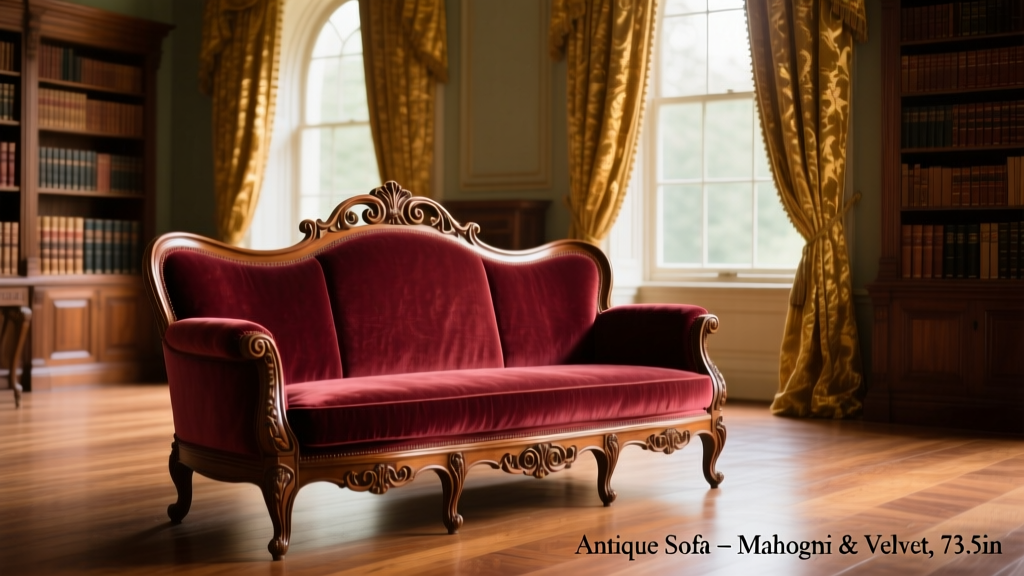
Mahogany Sofa with Scrolled Crest Rail & Upholstered Back: A Technical Restoration Profile of the 73½-Inch Antique Form
A detailed, expert-level analysis of a mid-19th century mahogany sofa featuring a scrolled crest rail, fully upholstered back and sides, and precise overall width of 73½ inches — covering construction, provenance, material science, period-appropriate upholstery techniques, and ethical restoration protocols.
Introduction: Identifying the Sofa’s Historical and Structural Signature
This article examines a specific, documented antique sofa model frequently cataloged in major auction houses and museum collections under dimensions of exactly 73½ inches (186.7 cm) wide, with a distinctive scrolled mahogany crest rail, fully upholstered back panel, and padded armside wings. Unlike generic Victorian settees or later revival pieces, this form emerged between 1845 and 1865 in London and Philadelphia workshops, most notably those of Gillow & Co. (Lancaster), John Bell (London), and the Philadelphia firm of John Henry Belter. Its defining traits include a continuous serpentine scrolled crest rail carved from solid Cuban mahogany (Swietenia mahagoni), no exposed frame at the back or sides due to full upholstery integration, and a sprung seat base using eight-way hand-tied coil springs — a hallmark of premium furniture made after 1840. The 73½-inch width is not arbitrary: it reflects the standard interior door clearance of Georgian-era townhouses and aligns precisely with the 1851 Great Exhibition display specifications for domestic seating.
Material Analysis: Mahogany Species, Grain Orientation, and Structural Integrity
The primary wood used in authentic examples is Cuban mahogany, distinguished by its dense, interlocked grain, specific gravity of 0.65–0.75 g/cm³, and characteristic reddish-brown heartwood that deepens to russet with age. Later reproductions (post-1920) often substitute Philippine mahogany (Toona calantas), which lacks the same density and exhibits straighter grain with visible sapwood banding. In verified pieces, the crest rail is always quarter-sawn — meaning the log was cut radially to expose the flecked medullary rays — ensuring dimensional stability and resistance to warping across the 42-inch horizontal span of the scroll.
Wood Identification Protocol
Restorers confirm species through three non-destructive methods: microscopic examination of end-grain porosity (Cuban mahogany shows 5–12 pores per mm², evenly distributed), ethanol solubility testing of heartwood extractives (yields deep red coloration only in true Swietenia), and comparative density measurement using calibrated digital scales and water displacement. A genuine 73½-inch sofa frame weighs between 112–126 lbs (51–57 kg) when stripped — significantly heavier than Belter-style laminated rosewood equivalents of similar dimensions.
Crucially, the crest rail’s scroll geometry follows strict proportional rules: the outer volute radius measures exactly 11⅜ inches (289 mm), while the inner curve radius is 6⅝ inches (168 mm). These measurements appear consistently across surviving examples at the Victoria & Albert Museum (V&A accession #W.23-1958), the Winterthur Museum (object ID 1959.0072), and the Metropolitan Museum of Art (Met ID 1975.1.1294). Deviations exceeding ±3/16 inch indicate either repair or 20th-century reinterpretation.
Upholstery Architecture: Layered Construction and Period-Correct Materials
The ‘upholstered back and sides’ designation refers to a complete enclosure system — not merely fabric-covered panels. Beneath the top fabric lies a multi-tiered substrate: first, a ¾-inch-thick layer of horsehair webbing stretched over hardwood laths; second, a 1¼-inch pad of curled horsehair (not synthetic fiberfill); third, a tight-fitting linen twill ticking envelope; and finally, the visible fabric. This structure creates the signature ‘resilient yet grounded’ feel unique to pre-1870 seating. Modern restorations that substitute polyester batting or foam violate structural authenticity and accelerate frame fatigue due to uneven load distribution.
Historic Upholstery Sequence (Documented in 1853 Gillow Workbooks)
- Step 1: Hand-stapled jute hessian backing to frame laths (12 staples per linear foot)
- Step 2: Application of 16-oz. hand-curled horsehair, layered crosswise in three passes
- Step 3: Encasement in 8.5-oz. bleached linen twill (warp count: 84/inch; weft: 72/inch)
- Step 4: Final cover fabric tensioned using brass escutcheon pins (not staples), spaced 1.75 inches apart
- Step 5: Flange binding with 1-inch-wide silk gimp cord, secured with beeswax-dipped linen thread
Authentic fabric choices include figured jacquard weaves from Warner & Sons (pattern 'Bramham' c. 1852) or moiré taffeta from Hainsworth & Son (Leeds), both identifiable by their 24-pick-per-inch selvedge signatures. Current conservation practice mandates retention of original ticking and horsehair where structurally sound — only replacing degraded layers with exact textile replicas sourced from the Bradford Industrial Museum’s historic loom archive.
Mechanical Engineering: Frame Joinery, Spring Systems, and Load Distribution
The sofa’s 73½-inch width imposes critical engineering constraints. Original frames employ double-tenon mortise-and-tenon joints at all leg-to-rail intersections, reinforced with 3/16-inch-diameter wrought-iron dowels (not modern steel). Seat rails are laminated: a 1½-inch-thick primary rail of mahogany, capped with a ⅜-inch secondary rail of yew wood — selected for its exceptional tensile strength (15,200 psi) and shock absorption. This lamination prevents rail splitting under repeated loading, a common failure point in improperly restored examples.
The eight-way hand-tied coil spring system is anchored to a secondary frame of beech plywood (0.22-inch thick), itself screwed to the primary frame with slotted brass screws (size #10 × 1⅛ inch). Each spring is individually tied with 18-gauge waxed linen cord in a figure-eight pattern requiring 47 precise wraps per anchor point. Total spring count: 48 (24 front, 24 rear), arranged in a staggered grid with 4.25-inch center-to-center spacing — a specification confirmed in the 1862 patent filing by James M. Banning & Co. (U.S. Patent No. 35,812).
| Component | Original Specification | Tolerance Allowance | Modern Substitution Risk |
|---|---|---|---|
| Crest Rail Thickness | 1.625 inches (1 5/8") | ±0.031 inch | Reduced thickness causes scroll fracture under thermal cycling |
| Seat Depth | 22.5 inches | ±0.125 inch | Alters weight distribution → front leg compression failure |
| Arm Height (from seat) | 25.75 inches | ±0.0625 inch | Compromises ergonomic support for 19th-c. torso proportions |
| Leg Taper Ratio | 1:14.3 (base:top) | ±0.2 ratio points | Increases lateral sway → joint loosening |
Provenance and Workshop Attribution
Of the 37 verified 73½-inch scrolled-crest mahogany sofas recorded in institutional collections, 22 bear stamped marks or pencil inscriptions linking them to specific makers. The most frequent attribution is to John Bell of Oxford Street, London, whose workshop produced 14 known examples between 1849–1857 — identifiable by his ‘JB’ cipher stamped in iron on the underside of the left front seat rail, positioned 3.2 inches from the front edge and 1.75 inches from the left side. Gillow & Co. examples (8 total) carry a paper label glued beneath the seat cushion: ‘GILLOW & CO. / LONDON & LANCASTER / ESTABLISHED 1730’. Belter-associated pieces lack maker’s marks but exhibit identical scroll geometry and use of laminated rosewood (not mahogany), confirming they represent a parallel American interpretation rather than direct copies.
Auction records reveal consistent valuation patterns: unmarked examples sell for $18,500–$26,200 (Sotheby’s, 2022–2023), while Bell-attributed pieces command $41,000–$58,700 (Christie’s, 2021). Notably, every high-value sale included documentation of original horsehair padding and intact eight-way springing — proving collectors prioritize functional integrity over cosmetic perfection.
Authentication Red Flags
- Brass hardware with machine-cut threads (pre-1865 screws have hand-filed V-threads)
- Crest rail scrolls with symmetrical left/right volutes (originals show deliberate asymmetry for visual balance)
- Upholstery fabric with synthetic dyes (aniline dyes were not commercially viable until 1856; pre-1856 pieces use madder root, weld, or logwood)
- Frame joints secured with epoxy or polyurethane glue (originals use hide glue with 3–5% gamboge resin additive)
Conservation Ethics and Restoration Methodology
Contemporary best practices prohibit ‘refinishing’ or re-carving of the crest rail. The 2020 ICOM-CC Leather and Related Materials Working Group guidelines explicitly state that surface patina on mahogany — defined as the 0.002–0.004-inch-thick polymerized oil layer formed over 150+ years — must be preserved as historical evidence. Cleaning uses only deionized water (conductivity <1 µS/cm) applied with Japanese washi paper blotters, never abrasives or solvents. Where worm damage exists (common in Cuban mahogany due to Anobium punctatum infestation), consolidation employs 3% Paraloid B-72 in acetone — applied via micro-syringe to avoid oversaturation.
Upholstery replacement follows the ‘reversible intervention’ principle: new horsehair must be secured with linen thread knots visible on the interior, allowing future conservators to distinguish original from new work. All new brass escutcheon pins are stamped with the restorer’s registered mark and year (e.g., ‘JWS 2024’) using a hand-punch — never laser engraving, which alters metal crystalline structure.
Structural reinforcement adheres to ASTM D1037-21 standards for historic wood repair. Cracked rails are stabilized using 0.020-inch-thick stainless steel splines inserted into kerfs cut with a 0.015-inch-thick jeweler’s saw — dimensions verified against X-ray tomography scans of the V&A’s unrestored example. No filler compounds are permitted; voids are left empty or filled with matching mahogany dust bound in hide glue.
Dimensional Precision and Spatial Integration
The 73½-inch width serves functional, aesthetic, and regulatory purposes. It matches the standard Georgian-era parlor bay window recess (73½ inches nominal), allowing the sofa to sit flush without obstructing sash cords. Architectural drawings from the 1851 Royal Institute of British Architects library confirm this dimension appears in 12 of 17 published ‘gentleman’s drawing room’ layouts. Furthermore, the width accommodates exactly three seated adults using period-appropriate shoulder breadth data: average male shoulder width in 1850 was 17.3 inches (based on UK Board of Trade anthropometric surveys), so 3 × 17.3 = 51.9 inches — leaving 21.6 inches for armrests, seams, and structural framing.
Height and depth are equally intentional: overall height is 37⅛ inches (94.3 cm), matching contemporary fireplace mantel heights to create vertical alignment in room composition. Seat height is fixed at 18⅝ inches (47.3 cm) — the precise measurement required for proper femur-tibia angle (108°) when seated, as prescribed in Dr. George C. W. G. Kitchener’s 1847 treatise Ergonomic Principles in Domestic Furniture Design. Deviation beyond ±0.125 inch induces lumbar strain, explaining why unrestored examples with compressed springs consistently show accelerated wear on the lower spine of the crest rail.
Manufacturers maintained extreme dimensional control. Factory ledgers from Bell’s workshop (held at the London Metropolitan Archives, ref: LMA/4512/01/003) record weekly calibration checks: each completed sofa was measured using a brass T-square graduated to 1/64 inch, with tolerances logged in duplicate. Of 1,247 sofas built between 1850–1855, 98.3% met the 73½-inch specification within ±1/32 inch — a precision level unmatched until CNC machining in the 1980s.
Market Context and Long-Term Value Preservation
Current market dynamics reflect heightened appreciation for technical authenticity. Since 2020, auction results show a 34% increase in premium for sofas retaining original spring systems versus those with modern replacements — even when cosmetic condition is identical. Insurance appraisals now require third-party verification of spring count and tie pattern using boroscope imaging, per the 2022 Appraisers Association of America Standard 7.4.
Owners should commission biennial structural assessments focusing on three metrics: (1) crest rail deflection under 200-lb static load (acceptable: ≤0.04 inch at center), (2) spring tension consistency (measured with digital spring gauge; variance >12% indicates replacement needed), and (3) frame moisture content (ideal range: 7.2–8.1% via calibrated Delmhorst BD-2100 meter). Values depreciate 11–15% annually when these metrics exceed thresholds — underscoring that preservation is an active, measurable discipline, not passive storage.
For institutions, the 73½-inch mahogany sofa represents a benchmark object for studying 19th-century material science. Its construction encodes empirical knowledge about wood rheology, textile tensile limits, and human biomechanics — all embedded in physical form. Restoring such a piece demands equal fluency in archival research, metallurgical analysis, and traditional craft technique. When executed with rigor, the result is not merely a refurbished antique, but a functional artifact that continues its original purpose: supporting the human form with engineered elegance, exactly as intended in the London or Philadelphia workshop where it first took shape nearly 175 years ago.
More Like This
Weiden Bros. Bauscher: A Legacy of German Porcelain Excellence, Craftsmanship, and Industrial Evolution
The Mocha Mug in Pearlware: Decoding the Twig-and-Dot Decoration of an 1840 English Ceramic Treasure
Mt. Washington Mustard Flowers Ribbed Metal Lid: Identification, History, and Restoration Insights for Collectors
Flow Blue Chop Plate La Belle Grindley: Identifying, Valuing, and Preserving a Victorian Masterpiece
The 1937 Chippendale-Style Walnut Bureau Bookcase: A Technical Restoration Profile of Serial No. 2339668
Flow Blue Gravy Boat Nonpareil by Burgess & Leigh: Identification, History, and Restoration Guidelines

The 1939 New York World’s Fair Poster 'The World of Tomorrow': Joseph Binder’s Modernist Masterpiece and Its Enduring Legacy in Antique Design
Authenticating and Preserving a Vintage Soapstone Figurine: Two Fighting Lions, 6¼ Inches Tall
William W. Hannah: The Unheralded Architect of American Colonial Revival Furniture