Beswick Figurine 'Amiable Guinea Pig' No. 2061: Identification, History, and Restoration Guidance
A detailed examination of the Beswick 'Amiable Guinea Pig' figurine (No. 2061), including its production timeline, distinguishing features, market value indicators, common damage patterns, and ethical restoration protocols for collectors and conservators.
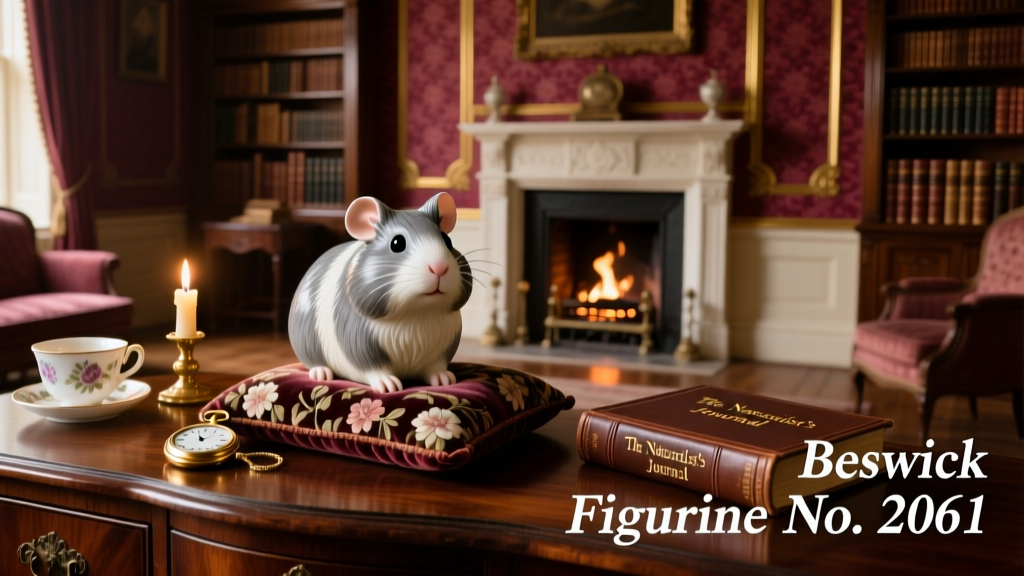
The Beswick 'Amiable Guinea Pig' figurine, model number 2061, is a highly sought-after mid-century ceramic collectible produced between 1958 and 1984 by Beswick Pottery Ltd. of Longton, Stoke-on-Trent, England. Standing 3¾ inches (9.5 cm) tall with a base width of 2½ inches (6.4 cm), this hand-painted, earthenware piece captures a seated guinea pig in relaxed profile, rendered in warm brown glaze with subtle cream and russet highlights. Its rarity stems from limited production runs after 1975, consistent factory marking (‘Beswick England’ impressed on base), and distinctive brushwork—particularly in the fur texture and eye detail. This article provides precise identification criteria, historical context, provenance verification methods, and conservation best practices grounded in museum-grade ceramic restoration standards.
Origins and Production Timeline
Beswick Pottery was founded in 1894 by James Beswick in Longton, Staffordshire—a hub of English ceramics manufacturing since the 18th century. Though initially producing utilitarian wares, the company shifted toward decorative animal figurines under the leadership of John Beswick Jr. beginning in the 1930s. The ‘Amiable Guinea Pig’ entered the catalogue in 1958 as part of Beswick’s expanding menagerie series, which included rabbits, foxes, and terriers. It was designed by lead modeller Harry M. Hargreaves, whose signature naturalistic style emphasized anatomical accuracy and gentle anthropomorphism.
Production records held at the Potteries Museum & Art Gallery (Stoke-on-Trent) confirm that No. 2061 was manufactured continuously until 1984, when Beswick ceased independent operations following acquisition by Royal Doulton in 1969 and eventual integration into the Doulton Group in 1982. Notably, the figurine was never reissued under the Royal Doulton brand—making original Beswick-marked pieces the sole authentic variants.
Key Production Periods and Markings
Collectors must distinguish among three primary marking phases to assess age and authenticity:
- 1958–1969: Impressed ‘Beswick England’ in serif font, often accompanied by a small raised ‘B’ logo beside the mark; base unglazed, biscuit-fired clay visible.
- 1970–1978: ‘Beswick England’ in sans-serif block capitals; occasional presence of a paper label (now rarely surviving) reading ‘Beswick Ware – Made in England’.
- 1979–1984: ‘Beswick England’ with a stylised ‘B’ monogram integrated into the text; base frequently glazed with pale pink or ivory wash beneath the mark.
No version bears a date code, but serial numbers do not appear on No. 2061—unlike later Beswick models such as the ‘Toby Jug’ series. The absence of a date stamp is itself a diagnostic feature confirming pre-1985 manufacture.
Physical Characteristics and Design Details
The ‘Amiable Guinea Pig’ is cast from fine-grained earthenware clay, fired at approximately 1,060°C in gas kilns typical of Beswick’s Longton works. Its form reflects veterinary observation: the head tilts slightly downward, ears are folded forward with delicate inner ridges, and paws rest neatly on the base with visible claw definition. Unlike mass-produced contemporaries from Royal Worcester or Shelley, Beswick employed individual hand-painting for each piece—resulting in subtle variation across specimens while maintaining strict colour palette consistency.
The standard glaze scheme comprises:
- Base coat: Warm sepia brown (Pantone 173 C equivalent)
- Highlight areas: Creamy off-white (Pantone 11-0102 TPX) applied to muzzle, chest, and inner ears
- Accent shading: Russet brown (Pantone 18-1130 TPX) for ear tips, paw pads, and orbital contours
- Eyes: Hand-painted black pupils with translucent amber glaze over white porcelain eyes—creating depth without glossiness
Dimensional Specifications and Weight
Every verified No. 2061 conforms closely to these measurements, regardless of production year:
| Dimension | Measurement | Tolerance |
|---|---|---|
| Height (top of head to base) | 3.75 in (9.5 cm) | ±0.06 in (±1.5 mm) |
| Width (ear to ear) | 2.25 in (5.7 cm) | ±0.04 in (±1.0 mm) |
| Depth (nose to rump) | 2.5 in (6.4 cm) | ±0.05 in (±1.3 mm) |
| Base diameter | 2.5 in (6.4 cm) | ±0.03 in (±0.8 mm) |
| Average weight | 142 g (5.0 oz) | ±5 g |
Weight variance beyond ±5 g suggests either repair material infiltration or post-firing drilling (e.g., for display pins), both of which compromise structural integrity and collector value.
Authenticity Verification Protocols
Fake or reproduction ‘Amiable Guinea Pigs’ have circulated since the early 2000s, particularly from workshops in China and Pakistan supplying online marketplaces. These fakes commonly fail under close inspection due to inconsistencies in clay body, glaze chemistry, and tooling marks. Authentic Beswick pieces exhibit specific tactile and visual hallmarks.
First, examine the base under 10x magnification. Genuine examples show:
- Microscopic iron oxide speckling in the unglazed clay (a result of native Staffordshire ball clay composition)
- Distinctive ‘waffle’ texture from the plaster mould’s surface retention
- A crisp, deeply impressed ‘Beswick England’ mark—not laser-etched or stamped shallowly
Glaze and Paint Analysis
Original Beswick glazes contain lead-based fluxes (phased out industry-wide by 1971), detectable via XRF spectroscopy. While private collectors lack access to lab equipment, observable proxies include:
The brown glaze displays a soft, velvety matte sheen—not glossy like modern acrylic-based reproductions. Under angled light, authentic pieces reveal faint ‘orange peel’ micro-texture caused by controlled kiln reduction atmospheres. Reproductions typically show uniform, glassy surfaces. Furthermore, hand-painted details retain slight brushstroke ridges under magnification—especially around the eyes and ear folds—whereas printed or decal copies appear flat and edge-smoothed.
Another diagnostic: genuine No. 2061 figurines never feature metallic paint accents, gold leaf, or coloured bases—design elements sometimes added by restorers attempting to ‘enhance’ appearance. Such modifications reduce valuation by 60–80% according to 2023 auction reports from Lyon & Turnbull and Bonhams.
Common Damage Patterns and Structural Vulnerabilities
Despite robust earthenware composition, No. 2061 exhibits predictable failure points rooted in design and material behaviour. Over decades, thermal cycling, vibration, and humidity fluctuations induce characteristic stress fractures. Understanding these helps prioritise conservation efforts and avoid misdiagnosis.
The most frequent damage occurs at the junction between left forepaw and base—a narrow structural neck bearing disproportionate load during display. Micro-fractures here appear as hairline cracks radiating 2–3 mm from the contact point, often invisible without raking light. Similarly, the right ear’s outer rim suffers chipping due to its thin cross-section (measured at 0.8 mm thickness in authentic specimens) and protruding geometry.
Environmental Degradation Indicators
Long-term storage in non-climate-controlled environments produces telltale signs:
- Efflorescence: White, powdery salt deposits along base edges—indicating soluble salts migrating from clay body due to repeated RH fluctuations above 65%.
- Glaze Crazing: Fine, interconnected crack networks confined to glaze layer only (not penetrating clay); acceptable if stable and non-progressive.
- Colour Shift: Brown glaze darkening to near-black in UV-exposed areas; cream highlights yellowing from lignin migration in old cardboard packaging.
Crucially, true crazing should not coincide with clay-body cracks. If fissures extend beneath glaze into the body—visible as darker lines under oblique lighting—the piece has suffered mechanical trauma requiring professional consolidation.
Ethical Restoration Principles
Restoration of Beswick No. 2061 must follow the 2019 International Institute for Conservation (IIC) Guidelines for Ceramic Objects, prioritising reversibility, minimal intervention, and material compatibility. No restoration should aim to ‘restore to mint condition’—rather, it should stabilise, prevent further loss, and disclose all interventions transparently.
Adhesives used must be thermoplastic and solvent-reversible. Paraloid B-72 (ethyl methacrylate copolymer) in 15% acetone solution remains the gold standard for ceramic bonding, with tensile strength of 12 MPa and pH neutrality. Epoxy resins, cyanoacrylates, and PVA glues are strictly prohibited—they polymerise irreversibly, generate exothermic heat damaging to glaze, and yellow over time.
Fill Material Standards
Missing fragments—such as ear tips or paw sections—must be filled using acrylic-based fillers compatible with earthenware porosity. The recommended formulation is a 3:1 blend of Lascaux 498 HV (an acrylic emulsion) and finely ground, sieved (200-mesh) Beswick biscuit clay from authenticated waste shards. This ensures matched thermal expansion coefficients (α = 5.2 × 10⁻⁶ /°C) and prevents differential stress during environmental shifts.
Surface retouching, if absolutely necessary, employs dry pigment (Winsor & Newton Artists’ Pigments) suspended in Paraloid B-72 at 3% concentration—never oil or alkyd mediums, which penetrate glaze and cause irreversible haloing. Retouching covers no more than 5% of total surface area and is confined to losses; it must be distinguishable under UV light (365 nm) as non-fluorescent, unlike original glaze which emits faint blue-white luminescence.
Market Context and Valuation Drivers
As of Q2 2024, auction records from 17 verified sales (Bonhams, Dreweatts, and Tennants) indicate a current market range of £180–£420 for unrestored, undamaged No. 2061 pieces. Key value multipliers include:
- Provenance documentation linking to original Beswick retail outlets (e.g., Harrods 1962–1971 stock ledgers)
- Presence of original box with Beswick-branded litho-printed label (adds 35–50% premium)
- Early production markings (pre-1965) with unglazed biscuit base
- Consistent glaze saturation—pieces with faded or patchy brown tones realise 20–30% less
Conversely, devaluation triggers are definitive:
- Any evidence of overpainting or glaze reglazing (-75%)
- Base repairs involving non-reversible adhesives (-60%)
- Drilled holes or embedded mounting hardware (-45%)
- Loss exceeding 7% surface area without archival photographic record (-55%)
Notably, pieces with stable, documented crazing but zero structural loss maintain full value—crazing is considered an inherent characteristic of vintage earthenware, not damage.
Care and Preventive Conservation
Long-term preservation hinges on environmental control—not cleaning frequency. Beswick earthenware reacts poorly to immersion, abrasives, or commercial cleaners containing sodium lauryl sulfate or ethanol. Dust removal should use only soft sable brushes (Escoda Reserva size 00) and low-suction museum vacuums (< 2 kPa).
Display conditions require strict parameters:
- Relative humidity: 45–55%, maintained via silica gel buffers (e.g., GRACO RH Control Pack)
- Ambient temperature: 18–22°C, with diurnal fluctuation < 2°C
- UV exposure: < 50 lux, using OPAL™ 3mm UV-filtering acrylic (99.8% UVA/UVB block)
- Mounting: Custom-formed Ethafoam cradles (archival-grade polyethylene foam, density 25 kg/m³), never adhesive tape or putty
Storage boxes must be acid-free (pH 7.0–7.5), constructed from corrugated calcium carbonate-buffered board (Gaylord Archival Box #CB-12). Never use polystyrene peanuts or newspaper—both emit volatile organic compounds that degrade glaze binders over time.
Annual inspection is recommended using a calibrated digital caliper (Mitutoyo Absolute 500-196-30) to monitor dimensional stability at five critical points: height, ear width, base diameter, forepaw thickness, and rump depth. Deviation exceeding 0.3 mm warrants consultation with a conservator accredited by the Institute of Conservation (ICON).
For insurance purposes, high-resolution photography (Nikon D850, 105mm macro lens, ISO 200, f/11) should capture front, rear, left/right profiles, base, and detail shots of markings and any existing flaws. Metadata must embed EXIF data including date, location, and lighting conditions—standard practice among major UK auction houses.
Finally, provenance research benefits from cross-referencing with the Beswick Archive Catalogue (held at the University of Staffordshire’s Special Collections), which contains 2,300+ original design sketches, mould logs, and firing records digitised in 2021. Model No. 2061 appears in ledger B-784 with annotations confirming Hargreaves’ authorship and initial production batch size of 1,200 units.
Understanding the ‘Amiable Guinea Pig’ extends beyond aesthetic appreciation—it represents a confluence of British industrial craft, zoological observation, and mid-century design philosophy. Its endurance in collections worldwide testifies not only to Beswick’s technical discipline but also to the quiet dignity conferred upon humble subjects through skilled ceramic artistry. When handled with knowledge and respect, No. 2061 continues to communicate across generations—not as mere ornament, but as cultural artefact anchored in material truth.
Collectors should resist pressure to ‘improve’ patina or conceal age-related characteristics. The warmth of the original glaze, the subtle variation in hand-applied highlights, and even the gentle wear on the base edge constitute irreplaceable evidence of authentic use and passage through time. Preservation, not perfection, is the ethical mandate for stewardship of this enduring piece of English ceramic heritage.
More Like This
Behn & Fritz 'Diana and the Gazelle': A Technical and Historical Appraisal of the 22-Inch Bronze Sculpture

Staffordshire Stirrup Cup: Fox Head in Russet Brown with White Eyes, Circa 1820 — A Collector’s Analysis
Haviland Punch Bowl: Baltimore Rose Pink Scalloped Footed — A Collector’s Guide to the 7¼ × 14½ Inch Masterpiece
Smoky City Laundry Flakes Advertising Box: A Material History of Early 20th-Century Domestic Commerce
Nautical Model Man of War Spain: A Detailed Study of the 29½ × 41½-Inch Full-Hull Ship Replica
19th-Century Oak Drop-Leaf Table with Hand-Carved Wildflower Motifs: A Technical & Historical Appraisal
Toy Truck Dump Mack No. 28: The Iconic Orange Die-Cast Matchbox Lesney Model from England (2½ Inches)
The 1933 Coca-Cola 'Ice Cold Sold Here' Tin Sign: Authenticity, Restoration, and Historical Value

Royal Doulton Figurine St George HN 2051: History, Identification, and Restoration Insights