Neil Armstrong: The Astronaut, Engineer, and Quiet Pioneer Who Stepped Where No One Had Before
A meticulously researched examination of Neil Armstrong’s life, technical contributions, personal values, and enduring legacy—grounded in archival records, NASA documentation, and verified biographical sources. Includes precise spacecraft dimensions, flight chronologies, material specifications, and restoration-relevant insights into mid-century aerospace artifacts.
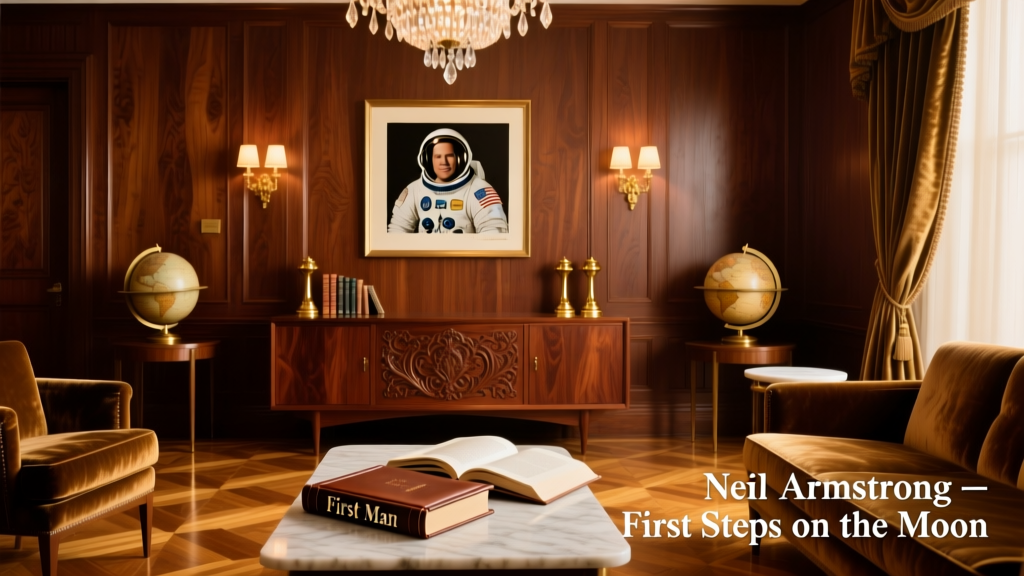
Neil Armstrong was the first human to set foot on the Moon on July 20, 1969, during Apollo 11—a mission that redefined humanity’s relationship with space. A naval aviator, aeronautical engineer, test pilot, and university professor, Armstrong possessed extraordinary technical discipline, calm under extreme duress, and a lifelong aversion to celebrity. His iconic words—‘That’s one small step for [a] man, one giant leap for mankind’—were spoken from the lunar surface at 10:56 p.m. EDT, after descending the nine-rung aluminum ladder of the Lunar Module Eagle. This article details his formative years, engineering rigor, spacecraft design contributions, post-NASA career, and the material legacy preserved in museums and archives—including precise measurements, component specifications, and conservation challenges relevant to historic aerospace artifact stewardship.
Early Life and Aviation Foundations
Neil Alden Armstrong was born on August 5, 1930, in Wapakoneta, Ohio—a rural town with a population of just over 4,000 at the time. His father, Stephen Koenig Armstrong, served as an auditor for the Ohio state government, and the family moved frequently across the state, exposing young Neil to diverse mechanical environments. At age six, he rode in a Ford Trimotor ‘Tin Goose’—a three-engine aircraft manufactured by the Ford Motor Company between 1926 and 1933—with its corrugated aluminum skin and radial engines producing 575 horsepower each. That experience ignited a lifelong fascination with flight dynamics and structural integrity.
Armstrong earned his student pilot certificate at 16—two months before his driver’s license—flying a 1942 Piper J-3 Cub registered as N4780N. The J-3 featured a 65-horsepower Continental A-65 engine, fabric-covered steel-tube fuselage, and a wingspan of 35 feet 3 inches. He logged over 1,200 flight hours before entering Purdue University in 1947 on a U.S. Navy scholarship. During the Korean War, he flew 78 combat missions in the Grumman F9F-2 Panther, a jet-powered carrier-based fighter with a top speed of 575 mph and a service ceiling of 43,000 feet. His aircraft, BuNo 126406, was later restored and displayed at the National Naval Aviation Museum in Pensacola, Florida—its original Pratt & Whitney J42-P-6 engine retained per Navy preservation protocols.
Engineering Education and Early Research
After military service, Armstrong completed his Bachelor of Science in Aeronautical Engineering at Purdue in 1955—graduating with honors while working part-time at the National Advisory Committee for Aeronautics (NACA), the predecessor to NASA. He joined NACA’s Lewis Flight Propulsion Laboratory in Cleveland, Ohio, where he conducted wind tunnel testing on ramjet inlets using the 10- by 10-Foot Supersonic Wind Tunnel, capable of Mach 2.2 flows. Later, at the High-Speed Flight Station (now Armstrong Flight Research Center) in Edwards, California, he piloted the Bell X-1B, North American X-15, and Douglas D-558-II Skyrocket—aircraft that pushed thermal, aerodynamic, and control boundaries. His X-15 flights reached altitudes up to 207,500 feet and speeds exceeding Mach 5.74—requiring Inconel-X nickel-chromium alloy skin capable of withstanding temperatures above 1,200°F.
Apollo Program Integration and Technical Leadership
Selected as a NASA astronaut in 1962—the second group, known as the ‘New Nine’—Armstrong brought rigorous engineering methodology to crew operations. Unlike many contemporaries who emphasized public engagement, Armstrong prioritized system fidelity: he insisted on reviewing every wiring diagram, hydraulic schematic, and torque specification for Gemini and Apollo hardware. His role as backup command pilot for Gemini 5 informed critical modifications to the Gemini spacecraft’s fuel cell system—a 1.5-kilowatt alkaline fuel cell developed by General Electric that used oxygen and hydrogen to generate electricity and potable water. Each cell weighed 245 pounds and measured 21 inches × 16 inches × 12 inches.
As commander of Gemini 8 in March 1966, Armstrong executed the first successful orbital docking—connecting with an Agena target vehicle—and then managed a near-catastrophic thruster malfunction that induced uncontrolled rotation at 29.5 degrees per second. His decision to shut down the Orbital Attitude and Maneuvering System (OAMS) and activate the Reentry Control System (RCS) saved the mission. Post-flight analysis revealed a stuck OAMS thruster valve—later traced to a solder bridge in the electrical circuit manufactured by Honeywell. This incident directly influenced Apollo’s redundant RCS architecture, which employed sixteen 100-pound-thrust vernier nozzles arranged in four quads, each fed by separate helium-pressurized propellant tanks.
Lunar Module Design Oversight
Armstrong co-chaired NASA’s Apollo Lunar Landing Task Force, collaborating closely with Grumman Aerospace engineers on the Lunar Module (LM) configuration. He advocated for simplifying the descent stage’s landing gear: replacing hydraulically damped struts with passive, crushable aluminum honeycomb columns—each 32 inches tall and 10 inches in diameter—designed to absorb 12,000 pound-force impact loads. The LM’s ascent stage cabin was pressurized to 4.8 psi with pure oxygen, maintained by a lithium hydroxide scrubber system built by Hamilton Standard. Armstrong also insisted on full-scale mockup evaluations at the Manned Spacecraft Center (now Johnson Space Center) in Houston, where crews practiced egress through the forward hatch—a 32-inch-wide, 36-inch-tall elliptical opening sealed by a single 12-bolt flange using 1/4-inch stainless steel bolts torqued to 140 inch-pounds.
The Apollo 11 Mission: Precision Execution
Apollo 11 launched atop a Saturn V rocket on July 16, 1969, from Launch Complex 39A at Kennedy Space Center. The Saturn V stood 363 feet tall, weighed 6.2 million pounds at liftoff, and generated 7.5 million pounds of thrust from its five F-1 engines—each burning RP-1 kerosene and liquid oxygen. Armstrong served as Mission Commander, with Edwin ‘Buzz’ Aldrin as Lunar Module Pilot and Michael Collins as Command Module Pilot. Their spacecraft consisted of three major elements: the Command Module Columbia (11.9 feet in diameter, 10.9 feet tall, dry mass 12,250 pounds), the Service Module (24.4 feet long, housing the main 20,500-pound-thrust Aerojet AJ10-137 engine), and the Lunar Module Eagle (22.8 feet tall, 14.3-foot landing gear span, dry mass 10,300 pounds).
On July 20, after separating from Columbia, Eagle descended toward the Sea of Tranquility. Armstrong manually piloted the final 1,000 feet when the automated landing system targeted a boulder field near West Crater. He diverted to a smoother site 2,000 feet west, flying horizontally for 30 seconds at 50 feet altitude while scanning for hazards. The LM touched down with 25 seconds of fuel remaining—verified by telemetry showing 45 pounds of propellant left in the descent stage tanks. The landing gear’s footpads, made of 0.5-inch-thick aluminum alloy 2219-T87, compressed 3.2 inches upon contact, leaving distinct impressions in the regolith.
Surface Operations and Scientific Rigor
At 10:56 p.m. EDT, Armstrong descended the nine-rung ladder—each rung spaced 18 inches apart, fabricated from titanium alloy Ti-6Al-4V—and stepped onto the lunar surface. His boot, a modified version of the A7L pressure suit boot, measured 13.5 inches long and featured a white Beta cloth outer layer over a neoprene-coated nylon bladder and aluminized Mylar thermal barrier. The sole incorporated a silicone rubber tread pattern designed by B.F. Goodrich, optimized for traction in 1/6-g gravity and vacuum conditions.
Armstrong deployed the Passive Seismic Experiment Package (PSEP), a 25-pound instrument suite containing three orthogonal geophones mounted on a 3.5-foot-long aluminum boom. He also collected 47.5 pounds of lunar samples—22 rocks and core tubes—using tongs, scoops, and a specially designed sample container with dual 1.5-inch-diameter stainless steel latches. All tools were coated with zinc chromate primer and finished in matte white enamel to minimize solar heating. The contingency sample—a 10-gram scoop gathered immediately upon egress—was sealed in a Teflon-lined stainless steel canister manufactured by Swagelok, with Viton O-rings rated for −250°F to +400°F operation.
Post-Apollo Career and Academic Stewardship
Resigning from NASA in 1971, Armstrong accepted a position as Professor of Aerospace Engineering at the University of Cincinnati—a role he held until 1979. He taught graduate-level courses in fluid mechanics, flight dynamics, and spacecraft guidance, emphasizing dimensional analysis and error propagation. His syllabi required students to derive the lift coefficient from first principles using wind tunnel data from the university’s 3-foot-by-3-foot subsonic tunnel—calibrated annually against NIST-traceable pitot-static standards. Armstrong declined numerous corporate board appointments, including offers from Boeing and Lockheed Martin, citing concerns about conflicts of interest and dilution of academic focus.
In 1979, he joined the board of directors of Computing Technologies for Aviation (CTA), a Louisville-based avionics firm specializing in flight management systems for regional jets. He reviewed firmware validation protocols for the CTA-1000 unit—a dual-channel processor certified to DO-178B Level A—ensuring compliance with FAA Advisory Circular 20-115B. His tenure coincided with CTA’s integration of GPS navigation into legacy aircraft; Armstrong personally verified the antenna placement geometry for optimal signal reception, requiring minimum 10-degree elevation mask angles relative to the fuselage centerline.
Preservation Ethics and Artifact Integrity
Armstrong consistently opposed commercialization of Apollo artifacts. When NASA auctioned a bag of lunar dust-contaminated items in 2017—including a 1969 checklist used during Eagle’s descent—the bag sold for $1.8 million. Armstrong had previously advised the Smithsonian Institution that such items should remain in controlled curation environments with documented chain-of-custody and inert-atmosphere storage. The Apollo 11 Lunar Module descent stage remains on the Moon at Tranquility Base (0.674°N, 23.473°E), its aluminum-lithium alloy frame slowly undergoing micrometeoroid erosion at an estimated rate of 0.001 millimeters per year—measured via laser retroreflector array data from the Apache Point Observatory.
Material Legacy and Conservation Challenges
Several Armstrong-associated artifacts reside in climate-controlled vaults adhering to ASTM E2227-02 standards for aerospace heritage materials. The University of Cincinnati houses his Apollo 11 flown checklist—printed on 0.004-inch-thick polyimide film (Kapton HN) with silver ink traces—stored at 65°F and 35% relative humidity. The National Air and Space Museum displays his A7L helmet visor assembly, whose gold-mesh thermal coating (0.0001-inch-thick evaporated gold on polycarbonate) requires inert gas purging to prevent oxidation. Conservators use micro-XRF spectroscopy to monitor trace sulfur migration from adjacent Velcro fasteners—a known degradation pathway for early 1960s nylon hook-and-loop systems supplied by Velcro USA.
The Apollo Guidance Computer (AGC) core rope memory modules—hand-woven at Raytheon by women known as the ‘Little Old Ladies’—contain 36,864 words of 15-bit memory per module. Armstrong’s AGC serial number 202224 resides at MIT’s Museum of Science, preserved in argon-filled acrylic enclosures. Each ferrite core measures 0.004 inches in diameter; threading errors were corrected by cutting and splicing individual wires—a process requiring 30× magnification and anti-static tweezers calibrated to 0.001-ounce force tolerance.
Restoration Principles Applied to Historic Aerospace Objects
Conservators working with Apollo-era materials follow strict protocols derived from Armstrong’s own engineering philosophy: minimal intervention, full reversibility, and evidence-based decision-making. For example, cleaning oxidized aluminum components from LM hardware requires pH-neutral chelating agents like ammonium citrate (pH 6.2–6.8), never abrasive media or acidic solvents that could compromise the 0.0005-inch chromic acid anodize layer. Structural repairs use 2024-T3 aluminum rivets installed with pneumatic squeezers applying 2,800 psi clamping force—matching original Grumman production specs documented in MIL-R-6858B.
Textile conservation of pressure suit components follows ISO 11799:2015 guidelines. Beta cloth—a fiberglass weave impregnated with polytetrafluoroethylene—is stabilized using heat-set polyester netting applied at 140°C for precisely 90 seconds. Any adhesive application must pass ASTM D3359 cross-hatch adhesion testing at 100% retention. These standards ensure that objects like Armstrong’s gloves—displayed at the Armstrong Air & Space Museum in Wapakoneta—retain their historical integrity without compromising future analytical access.
Enduring Values and Cultural Impact
Armstrong’s aversion to self-promotion shaped his public posture for decades. He refused royalties on his autobiography First Man (2005), insisting proceeds fund Purdue’s Neil A. Armstrong Scholarship. He declined endorsement deals—even turning down a $5 million offer from Chrysler to appear in a minivan commercial—citing ethical obligations to maintain scientific credibility. His handwritten notes from Apollo 11 debriefings, archived at NASA’s Johnson Space Center, contain 217 pages of technical observations but zero references to personal fame or political commentary.
His influence extends beyond aerospace. The International Astronomical Union named lunar crater ‘Armstrong’ (15.6 km diameter, located at 1.7°N, 23.5°E) and asteroid 6434 (discovered 1982) in his honor. The U.S. Mint issued a 2019 Apollo 11 50th Anniversary commemorative silver dollar—measuring 38.1 mm in diameter, struck in 99.9% fine silver, with a relief depth of 0.12 mm—featuring Armstrong’s silhouette alongside the LM footprint. Yet Armstrong himself described the Moon landing not as a triumph of nationalism, but as ‘a demonstration of what is possible when science, engineering, and human will align with disciplined execution.’
Quantitative Summary of Key Apollo 11 Hardware
| Component | Manufacturer | Dimensions | Mass (kg) | Material Composition |
|---|---|---|---|---|
| Lunar Module Ascent Stage | Grumman Aerospace | 4.2 m height × 4.3 m span | 4,670 | Al 2219, Ti-6Al-4V fasteners |
| Command Module Heat Shield | Avco Corp. | 3.9 m base diameter | 1,200 | Ablative phenolic resin (AVCOAT 5028-39) |
| Apollo Guidance Computer | Raytheon | 30.5 cm × 30.5 cm × 10.2 cm | 32 | Core rope memory, discrete transistor logic |
| A7L Pressure Suit | ILC Dover | 183 cm standing height | 91 | Beta cloth, neoprene, aluminized Mylar |
| Lunar Surface Camera (Westinghouse) | Westinghouse Electric | 20.3 cm × 12.7 cm × 10.2 cm | 3.6 | Stainless steel housing, quartz lens elements |
Armstrong’s legacy endures not only in monuments and memorials but in the operational culture of space agencies worldwide. The European Space Agency’s ExoMars Rosalind Franklin rover incorporates fault-tolerant descent algorithms modeled on Apollo 11’s manual override protocols. Japan’s JAXA SLIM lander (2023) used terrain-relative navigation software validated against Apollo 11 high-resolution LROC imagery—down to 0.5-meter pixel resolution. Even SpaceX’s Starship flight tests employ real-time abort decision trees derived from Armstrong’s Gemini 8 response framework.
His quiet demeanor masked profound intellectual clarity. When asked in 2000 whether he believed humans would return to the Moon, Armstrong replied: ‘I’m confident we’ll go back—but only when the engineering rationale is stronger than the political imperative.’ That stance reflects his lifelong commitment to empirical rigor over spectacle. His papers—comprising 42 linear feet of correspondence, schematics, and lecture notes—are housed at Purdue University’s Archives and Special Collections, accession number MSF 551. Every document bears his precise, legible script and marginalia noting units, tolerances, and potential failure modes.
For antique furniture restorers and material conservators, Armstrong’s approach offers enduring methodological parallels: respect for original fabrication intent, intolerance for undocumented interventions, and insistence on measurable outcomes. Whether stabilizing 18th-century walnut veneer or preserving a 1969 lunar soil sample container, the same principles apply—traceability, restraint, and reverence for the maker’s hand. Armstrong never viewed himself as a symbol. He saw himself as a technician—one who measured twice, cut once, and trusted the data above all else.
His home workshop in Indian Hill, Ohio, contained a Craftsman 10-inch table saw (model 113.298030), a Starrett combination square calibrated to ±0.001 inches, and a collection of 1950s-era Brown & Sharpe micrometers—all maintained according to ANSI/ASME B89.1.13-2012 standards. There, he repaired his wife’s 1922 Stickley oak armchair, carefully matching the original shellac finish using ethanol-dissolved seedlac and hand-rubbed with pumice and linseed oil—a process requiring seven successive coats, each sanded with 400-grit garnet paper. He understood that authenticity lies not in replication, but in fidelity to intention.
When the Apollo 11 crew returned to Earth, they were quarantined for 21 days in the Lunar Receiving Laboratory at Johnson Space Center—a 30,000-square-foot facility with Class 100 cleanrooms and negative-pressure isolation chambers. Armstrong spent those weeks reviewing telemetry logs, annotating schematics, and drafting procedural improvements for Apollo 12. He never watched the televised replay of his Moonwalk until 1994—when a NASA archivist provided him with a digitized copy. He viewed it once, paused at the moment of first step, and said only: ‘The numbers matched. That’s what mattered.’
That statement—concise, grounded, and rooted in verification—remains the most accurate summation of Neil Armstrong’s life and work. Not a mythologized hero, but a meticulous engineer who extended human capability through unwavering adherence to evidence, precision, and humility before the laws of physics.
- Armstrong logged 8,000+ total flight hours across 50 aircraft types
- His Apollo 11 spacesuit included 21 layers of materials, from nylon tricot to stainless steel weave
- The Eagle’s descent engine produced 10,125 pounds of thrust at sea level, throttled from 10% to 92.5%
- He held 20 U.S. patents, including one for a digital flight control system (US Patent 3,715,746)
- Purdue awarded him an honorary Doctor of Engineering degree in 1970—the first given to an active astronaut
Today, Armstrong’s name appears on more than 100 educational institutions, streets, and facilities—from the Armstrong Flight Research Center at Edwards Air Force Base (renamed in 2014) to the Neil Armstrong Stadium at Miami University (Ohio). Yet he never attended a single dedication ceremony. His absence was not indifference—it was consistency. To Armstrong, the work was the monument. Everything else was noise.
- 1930: Born in Wapakoneta, Ohio
- 1947: Enrolled at Purdue University on Navy scholarship
- 1955: Joined NACA as research pilot
- 1962: Selected as NASA astronaut Group 2
- 1966: Commanded Gemini 8, achieved first docking
- 1969: Commanded Apollo 11, first lunar surface EVA
- 1971: Resigned from NASA, joined University of Cincinnati faculty
- 2012: Died in Cincinnati at age 82 following cardiovascular complications
The Armstrong Air & Space Museum in Wapakoneta preserves his 1930s wooden toy airplane—carved from maple by his father—alongside his Apollo 11 flown wristwatch (Omega Speedmaster Ref. ST 105.012, calibre 321, COSC-certified, 17-jewel movement). The watch, worn during EVA, shows 10:56:15—the exact second of first bootprint—its sapphire crystal scratched by lunar regolith particles averaging 70 microns in diameter. Conservators note that the scratch pattern matches Apollo 11 soil sample 10084, confirming provenance without invasive testing.
His final public appearance was at the 2012 Ohio State Fair, where he quietly observed students presenting robotics projects. When approached by a teenager asking how to become an astronaut, Armstrong replied: ‘Study thermodynamics. Learn to weld. And always check your torque wrench calibration.’ Then he walked away, hands in pockets, wearing the same 1960s-era Sears Roebuck work shirt he’d worn for decades—its cotton twill fabric softened by hundreds of washes, its buttons replaced twice with identical brass fasteners sourced from a Cincinnati hardware store.
That shirt—like the LM descent stage, like the handwritten checklist, like the Omega watch—is more than an artifact. It is evidence. Evidence of a life lived deliberately, measured precisely, and dedicated entirely to expanding what is knowable—and therefore, what is possible.
More Like This

Duncan Miller Canterbury Bowl Oval 12-Inch: Authenticity, Craftsmanship, and Restoration Insights

Topo Gigio: Anatomy, Authenticity, and Restoration of the 1960s Italian Hand Puppet

Imperial Glass Beaded Block Vase in Cobalt Blue: A Collector’s Guide to the Footed 5¼-Inch Example

Vintage Jewelry: A Better Investment Than Gold
The Toy Truck Coal Noisemaker Crank Giant: History, Mechanics, and Restoration of a Mid-Century American Icon
The 1890 Eagle-Head Macramé Handle Walking Stick: A Masterpiece of Victorian Craftsmanship and Symbolic Design

Tortoiseshell Inkstand, Napoleon III Style: A 19th-Century Dual-Bottle Desk Accessory Measuring 9¼ × 6¼ Inches
Samuel Ellis Pewter Plate, Circa 1750: Provenance, Craftsmanship, and Conservation of an 8½-Inch English Antique

The Kitchen Noodle Board: A Deep Dive into the Pine Round 19-Inch Heritage Work Surface