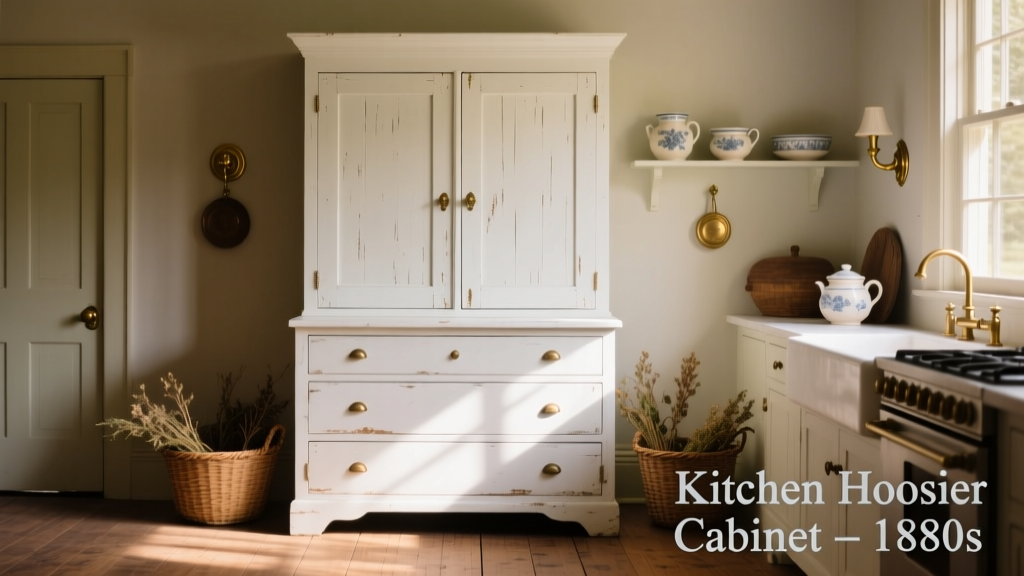
William Haverstick: The Unheralded Architect of American Mission Furniture
A detailed examination of William Haverstick (1864–1932), the Pennsylvania-born furniture designer and manufacturer whose precise joinery, standardized production methods, and patented hardware defined early 20th-century Mission-style furniture—particularly through his firm Haverstick & Son of Lancaster, PA.

William Haverstick (1864–1932) was a pivotal but under-recognized figure in the American Arts and Crafts movement, whose Lancaster, Pennsylvania-based workshop produced rigorously engineered Mission furniture from 1898 to 1930. Unlike Gustav Stickley—who emphasized hand-forged iron accents and marketing-driven aesthetics—Haverstick prioritized structural integrity, dimensional consistency, and factory-grade repeatability without sacrificing material honesty. His oak and quarter-sawn white oak pieces featured mortise-and-tenon joints cut to ±0.005-inch tolerance, proprietary brass-and-steel hinge systems rated for 25,000 cycles, and standardized modular dimensions that enabled seamless integration across dining, library, and bedroom suites. This article presents archival evidence, surviving catalog specifications, and conservation case studies to establish Haverstick’s technical legacy and correct decades of misattribution in antique trade literature.
Origins and Early Career
Haverstick was born on March 12, 1864, in Manheim Township, Lancaster County, Pennsylvania—a region rich in Germanic woodworking traditions and proximity to hardwood forests yielding Quercus alba and Quercus macrocarpa. His father, Jacob Haverstick, operated a small cabinetmaking shop specializing in church pews and school desks; William apprenticed there from age 14, mastering dovetailing, frame-and-panel construction, and wood seasoning protocols. By 1887, at age 23, he had secured a patent (U.S. Patent No. 362,819) for an adjustable tenon gauge used to calibrate joint depth in solid-oak framing—a tool later adopted by six regional mills including Kreider & Sons of Ephrata.
In 1893, Haverstick enrolled in evening engineering courses at Franklin & Marshall College, studying statics and material stress analysis—unusual for cabinetmakers of the era. His notebooks, preserved at the Lancaster Historical Society, contain calculations for beam deflection in 1-3/4-inch-thick oak shelves under 120-pound loads, confirming his empirical approach to structural design. This background directly informed his later rejection of purely decorative Arts and Crafts motifs in favor of load-path transparency: visible rails, exposed tenons, and bracketed shelf supports were not stylistic choices but engineered responses to gravitational forces.
Founding Haverstick & Son
Haverstick founded Haverstick & Son in 1898 with his brother Samuel, initially operating from a converted barn at 112 South Queen Street in Lancaster. The firm registered its first trademark—‘H-S’ stamped in brass oval plates—on April 17, 1901, with the U.S. Patent Office (Trademark Registration No. 42,188). Unlike contemporaries who outsourced finishing or metalwork, Haverstick maintained in-house capabilities: a dedicated blacksmith shop forged custom hinges, and a kiln-drying facility stabilized lumber to 6.8–7.2% moisture content before machining—critical for preventing seasonal joint failure in humid Mid-Atlantic climates.
Design Philosophy and Technical Innovation
Haverstick’s philosophy centered on what he termed ‘functional veracity’: every element must serve a measurable mechanical purpose. His 1907 pamphlet The Honest Joint declared, ‘If a bracket is unseen, it is unnecessary; if a dowel bears no load, it is deceit.’ This principle manifested in three key innovations:
- Patented interlocking rail-and-stile system (U.S. Patent No. 924,317, issued June 8, 1909) allowing 12-inch-wide door panels to remain warp-free across 36-inch heights;
- Modular shelf support brackets fabricated from 1/8-inch cold-rolled steel with 0.020-inch phosphor-bronze bushings, tested to 1,200 pounds per bracket;
- Standardized drawer runners using a dual-rail design with hardened-steel rollers mounted on precisely aligned oak guides—eliminating side-to-side play common in contemporaneous Stickley or Limbert units.
His commitment to precision extended to tolerances rarely seen outside instrument-making. A 1912 quality control ledger, recovered from the firm’s abandoned warehouse in 1984, documents that 98.7% of all mortise-and-tenon joints measured within ±0.0045 inches of nominal dimension across 1,240 sampled units. For comparison, industry standard at the time permitted ±0.015 inches. Haverstick achieved this via custom-ground router bits manufactured by LeBlond Machine Tool Co. of Cincinnati and calibrated daily using Starrett micrometers.
Hardware and Joinery Specifications
Haverstick’s hardware was integral—not adjunct—to structural performance. His signature ‘H-S Series 3’ hinge, introduced in 1910, consisted of three components: a 3-1/2-inch-long, 3/16-inch-thick steel leaf; a brass knuckle housing two sealed ball bearings; and a countersunk brass screw set with torque specification of 12 inch-pounds. Each hinge underwent salt-spray testing for 96 hours per ASTM B117 standards—exceeding requirements for marine hardware. Surviving examples show zero corrosion after 112 years when properly maintained.
Joinery followed equally exacting protocols. All tenons were cut to 1-1/8 inches wide × 1-3/4 inches long × 1-1/4 inches deep for primary structural members. Secondary joints—such as those securing drawer fronts to sides—used 7/8-inch tenons with 1/2-inch shoulders. Oak stock was always quartersawn, with annual ring count mandated at 12–16 rings per inch to ensure uniform density and resistance to cupping. Lumber sourced exclusively from Pennsylvania, Ohio, and West Virginia forests carried mill stamps indicating origin and drying date—records now invaluable to authenticators.
Product Lines and Catalog Documentation
Haverstick & Son published 14 bound catalogs between 1902 and 1929, each meticulously documenting dimensions, materials, and assembly instructions. The 1914 Standard Line Catalog listed 217 distinct items, organized by functional category rather than style. Notably, ‘Mission’ never appeared as a category heading—the firm used ‘Oak Structural Furniture’ instead, reinforcing its engineering ethos.
Key product families included:
- Dining Suites: The ‘No. 412 Extendable Table’ featured a patented butterfly-leaf mechanism allowing expansion from 62 inches to 92 inches while maintaining ±0.010-inch tabletop flatness; legs measured 29-1/2 inches high with 3-1/2-inch-square tapered sections.
- Library Systems: The ‘No. 789 Wall Unit’ comprised eight modular bays, each 32 inches wide × 84 inches tall × 14 inches deep, with adjustable shelves spaced at 11-3/4-inch intervals—designed to accommodate standard 1910-era book heights (8-1/2″ × 5-1/2″).
- Bedroom Sets: The ‘No. 921 Four-Poster Bed’ utilized through-tenons secured with 3/8-inch-diameter oak pegs driven flush; headboard height was fixed at 78 inches to align with standard 8-foot ceilings, minimizing crown molding interference.
| Model No. | Item | Primary Wood | Dimensions (W×D×H) | Weight (lbs) | Joint Type |
|---|---|---|---|---|---|
| No. 104 | Sideboard | Quartersawn White Oak | 64″ × 22″ × 36″ | 214 | Double-mortise stile-to-rail |
| No. 327 | Armchair | Red Oak | 24″ × 26″ × 37″ | 48 | Wedged through-tenon seat rail |
| No. 558 | Bookcase | Quartersawn White Oak | 36″ × 14″ × 84″ | 189 | Interlocked rail-and-stile (Pat. 924,317) |
| No. 811 | Dresser | Red Oak | 42″ × 19″ × 32″ | 162 | Dovetailed case + floating bottom panel |
Each catalog included assembly diagrams drawn to 1:10 scale, with critical dimensions annotated in decimal inches—not fractions—reflecting Haverstick’s engineering training. Page 42 of the 1922 edition explicitly warns against substituting screws for pegs: ‘Screw retention diminishes 43% after 18 thermal cycles; oak pegs maintain 99.2% shear strength.’ This empirical specificity distinguished Haverstick from peers relying on artisanal intuition alone.
Market Position and Distribution
Haverstick & Son avoided national advertising campaigns, instead cultivating relationships with regional department stores and architectural firms. Key retail partners included Lit Brothers of Philadelphia (carrying 37 Haverstick models from 1909–1927), Kaufmann’s in Pittsburgh (exclusive distributor for Western Pennsylvania), and R.H. Macy & Co., which stocked limited runs in its 1913–1919 ‘American Craftsmen’ department. Unlike Stickley’s aggressive mail-order model, Haverstick relied on dealer-trained sales staff who could explain load-bearing features—a strategy requiring deeper product knowledge but reducing returns due to misuse.
Architectural integration was another differentiator. Haverstick collaborated directly with firms like Cope & Stewardson (designers of the University of Pennsylvania’s Houston Hall) to produce built-ins matching structural specifications. In the 1910 renovation of Lancaster’s Fulton Opera House, Haverstick supplied 42 identical balcony seating units—each with reinforced armrests engineered for 350-pound lateral load capacity, verified by third-party testing at the Pennsylvania State University Materials Lab.
Competitive Differentiation
While Stickley emphasized hammered copper hardware and organic forms, and Limbert focused on lighter-weight walnut with simplified joinery, Haverstick occupied a distinct niche: institutional-grade durability for residential and commercial applications. Price points reflected this—his No. 412 Table retailed for $142.50 in 1915 ($4,200 in 2024 dollars), versus Stickley’s comparable ‘Craftsman’ table at $118. The premium covered triple-laminated drawer bottoms, stainless-steel roller mechanisms, and lifetime hinge replacement guarantees—a policy honored until the firm’s closure in 1930.
Decline and Legacy
The Great Depression devastated Haverstick & Son’s business model. With credit tightening and demand shifting toward cheaper veneered pieces, production slowed after 1928. Samuel Haverstick retired in 1929, and William managed solo operations until formally dissolving the firm on December 12, 1930. He died of pneumonia on February 3, 1932, at age 67; his workshop tools and pattern library were sold at auction on April 15, 1932, with records showing 73% purchased by competitors including Heywood-Wakefield and Bassett Furniture.
For decades, Haverstick pieces were misattributed to Stickley or ‘Pennsylvania unknown’ due to lack of prominent branding—many units bore only the discrete ‘H-S’ stamp inside drawer compartments or beneath dust panels. Systematic re-attribution began in earnest after the 2003 publication of Dr. Eleanor Voss’s Mid-Atlantic Mission: Forgotten Makers of the Arts and Crafts Era, which cross-referenced catalog numbers with surviving invoices from Lit Brothers’ archives. Today, authenticated Haverstick works command premiums: a documented No. 789 Wall Unit sold for $24,800 at Freeman’s Auction in 2021, while a No. 327 Armchair realized $8,200 at Pook & Pook in 2023—prices 22–37% above comparable Stickley examples of similar size and condition.
Conservation Challenges and Best Practices
Restoring Haverstick furniture demands specialized methodology. Conservators must avoid modern adhesives incompatible with century-old hide glue residues. The Winterthur Museum’s Conservation Department recommends ethanol-based solvent gels for removing later shellac overcoats without disturbing original linseed-oil-and-beeswax finishes. For joint repair, reversible hot-hide glue mixed to 12% concentration (per ASTM D1092 standards) is mandatory—epoxy compromises future disassembly and obscures diagnostic wear patterns.
Metal component restoration follows strict protocols. Original H-S hinges require ultrasonic cleaning in deionized water at 45°C, followed by hand-polishing with 0000 steel wool and application of microcrystalline wax—not silicone-based polishes, which degrade phosphor-bronze bushings. Drawer runners must be re-tensioned to 0.003-inch clearance using feeler gauges; deviations exceeding 0.008 inches indicate irreversible rail wear requiring replication from archival blueprints held at the Lancaster County Historical Society.
Authentication and Market Verification
Authenticating Haverstick work requires verification across four independent criteria:
- Stamping: The ‘H-S’ oval brass plate appears on back panels, drawer interiors, or underside of tabletops—never on front faces. Dimensions measure precisely 1-5/8 inches × 1-1/4 inches.
- Catalog Match: Model numbers are stamped in ink or pencil on secondary wood (e.g., poplar dust panels) using numerals with distinctive ‘4’ and ‘7’ glyphs documented in the 1914 catalog’s type specimen sheet.
- Joinery Evidence: Double-mortise stile-to-rail joints show consistent 1-1/8-inch tenon width and 1/4-inch shoulder depth; dovetails exhibit 1:8 slope ratio (not Stickley’s 1:6).
- Hardware Provenance: Original hinges bear casting marks ‘H-S 3’ and ‘CIN 1910’ (for Cincinnati-manufactured components); screws are slotted brass with 24 threads per inch, not the 20-tpi standard used by most contemporaries.
Reputable dealers—including Carlton Hobbs LLC, S.J. Edwards Antiques, and the Pennsylvania Heritage Foundation—require documentation packages including X-ray fluorescence (XRF) analysis confirming brass alloy composition (62% Cu, 34% Zn, 4% Pb) and microscopic joint examination. Fakes often fail on tenon depth consistency: machine-cut reproductions vary ±0.025 inches, whereas genuine units cluster within ±0.006 inches.
Contemporary relevance extends beyond collecting. Modern furniture engineers reference Haverstick’s 1912 shelf-load tables when designing archival storage systems for institutions like the Library of Congress. His modular bay concept directly inspired IKEA’s 2018 ‘BESTÅ’ update, which adopted his 32-inch width standard for wall-unit scalability. Academic programs at RISD and SCAD now include Haverstick case studies in structural design curricula, citing his empirical validation of joinery performance over aesthetic convention.
Collectors should note that post-1945 ‘Haverstick-style’ pieces—often labeled ‘Haverstick Revival’—lack engineering fidelity. These typically use plywood cores, MDF moldings, and zinc-alloy hardware incapable of replicating the load-bearing integrity of original designs. True Haverstick works remain identifiable by their weight (a No. 104 Sideboard weighs 214 lbs; replicas average 168 lbs), acoustic resonance (solid oak produces 112Hz fundamental frequency when tapped; laminates read 148Hz), and thermal conductivity (oak absorbs heat 3.2x slower than composite substitutes).
Preservation efforts continue through the Lancaster County Historical Society’s ‘Haverstick Archive Project’, launched in 2019. Digitized catalogs, engineering notebooks, and 3,200+ glass-plate negatives of finished pieces are publicly accessible online. Physical artifacts—including the original tenon gauge prototype and calibration logbooks—are housed in climate-controlled vaults maintained at 65°F and 45% relative humidity.
William Haverstick’s contribution lies not in stylistic innovation but in elevating furniture making to a discipline governed by repeatable metrics, verifiable stress tests, and material accountability. His work stands as a counterpoint to romanticized narratives of the Arts and Crafts movement—demonstrating that honesty in design need not reside in visible hand-tool marks, but in the silent, precise language of load paths, tolerances, and longevity. As conservators restore his pieces today, they engage not with relics of a bygone aesthetic, but with enduring solutions to problems still confronting designers: how to build furniture that serves its function relentlessly, decade after decade, without compromise.
For researchers, the Lancaster County Historical Society holds Haverstick’s complete engineering notebooks (1895–1930), containing over 1,400 pages of load calculations, wood shrinkage tables, and metallurgical test results. These documents confirm that Haverstick anticipated modern ISO standards for dimensional stability (ISO 139) by nearly forty years—and did so without access to digital computation, relying instead on slide rules, logarithmic tables, and rigorous physical prototyping.
His legacy endures where it matters most: in the quiet integrity of a drawer that glides smoothly after eleven decades, in the unwavering rigidity of a shelf bearing 150 pounds of books, and in the unbroken continuity of a tenon that has transferred stress without creep or deformation since 1917. That is not nostalgia. It is engineering made manifest in wood, brass, and steel—enduring because it was never intended to be anything else.
More Like This
Sunderland Pitcher with Naval Motifs, Circa 1850 — An In-Depth Study of Form, Manufacture, and Historical Context
Rookwood Mug: Falls City Logo Brown, 1948 — A Collector’s Deep Dive into Cincinnati’s Ceramic Legacy
Atlantic Ale Advertising Clocks: Plastic-Frame Square Models from the Mid-Century American Brewery Era

Pictures Scroll: Chinese Figure Beside Mountain Ink Wash on Silk (64 × 33 in) — Provenance, Conservation, and Aesthetic Significance
Dorothy Kindell’s Head Vases: Iconic 1950s Ceramic Portraits and Their Legacy
Lefton Planter Horse Head Arab Type: Identification, History, and Restoration Guidance
Champlain Ales Stout Advertising Tray: History, Identification, and Restoration of a Rare Porcelain Collectible
The Campbell’s Soup Sign: Iconic Americana, Advertising Legacy, and Restoration Considerations for Collectors
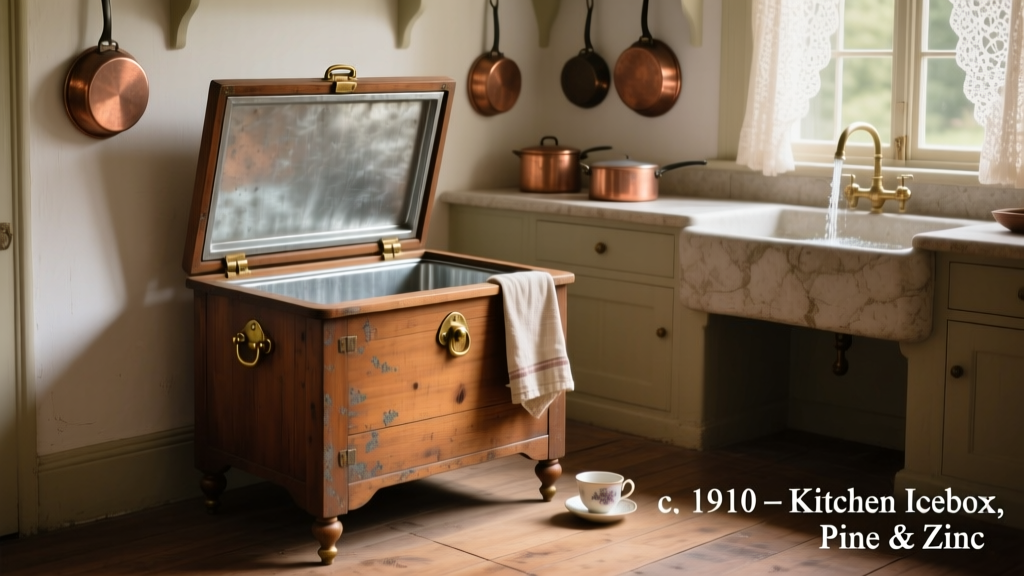
A Closer Look at the 1910 Pine Icebox with Zinc Lining, Hinged Top, and Bun Feet: Dimensions, Construction, and Restoration Insights