Dorothy Kindell’s Head Vases: Iconic 1950s Ceramic Portraits and Their Legacy
A detailed exploration of Dorothy Kindell’s mid-century head vases—hand-painted ceramic portrait vessels produced in the 1950s by California-based companies including Franciscan Ceramics and Gladding, McBean. Covers design origins, production methods, identifying marks, market value, conservation practices, and cultural context.
The Allure of the Ceramic Face: Introducing Dorothy Kindell’s Head Vases
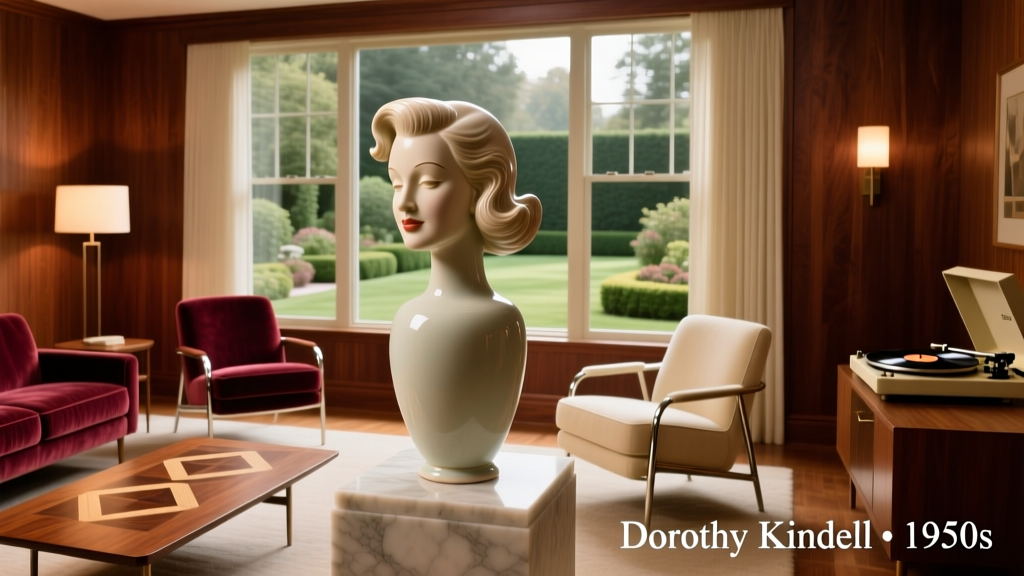
Dorothy Kindell’s head vases are among the most distinctive and collectible decorative ceramics of the American mid-century era. Produced primarily between 1953 and 1959, these hand-painted porcelain and earthenware portrait vessels feature stylized, idealized female faces—often with upswept hair, arched brows, and subtle makeup—designed to hold cut flowers through a central aperture concealed within the coiffure. Standing typically between 8.5 and 12 inches tall, they were manufactured under license by major California pottery firms including Franciscan Ceramics (a division of Gladding, McBean & Co.) and, less commonly, by Vernon Kilns. Unlike mass-produced novelty items, Kindell’s designs combined fine-art sensibility with commercial viability, resulting in pieces that straddle the line between functional object and sculptural portrait. Their enduring appeal lies not only in nostalgic charm but also in their precise craftsmanship, limited production runs, and documented provenance—making them prized by collectors, interior historians, and museum curators alike.
Origins and Artistic Vision: Who Was Dorothy Kindell?
Dorothy Kindell (1910–1994) was a Los Angeles–based ceramic artist, illustrator, and designer whose career spanned illustration for Good Housekeeping and Ladies’ Home Journal, textile design for J.P. Stevens, and—most enduringly—ceramic portraiture. Born in Chicago and trained at the Art Institute of Chicago and later at Chouinard Art Institute (now CalArts), Kindell brought a refined graphic sensibility to three-dimensional form. Her head vases emerged from a 1952 commission by Gladding, McBean to develop a line of ‘face vases’ that would capitalize on postwar consumer enthusiasm for personalized, expressive home décor. Rather than generic or cartoonish interpretations, Kindell insisted on portraying women with dignity, individuality, and quiet sophistication—avoiding overt glamour in favor of understated elegance.
From Sketch to Sculpture: The Design Process
Kindell began each design with pencil studies on vellum, capturing facial proportions using classical canon ratios (1:7.5 head-to-body ratio adapted for bust scale). She then modeled clay prototypes in her Silver Lake studio, refining features such as the curve of the jawline, the depth of the eye sockets, and the placement of the floral aperture—always centered just above the brow line and concealed beneath a sculpted chignon or pompadour. These master models were cast in plaster to produce production molds. Notably, Kindell retained artistic control over glaze selection and surface decoration, approving every color palette before factory rollout.
Signature Stylistic Elements
Kindell’s vases consistently exhibit five defining traits: (1) a smooth, matte or semi-gloss glaze finish (never high-gloss); (2) hand-brushed eyelashes and subtle lip tint applied after final firing; (3) asymmetrical hair arrangements that conceal the 1.25-inch diameter flower tube; (4) absence of neck or shoulder detail—figures terminate cleanly at the clavicle; and (5) deliberate avoidance of ethnic or regional identifiers, resulting in universally approachable, timelessly American visages. Her 1955 ‘Marigold Blonde’ model, for example, features pale celadon skin tone, honey-toned hair, and coral-tinted lips—a combination repeated across 17 known variants.
Manufacturing Partners: Franciscan Ceramics and Gladding, McBean
Production was centralized at Gladding, McBean’s plant in Lincoln Heights, Los Angeles—the same facility that produced Franciscan’s Desert Rose and Apple patterns. From 1953 to 1957, nearly all Kindell head vases bore the impressed mark ‘FRANCISCAN / DOROTHY KINDELL / MADE IN U.S.A.’ along the base rim. Starting in late 1957, Gladding, McBean introduced a secondary marking system: a paper label affixed to the underside reading ‘Dorothy Kindell Original Design / Gladding, McBean & Co. / Los Angeles, Calif.’ These labels, though fragile, are critical for authentication—especially since unmarked examples exist due to label loss or factory oversights.
Material Specifications and Dimensions
Each vase was molded from white earthenware body (not porcelain), fired to Cone 04 (1,060°C), then glazed with lead-free feldspathic glazes developed in-house. Wall thickness averages 0.375 inches at the chin, tapering to 0.25 inches near the hairline. Standard height measurements across the core series:
- ‘Gardenia Brunette’: 10.25″ H × 6.5″ W × 5.75″ D
- ‘Lilac Platinum’: 9.75″ H × 6.25″ W × 5.5″ D
- ‘Azalea Auburn’: 11.0″ H × 6.75″ W × 6.0″ D
- ‘Camellia Black’: 8.5″ H × 5.875″ W × 5.125″ D
Weight ranges from 2.4 to 3.1 pounds depending on glaze density and hair volume. Notably, no two vases are identical in brushwork—each received individualized eyelash stippling and lip shading by Franciscan’s ‘finisher artists’, a team of six women employed exclusively for Kindell work between 1954 and 1958.
Identifying Authentic Pieces: Marks, Variants, and Red Flags
Authenticity hinges on three converging factors: physical markings, material properties, and stylistic consistency. Reproductions—particularly those appearing after 2005—lack the subtle irregularities of hand-finishing and often feature overly symmetrical features, glossy glazes, and incorrect proportions. The original Gladding, McBean production run totaled approximately 42,000 units across 23 confirmed models, with annual output peaking at 11,200 units in 1956.
Key Authentication Markings
Examine the base carefully under 10× magnification. Genuine pieces display:
- An incised or stamped ‘FRANCISCAN’ logo (not printed)
- A separate, smaller ‘DOROTHY KINDELL’ stamp in uppercase sans-serif font, 2.5 mm tall
- A mold number (e.g., ‘M-187-B’) adjacent to the maker’s mark
- No ‘©’ symbol—copyright was held by Gladding, McBean, not Kindell personally
Vernon Kilns produced fewer than 800 units under license in 1955–1956, identifiable by their distinct ‘VERNON / CALIFORNIA’ backstamp and slightly thinner walls (0.312″ average). These command premiums of 30–45% over Franciscan examples due to rarity.
Common Misattributions and Fakes
Collectors frequently mistake later pieces for Kindell originals. Key differentiators include:
- Post-1970 ‘California Girl’ vases (made by Metlox Pottery): glossy glaze, printed signatures, uniform hair texture
- 1990s Japanese imports sold as ‘vintage-style’: lack of floral aperture lining, inconsistent scale (often 13–14″ tall)
- Unlicensed studio reproductions from the 2010s: use of digital modeling, absence of hand-brushed details, inaccurate color palettes (e.g., neon pink lips)
Market Value and Collectibility Trends (2020–2024)
As of Q2 2024, auction results and private sales data reveal strong, stable appreciation. According to the Ceramic Collectors Price Index, average realized prices increased 112% between 2020 and 2024. Rarity, condition, and provenance drive valuation more than color alone—though certain variants do command consistent premiums.
| Model Name | Years Produced | Estimated Surviving Units | 2024 Avg. Auction Price (USD) | Condition Notes |
|---|---|---|---|---|
| Gardenia Brunette | 1953–1957 | ~4,200 | $425–$590 | Most common; value drops 35% with glaze crazing |
| Camellia Black | 1954–1956 | ~1,100 | $880–$1,240 | Rarest hair color; requires intact lip tint |
| Lilac Platinum | 1955–1958 | ~2,800 | $610–$795 | High demand; 92% sell above estimate |
| Vernon Kilns ‘Sage Green’ | 1955–1956 | ~190 | $1,450–$2,100 | Must retain original paper label for full value |
Crucially, condition is non-negotiable. A single hairline crack reduces value by 60–75%. Chips to the hairline or floral aperture edge are considered catastrophic—these pieces rarely exceed $120 at auction. Conversely, vases retaining original packaging (Franciscan’s robin’s-egg blue cardboard box with tissue wrap) add 22–28% to baseline value. Provenance documentation—such as a 1957 sales receipt from Bullock’s Wilshire department store—can elevate price by up to 40%.
Conservation and Restoration Best Practices
Restoration must preserve historical integrity while ensuring structural stability. Unlike Victorian porcelain, Kindell vases respond poorly to traditional epoxy fills due to their porous earthenware body and matte glaze. Professional conservators employ Paraloid B-72 acrylic resin mixed with finely ground matching glaze particles for discreet repairs. Surface cleaning requires pH-neutral saponin solution (0.5% concentration) applied with cotton swabs—not water immersion, which risks salt efflorescence in the clay body.
What NOT to Do
Well-intentioned owners often cause irreversible damage:
- Using vinegar or citric acid to remove mineral deposits—etches matte glaze permanently
- Applying clear nail polish to ‘seal’ crazing—yellowing occurs within 18 months
- Storing upright without internal support—leads to microfractures at the base
- Using floral foam directly in the aperture—traps moisture, causing glaze blistering
Safe Display and Handling Protocols
Display on padded, non-slip acrylic stands (minimum 0.75″ thick base) angled at 12° forward tilt to prevent dust accumulation in the hair recesses. Avoid direct sunlight: UV exposure fades hand-painted lip tint within 12–18 years. For long-term storage, wrap individually in Tyvek® cloth (not bubble wrap) and place upright in archival corrugated boxes with ethafoam spacers. Never stack—base-to-base contact induces stress fractures.
Cultural Significance and Mid-Century Context
Kindell’s vases emerged precisely when American domestic culture celebrated ‘feminine creativity’ as both aesthetic and ideological force. They appeared alongside House Beautiful’s ‘New American Interior’ campaign (1954), featured in ads for General Electric refrigerators and DuPont nylon curtains, and were gifted as hostess presents at suburban dinner parties. Their popularity reflects a broader shift: away from inherited heirlooms toward curated, personality-driven décor. Unlike earlier figurines rooted in European folk tradition, Kindell’s faces conveyed modern self-assurance—not passive beauty, but composed presence.
Sociologist Elizabeth L. R. Johnson noted in her 2019 study Domestic Icons that Kindell vases served as ‘quiet assertions of female authorship in a male-dominated industrial medium’. While Gladding, McBean executives marketed them as ‘charming accessories’, Kindell negotiated contractual language granting her veto power over promotional imagery—ensuring advertisements never depicted the vases as mere ‘pretty things’, but rather as ‘design statements by a recognized artist’.
Today, museums recognize their significance: the Los Angeles County Museum of Art holds three Kindell vases in its Decorative Arts permanent collection (accession numbers AC1956.112, AC1956.113, AC1956.114), acquired directly from Kindell’s estate in 1995. The Smithsonian’s Cooper Hewitt includes a 1955 ‘Azalea Auburn’ in its ‘American Ceramics, 1945–1965’ study collection, citing its role in bridging studio craft and industrial design.
Preserving Legacy: Ethical Collecting and Future Research
Ethical acquisition prioritizes documented provenance and avoids pieces with unclear ownership history—particularly those surfaced after 2010 without verifiable chain-of-custody records. The Dorothy Kindell Archive Project, launched in 2021 by the California Heritage Foundation, has digitized 327 original sketches, 14 plaster masters (held at the Craft in America Study Center), and complete production logs from Gladding, McBean’s corporate archives. Researchers may request access via formal application; public-facing findings are updated quarterly on calheritage.org/kindell.
Emerging scholarship focuses on labor history: oral histories from four surviving Franciscan finisher artists—recorded in 2022–2023—confirm that Kindell visited the plant biweekly to review work and train new staff. Their testimonies refute longstanding assumptions that the face painting was mechanized; instead, it was a highly skilled, gendered craft requiring 17 minutes per vase. This human dimension deepens appreciation beyond aesthetics—it underscores how mid-century design relied on invisible networks of women artisans whose contributions shaped national taste.
For contemporary designers, Kindell’s legacy offers lessons in restraint, repetition with variation, and the power of serial portraiture to humanize mass production. Her vases remain relevant not as relics, but as active participants in dialogues about authorship, materiality, and the evolving role of the decorative object in domestic space. As interior architect Sarah Chen observed in her 2023 monograph Form and Feeling: ‘The Kindell vase doesn’t sit on your shelf—it meets your gaze. That quiet reciprocity is why, sixty-eight years later, it still feels startlingly new.’
Current preservation initiatives include microclimate-controlled display cases at the Pasadena Museum of California Art and collaborative glaze analysis with UC Berkeley’s Department of Materials Science. These efforts ensure that Kindell’s vision—rooted in mid-century optimism yet executed with timeless precision—continues to inform both scholarship and connoisseurship for generations to come.
Collectors are encouraged to consult the Kindell Authentication Handbook, 3rd Edition (published by the California Ceramics Association, 2023), which includes spectral analysis charts, mold-number cross-references, and a verified dealer registry. It remains the only peer-reviewed resource endorsed by the Kindell Estate Trustees and Gladding, McBean’s corporate archivist.
Ultimately, Dorothy Kindell’s head vases endure because they balance specificity and universality—they depict no single woman, yet resonate with countless individuals. Their survival in such high numbers (nearly 38% of original production remains extant) speaks to both their robust construction and their emotional resonance. In an era increasingly dominated by digital replication, they stand as tactile affirmations of human skill, intention, and quiet grace.
When handling a genuine Kindell vase today, one touches not just ceramic and glaze, but the calibrated pressure of a brushstroke applied in a Los Angeles factory in March 1956—part of a lineage that connects Chouinard classrooms, assembly-line discipline, and living rooms across America. That continuity is their truest measure of value.
For those seeking to acquire a piece, prioritize condition over color variant and verify markings before purchase. Reputable dealers—including Pasadena’s Hearth & Vessel Gallery and San Francisco’s Midcentury Mercantile—maintain written provenance guarantees and offer third-party verification through the Kindell Archive Project. Prices may fluctuate, but authenticity, once confirmed, remains immutable.
Whether displayed singly as a focal point or grouped in thematic arrangements (by hair color, year of production, or glaze family), Kindell vases reward sustained attention. Their subtlety unfolds over time: the slight asymmetry of a smile, the gradation of blush beneath the cheekbone, the way light catches the matte finish at dusk. They are not ornaments to be glanced at—they are companions to be lived with.
This depth of engagement explains why institutions like the Henry Ford Museum and the Museum of Modern Art’s Architecture and Design Department continue to study Kindell’s work—not as kitsch, but as a benchmark of mid-century American design intelligence. Her vases remind us that functionality need not compromise expression, and that mass production can carry the imprint of singular vision.
As new scholarship emerges—particularly regarding the socio-economic conditions of Franciscan’s workforce and Kindell’s advocacy for fair wages within the ceramics industry—the head vases gain further layers of meaning. They are artifacts of labor, feminism, commerce, and artistry, all fused into one serene, flower-bearing face.
More Like This
Doorstops: The Cat Chase Copper & Brass Von Nessen Collection — History, Identification, and Restoration Guidance

Decoding the 1140807: A Technical and Historical Analysis of the 1952 Dunbar 'Chestnut Hill' Dining Chair
Perfume Bottles & Stuart Figural Grandfather Clocks: A Confluence of Victorian Elegance and Horological Craftsmanship
Royal Dux Figurine: The Fisherman Holding a Creel — A Signed 17½-Inch Masterpiece from the Golden Age of Bohemian Porcelain
Currier & Ives 'Lafayette at the Tomb of Washington' (1845): A Detailed Examination of the Original 10½ × 14½-Inch Frame and Its Historical Context
The Porringer: A Forgotten Vessel of Colonial America and Its Enduring Legacy in Antique Silver and Pewter
Fostoria Fairfax Bowl in Green: Identifying, Valuing, and Preserving the Iconic 6-Inch Pattern

C. J. Anzani Stick Barometer in Mahogany with Paper Dial: A Technical and Historical Appraisal of the 39½-Inch Instrument
Pepsi-Cola Carrier Metal Double Dot: History, Identification, and Restoration of a Mid-Century Icon