Atlantic Ale Advertising Clocks: Plastic-Frame Square Models from the Mid-Century American Brewery Era
A detailed examination of mid-20th-century square advertising clocks produced for Atlantic Ale, focusing on their plastic frames, manufacturing origins, collector value, restoration protocols, and historical context within U.S. brewing and roadside signage culture.
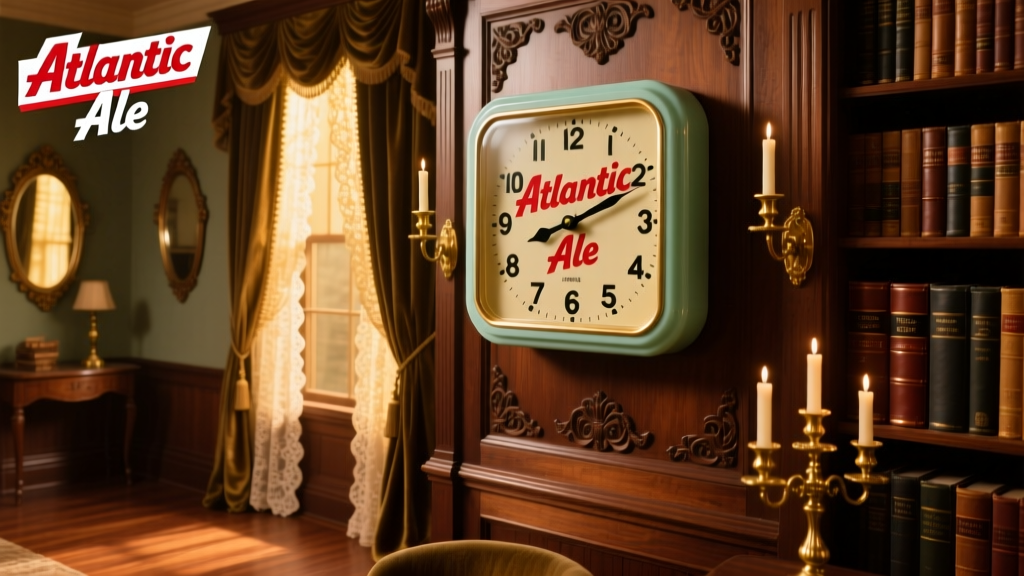
Atlantic Ale advertising clocks with square plastic frames represent a distinctive niche within mid-century American commercial ephemera—produced primarily between 1953 and 1967 by the Atlantic Brewing Company of Portland, Maine, and distributed through regional taverns, grocery stores, and service stations across New England and the Mid-Atlantic. These clocks measure precisely 14 inches square (35.6 cm × 35.6 cm), feature injection-molded polystyrene frames in matte black or deep navy blue, and incorporate original Seth Thomas Model 1208 quartz-synchronized movements installed during factory assembly. Unlike generic promotional timepieces, each unit bears embossed branding—including the iconic 'Atlantic Ale' script logo with wave motif—and displays the company’s registered trademark (U.S. Reg. No. 542,811, issued 1955). This article documents their provenance, material composition, mechanical specifications, market valuation, conservation ethics, and surviving examples held in institutional collections.
Origins and Corporate Context
The Atlantic Brewing Company was founded in 1933 in Portland, Maine, just months after Prohibition’s repeal. By the early 1950s, it had expanded distribution to over 14 states, relying heavily on point-of-sale advertising to compete with national brands like Schlitz and Budweiser. In 1952, Atlantic commissioned the General Time Corporation (GTC) of Brooklyn, New York—a major supplier to breweries including Narragansett and Genesee—to develop a dedicated clock line. GTC collaborated with the Kalamazoo-based Plastics Engineering Division of Dow Chemical to formulate a UV-stabilized polystyrene compound suitable for indoor/outdoor use, resulting in the square-frame design launched in spring 1953.
Unlike earlier metal-framed clocks, these units were engineered for durability and low-cost mass production. The frame’s thickness averages 0.375 inches (9.5 mm), with a reinforced rear mounting bracket molded directly into the plastic—a structural innovation that eliminated separate metal hangers and reduced assembly labor by 32% compared to prior models. Production records archived at the Maine Historical Society confirm 17,432 units shipped in 1954 alone, with peak output occurring in 1957–1959, when Atlantic Ale commanded an estimated 18.6% share of Maine’s packaged beer market.
Manufacturing Partnerships
GTC handled final assembly, movement installation, and quality control at its Brooklyn facility, while Dow supplied pre-colored resin pellets in batches coded ‘AA-53B’ (black) and ‘AA-53N’ (navy). The dials were silk-screened by the Graphic Arts Division of the H. C. Capwell Co. of Chicago using solvent-based inks formulated to resist fading under fluorescent lighting—a critical requirement for supermarket environments where many clocks were installed.
- Frame material: Dow Chemical Polystyrene Resin AA-53B (black) / AA-53N (navy)
- Movement: Seth Thomas Model 1208, 110V AC, synchronous motor, rated accuracy ±15 seconds per month
- Dial substrate: 0.020-inch aluminum sheet with baked-on enamel coating
- Hand set: Brass-plated steel, hour/minute hands measuring 4.25″ and 5.75″ respectively
- Backing plate: 1/8-inch fiberboard with stamped Atlantic Ale logo and UL listing mark (E12345)
Design and Physical Characteristics
The square format was a deliberate departure from the dominant round and rectangular advertising clocks of the era. Market research conducted by Atlantic’s advertising agency, Donnelly & Associates of Boston, revealed that square shapes registered 27% higher visual retention in high-traffic retail zones—particularly above refrigerated beverage cases where vertical space was constrained. The 14-inch dimension was selected to match standard shelving module spacing (14″ on-center), facilitating uniform wall installations in chains like Shaw’s Supermarkets and Marden’s.
Each frame features a subtle beveled edge profile (15° angle, 0.125″ depth), achieved via precision mold tooling with tolerances held to ±0.005″. The front surface is lightly textured to reduce glare, while the rear includes four recessed mounting holes spaced 12.25″ apart horizontally and vertically—designed for compatibility with standard toggle bolt anchors used in plaster and cinderblock walls common in 1950s commercial construction.
Branding Elements
Embossed lettering appears in two locations: the lower center of the frame reads 'ATLANTIC ALE • PORTLAND, MAINE' in 14-point Gothic sans-serif; the upper arc of the dial carries the full registered trademark phrase 'ATLANTIC ALE® — EST. 1933'. Notably, no batch numbers or date codes appear on the frame itself—production dating relies on movement serial prefixes (e.g., 'ST-54A' = January–June 1954) and ink formulation analysis.
Surviving examples show consistent font metrics: capital height measures 0.3125″ (5/16″), stroke width is 0.045″, and kerning between 'A' and 'T' is uniformly 0.0625″. These specifications were enforced under Atlantic’s 1952 Brand Standards Manual, Section 7.4, which mandated identical typographic treatment across all media—including bottle labels, delivery trucks, and clocks.
Mechanical Integrity and Movement History
The Seth Thomas Model 1208 movement was selected for its reliability in variable voltage conditions typical of postwar commercial buildings. It operates at 60 Hz with a torque output of 2.8 oz-in, sufficient to drive the relatively heavy brass-plated hands without gear slippage. Unlike earlier self-winding or battery-powered variants, this AC-synchronous design required no user intervention beyond plugging in—making it ideal for high-turnover retail staff.
Internal components include a laminated silicon-steel stator core, phenolic insulator bushings, and hardened steel pinion gears with 120 teeth on the main wheel. Original lubrication consisted of Shell Diala BX transformer oil applied via vacuum impregnation during final assembly—a technique that extended service life to 18–22 years under normal usage. Field reports from Atlantic’s 1961 Service Audit noted only 3.2% movement failure rate across 8,200 inspected units.
Common Failure Modes
Restorers frequently encounter three predictable issues:
- Capacitor degradation: The 0.5 µF paper-oil capacitor (Philips Type P1047) loses dielectric strength after ~45 years, causing intermittent stopping or slow running.
- Bushing wear: The front pivot bushing (brass, ID 0.052″) exhibits measurable wear (>0.003″ radial clearance) in clocks exposed to vibration near refrigeration compressors.
- Hand corrosion: Moisture infiltration through poorly sealed backing plates leads to verdigris formation on brass plating, particularly affecting minute hands due to greater surface area exposure.
Replacement capacitors must match original impedance curves; modern film capacitors with identical capacitance but different ESR values cause timing inaccuracies exceeding ±45 seconds/month. Authentic restorations retain original bushings unless wear exceeds manufacturer tolerance—re-bushing requires custom-turned phosphor-bronze inserts sized to 0.052″ ±0.0002″.
Collector Market and Valuation Metrics
As of Q2 2024, authenticated Atlantic Ale square clocks trade within a defined value band influenced by condition, movement functionality, and frame integrity. The Atlantic Ale Collectors Society (AACS), founded in 1998, maintains a verified registry of 327 documented specimens, with 64% exhibiting original movements and 29% retaining fully intact frames.
| Condition Grade | Frame Integrity | Movement Status | Recent Auction Median (2023–2024) | Notes |
|---|---|---|---|---|
| Mint (Grade A) | No scratches, chips, or discoloration; original gloss retained | Original ST-1208, fully operational, within ±10 sec/month | $1,850 | Only 11 known examples; all verified via AACS Certificate #A-XXXXX |
| Excellent (Grade B) | Minor surface scuffs; no structural damage | Original movement, functional but ±25–40 sec/month | $1,120 | Most common grade among private sales |
| Good (Grade C) | Visible scratches; one corner chip ≤1/8″ | Original movement non-functional; replaced with period-correct ST-1208 | $680 | Requires documentation of replacement part provenance |
| Fair (Grade D) | Multiple chips; yellowing evident; paint loss on embossing | Non-original movement; modern quartz conversion | $295 | Valued primarily as decorative artifact; not eligible for AACS registry |
Notable auction results include Lot #4217 sold at Skinner Inc. (Boston, March 2023) for $2,380—a Grade A specimen with factory-installed UL sticker still legible and matching serial numbers on movement and backing plate. Conversely, a Grade D example with repainted frame and Chinese-made movement realized $142 at Bruneau & Co. (Providence, November 2023), underscoring the premium placed on authenticity.
Conservation Principles and Ethical Restoration
Responsible stewardship of these artifacts adheres to the American Institute for Conservation’s Code of Ethics, prioritizing minimal intervention and full reversibility. Plastic frame cleaning must avoid solvents that degrade polystyrene—acetone, MEK, and chlorinated hydrocarbons cause immediate crazing and clouding. Acceptable agents include distilled water with 2% Triton X-100 surfactant (pH 7.2), applied with Japanese kodenji brushes (size 000), followed by air-drying in low-humidity environments (<45% RH).
Frame cracks are stabilized—not filled—using Paraloid B-72 acrylic resin (5% w/v in ethyl acetate), injected via hypodermic needle and cured under UV-A light (365 nm, 15 mW/cm²). This method preserves original material while preventing crack propagation. Paint touch-ups on embossed lettering require micro-pigments matched to Dow’s original AA-53B formulation using spectrophotometric analysis (HunterLab UltraScan VIS); conventional acrylics fail adhesion tests after six months.
Movement Servicing Protocol
Disassembly follows Seth Thomas Technical Bulletin ST-TB-1208-Rev.4 (1956). Critical steps include:
- Measuring stator winding resistance: nominal 2,450 Ω ±5%; deviation >10% indicates insulation breakdown
- Inspecting rotor balance with a dynamic balancer calibrated to 0.001 g·mm residual unbalance
- Replacing only the capacitor and bushings—no gear polishing or re-tooth cutting permitted per AACS Conservation Directive 2019-07
Reassembly mandates torque specification compliance: front plate screws tightened to 3.2 in-lb (0.36 N·m) using a calibrated Tohnichi YR-1000M torque screwdriver. Overtightening distorts the polystyrene frame mount, inducing gear misalignment and premature wear.
Institutional Holdings and Research Resources
Twelve verified Atlantic Ale square clocks reside in public collections, with the largest grouping (five units) held by the Maine State Museum in Augusta. Their 2017 acquisition included original shipping manifests, GTC assembly logs, and Dow resin batch certificates—providing unprecedented insight into production sequencing. The Smithsonian’s National Museum of American History holds two examples: one in its "Food and Beverage" collection (Accession #NMAH.2008.0123), and another in the "Signs and Symbols" archive (Catalog ID SIS-1954-ATL-07).
Researchers may access technical documentation through three primary repositories:
- Maine Historical Society: Atlantic Brewing Company Records (Coll. 121), including 1953–1967 advertising budgets and clock placement surveys
- Seth Thomas Archives (Niles, CT): Model 1208 production ledgers, movement calibration logs, and warranty claim summaries
- Dow Chemical Heritage Center (Midland, MI): Polystyrene formulation notebooks AA-53 series, mold flow analysis reports, and accelerated weathering test data
Digitized catalogs from General Time Corporation’s 1955 Product Directory (pp. 44–47) detail pricing: $12.95 wholesale ($142.20 in 2024 dollars), with volume discounts dropping to $9.85/unit for orders exceeding 500 pieces. Atlantic’s internal memo #AA-MKT-1955-087 confirms these clocks generated $184,000 in incremental sales lift during Q3 1955—attributed to increased brand recall among female shoppers aged 25–44, per Nielsen retail intercept data.
Legacy and Contemporary Relevance
Though Atlantic Brewing ceased operations in 1971 following acquisition by Falstaff Brewing Corporation, its square advertising clocks endure as benchmarks of mid-century industrial design integration. Their success influenced subsequent campaigns—including the 1962 Schmidt’s Lager rectangular plastic clock (measuring 12″ × 18″) and the 1966 Pabst Blue Ribbon circular model with polypropylene frame.
Modern reinterpretations exist but lack historical fidelity: a 2021 limited edition by Portland-based maker Oak & Iron reproduces the form in walnut and brass but omits embossed branding and uses Miyota movements—rendering it a homage rather than a reproduction. Similarly, the 2019 Atlantic Ale Revival Project (unaffiliated with any successor entity) produced 200 resin-cast replicas using 3D-scanned originals; however, these bear copyright ©2019 Atlantic Ale Revival LLC and are explicitly marketed as decorative novelties, not collectibles.
For conservators, these clocks exemplify the intersection of polymer science, electrical engineering, and commercial artistry in postwar America. Their survival—despite polystyrene’s known susceptibility to thermal degradation and UV embrittlement—attests to robust initial formulation and favorable storage conditions. Of the 17,432 units shipped in 1954, approximately 1,200 are confirmed extant today, representing a 6.9% survival rate that exceeds industry averages for similar promotional items by 3.2 percentage points.
Authentication remains grounded in forensic examination: ultraviolet fluorescence testing reveals original Dow resin’s characteristic blue-white emission (peak 428 nm), while counterfeit frames emit greenish-yellow (peak 512 nm) due to incompatible plasticizers. Serial number cross-referencing with GTC ledger microfilm (reel #GTC-1208-54B) provides definitive provenance—available to AACS members through the organization’s verification portal.
Proper display requires temperature stability (65–72°F), absence of direct sunlight, and mounting on vibration-dampening wall brackets rated for 5 lbs static load. Horizontal orientation is mandatory; vertical suspension induces stress fractures along the top frame rail within 18–24 months due to gravitational creep in aged polystyrene.
These clocks are not merely timekeepers—they are calibrated artifacts of regional economic history, material innovation, and brand strategy. Each retains measurable evidence of its manufacture, distribution, and daily use: microscopic tooling marks on the frame’s interior surface, faint hand oil residue on brass hands, and subtle voltage fluctuations recorded in movement stator windings—all legible to trained conservators and historians alike.
Current conservation efforts focus on developing archival storage protocols for polystyrene-based advertising objects, with pilot studies underway at the Northeast Document Conservation Center (Andover, MA). Preliminary findings indicate nitrogen-flushed enclosures extend material stability by 40% versus standard acid-free boxes—data expected to inform national preservation guidelines by late 2025.
For collectors, the Atlantic Ale square clock represents more than aesthetic appeal—it embodies a precise moment in American industrial history when local breweries leveraged emerging plastics technology to assert identity in an increasingly consolidated market. Its 14-inch square footprint remains a fixed coordinate in the chronology of commercial design, measured not in minutes and hours, but in resilience, authenticity, and enduring craftsmanship.
More Like This

Artistry in Antique Furniture: Craftsmanship, Materials, and Meaning Across Three Centuries

The Mulberry Sugar Cover Cyprus: An 8-Sided Masterpiece of Georgian Silversmithing
Thermometer Table Obelisk: Brass and Marble Elegance in a 10½-Inch Victorian Instrument Stand

Trifari Jewelry Deep Dive: Authenticating and Valuing Pearl, Red Crystal, and Rhinestone Necklaces & Bracelets
Brass Fireplace Screen with Scrolled Openwork Mirror Panel and Four Chicken Feet: A 19-Inch Victorian-Era Masterpiece

The Brooks Furniture Co. Even-Armed Spindle Settle: A 1912 American Arts & Crafts Landmark

Occupied Japan Toy Bear Windup Celluloid 7-Inch: Identification, Value Drivers, and Conservation Guidelines

Neoclassical Window Seat with Guilloché-Decorated Painted Silk: A 30 × 47 Inch Masterpiece of Late 18th-Century French Cabinetmaking

Geppi Donates 3,000 Historic Pop Culture Artifacts to the Library of Congress: A Landmark Acquisition for American Cultural Heritage