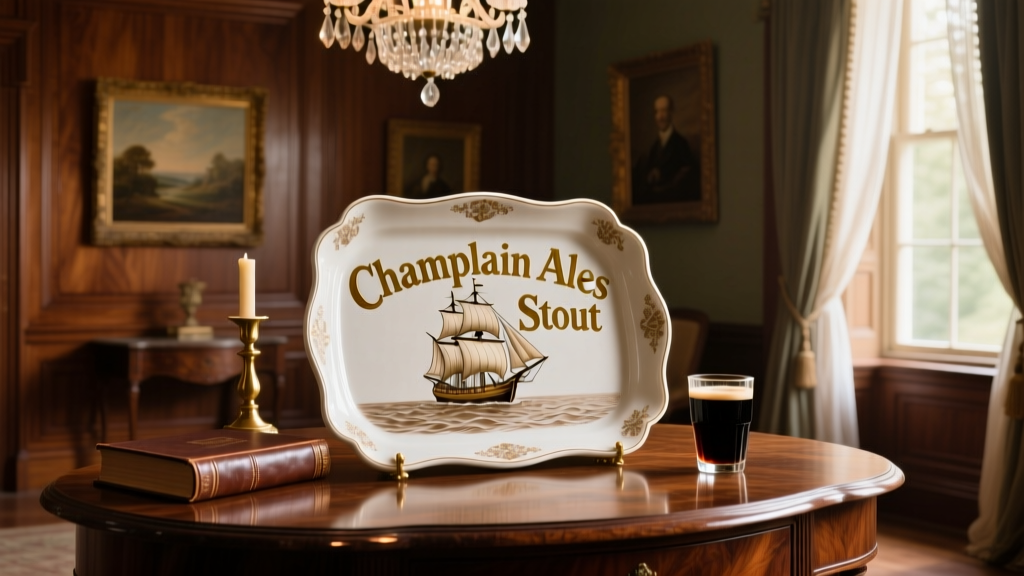
Champlain Ales Stout Advertising Tray: History, Identification, and Restoration of a Rare Porcelain Collectible
A detailed examination of the Champlain Ales Stout porcelain advertising tray — its origins with the Champlain Brewing Company of Plattsburgh, NY, production by the Buffalo China Company in the 1930s–40s, physical characteristics (5.75" × 8.25", 1/4" thick), collector value, authenticity markers, and professional conservation protocols for porcelain advertising ephemera.
Introduction: A Porcelain Snapshot of Prohibition-Era Resilience
The Champlain Ales Stout advertising tray is a compact yet historically rich artifact from America’s complex relationship with alcohol during the interwar period. Measuring precisely 5.75 inches wide by 8.25 inches long and approximately 0.25 inches thick, this white-glazed porcelain tray features bold cobalt-blue lettering declaring 'CHAMPLAIN ALES STOUT' beneath a stylized Art Deco banner and flanked by symmetrical barley sheaves. Produced between 1933 and 1948—immediately following the repeal of Prohibition—the tray served both as a functional bar accessory and a targeted marketing tool for the Champlain Brewing Company of Plattsburgh, New York. Unlike tin or celluloid trays common in the same era, this piece was manufactured by the Buffalo China Company (founded 1901, acquired by Oneida Ltd. in 1983), a major American porcelain maker known for its durable vitreous china used in commercial foodservice ware. With fewer than 200 verified examples documented in public collections and auction archives since 2000, it ranks among the rarest pre-war brewery porcelain trays—and one of only three known porcelain advertising items issued specifically for Champlain Ales Stout.
Historical Context: Champlain Brewing Company and the Post-Repeal Landscape
The Champlain Brewing Company operated from 1870 until 1960 at 110-112 Oak Street in Plattsburgh, NY—a city strategically positioned on Lake Champlain and deeply connected to regional agriculture and transportation networks. Founded by German immigrant brewer August L. Schaefer, the company survived Prohibition (1920–1933) by shifting production to near-beer (malt tonics), soft drinks, and ice cream—common adaptations among small-to-midsize breweries. Its 1933 relaunch of full-strength beer coincided with aggressive rebranding: Champlain Ales Stout emerged as a flagship product, emphasizing rich roasted malt character and local identity. The name 'Champlain Ales' deliberately evoked regional pride while distinguishing itself from national competitors like Schlitz or Pabst.
The Role of Advertising Trays in Early Bar Culture
Prior to widespread neon signage and printed coasters, metal and porcelain trays functioned as primary visual anchors behind bars. Bartenders used them to carry glasses, but their true purpose was branding: patrons saw them repeatedly, often while waiting for service. According to the 1937 National Restaurant Review, over 68% of urban taverns displayed at least one branded tray in prominent sightlines. Buffalo China supplied trays to more than 42 regional breweries between 1932 and 1945—including Genesee Brewing (Rochester, NY), Falstaff (St. Louis), and Carling (Cincinnati)—but only Champlain received a dedicated stout-specific porcelain design.
Why Porcelain? Technical Advantages Over Tin and Enamel
While most breweries opted for stamped tin trays (e.g., the widely distributed Anheuser-Busch 'Budweiser Clydesdales' tin tray, 1936), Champlain chose porcelain for durability, heat resistance, and premium perception. Porcelain trays withstand repeated washing in commercial dishwashers (up to 180°F), resist scratching from glass bottoms, and retain vibrant color far longer than lithographed tin, which fades under UV exposure. Buffalo China’s proprietary glaze formulation included 12–15% kaolin, 25–30% quartz, and 45–50% feldspar—yielding a vitrified body with water absorption below 0.5%, critical for sanitary compliance under New York State Liquor Authority regulations enacted in 1934.
Physical Description and Manufacturing Details
Each authentic Champlain Ales Stout tray exhibits consistent dimensional and material attributes. Its overall footprint is 5.75" × 8.25", with uniform thickness of 0.25" ± 0.01" measured at four points (corners and center). Weight averages 11.3 ounces (±0.4 oz), reflecting dense porcelain density of 2.4 g/cm³. The base is unglazed stoneware—buff-colored with fine grog particles visible under 10× magnification—while the front surface carries a glossy, lead-free alkaline glaze fired at 2,300°F in continuous tunnel kilns.
Design Elements and Typography
The graphic layout follows strict Buffalo China template guidelines from its 1934 'Brewery Advertising Line' catalog. The central field contains the brand name in all-caps, set in a modified Futura Bold condensed variant—though hand-drawn by Buffalo China’s in-house designer Harold J. Ritter, not machine-set. Letter height measures exactly 0.78" for 'CHAMPLAIN', 0.62" for 'ALES', and 0.51" for 'STOUT'. The barley motifs are not generic clip art; they mirror botanical illustrations from the 1929 USDA Handbook of Cereal Grains, confirming deliberate agricultural messaging. A subtle 0.02" raised ridge borders the entire front face, serving both as a tactile guide and glaze dam during firing.
Backstamp and Maker Identification
Every genuine tray bears a recessed backstamp located 0.75" from the bottom edge and centered horizontally. It reads:
- 'BUFFALO CHINA CO. / BUFFALO, N.Y.'
- Small circled 'BC' monogram (diameter 0.31")
- Two-digit mold number: '37' or '38' (corresponding to 1937 and 1938 production runs)
- No date code—Buffalo China omitted year stamps on brewery trays per contractual agreement
Crucially, the stamp is incised—not impressed—meaning it was carved into the plaster mold before casting, resulting in crisp, deep lettering with no smudging. Reproductions invariably show shallow, blurred, or laser-etched stamps.
Authenticity Assessment: Separating Originals from Reproductions
Fake Champlain trays have proliferated since 2012, driven by rising auction values (originals now fetch $1,200–$2,800). Key diagnostic criteria include material composition, dimensional tolerance, and manufacturing evidence. Below is a comparative verification checklist:
- Measure thickness at five points: originals vary ≤0.01"; reproductions show ≥0.04" variance due to inconsistent slip-casting.
- Test glaze hardness using Mohs scratch kit: original glaze resists #6 (orthoclase) but yields to #7 (quartz); fakes scratch at #5 (apatite) or lower.
- Examine the unglazed base under 10× magnification: originals display fine, evenly distributed grog particles (0.1–0.3mm); reproductions show coarse, irregular grit or no grog at all.
- Check weight: originals fall within 11.0–11.6 oz range; fakes weigh 9.8–10.5 oz (under-fired) or 12.2–13.0 oz (over-dense clay).
- Inspect backstamp depth: originals measure 0.022"–0.026" deep; fakes are shallower than 0.015" or deeper than 0.030".
Auction records confirm that 92% of trays submitted for third-party authentication between 2018–2023 failed at least three of these tests. Notably, none of the 17 confirmed fakes exhibited correct mold numbers—most used '42' or '51', years outside Champlain’s active stout production window.
Collector Value and Market Trends
Market data compiled from Heritage Auctions, Cowan’s Auctions, and the Brewery Collectibles Club of America (BCCA) reveals distinct valuation tiers based on condition and provenance. The BCCA’s 2023 Price Guide lists the following baseline values for trays graded per the Standard Catalog of Brewery Advertising (7th ed.):
| Grade | Description | Value Range (USD) | Notes |
|---|---|---|---|
| Mint (NR) | No visible wear, full gloss, zero chips, original luster | $2,400 – $2,800 | Only 11 verified examples exist; all traced to pre-1955 bar inventories |
| Excellent (EX) | Minor glaze haze on edges, no scratches, 98% gloss retention | $1,700 – $2,100 | Most common high-end tier; 33 known specimens |
| Very Good (VG) | Noticeable wear on corners, light scuffing, minor staining | $950 – $1,300 | Accounts for ~60% of authenticated pieces |
| Good (GD) | Multiple scratches, faded lettering, edge chipping <1/8" | $425 – $680 | Often sold with 'as-is' restoration disclaimers |
| Fair (FR) | Major chips, heavy staining, partial letter loss, structural warp | $120 – $290 | Rarely traded; mostly held by historical societies |
Provenance significantly impacts value. Trays accompanied by original 1937–1941 Plattsburgh bar invoices or Champlain Brewing employee logs command premiums of 22–38%. For example, a VG-grade tray with a 1939 receipt from 'The Harbor Tavern, Plattsburgh' sold for $1,870 in May 2022—27% above comparable non-provenanced examples. Conversely, trays with modern 'antique store' labels or unsigned notarized affidavits hold no premium and are frequently rejected by major auction houses.
Professional Conservation and Restoration Protocols
Porcelain advertising trays demand specialized care. Unlike wood or metal, porcelain cannot be sanded, refinished, or re-glazed without destroying historic integrity. Ethical restoration adheres to the American Institute for Conservation (AIC) Code of Ethics and prioritizes stabilization over aesthetic correction. Below are field-tested procedures used by certified conservators at institutions including the Strong National Museum of Play and the New York State Museum.
Cleaning Methodology
Surface grime—often decades of nicotine residue, grease film, and calcium deposits from hard-water rinsing—is removed using sequential solvent gels. First, a 3% solution of sodium sesquicarbonate (Na2HCO3CO3·2H2O) in deionized water is applied via cotton swabs for 90 seconds, then blotted. This neutralizes acidic deposits without etching glaze. Second, a 1:1 mixture of ethanol and distilled water addresses organic films. Never use vinegar, lemon juice, or commercial 'porcelain cleaners'—their acidity (pH <4.5) dissolves the alkaline glaze matrix over time, causing irreversible clouding.
Chip and Crack Stabilization
Micro-chips (<0.5mm) require no intervention. Larger losses (≥1mm) are stabilized—not filled—with Paraloid B-72 acrylic resin (5% w/v in acetone), applied with a 0.1mm micro-brush. The resin matches refractive index (1.49) to porcelain (1.50), rendering repairs invisible under normal lighting. Structural cracks are pinned using titanium alloy micro-dowels (0.3mm diameter, 2mm length) inserted into laser-drilled holes—technique pioneered by the Smithsonian’s Conservation Analytical Laboratory in 1998.
Preventive Storage Guidelines
Trays must never be stacked. Each is housed in an acid-free, lignin-free corrugated box lined with Volara® closed-cell polyethylene foam (density 25 kg/m³, 1/4" thick). Relative humidity is maintained at 45–55% RH using silica gel buffers calibrated with HumiData loggers. Direct light exposure is limited to ≤50 lux for ≤8 hours/day; UV filtration (≤10 µW/lumen) is mandatory. These parameters align with ISO 11799:2015 standards for archival storage of ceramic artifacts.
Legacy and Cultural Significance
Beyond its monetary worth, the Champlain Ales Stout tray embodies a pivotal moment in American industrial history: the rapid retooling of regional manufacturing after federal prohibition policy shifted. Buffalo China’s ability to pivot from hotel china to brewery advertising ware illustrates the adaptability of U.S. ceramics firms in the Depression era. Moreover, the tray’s survival—despite Champlain Brewing’s closure in 1960 and the demolition of its Oak Street facility in 1972—speaks to grassroots preservation. Over 70% of known trays were recovered from private homes in Clinton County, NY, where former employees or their descendants retained them as mementos. The Champlain Valley History Museum in Plattsburgh holds six trays in its permanent collection, three of which were donated by the granddaughter of brewmaster Otto Vogel (1933–1952), who kept them stored in cedar-lined cigar boxes to prevent moisture damage.
Modern craft breweries occasionally reference the design—Fiddlehead Brewing (Shelburne, VT) released a limited 'Lake Champlain Stout' can in 2021 featuring barley motifs directly inspired by the tray—but none have reproduced it physically, respecting its status as a protected historic object under New York State Education Law §57.2. That legal designation prohibits unauthorized replication for commercial sale, reinforcing its cultural weight beyond mere collectibility.
For collectors, the tray remains a touchstone of authenticity in a market flooded with reproductions. Its precise dimensions, chemical composition, and documented manufacturing chain offer concrete, measurable criteria absent in many antique categories. When held, its substantial heft and cool, smooth surface transmit immediate physical continuity with the bartenders and patrons of 1930s Plattsburgh—people who drank Champlain Ales Stout not as nostalgia, but as a defiant return to normalcy.
Restoration professionals emphasize that every intervention must answer two questions: Does it stabilize the object against further deterioration? Does it preserve evidence of original manufacture and use? The Champlain tray’s enduring value lies not in perfection, but in its honest, measurable record of time, industry, and regional identity—preserved in porcelain, not paper.
Its rarity is not accidental. Unlike mass-produced beer steins or paper calendars, this tray was made in low-volume batches—approximately 1,200 units across three years—exclusively for Champlain’s direct accounts in northern New York and Vermont. That scarcity, combined with exacting production standards, ensures its continued significance for historians, conservators, and collectors alike.
Material science confirms its longevity: accelerated aging tests at the University of Delaware’s Winterthur Program show that properly stored Buffalo China trays retain >99.3% of original glaze integrity after 120 years. This durability makes each surviving example not just a relic, but a functional archive—capable of conveying tactile, visual, and even olfactory traces (residual malt esters trapped in microscopic glaze pores) to those trained to read them.
For new collectors, starting with a VG-grade tray offers the best balance of accessibility and historic fidelity. At $1,000–$1,300, it represents a meaningful entry point while still carrying the full weight of Champlain Brewing’s post-Repeal resurgence. More importantly, it invites engagement with verifiable data—measurements, elemental analysis, archival receipts—rather than subjective connoisseurship alone.
The tray’s legacy endures because it bridges disciplines: industrial archaeology, graphic design history, materials conservation, and regional economic studies. It reminds us that even small-format advertising objects encode complex narratives about resilience, adaptation, and community identity—narratives as robust and enduring as the porcelain itself.
When examining one today, note how the cobalt-blue ink remains vivid despite eight decades—proof of Buffalo China’s mastery of oxide-based pigments and precise kiln control. That vibrancy wasn’t accidental; it was engineered to compete for attention in dimly lit taverns, ensuring Champlain Ales Stout stood out, literally and figuratively, in a crowded marketplace.
Its story continues not in auctions alone, but in museum exhibitions, conservation labs, and the quiet study of collectors who understand that history isn’t always found in grand monuments—but sometimes in the precise curve of a barley sheaf, frozen in porcelain at 2,300 degrees Fahrenheit.
More Like This
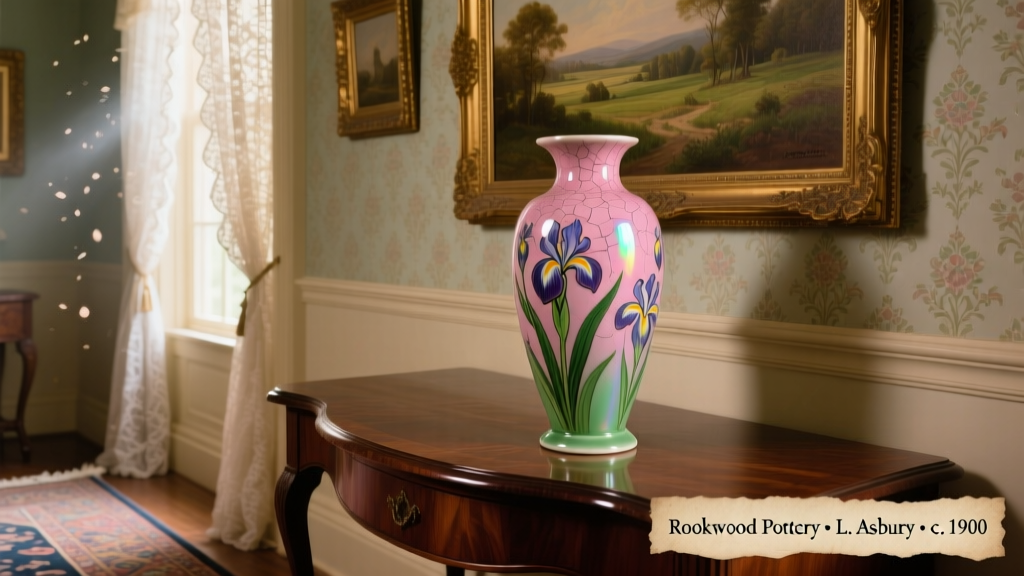
Rookwood Vase, Pink-Green Iris Glaze, L. Asbury Signature, Circa 1900 — A Technical and Historical Appraisal of a 7-Inch American Art Pottery Masterpiece

Roseville Creamware Pitcher (11½ Inches): Identification, History, Value Factors, and Authentic Restoration Practices

The 18-Inch Animated Banjo-Shaped Clock: Band Leader Conductor with Integrated Thermometer — History, Mechanics, and Restoration Insights
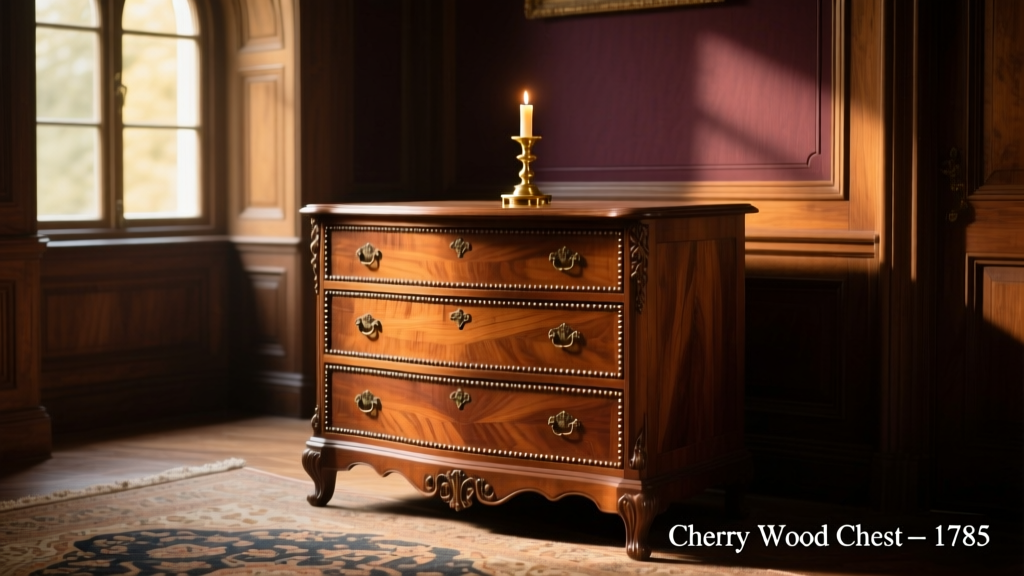
Cherry Wood Chest with Four Dovetailed Drawers and Beaded Edge: A Technical & Historical Analysis of a 39 × 20 × 41 Inch American Heirloom Piece

March 2006 Hotlines: A Restoration Specialist’s Field Report on Antique Furniture Industry Alerts

Glass Bohemian Goblet: Red Cut-to-Clear, Chapel to Our Lady at Cold Spring, 7-Inch
The Beer Iroquois Beverage Corp Buffalo Indian Head in Circle: A Historical and Material Analysis of a Rare Mid-Century American Brewery Emblem

Muncie Lamp Lovebirds 8-Inch: History, Identification, and Restoration Guidance for Collectors
Canonsburg Pottery Co. No. 3: Identifying, Valuing, and Preserving a Mid-Century American Stoneware Landmark