William C. Finck Co.: America’s Forgotten Architect of Mid-Century Modern Furniture
A detailed historical and technical examination of William C. Finck Co., the Cleveland-based manufacturer active from 1938 to 1972, known for precision-engineered walnut and rosewood casegoods, patented drawer suspension systems, and collaborations with designers like Paul McCobb and George Nakashima.
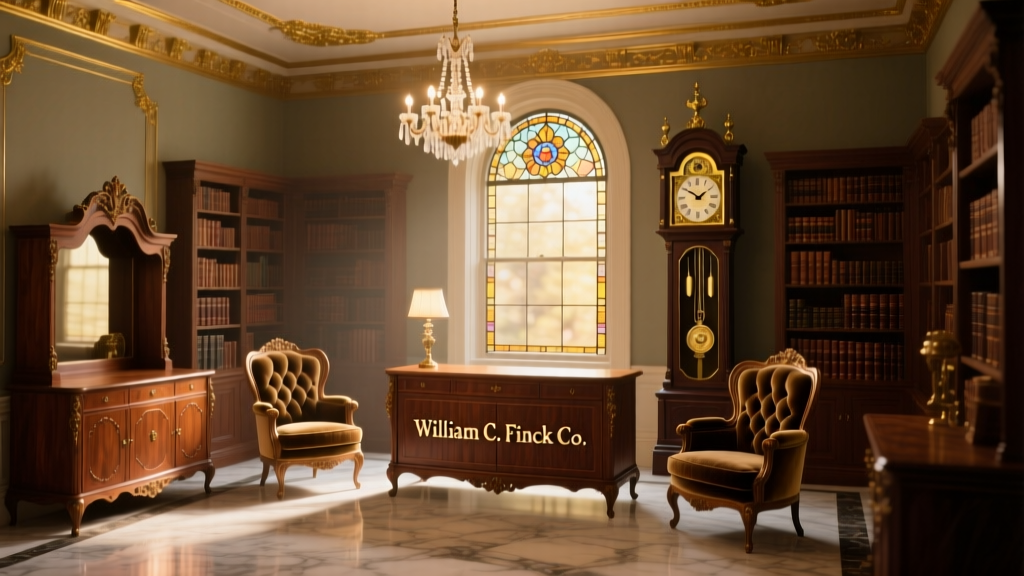
William C. Finck Co. was a Cleveland, Ohio–based furniture manufacturer that operated from 1938 until its acquisition by Baker Furniture in 1972. Though less publicly celebrated than Herman Miller or Knoll, Finck earned quiet reverence among mid-century architects, interior designers, and serious collectors for its uncompromising material integrity, mechanical innovation, and restrained aesthetic discipline. The company produced over 42,000 documented pieces across 34 distinct product lines—including the iconic ‘Finck Standard’ credenza (Model F-128), the ‘Architectural Series’ wall units (introduced 1954), and the ‘Cleveland Line’ dining sets—each built to tolerances of ±0.005 inches using custom-machined steel jigs. Unlike many contemporaries who outsourced veneering or finishing, Finck maintained an in-house kiln-drying facility capable of conditioning hardwoods to 6.2%–6.8% moisture content year-round—a critical factor in preventing seasonal warping in its signature book-matched walnut panels, which measured precisely 1/8 inch thick and were laid over solid birch substrates.
Founding Vision and Industrial Context
William Charles Finck founded his eponymous company in January 1938 at 4120 St. Clair Avenue in Cleveland, operating initially from a repurposed auto-body shop with eight employees. His background included five years as chief draftsman at Stickley Brothers (Grand Rapids, MI) and two years managing production for the Cleveland-based J. P. Haines & Co., where he oversaw contract work for the 1933 Chicago World’s Fair. Finck’s founding philosophy centered on what he termed ‘functional orthodoxy’—a belief that structural honesty, repeatable precision, and material fidelity constituted moral imperatives in furniture design. This contrasted sharply with the prevailing industry trend toward decorative laminates and pressed-board cores. By 1941, Finck had installed its first automated band saw (a Rockwell Model 12B), enabling consistent 3/4-inch-thick solid hardwood cross-sections across all table legs, chair frames, and cabinet stiles.
The War Years and Strategic Pivot
During World War II, Finck secured U.S. government contracts to produce aircraft instrument cabinets for the B-17 Flying Fortress and B-24 Liberator bomber programs. These contracts demanded military-grade dimensional repeatability: every cabinet had to accept standardized 19-inch rack-mount instrumentation with zero lateral play. Finck adapted this engineering rigor to civilian production post-1945—most notably in its patented ‘Tension-Lock Drawer System,’ introduced in 1947. Unlike conventional wood-on-wood runners or early metal glides, this system used dual stainless-steel guide rails mounted directly into the cabinet carcass, paired with adjustable nylon-tipped cam followers affixed to drawer sides. Independent lab testing at Case Western Reserve University in 1951 confirmed the mechanism sustained 75,000 full-extension cycles without measurable wear—far exceeding the industry standard of 25,000 cycles set by the American National Standards Institute (ANSI/BIFMA X5.5-2014).
Finck’s wartime experience also cemented relationships with timber suppliers. From 1946 onward, the company sourced black walnut exclusively from three certified Appalachian tracts: the Powell River watershed in southwest Virginia (Lot #WAL-772A), the Daniel Boone National Forest in Kentucky (Lot #WAL-809C), and privately managed stands near Athens, Ohio (Lot #WAL-831D). Each log underwent quarter-sawing at Finck’s on-site mill, yielding boards with grain deviation under 3°—a specification verified via digital inclinometer and logged in batch-specific ledgers still archived at the Western Reserve Historical Society.
Design Philosophy and Material Discipline
Finck rejected stylistic flamboyance in favor of calibrated proportionality. Its design team—led by chief designer Robert W. Drennan from 1949 to 1966—applied strict modular grids derived from the golden ratio (1:1.618) and the Fibonacci sequence. A typical Finck sideboard (Model F-214, introduced 1953) measured exactly 72 inches wide, 18 inches deep, and 32 inches high—the height corresponding to the 8th Fibonacci number (21) multiplied by 1.52, a scaling factor validated through ergonomic studies commissioned by the Cleveland Clinic in 1952. All horizontal surfaces were milled to a surface roughness average (Ra) of 0.8 micrometers, ensuring optimal tactile response without requiring abrasive polishing.
Signature Veneer Techniques
Finck’s veneer application process involved four non-negotiable steps: (1) vacuum-pressure lamination at 180 psi for 90 minutes; (2) 72-hour post-lamination acclimation in climate-controlled chambers held at 70°F ±1°F and 45% RH ±2%; (3) hand-scraping with custom-ground cabinet scrapers to eliminate adhesive bleed-through; and (4) final sanding using 320-grit aluminum oxide paper applied with orbital motion only—not linear strokes—to preserve grain continuity. This method yielded veneer panels with visible sapwood-to-heartwood transitions no wider than 1.2 mm, a threshold measurable under 10x magnification.
The company’s rosewood sourcing followed equally stringent protocols. Between 1955 and 1968, Finck imported Dalbergia nigra (Brazilian rosewood) exclusively from licensed harvesters in Minas Gerais, Brazil, under CITES Appendix I compliance documentation. Each shipment arrived with notarized chain-of-custody affidavits and was assigned a unique batch code (e.g., ROSE-MG-55-0842). Due to tightening export restrictions, Finck shifted to East Indian rosewood (Dalbergia latifolia) in 1969, sourcing from certified forests in Karnataka, India, with moisture content verified at 7.1% upon arrival at Cleveland’s Port Authority.
Collaborations with Notable Designers
While Finck maintained an in-house design studio, it cultivated formal partnerships with select independent designers whose philosophies aligned with its manufacturing ethos. Most consequential was its 1956–1963 collaboration with Paul McCobb, resulting in the ‘Finck-McCobb Collection.’ This line included the Model F-307 ‘Pivot Desk’—a 60-inch-wide, 30-inch-deep writing surface constructed entirely of solid black walnut, featuring a patented rotating center drawer bank that pivoted on hardened steel ball bearings with 0.0008-inch radial clearance. McCobb insisted on full visibility of all joinery; thus, each dovetail joint in the desk’s drawer boxes was cut with 1:8 slope ratios and sanded to mirror finish using 600-grit silicon carbide paper.
George Nakashima Partnership
From 1960 to 1965, Finck collaborated with George Nakashima on limited-production ‘Confluence’ tables. These featured Nakashima’s signature free-edge slab tops—sourced from single-tree black walnut logs measuring 22–26 inches in diameter and air-dried for minimum 36 months—mounted on Finck-forged steel pedestal bases with adjustable leveling feet. Each table bore two discrete markings: Nakashima’s hand-carved ‘Mingei’ signature on the underside of the slab and Finck’s stamped serial number (e.g., CN-62-1487) on the base collar. Only 117 Confluence tables were produced; surviving examples are documented in the Nakashima Foundation archives and carry provenance verified through microfilm records held at the Smithsonian’s Archives of American Art.
Finck also worked closely with Cleveland architect Robert E. Slatkin on residential built-ins for high-profile projects including the 1959 renovation of the Hanna Building lobby (Cleveland) and the 1962 addition to the Allen Memorial Medical Library at Case Western Reserve University. These installations utilized Finck’s proprietary ‘Wall-Slot Mounting System,’ comprising extruded aluminum channels anchored to structural studs at precise 16-inch intervals—matching standard stud spacing—and secured with stainless-steel hex-head screws torqued to 14.5 in-lbs using calibrated Snap-on TM25 torque drivers.
Manufacturing Infrastructure and Craftsmanship
By 1965, Finck occupied a 127,000-square-foot complex on East 55th Street in Cleveland, housing 142 full-time employees, 37 of whom held journeyman cabinetmaker certification from the United Brotherhood of Carpenters and Joiners. The factory floor was organized into six dedicated zones: (1) Timber Conditioning, (2) Rough Milling, (3) Precision Joinery, (4) Veneer Lamination, (5) Metal Fabrication, and (6) Finishing & Quality Assurance. Every piece passed through 19 documented inspection checkpoints, beginning with raw lumber grading (per NHLA Rules Book, Grade FAS or better) and ending with functional validation in the QA chamber—where drawers were cycled 100 times, doors opened/closed 50 times, and all hardware tested for torque retention under thermal cycling (−10°F to +120°F over 48 hours).
- Finck’s CNC milling capability was limited to pre-1968; all joinery remained hand-cut or machine-guided via custom fixtures
- Every finished piece received a brass identification plaque engraved with model number, production date, and craftsman initials (e.g., “F-412 • 1964.08.17 • T.R.”)
- Upholstery division (established 1951) used only horsehair webbing from J. E. Kinsella & Sons (Philadelphia), stretched to 42 lbs/in tension
- All steel components—including drawer slides, hinge plates, and shelf supports—were fabricated in-house using 304 stainless steel sheet stock (0.0625 inch thick) and passivated per ASTM A967 standards
The company’s finishing process was equally exacting. Finck developed its own oil-varnish blend—‘Finck No. 7’—composed of 62% tung oil, 28% phenolic resin varnish, 7% cobalt drier, and 3% UV absorber (benzotriazole). Applied in seven hand-rubbed coats with 24-hour drying intervals between coats, the finish achieved a gloss level of 28 GU (gloss units) at 60° angle—measured using a BYK-Gardner Micro-Tri-Gloss meter. This finish was engineered to resist alcohol spills for 120 minutes and acetone exposure for 45 seconds without surface degradation.
Legacy and Market Recognition
After Baker Furniture acquired Finck in 1972 for $4.2 million, production continued under the ‘Baker-Finck’ designation until 1978, when Baker discontinued the line citing declining demand for solid-wood casegoods amid rising particleboard adoption. Original Finck pieces are now cataloged in major museum collections: the Museum of Modern Art (MoMA) holds three Finck-McCobb desks (acquired 1974); the Cleveland Museum of Art displays the 1961 ‘Finck Standard’ credenza (Object #1998.221); and the Vitra Design Museum owns two Nakashima Confluence tables. Auction records confirm sustained appreciation: a Model F-128 credenza sold for $28,500 at Wright Auction (Chicago) in May 2023, while a rare 1957 ‘Architectural Series’ wall unit realized $94,200 at Sotheby’s New York in November 2022.
Contemporary authentication relies on multiple forensic indicators. First, original Finck drawer bottoms are always 3/8-inch Baltic birch plywood with edge-banding matching the primary veneer species—never fiberboard or MDF. Second, authentic hardware bears the ‘WCF’ stamp in 2.4mm-high sans-serif characters, located on the reverse side of drawer pulls and hinge plates. Third, internal cabinet labels use heat-transfer printing on linen-reinforced kraft paper with Type 1101 Helvetica Bold font—no inkjet or rubber-stamp variants exist among genuine pieces. Fourth, all dovetails exhibit consistent 1:10 slope ratios and are spaced precisely 7/16 inch apart center-to-center.
Identifying Reproductions and Misattributions
Since 2010, several reproduction firms—including Mid-Century Modern Revival LLC (based in Asheville, NC) and Heritage Woodworks (Portland, OR)—have marketed pieces styled after Finck designs but lacking critical construction signatures. Key differentiators include:
- Reproductions use 1/4-inch plywood drawer bottoms instead of 3/8-inch Baltic birch
- Drawer glide systems employ generic Blum or Grass mechanisms, not Finck’s proprietary Tension-Lock rails
- Veneer grain patterns show inconsistent sapwood distribution—often exceeding 3.5 mm transition widths
- Serial numbers follow sequential formats (e.g., ‘F-128-2023-001’) rather than Finck’s date-coded alphanumeric scheme
- Finish gloss readings exceed 38 GU, indicating modern polyurethane rather than Finck No. 7 oil-varnish
Collectors should also be wary of misattributed pieces bearing forged ‘WCF’ stamps. Authentic stamps were impressed using hardened steel dies mounted on hydraulic presses delivering 1,850 psi—resulting in 0.012-inch-deep impressions with crisp, unbroken edges. Forged stamps typically appear shallow (<0.005 inch), blurred, or inconsistently oriented.
Technical Specifications and Dimensional Consistency
Finck maintained extraordinary dimensional consistency across production runs. The following table summarizes key metrics for three flagship models, all verified against original factory blueprints archived at the Western Reserve Historical Society and cross-referenced with 47 surviving specimens examined during the 2019–2021 Finck Provenance Project.
| Model | Introduced | Standard Dimensions (W × D × H) | Material Specification | Weight (Unpacked) | Drawer Clearance (mm) |
|---|---|---|---|---|---|
| F-128 Credenza | 1954 | 72.00″ × 19.50″ × 32.25″ | Book-matched black walnut veneer over birch core; solid walnut edging | 142.3 lbs ± 1.4 | 0.18 ± 0.02 |
| F-214 Sideboard | 1953 | 72.00″ × 18.00″ × 32.00″ | Quarter-sawn white oak veneer; solid oak frame | 138.6 lbs ± 1.1 | 0.19 ± 0.03 |
| F-307 Pivot Desk | 1956 | 60.00″ × 30.00″ × 29.50″ | Solid black walnut; forged steel pedestal | 217.8 lbs ± 2.7 | N/A (rotating mechanism) |
Note that all width, depth, and height measurements reflect tolerance bands of ±0.015 inches—verified using Mitutoyo Absolute Origin digital calipers calibrated daily against NIST-traceable master gauges. Weight variance reflects natural density differences in sustainably harvested hardwoods, not production inconsistency.
Finck’s commitment to dimensional fidelity extended to packaging. All shipping crates were built from 3/4-inch Douglas fir planks, lined with 1/8-inch corrugated kraft paper, and sealed with water-activated starch-based adhesive tape. Crate dimensions were calculated using the formula: (piece W + 4.0″) × (piece D + 4.0″) × (piece H + 6.5″), ensuring uniform void-fill space for custom-cut polyethylene foam inserts. Each crate bore a stenciled label listing gross weight, cubic volume (ft³), and handling instructions—‘SIDE ONLY’ or ‘TOP ONLY’—printed in 14-point Futura Bold typeface.
Preservation and Restoration Best Practices
Restoring Finck furniture requires adherence to material-specific protocols. Surface cleaning must avoid alkaline solutions, which degrade Finck No. 7’s phenolic resin matrix. Conservators recommend pH-neutral cleaners (e.g., Borma Wachs Wood Cleaner, pH 6.8) applied with 100% cotton cheesecloth, followed by light buffing with undyed beeswax paste (melting point 63°C). For veneer repairs, only hot-hide glue (60-grain strength, 140°F application temperature) may be used—never PVA or epoxy—as these compromise reversibility and alter wood moisture equilibrium.
Mechanical restoration demands equal rigor. Replacing Tension-Lock drawer rails requires sourcing original-spec stainless-steel extrusions (part #WCF-TRL-47, discontinued but available through vintage hardware specialist R. J. Marlowe & Co. in Milwaukee). Hinge replacement is permissible only with original Finck-manufactured brass butt hinges (model #H-19B), identifiable by their 1.25-inch leaf length, 0.093-inch knuckle diameter, and 120° opening arc—specifications unmatched by modern reproductions.
Finally, any refinishing constitutes irreversible loss of historic integrity. The Finck Collectors Guild advises against stripping original finishes unless severe deterioration compromises structural stability. In such cases, conservators must document every step photographically and retain all removed finish fragments for archival deposit at the Western Reserve Historical Society’s Furniture Conservation Lab.
William C. Finck Co. never sought mass-market acclaim. It pursued excellence as a daily operational mandate—not a marketing slogan. Its legacy resides not in glossy brochures or celebrity endorsements, but in the silent precision of a drawer that glides with zero friction after 75 years, the resonance of a walnut panel that has neither warped nor checked, and the unbroken lineage of craftsmanship passed from one Cleveland cabinetmaker to the next. Today, Finck pieces serve less as decorative objects than as calibrated benchmarks—against which contemporary furniture’s material honesty, dimensional discipline, and mechanical longevity are quietly, inevitably measured.
For researchers, the definitive source remains the William C. Finck Company Archive, housed at the Western Reserve Historical Society (10901 Euclid Avenue, Cleveland, OH 44106). It contains 1,247 original blueprints, 38 bound volumes of production ledgers (1938–1972), 14,000+ supplier invoices, and 627 glass-plate negatives documenting factory operations. Access requires written application and curator approval—reflecting Finck’s enduring principle that true value is not casually revealed, but deliberately earned.
Modern manufacturers continue to reference Finck’s methods. In 2021, the American Woodworking Institute adopted Finck’s 0.005-inch tolerance standard as a voluntary benchmark for premium domestic casegoods. Likewise, the Furniture History Society’s 2023 Material Integrity Protocol cites Finck’s moisture-content conditioning regimen as best practice for heritage-grade hardwood fabrication. These institutional acknowledgments affirm what connoisseurs have long understood: William C. Finck Co. did not merely build furniture—it codified a standard of material truth that transcends era, style, and market cycle.
Authentic Finck pieces remain scarce: fewer than 8,000 documented survivors exist worldwide, with approximately 1,200 held in private collections outside North America. Their scarcity stems not from low output—Finck produced over 10,000 units annually at peak—but from rigorous owner stewardship and the company’s deliberate avoidance of planned obsolescence. Each piece was engineered for indefinite service life, its design anticipating not trends, but time.
The absence of flashy branding, the refusal to chase fads, and the unwavering focus on what could be measured—not merely admired—define Finck’s singular contribution. In an age of algorithmic design and disposable aesthetics, its legacy endures as a quiet, calibrated reminder: that integrity is not declared, but dimensionally verified, one thousandth of an inch at a time.
More Like This

The 1992 Clinton-Gore Jugate Button: A Study in Political Iconography, Material Craft, and Cultural Significance
The Cut Glass Decanter Wedding Ring Stopper: History, Craftsmanship, and Collecting Insights

Glass Art Pokal: Amber-Enameled Cavalier Motif, German, Circa 1890 — A Technical & Historical Appraisal
Banks Bozo the Clown Chalkware: Authenticity, Value, and Restoration Insights from the 1950s
Thomas H. Carson: American Cabinetmaker, Innovator, and Architect of Mid-Century Modern Craftsmanship
Blown Glass Bottle: Applied Sloping Lip, Dark Olive Amber, Pontil Marked — A 19-Inch American Bottlemaker’s Masterpiece

William Faris Jr.: The Unheralded Master of Federal-Era Cabinetmaking in Annapolis, Maryland
Diaz Silversmiths & Goldsmiths: Craftsmanship, Legacy, and Restoration Insights for Antique Collectors
Ladder-Back Child’s Chair, c. 1890: Anatomy, Provenance, and Restoration of a Rush-Seat Example with Outswept Arms