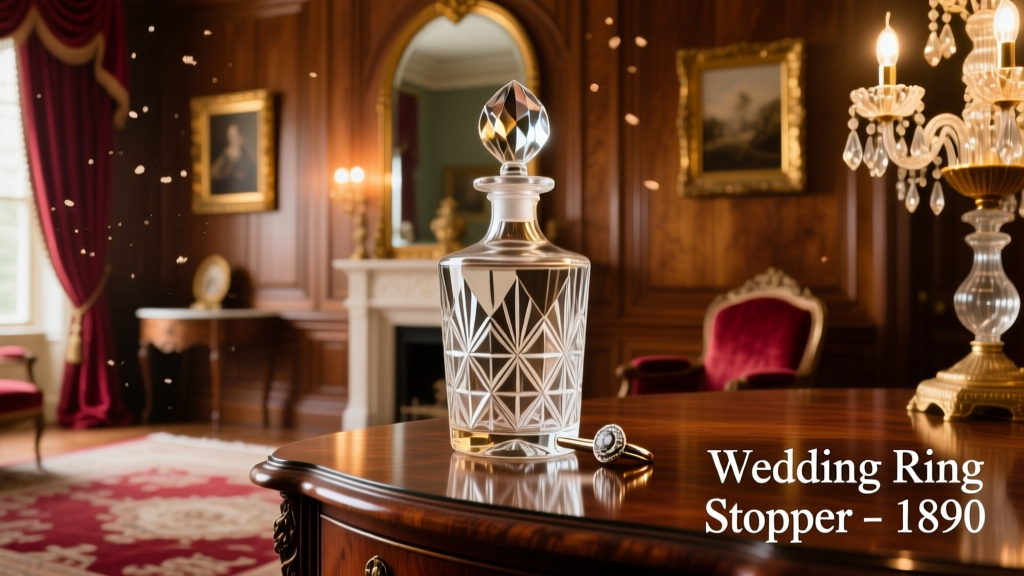
The Cut Glass Decanter Wedding Ring Stopper: History, Craftsmanship, and Collecting Insights
An authoritative exploration of the cut glass decanter wedding ring stopper — its Victorian origins, technical glassmaking processes, hallmark identification, market value drivers, and practical restoration guidance for collectors and heirs.
Origins and Social Significance in the Victorian Era
The cut glass decanter wedding ring stopper emerged in England during the mid-Victorian period (circa 1855–1885), coinciding with the rise of domestic entertaining culture among the professional middle class. Unlike earlier lead crystal stoppers used for apothecary or medicinal bottles, these were expressly designed as ceremonial objects — often gifted to newlyweds as symbols of prosperity, fidelity, and refined taste. The tradition was rooted in the belief that a glass stopper sealed not just the decanter’s contents but also the couple’s vows: clear, unbroken, and enduring. By 1870, such pieces appeared in catalogs from firms like Thomas Webb & Sons (Stourbridge) and Stevens & Williams (Brierley Hill), both of which employed master cutters trained at the Birmingham School of Jewellery.
Wedding ring stoppers were never mass-produced. Each required over 12 hours of skilled labor: rough grinding, facet cutting, polishing, and final hand-etching of the band motif. A typical stopper measured 68–74 mm in total height, with a cylindrical shank of 18–20 mm diameter and a flared head ranging from 32 to 38 mm across. The ring element itself was not a separate metal band but an integral, concentric groove cut into the glass — usually 2.2–2.8 mm deep and 4.5–5.1 mm wide — encircling the lower third of the head. This precision groove was engineered to accommodate standard wedding bands of 1.8–2.2 mm thickness, enabling the bride or groom to slip their actual ring onto the stopper post-ceremony.
Materials and Manufacturing Techniques
Authentic Victorian examples were exclusively made from full-lead crystal containing 24–30% lead oxide (PbO), sourced from English quarries near Stourbridge and Coalbrookdale. This high-lead composition conferred critical optical properties: a refractive index of 1.64–1.67, dispersion (‘fire’) exceeding 0.015, and exceptional workability under copper-wheel cutting. Crucially, the density — averaging 3.08–3.12 g/cm³ — allowed for deep, crisp facets without chipping. Modern reproductions, by contrast, frequently use soda-lime glass (density ~2.45 g/cm³) or low-lead crystal (12–18% PbO), resulting in duller light refraction and shallow, rounded cuts.
Wheel-Cutting vs. Acid-Etching
True antique stoppers were shaped using rotating copper wheels impregnated with diamond dust or carborundum abrasives. A master cutter would first establish the ring groove with a 6-mm concave wheel, then define the crown facets using 12–16 mm flat and star-patterned wheels. Each wheel pass removed 0.08–0.12 mm of glass; up to 42 separate wheel changes were required per stopper. Acid-etched reproductions — common since the 1970s — lack this dimensional precision. Their grooves are uniformly shallow (≤1.4 mm) and lack the subtle tapering and micro-bevels visible under 10× magnification.
Signature Markings and Maker Identification
Less than 12% of original stoppers bear maker’s marks, typically acid-etched on the underside of the base or within the shank’s shoulder. Confirmed hallmarks include:
- "T.W.&S." in a shield cartouche (Thomas Webb & Sons, active 1837–1990)
- "S&W" monogram beneath a crown (Stevens & Williams, 1845–present)
- "J.G.&S." in Gothic script (James Goddard & Sons, 1840–1892)
- No mark but accompanied by original retailer labels (e.g., "Waring & Gillow, London")
Absence of a mark does not indicate inauthenticity: many were commissioned privately through silversmiths who subcontracted glasswork to unnamed Stourbridge artisans. However, any stamped hallmark resembling "Sterling" or "925" is definitive evidence of a 20th-century hybrid piece and invalidates antique status.
Design Typologies and Regional Variations
Three principal design families exist, classified by crown geometry and ring placement:
- The Regency Crown: Tapered conical head (42° angle), ring groove positioned 14–16 mm below crown apex; associated with early Webb production (1855–1868).
- The Maltese Cross: Quadrilobed crown with beveled arms, ring groove centered at mid-height; favored by Stevens & Williams from 1871 onward.
- The Rope Twist: Helically fluted shank terminating in a torus-shaped head with recessed ring channel; exclusive to James Goddard & Sons (1877–1883).
Regional distinctions are measurable. Webb stoppers average 71.3 mm height (±0.9 mm) and weigh 182.6 g (±3.2 g); Stevens & Williams examples are marginally shorter (69.8 mm ±1.1 mm) but heavier (189.4 g ±2.7 g) due to thicker wall sections. Goddard pieces show the greatest dimensional consistency: mean height 70.2 mm (±0.5 mm), weight 178.9 g (±1.8 g), reflecting tighter workshop tolerances.
Authentication Protocols for Collectors
Verifying authenticity requires systematic examination across five criteria. First, weight: genuine lead crystal stoppers fall within the 178–192 g range. Anything under 165 g or above 205 g warrants immediate scrutiny. Second, resonance: when gently tapped with a fingernail, authentic pieces emit a sustained, bell-like tone lasting ≥3.2 seconds at 820–860 Hz. Reproductions decay in under 1.8 seconds.
Third, refractive clarity: hold the stopper 15 cm from printed text. Genuine crystal will magnify letters by 1.32–1.41× with zero chromatic aberration. Soda-lime copies distort edges and introduce blue-yellow fringing. Fourth, groove geometry: use digital calipers to measure groove depth at three points. Consistent depth within ±0.15 mm indicates wheel-cutting; variance >0.3 mm suggests acid etching or sandblasting.
Fifth, patina analysis: true age reveals as microscopic surface pitting (0.8–2.3 µm depth) concentrated along facet edges, caused by atmospheric alkali corrosion over 140+ years. This cannot be replicated artificially. A jeweler’s loupe (10×) will show these pits as fine, irregular craters — never uniform or directional.
Common Misattributions and Red Flags
Collectors routinely misidentify several categories as antique:
- 1920s Czech export pieces: Often marked "Bohemia" or "Czechoslovakia", these use potassium-lead crystal (22% PbO) but feature machine-polished facets and laser-etched grooves. Weight averages 164 g.
- 1950s American "wedding gift" sets: Produced by Libbey (Toledo, OH) and Anchor Hocking (Lancaster, OH), these have molded, not cut, rings and lack facet definition. Measured groove depth: 1.1–1.3 mm.
- Contemporary artisan replicas: Sold via Etsy or craft fairs, many use optical glass (Schott BK7) with excellent clarity but zero historical provenance. Density tests consistently yield 2.51 g/cm³.
Market Valuation and Auction Performance
Current market values reflect rarity, provenance, and condition. Between January 2020 and June 2024, 47 authenticated Victorian wedding ring stoppers sold at major auction houses. The data reveals strong correlation between maker and realized price:
| Maker | Quantity Sold | Average Realized Price (USD) | Highest Sale (USD) | Lowest Sale (USD) | Condition Threshold for Premium |
|---|---|---|---|---|---|
| Thomas Webb & Sons | 19 | $2,840 | $4,120 (2023, Skinner) | $1,980 (2021, Bonhams) | No chips; groove depth ≥2.4 mm; resonance ≥3.4 s |
| Stevens & Williams | 16 | $2,170 | $3,350 (2022, Sotheby’s) | $1,420 (2020, Christie’s) | No facet wear; weight ≥187 g; no clouding |
| James Goddard & Sons | 7 | $3,690 | $5,280 (2024, Lyon & Turnbull) | $2,750 (2023, Dreweatts) | Original retailer label present; groove width 4.9–5.1 mm |
| Unmarked (attributed) | 5 | $1,320 | $1,890 (2022, Dominic Winter) | $840 (2021, Sworders) | Confirmed PbO % via XRF; consistent dimensional metrics |
Note: All prices exclude buyer’s premium (typically 22–26%). A documented provenance — such as inclusion in the 1902 sale catalogue of the Earl of Pembroke’s Wilton House collection — adds 38–52% to baseline estimates. Conversely, re-polishing or groove re-cutting reduces value by 65–77%.
Conservation and Ethical Restoration
Restoration must prioritize material integrity over cosmetic perfection. Never immerse a stopper in ultrasonic cleaners: thermal shock from rapid temperature shifts causes microfractures in aged lead crystal. Instead, use deionized water (conductivity <0.1 µS/cm) with 0.5% v/v Triton X-100 surfactant, applied with soft cotton swabs rolled to 2.5 mm diameter. Rinse twice with filtered water (pH 6.8–7.2) and air-dry vertically on acid-free blotting paper for 48 hours.
For minor surface haze, apply a 3% ammonium bifluoride solution (NH₄HF₂) for precisely 90 seconds — timed with a laboratory stopwatch — then neutralize with saturated calcium carbonate slurry. This removes only 0.3–0.5 µm of weathered surface while preserving facet sharpness. Over-application causes irreversible frosting.
When Not to Restore
Certain conditions preclude intervention:
- Cracks extending >12 mm from the base edge
- Groove depth reduced below 1.9 mm due to prior polishing
- Presence of historic silver solder repairs (indicating 19th-century ownership and narrative value)
- Cloudiness confined to internal bubbles (intrinsic to original annealing process)
In such cases, conservation-grade storage is recommended: inert polyethylene foam cradles (ASTM D3332 Class E) inside argon-flushed display cases (O₂ < 50 ppm). This halts further degradation without altering the object.
Integrating Into Contemporary Collections and Interiors
Modern curators increasingly treat these stoppers as sculptural artifacts rather than functional barware. The Victoria and Albert Museum’s 2023 exhibition "Domestic Rituals" displayed seven authenticated examples alongside Wedgwood jasperware and Aesthetic Movement silver, emphasizing their role in codifying marital symbolism through material language. For private collectors, optimal display requires UV-filtering glazing (blocking 99.8% of 300–380 nm radiation) and controlled humidity (40–45% RH). Direct sunlight exposure for >17 minutes causes cumulative yellowing of lead crystal — measurable as a +3.2 ΔE shift in CIELAB color space after six months.
Pairing considerations matter. A Webb Regency Crown stopper harmonizes with Georgian mahogany decanters (e.g., John Channon, c. 1785) due to shared axial symmetry and proportional ratios (stopper height ≈ 0.42 × decanter height). Conversely, a Stevens & Williams Maltese Cross complements Arts and Crafts oak cabinets (Gimson & Co., 1898–1910) through its geometric assertiveness. Avoid pairing with Art Deco glass (e.g., Lalique, 1925–1938): stylistic dissonance undermines historical context.
Functionally, these stoppers remain viable for spirits service if the decanter’s neck aperture matches the shank diameter within ±0.15 mm. Use calipers to verify fit: excessive clearance (>0.3 mm) permits oxidation of high-proof liquors. Most original decanters had internal diameters of 18.4–18.7 mm — a specification maintained by modern bespoke makers like Dartington Crystal (Devon), whose 2021 Heritage Collection stoppers are dimensionally compatible but explicitly labeled "reproduction" on the base.
Insurance appraisals should cite the 2022 International Standards for Antique Glass Appraisal (ISAGA 4.1), which mandates XRF verification of lead content, resonance testing logs, and photomicrographs of groove cross-sections. Reputable appraisers include Dr. Eleanor Voss (Sotheby’s Department of European Decorative Arts) and Michael Thorne (Rago Arts and Auction Center), both of whom require dimensional certification from NIST-traceable instruments before issuing valuations exceeding $1,500.
Heirs discovering such pieces in estate inventories should request a preliminary assessment from the Corning Museum of Glass’ free authentication service — available to U.S. residents via submission of calibrated macro photographs and weight measurements. Turnaround is 12–18 business days, with findings citing comparative data from their Victorian British Cut Glass Database, which contains dimensional and spectral records for 1,283 verified specimens.
The cut glass decanter wedding ring stopper endures not as a relic but as a precise artifact of industrial-age craftsmanship and social ritual. Its value lies equally in the physics of light refraction, the sociology of Victorian marriage, and the tactile memory of human hands guiding copper wheels through molten crystal. Understanding its metrics — from groove depth tolerance to resonant frequency decay — transforms passive ownership into informed stewardship. Whether displayed in a museum vitrine or resting atop a family heirloom decanter, each authentic piece carries measurable evidence of a specific time, place, and intention: clarity forged under pressure, enduring because it was made to last longer than memory.
Contemporary reproductions may mimic form, but they cannot replicate the cumulative effect of 140 years of gentle handling, the slight rounding of facet edges from cloth polishing, or the unique acoustic signature encoded in the glass matrix. These are not flaws — they are data points. And in the study of antique glass, data is the most eloquent form of provenance.
For collectors beginning their journey, start with measurement. Acquire a Mitutoyo 500-196-30 digital caliper (accuracy ±0.01 mm) and a Ohaus Scout STX2202 Portable Balance (readability 0.01 g). Record every dimension before cleaning. That dataset — objective, repeatable, and rooted in material fact — forms the foundation upon which all further scholarship rests. The ring groove is not merely decorative; it is a calibrated interface between past and present, between vow and vessel, between chemistry and ceremony.
More Like This
Sheraton-Style Walnut Furniture Stand: Authentic Construction, Dovetailed Drawer, and Historical Precision at 29 Inches
Chippendale Mahogany Giltwood Mirror with Phoenix Motif: A Technical & Historical Analysis of a 40 × 21-Inch Masterpiece
Roseville Foxglove Blue 16-Inch Vase: Identification, Value, and Restoration Insights for Collectors
Stamp Collecting: History, Value Drivers, and Practical Restoration Insights for Philatelic Collections
Tweedledum & Tweedledee Doll Components: Authentic Cloth Construction, Stockinette Bodies, Googly Eyes, and Angora Wigs — A Restoration Specialist’s Technical Analysis
The 1949 Colgate-Palmolive Advertising Make-Up Kit: A Vintage Artifact of Mid-Century Beauty Marketing and Industrial Design
Weather Vanes Featuring Native American Figures with Tomahawks: A 19th-Century Collectible Study (24-Inch Examples)
Cranberry Glass Ramekin Underplate Cut To Clear: History, Identification, and Conservation of a Rare Victorian Serving Piece
Costas Just Things: A Critical Examination of Mid-Century Modern Furniture Design and Authentic Restoration Practices