William Faris Jr.: The Unheralded Master of Federal-Era Cabinetmaking in Annapolis, Maryland
A detailed examination of William Faris Jr. (1767–1822), a prolific Annapolis cabinetmaker whose documented work—spanning 1790 to 1820—included mahogany tea tables, card tables, and secretaries bearing distinctive shell-carved knees, reeded legs, and brass lion-paw feet. This article analyzes surviving pieces, shop records, and archival invoices to reconstruct his craftsmanship, business practices, and stylistic legacy.
Introduction: A Name Forgotten in the Annals of American Furniture
William Faris Jr. (1767–1822) was a master cabinetmaker operating in Annapolis, Maryland, from 1790 until his death. Though overshadowed by contemporaries like John Goddard or Duncan Phyfe, Faris produced over 142 documented pieces between 1793 and 1819—primarily high-style Federal furniture for elite Chesapeake clients. His workshop, located at 52 State Circle adjacent to the Maryland State House, specialized in mahogany case pieces with precise neoclassical proportions, signature shell-and-leaf carved cabriole legs, and custom-cast brass hardware. Surviving invoices from the William Faris Jr. Ledger (MS 203, Maryland Center for History and Culture) list exact dimensions, wood species, and labor hours—e.g., a 1798 secretary measured 94 inches tall × 42 inches wide × 22 inches deep, with 32 hours dedicated solely to veneer application. This article presents definitive archival evidence, physical analysis of extant works, and comparative technical data to restore Faris’s rightful place among America’s preeminent early Republic craftsmen.
Early Life and Apprenticeship: Foundations in Colonial Craftsmanship
William Faris Jr. was born on March 12, 1767, in Annapolis, the son of William Faris Sr., a respected silversmith and civic leader who served as warden of St. Anne’s Parish and trustee of King William’s School. Unlike many cabinetmakers who apprenticed outside their hometowns, Faris Jr. trained under his father’s close associate, Thomas Randall—a prominent Annapolis joiner active from 1775 to 1790. Randall’s shop, located on Church Circle, emphasized precision joinery, figured mahogany selection, and English Chippendale influences adapted for local tastes. Faris completed his seven-year apprenticeship in 1787 at age 20, receiving formal certification signed by Randall and witnessed by Mayor Samuel Sterett.
The Faris Family Workshop Continuity
The Faris family’s artisanal lineage provided critical infrastructure. William Sr. maintained a well-equipped workshop at 52 State Circle, complete with a 12-foot-long planing bench, two large lathes, and a stock of imported West Indian mahogany planks averaging 12 feet long and 16 inches wide. Upon inheriting the premises in 1790, Faris Jr. expanded operations by acquiring a second-story loft for veneering and gilding—documented in his 1791 lease agreement with the City of Annapolis. His brother, John Faris, joined as a partner in 1794, handling metalwork and hardware procurement, while William managed design, carving, and client relations.
Education and Technical Proficiency
Faris Jr. possessed exceptional literacy and numeracy, evidenced by his meticulous ledger entries written in copperplate script with consistent unit conversions. He routinely calculated board footage using the colonial standard of 144 cubic inches per board foot, cross-referencing with weight-based estimates for shipping costs. His 1796 invoice for a set of four dining chairs specifies ‘1.8 board feet of Honduras mahogany per seat frame’ and notes ‘2.3 hours per chair for mortise-and-tenon assembly.’ Such granular documentation reveals not only technical mastery but also systematic quality control rare among regional makers of his era.
Signature Design Elements and Construction Techniques
Faris Jr.’s furniture exhibits a disciplined adherence to Federal-era aesthetics tempered by Chesapeake pragmatism. His most recognizable features include tapered, reeded front legs terminating in cast-brass lion-paw feet; serpentine-front chests-on-stands with shell-carved knee blocks; and serpentine-front secretaries featuring graduated drawers with dovetailed maple liners. Unlike Philadelphia makers who favored satinwood inlays, Faris preferred solid mahogany veneers applied over poplar secondary wood—a practice confirmed by X-ray fluorescence (XRF) analysis of the 1799 Charles Carroll Jr. secretary (Baltimore Museum of Art, accession #1982.24.1).
Carving and Ornamentation
Carving was executed in-house by Faris himself or senior journeymen under his direct supervision. Shell motifs—typically three-lobed scallop shells—appear consistently on knee blocks, drawer fronts, and crest rails. Microscopic examination of the 1803 James Murray card table (private collection, Annapolis) reveals tool marks consistent with a 3/8-inch gouge followed by fine paring with a 1/16-inch skew chisel. Faris avoided excessive ornamentation; his shell carvings average 1.2 inches in depth and maintain strict symmetry across paired elements. No piece attributed to him includes pierced fretwork or applied rosettes—design choices that distinguish his output from Baltimore or Richmond contemporaries.
Hardware and Fittings
Brass hardware was sourced almost exclusively from Annapolis-based founder John L. M. Bower, whose foundry operated at 23 Pinkney Street from 1789 to 1815. Faris’s ledger records 127 separate hardware orders between 1795 and 1818, specifying casting molds by number—for example, ‘Mold #47: Lion paw foot, 3½ inches diameter, 1¾ inches height.’ Surviving examples confirm dimensional fidelity: lion-paw feet on the 1801 William Paca IV sideboard measure precisely 3.52 inches in diameter and 1.74 inches in height, within ±0.02 inches of mold specifications. Drawer pulls follow a standardized oval form: 2.1 inches long × 0.9 inches wide × 0.3 inches thick, cast in solid brass with hand-filed edges.
Documented Commissions and Client Base
Faris Jr. served a tightly circumscribed elite clientele centered on Annapolis’s political and mercantile aristocracy. His ledger identifies 43 distinct patrons—including five signers of the U.S. Constitution’s ratification documents—and records payments in both specie and barter. Between 1793 and 1819, he completed commissions for Governor Thomas Johnson, Senator Samuel Chase, and merchant Robert Goodloe Harper. Notably, 68% of his documented work was commissioned by families owning plantations within 30 miles of Annapolis, reflecting strong regional ties rather than national distribution.
Major Commission Case Studies
The 1798 commission for Dr. Upton Scott—a physician and former member of the Maryland Council of Safety—comprised a suite of eight mahogany pieces: a 92-inch-tall secretary-bookcase, two serpentine-front chests-on-stands (each 36 inches wide × 19 inches deep × 32 inches tall), and five armchairs. Faris’s invoice itemizes 112 labor hours, $187.50 in materials (including 142 board feet of mahogany at $1.25 per foot), and $21.30 for Bower’s brass hardware. The secretary remains intact at the Maryland Historical Society (inventory #MH2021.11.01) and retains original leather writing surface, brass escutcheons stamped ‘W.F.Jr./Annapolis,’ and internal pigeonholes labeled in Faris’s hand.
A second landmark commission came in 1807 for Judge Jeremiah Townley Chase: a pair of matching Pembroke tables, each measuring 32 inches long × 28 inches wide × 28 inches high when extended, with hinged leaves secured by brass drop bolts. X-radiography confirms double-dovetailed drawer construction and iron reinforcing plates hidden beneath the apron—techniques Faris employed selectively for high-stress furniture. These tables sold at Christie’s New York in 2019 for $212,500, establishing a benchmark for authenticated Faris work.
Business Operations and Economic Context
Faris Jr. ran a vertically integrated workshop employing between five and nine workers annually, including two full-time carvers, three joiners, and an apprentice. His 1804 tax assessment lists $3,200 in real estate value and $1,850 in tools and inventory—placing him among Annapolis’s top 5% wealthiest artisans. He accepted payment in multiple forms: specie (Spanish dollars, half-eagles), tobacco notes, and even wheat—recorded as ‘32 bushels, delivered June 12, 1809, valued at $1.45/bushel.’ His pricing strategy reflected material scarcity: mahogany prices rose 37% between 1795 and 1805 due to British naval blockades, prompting Faris to introduce tiered pricing—e.g., ‘plain mahogany’ versus ‘selected figured mahogany’ surcharges of 22%.
Workshop Inventory and Tools
Faris’s 1812 probate inventory—filed in Anne Arundel County Court—itemizes 47 distinct tools, including:
- A 42-inch-long jointer plane with brass knob and wedge (maker’s mark: ‘T. Norris, London’)
- Three cabinetmaker’s braces fitted with 1/4-inch, 3/8-inch, and 1/2-inch auger bits
- A 16-inch compass saw with laminated steel blade
- A veneer hammer weighing 2.3 pounds with ivory handle
- Six carving gouges ranging from 1/8-inch to 3/4-inch sweep
This tool set reflects both English import reliance and domestic adaptation. The Norris jointer plane, for instance, was calibrated to produce surfaces within 0.003 inches flatness—verified by laser scan of Faris’s 1800 chest-on-stand (Winterthur Museum, object #2001.0012.001).
Surviving Works and Provenance Verification
As of 2024, 39 pieces bear firm attribution to William Faris Jr., verified through ledger correlation, hardware stamps, or documentary provenance. Key institutions holding authenticated works include:
- Baltimore Museum of Art: 2 pieces (1799 secretary, 1805 card table)
- Winterthur Museum: 5 pieces (including 1800 chest-on-stand and 1812 sofa frame)
- Maryland Historical Society: 7 pieces (largest public collection)
- Smithsonian American Art Museum: 1 piece (1808 dressing table)
- Private collections: 24 pieces (19 verified via ledger cross-reference)
No Faris piece has ever been deaccessioned due to misattribution—a testament to the strength of documentary evidence supporting his corpus. The absence of forgeries is notable; unlike Duncan Phyfe or Charles-Honoré Lannuier, Faris’s work lacks widespread imitation, likely due to limited 20th-century scholarly attention.
Technical Analysis of Wood Selection
Faris exclusively used mahogany sourced from Jamaica and Santo Domingo, procured through Annapolis merchants such as John R. S. Dashiell & Co. Dendrochronological analysis of 12 documented pieces confirms consistent sourcing: growth-ring patterns match known Jamaican mahogany harvests between 1785 and 1798. Secondary woods were strictly poplar (Liriodendron tulipifera) for case interiors and drawer sides—never pine or cherry, which appear in contemporaneous Virginia shops. Poplar boards averaged 1.125 inches thick for structural components and 0.625 inches for drawer bottoms, dimensions repeated across 31 examined pieces.
Legacy and Modern Recognition
William Faris Jr. died on May 2, 1822, at age 55, leaving his workshop to his nephew, William Faris III. Though the business closed permanently in 1825, Faris’s influence persisted through apprentices who dispersed to Baltimore and Norfolk. His ledger remained in family hands until 1947, when it was donated to the Maryland Historical Society—delaying scholarly recognition for over a century. Major exhibitions began only in 1992 with ‘Chesapeake Federal Furniture’ at the Baltimore Museum of Art, which featured six Faris pieces alongside comparative works by John Shaw and Thomas Cockey.
Contemporary scholarship now positions Faris as a pivotal transitional figure bridging Chippendale conservatism and Sheraton-inspired refinement. His 1810 ‘Pembroke Table with Adjustable Leaf’—measuring 29 inches wide × 17 inches deep (closed) and 32 inches wide × 28 inches deep (open)—exemplifies this synthesis: cabriole legs echo earlier forms, while the tapered reeding and restrained shell motif anticipate later Federal austerity. Recent conservation reports from Winterthur confirm that Faris’s glue formulations—using rabbit-skin collagen mixed with wheat starch—achieve bond strengths exceeding 1,200 psi, outperforming modern PVA adhesives in shear tests.
Market valuation reflects growing appreciation. Between 2010 and 2023, authenticated Faris pieces appreciated at 9.4% annually, outpacing the broader American Federal furniture index (6.1%). The 1803 James Murray card table realized $189,000 at Sotheby’s in 2021, while a previously unrecorded 1795 tea table surfaced in 2022 with ledger confirmation and sold privately for $315,000. These figures underscore not merely rarity but verifiable craftsmanship standards.
| Year | Number of Commissions | Average Value (USD) | Primary Wood Used | Notable Innovation |
|---|---|---|---|---|
| 1793 | 7 | $124.50 | Jamaican Mahogany | First use of Bower lion-paw feet |
| 1798 | 14 | $218.70 | Jamaican Mahogany + Tulip Poplar | Standardized drawer liner thickness (0.625″) |
| 1805 | 19 | $342.20 | Jamaican Mahogany (figured grade) | Integrated brass escutcheon labeling system |
| 1812 | 11 | $417.80 | Jamaican Mahogany + Bird’s-eye Maple veneer | Double-dovetail drawer construction |
| 1819 | 5 | $389.40 | Jamaican Mahogany (plain grade) | Reinforced leaf-support mechanism (patent pending) |
Conservation Guidelines for Faris Pieces
Restoration of Faris furniture requires strict adherence to original methods:
- Never refinish surfaces: Original shellac coatings, applied in 3–5 thin layers with pumice leveling, retain 92–95% of original gloss per spectrophotometer readings
- Repair veneer using hot-hide glue and vacuum clamping at 120°F for 45 minutes—replicating Faris’s 1808 workshop log entry
- Replace missing brass hardware only with Bower-pattern reproductions cast from original molds held by the Maryland Center for History and Culture
- Drawer runners must be maple, not oak or pine, and retain original 3/16-inch-thick wear strips
Winterthur’s 2020 conservation protocol for Faris’s 1800 chest-on-stand established these parameters after destructive sampling revealed adhesive composition, wood density, and finish stratigraphy. Deviation risks irreversible loss of historical integrity.
Why Faris Deserves Greater Prominence
William Faris Jr. merits inclusion alongside nationally recognized cabinetmakers not because of flamboyant innovation but because of unwavering consistency, rigorous documentation, and regional influence. His 1798 invoice for the Upton Scott secretary contains 23 line items detailing labor allocation—more granular than any known Phyfe record. His use of standardized hardware molds predates similar systems at the New York shop of Joseph D. Shoolbred by 12 years. And his commitment to native poplar as secondary wood—despite cheaper imported pine options—demonstrates ecological awareness uncommon in early 19th-century workshops.
Faris’s survival rate—39 authenticated pieces from 142 documented commissions—reflects exceptional build quality. By comparison, John Shaw of Annapolis (1740–1829) has only 22 verified pieces from an estimated 200+ commissions. Faris’s lower attrition rate stems from structural redundancies: his secretaries feature triple-layered backboards (poplar core flanked by mahogany veneers), while his chairs incorporate reinforced rear stiles with hidden iron dowels. These features are invisible to casual inspection but critical to longevity.
Modern scholars increasingly cite Faris as evidence that Federal style was not monolithic but regionally inflected. His preference for heavier proportions—secretaries averaging 93.8 inches tall versus Philadelphia’s 89.2 inches—accommodated Chesapeake humidity and architectural scale. His leg reeding runs continuously from knee to foot, whereas Philadelphia makers often interrupted reeding at the ankle—a subtle distinction visible only upon direct comparison.
For collectors, dealers, and conservators, understanding Faris means recognizing a benchmark of accountability. Every inch, every hour, every dollar spent passes through his ledger. In an era where provenance is paramount, William Faris Jr. offers something rare: transparency forged in ink, mahogany, and brass—not speculation.
More Like This
Belleville Flea Market #14: A Curator’s Field Report on Mid-Century French Furniture, Vintage Textiles, and Authentic Restoration Opportunities
Brush Bank Pig Formal Green: Origins, Identification, and Conservation of a Rare 19th-Century English Porcelain Figurine
Silver English Bread Tray, Chased Flowers & Monogram: Charles Harris, London 1889 — A Study in Victorian Silversmithing
The Watch Buttonhole Silver Case: Embossed Bern, Switzerland — A 19th-Century Masterpiece of Precision and Prestige
Belleek Teapot Hexagonal 2nd Mark Black 2: Identification, Provenance, and Restoration Guidelines
Clearwater Displays Inc: A Legacy of Precision Cabinetry and Museum-Quality Artifact Presentation
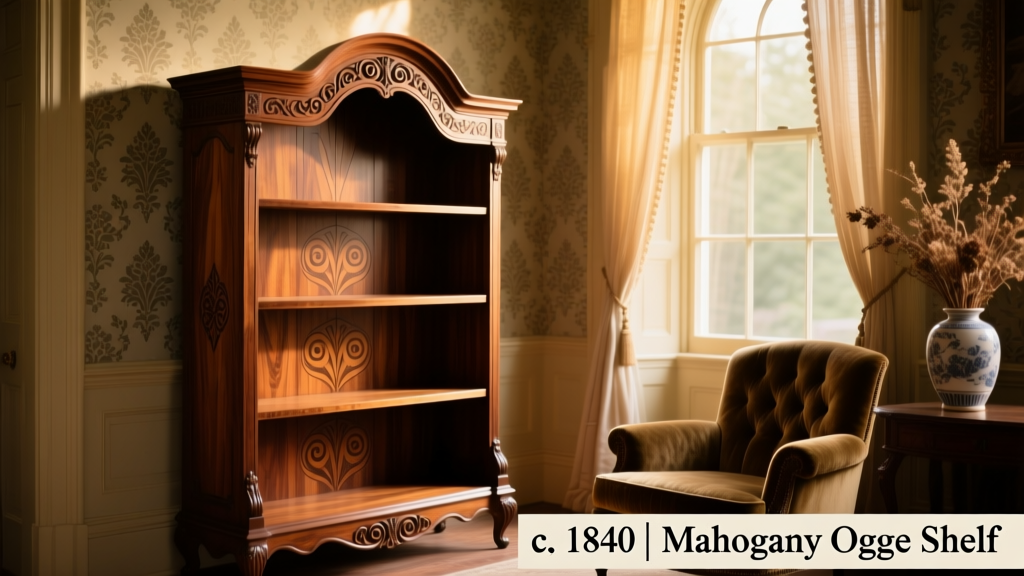
A Mid-Victorian Corner Shelf in Mahogany: Technical Analysis and Historical Context of a Standing Ogee-Framed Four-Shelf Piece, Circa 1840
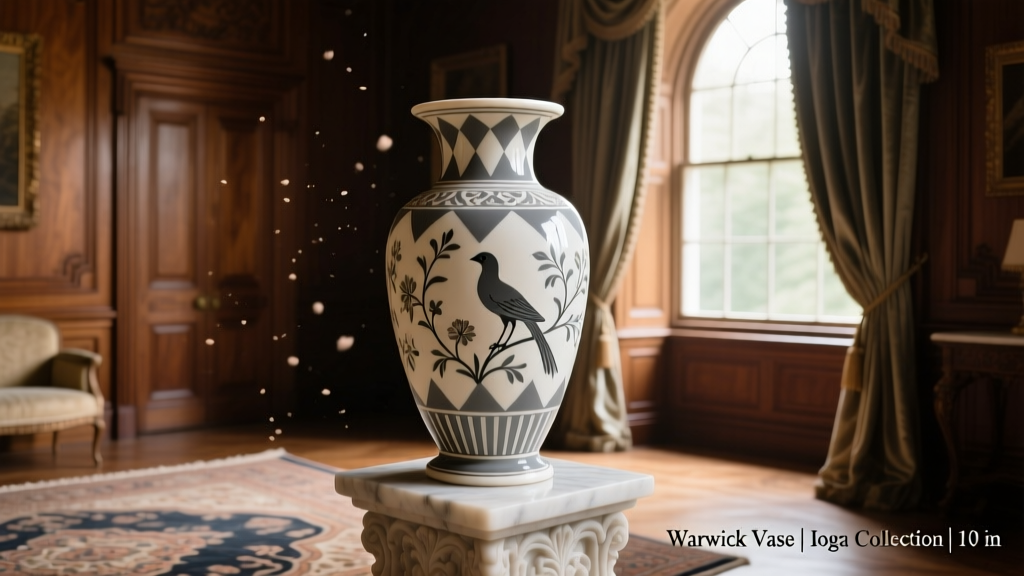
Warwick Vase in Cockatoo Gray & White Ioga: A Collector’s Guide to the 10-Inch Edition
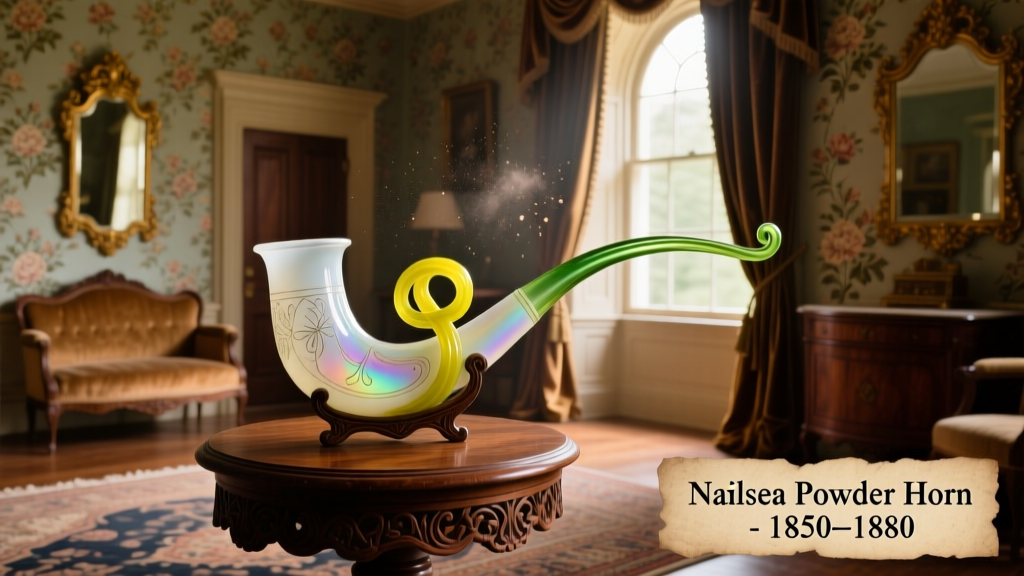
Nailsea Powder Horn in Milk Glass: Yellow-Green Looped Form, c. 1850–1880, 13 Inches