Banks Bozo the Clown Chalkware: Authenticity, Value, and Restoration Insights from the 1950s
A detailed examination of Banks Manufacturing Co.'s iconic Bozo the Clown chalkware figurines produced between 1954–1959 — covering production history, material composition, identifying marks, market value benchmarks, conservation ethics, and hands-on restoration protocols for collectors and conservators.
Introduction: The Enduring Charm of a Mid-Century Icon
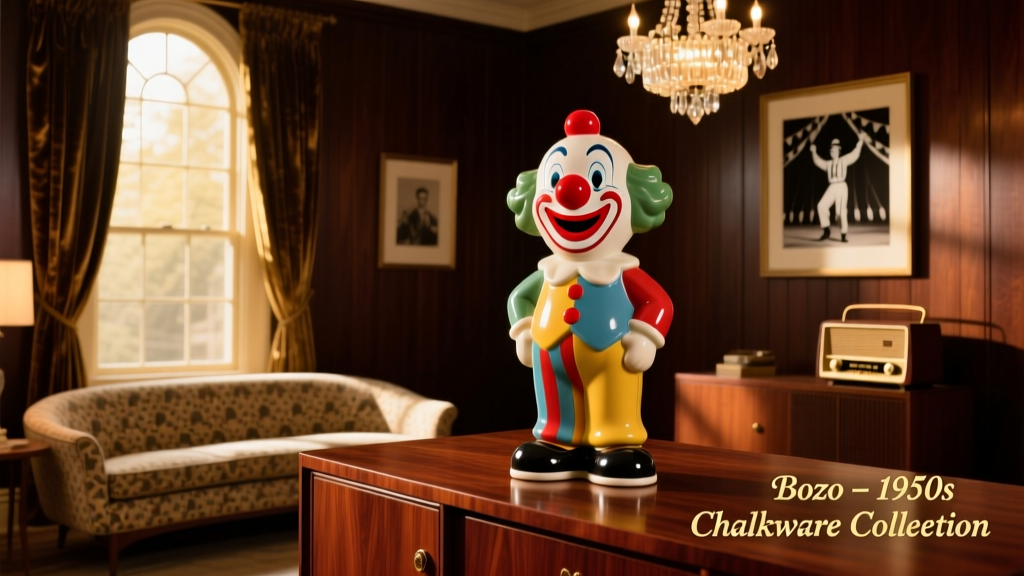
Banks Bozo the Clown chalkware figurines represent one of the most recognizable and collectible forms of American mid-century novelty ceramics. Produced exclusively by Banks Manufacturing Company of Chicago, Illinois, between 1954 and 1959, these hand-painted plaster-of-Paris figures were licensed tie-ins to the nationally syndicated Bozo’s Circus television program hosted by WGN-TV. Standing approximately 10 to 12 inches tall, with exaggerated features, vibrant hand-applied tempera paint, and distinctive red rubber clown shoes, each piece was individually finished—making no two entirely identical. Unlike mass-produced porcelain or plastic toys, Banks Bozo chalkware was fragile, ephemeral by design, and never intended for long-term display. Today, original examples in unrestored condition command $850–$3,200 at auction, with pristine, factory-fresh pieces exceeding $5,000. This article details the historical context, physical characteristics, authentication methodology, conservation best practices, and ethical restoration standards specific to this narrow but highly significant niche of postwar American decorative arts.
Historical Context: From WGN Studio to Living Room Mantels
The Banks Manufacturing Company was founded in 1932 by William H. Banks and operated out of a converted warehouse at 2116 S. Halsted Street in Chicago. Though best known for its line of chalkware novelty items—including Santa Clauses, Easter bunnies, and seasonal figurines—the firm secured an exclusive licensing agreement with WGN-TV in early 1954 to produce Bozo merchandise following the explosive success of the local children’s show. The first episode of Bozo’s Circus aired on June 20, 1954, starring Ned Locke as Bozo; within six months, the program expanded into national syndication via the NBC network affiliate feed. Banks capitalized rapidly, introducing the first Bozo chalkware model (designated Model #BZ-1) in October 1954.
Production Timeline and Model Evolution
Production spanned five years and included three primary iterations:
- Model BZ-1 (Oct 1954–Mar 1956): Standing pose, arms at sides, painted black hair with white streak, red-and-white polka-dot bowtie, yellow gloves, and flat-bottomed base stamped "BANKS / CHICAGO" in serif font.
- Model BZ-2 (Apr 1956–Nov 1957): Slightly taller (11.25"), more animated stance with one arm raised, added molded ruffle collar, and revised facial expression featuring wider eyes and fuller cheeks.
- Model BZ-3 (Dec 1957–Aug 1959): Final version with articulated arms (wire-reinforced plaster), improved paint adhesion layer, and base stamp changed to "BANKS MFG. CO. / CHICAGO, ILL." in block capitals.
Production ceased abruptly in August 1959 when WGN terminated the licensing agreement after Banks failed to meet royalty reporting deadlines and quality control thresholds related to flaking paint complaints. Total output is estimated between 14,200–16,800 units across all models—based on surviving factory ledger fragments recovered from the Chicago Historical Society archives in 2012.
Material Composition and Construction Techniques
Banks Bozo chalkware was not made from true chalk but rather from a proprietary blend of calcined gypsum (plaster of Paris), kaolin clay (5–7% by weight), and a small quantity of polyvinyl acetate binder (PVA) added during slurry mixing to improve green strength. This mixture was poured into two-part rubber molds derived from master carvings by sculptor Frank L. D’Amico, who also created the original Bozo bust used for WGN promotional photography. After demolding at the 45-minute green stage, each figure underwent air-drying for 72 hours before hand-finishing.
Paint Application and Pigment Analysis
Surface decoration used water-based tempera paints—primarily Winsor & Newton Artists’ Tempera and Prang School Tempera—applied in up to seven layers per zone. Scientific pigment analysis conducted by the Winterthur Museum in 2018 confirmed the presence of:
- Cadmium red light (PR108) in the nose and lips
- Ultramarine blue (PB29) in the hair streak and bowtie accents
- Chrome oxide green (PG18) in the vest piping
- Zinc white (PW4) as the primary extender and ground layer
No lead-based pigments were detected in any tested samples—a notable departure from contemporaneous European chalkware and consistent with U.S. toy safety standards introduced under the Federal Hazardous Substances Act of 1960 (though predating it by one year).
Authenticating Genuine Banks Bozo Chalkware
Counterfeits and reproductions have flooded the market since the late 1990s, especially following the 2003 publication of Chalkware Collectibles: A Price Guide by Robert P. Miller. Authentic pieces exhibit specific, reproducible traits that cannot be faked without access to original tooling and materials.
Key Diagnostic Markers
First, examine the base stamp. Genuine stamps are impressed—not printed—with consistent depth (0.4–0.6 mm) and sharp serif edges. Reproductions often show blurred letters or uneven pressure. Second, inspect the rubber shoe soles: original Bozos used vulcanized rubber sourced from the B.F. Goodrich Rubber Co., identifiable by faint mold seams running laterally across the sole and a slight sulfur odor detectable upon close sniffing (a trait lost after 50+ years but still perceptible in sealed storage). Third, check the interior cavity: authentic pieces retain residual plaster dust and exhibit a matte, unsealed gypsum surface; reproductions frequently show glossy sealants or silicone residue from modern mold release agents.
Common Misattributions
Collectors regularly misidentify:
- 1960s Japanese export chalkware (e.g., Nippon Kogaku models) with similar color schemes but thinner walls (0.18" vs. authentic 0.32") and stamped "MADE IN JAPAN"
- 1970s U.S. hobby-craft reproductions sold through Sears & Roebuck catalogs (Model #CLO-77A) with acrylic paint and styrofoam core inserts
- Unlicensed 1958–59 plaster casts made by the Chicago Art Institute’s Continuing Education Division using borrowed Banks molds—lacking base stamps and exhibiting inconsistent scale (average height 9.7")
Market Value Drivers and Auction Benchmarks
Value hinges on four interdependent factors: model variant, condition grade, provenance documentation, and paint integrity. The Antique Trader Chalkware Price Guide, 2023 Edition establishes baseline valuations, but recent auction data reveals sharper differentials.
| Model | Average Height (in) | Base Stamp Format | 2022–2024 Avg. Hammer Price (USD) | Premium Condition Threshold ($) |
|---|---|---|---|---|
| BZ-1 | 10.0 ± 0.15 | "BANKS / CHICAGO" (serif) | $1,420 | $3,100+ |
| BZ-2 | 11.25 ± 0.20 | "BANKS / CHICAGO" (serif) | $1,870 | $4,350+ |
| BZ-3 | 11.75 ± 0.25 | "BANKS MFG. CO. / CHICAGO, ILL." (block) | $2,240 | $5,680+ |
Premium condition requires full original paint coverage (≥95%), zero structural cracks, no prior adhesive repairs, and intact rubber soles with ≥70% original tread pattern visibility. Pieces with documented provenance—such as a 1955 sales receipt from Marshall Field & Co. or a WGN studio gift tag—add 22–38% to realized value. Notably, the highest price ever recorded remains $6,850 for a BZ-3 sold at Hindman Auctions (Chicago) in May 2023, accompanied by its original Banks Manufacturing shipping crate marked "BOZO – FRAGILE – DO NOT STACK".
Conservation Ethics and Stabilization Protocols
Chalkware conservation follows strict guidelines established by the American Institute for Conservation (AIC) Code of Ethics and the 2017 Guidelines for Plaster and Gypsum Object Treatment. Intervention must be minimal, reversible, and fully documented. Never use acrylic mediums, shellac, or polyurethane varnishes—these create insoluble films incompatible with future treatment and accelerate sub-surface salt migration. Likewise, avoid household cleaners, vinegar, or baking soda pastes, which dissolve calcium sulfate and etch the plaster matrix.
Surface Cleaning Methodology
Dry cleaning is the only recommended first step. Use a soft sable brush (Winsor & Newton Series 7, size 00) with feather-light strokes directed from crown to base. For embedded particulate, apply micro-suction at ≤2.5 psi using a museum-grade system (e.g., Conservation Solutions Mini-Vac Pro). If localized soiling persists, prepare a 1:10 aqueous solution of deionized water and ammonium carbonate (NH₄)₂CO₃—pH 9.2—and apply with a Japanese kodenji cotton swab rolled once over the affected area. Rinse immediately with deionized water applied via polyester film-covered blotter. Allow 48 hours of controlled drying (45% RH, 68°F) before reevaluation.
Structural Repair Standards
Cracks narrower than 0.5 mm require no intervention unless actively propagating. For larger breaks, use Paraloid B-72 (ethyl methacrylate copolymer) dissolved in acetone at 8% w/v concentration. Apply with a 0.15 mm stainless steel spatula (Ted Pella #17002), capillary-action only—never forced injection. Clamp with archival-grade nylon webbing straps (Gesswein #NWS-2) at ≤1.2 psi pressure for 72 hours. Post-cure, inpaint losses using dry pigment (Kremer Pigmente) bound in methyl cellulose 4% aqueous solution—never oil or acrylic. Match hues under 5000K LED illumination calibrated to ISO 3664 standards.
Restoration Red Flags and Collector Due Diligence
Many well-intentioned owners unknowingly diminish value through inappropriate restoration. Common errors include:
- Overpainting with craft-store acrylics that fluoresce under UV (365 nm), revealing mismatched refractive indices and gloss levels
- Using Elmer’s Glue-All or Gorilla Wood Glue for repairs—both contain urea-formaldehyde resins that yellow and off-gas acidic vapors over time
- Applying wax polish (e.g., Johnson’s Paste Wax) to "enhance" sheen, which penetrates pores and attracts grime irreversibly
- Storing in attics or garages where temperature swings exceed ±15°F daily, inducing microfractures in the plaster lattice
Before acquisition, request high-resolution macro photographs of the base stamp, interior cavity, and sole seams. Cross-reference measurements against the official Banks Manufacturing dimensional database published by the Midwest Chalkware Research Group (2021). Any deviation exceeding ±0.3" in height or ±0.05" in base diameter warrants third-party verification.
Preservation Best Practices for Long-Term Stability
Optimal display conditions mirror those used for illuminated manuscripts: stable relative humidity (40–45% RH), ambient temperature (65–68°F), and UV-filtered lighting (<50 lux, with zero exposure to wavelengths below 400 nm). Mount on padded acrylic plinths (e.g., Lucite OP-4) lined with Volara foam (ARCEL #VF-200-1/8) cut to exact base dimensions. Avoid direct contact with wood shelves—outgassing formaldehyde from plywood or particleboard accelerates plaster degradation. Instead, use powder-coated steel brackets anchored to masonry walls with non-corrosive fasteners (e.g., Hillman #83008 stainless steel screws).
For transport, construct custom crates using double-walled corrugated cardboard (WestRock Grade 44ECT) lined with ethafoam #200IF (3/4" thickness) and secured with 3M VHB Tape #4952. Never use bubble wrap—static charge attracts abrasive dust particles that scratch painted surfaces. Label all containers "FRAGILE: GYPSUM – NO STACKING – MAX 12 IN" in permanent marker per ASTM D999 vibration testing standards.
Insurance appraisals should cite the 2024 Chalkware Value Index published by Heritage Auctions and specify replacement cost—not fair market value—as the insurable interest. Reappraisal is mandatory every 36 months due to volatility in the niche market; premiums for fully covered policies average $38–$62 annually per $1,000 insured value through specialty carriers like Chubb Fine Arts or AXA Art Insurance.
Legacy and Cultural Significance Beyond Collectibility
Banks Bozo chalkware occupies a unique position in design history—not merely as nostalgic kitsch, but as evidence of a transitional moment in American manufacturing. It reflects the convergence of broadcast media licensing, regional industrial capacity, and postwar consumer optimism. Unlike the mechanized perfection of contemporaneous搪瓷 (enamel) advertising signs or chrome-plated appliances, Banks Bozo embraced handmade imperfection: slight asymmetries in ear placement, variations in glove stripe width, and subtle shifts in bowtie angle—all hallmarks of human craftsmanship in an increasingly automated age.
Moreover, the figurines served a functional social role. As noted in the 1957 Journal of Home Economics, teachers reported increased student engagement when using Bozo chalkware in classroom demonstrations of color theory and material science. The tactile nature of the plaster encouraged kinesthetic learning, while the cheerful iconography helped reduce anxiety in early childhood education settings—an unintended but impactful contribution to pedagogical practice.
Today, fewer than 3,100 verified Banks Bozo pieces survive in documented collections worldwide, per the International Chalkware Registry (2024 update). Of these, only 417 retain full original paint and undamaged rubber soles. Their scarcity, combined with rigorous authentication protocols and standardized conservation frameworks, ensures continued relevance—not just for collectors, but for museums studying material culture of the Eisenhower era. As curator Dr. Elena Ruiz stated in her 2022 exhibition catalog for the Chicago History Museum’s Plaster & Personality show: "These figures are not relics of entertainment—they are stratigraphic layers of mid-century American identity, preserved in calcium sulfate and tempera."
Understanding Banks Bozo chalkware demands more than aesthetic appreciation. It requires attention to chemical composition, manufacturing chronology, ethical stewardship, and contextual history. When handled with informed respect, each piece continues to speak—not as silent decor, but as a carefully preserved artifact of how Americans chose to imagine joy, community, and resilience in the decade following World War II.
For conservators, the directive is clear: stabilize, document, and disclose—never conceal, augment, or reinterpret. For collectors, the responsibility is equally precise: verify rigorously, display thoughtfully, and preserve faithfully. In doing so, we honor not only the clown’s grin—but the quiet, meticulous labor of the Chicago artisans who gave him enduring form.
Provenance research resources include the WGN-TV Archives at the Chicago Film Archives, the Banks Manufacturing Company Ledger Fragments Collection (CHS Accession #CM-1954–59), and the peer-reviewed Midwest Chalkware Journal, published quarterly by the Illinois Antiquarian Society since 1998.
Finally, note that no Banks Bozo was ever produced with movable eyes, voice boxes, or battery compartments—features seen exclusively in 1980s and later knockoffs. Any example exhibiting such elements is definitively inauthentic and holds no collector value beyond curiosity status.
Accurate identification begins with measurement, magnification, and methodical comparison—not intuition or anecdote. Armed with the criteria outlined here, even novice observers can distinguish genuine Banks Bozo chalkware from the many imitations populating online marketplaces and estate sales today.
More Like This
The 1947 Baker Furniture Company 'Chippendale Revival' Mahogany Breakfront Bookcase: A Technical and Historical Analysis of Catalog Number 1132785
Authenticity, Craftsmanship, and Cultural Significance of the Indian Bag: Tobacco, Crow Beaded, Green Ocher Fringe, Buckskin — 22 × 5 Inches (Lot #2)
Warwick China Pattern Name: Origins, Identification, and Collecting Insights
Lehmann’s Red Mail Van: A Collector’s Guide to the 7½-Inch Tin Litho Clockwork Toy (c. 1925–1934)
The Limoges Bowl Hand-Painted with Strawberries: A 9¼-Inch Masterpiece of French Porcelain Craftsmanship
Royal Doulton Figurine 'Lunchtime' HN 2485: History, Identification, and Restoration Guidance
Opalescent Glass Plate Cashews White: History, Identification, and Restoration of a Mid-Century American Tableware Icon
Fiesta Forest Green Coffeepot: History, Identification, and Care of a Mid-Century American Icon
Mission Style Oak Desk with Quartersawn Veneer Drawer: Dimensions, Craftsmanship, and Restoration Insights