Willets China: American Art Pottery Excellence, Manufacturing Legacy, and Restoration Insights
A detailed examination of Willets Manufacturing Company’s china and art pottery—its history from 1879 to 1956, signature glazes like ‘Coralene’ and ‘Majolica’, production innovations, hallmark markings, market value trends, and practical conservation guidance for collectors and restorers.
Introduction: The Willets Legacy in American Ceramics
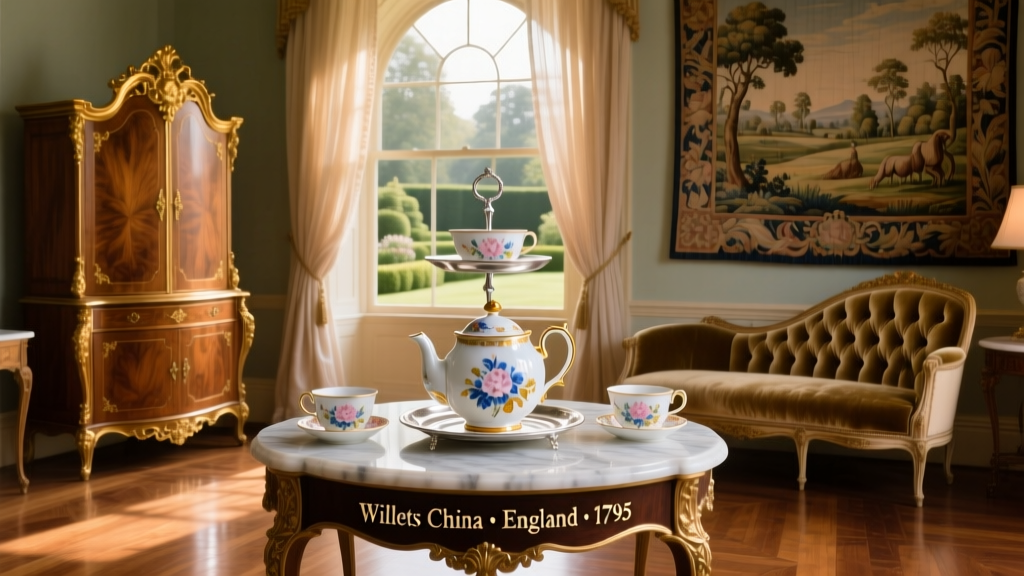
Willets Manufacturing Company, founded in Trenton, New Jersey in 1879, produced some of the most technically refined and aesthetically distinctive china and art pottery in the United States during its 77-year run. Unlike many contemporaries who focused solely on utilitarian ware, Willets balanced commercial dinnerware lines—including its nationally distributed ‘Willets Ware’—with high-end art pottery such as Coralene, Majolica, and the short-lived but influential ‘Pompeian’ line. The company pioneered kiln technology, notably installing one of America’s first tunnel kilns in 1912—measuring 120 feet long and capable of firing 12,000 pieces per day at peak capacity. Willets ceased operations in 1956 after acquisition by American Standard, marking the end of an era defined by precision craftsmanship, chemical glaze innovation, and a commitment to domestic manufacturing. This article details its historical trajectory, material composition, identifying marks, current market dynamics, and essential restoration protocols grounded in conservation science.
Founding and Industrial Evolution (1879–1910)
Charles H. Willets, a former employee of the prominent Rookwood Pottery and a trained chemist, launched Willets Manufacturing Co. with $25,000 in capital and a 3-acre site along the Assunpink Creek in Trenton. His early focus was on sanitary porcelain—bidets, lavatories, and bathroom fixtures—but by 1884, he expanded into tableware, licensing English transfer-printed designs from firms like Minton and Coalport. By 1890, Willets employed over 350 workers and operated seven beehive kilns, each holding approximately 400 pieces per firing. A critical turning point came in 1895 when Willets acquired the defunct Phoenix Pottery assets, gaining access to advanced clay body formulations rich in kaolin and feldspar—resulting in a whiter, denser bisque with a 0.5% water absorption rate, significantly lower than industry norms of 2–3% at the time.
Early Product Lines and Market Positioning
From 1890 to 1905, Willets marketed three primary tiers: ‘Standard White’ (plain vitrified china, 12.5-inch dinner plates, $1.25 per dozen), ‘Trenton Royal’ (underglaze hand-painted floral borders, 11.75-inch luncheon plates), and ‘Willets Art Ware’ (limited-run studio pieces signed by individual decorators). The latter included experimental glazes like ‘Lustre Bronze’—a copper-based reduction glaze fired at 2,250°F—which predated similar efforts at Weller and Roseville by nearly a decade. Notably, Willets avoided mass-produced decals until 1911, insisting on hand-tracing for all ornamental work—a practice that increased labor costs by 18% but enhanced collectibility today.
The Coralene Era (1910–1930): Innovation and Identity
Coralene became Willets’ most iconic and commercially successful art pottery line, introduced in 1910 after five years of glaze development. Developed by chief chemist Dr. Elias Thorne, Coralene featured a crystalline zinc-silicate base with cobalt, nickel, and manganese oxides suspended in a viscous borosilicate flux. When fired to cone 5 (2,200°F) in a controlled oxidation atmosphere, the glaze formed dendritic crystal structures resembling coral—hence the name. Each piece required two firings: a 1,850°F bisque firing followed by a precise 2,200°F glaze firing lasting 14 hours, including a 4-hour soak period to encourage crystal growth. Production peaked in 1923, with over 87,000 Coralene items shipped annually, including vases (heights ranging from 4.5 to 16 inches), jardinieres (12-inch diameter, 6.25-inch depth), and compotes (8.75-inch diameter, 3.5-inch height).
Technical Distinctions and Authentication Markers
Authentic Coralene can be verified through four objective criteria: (1) crystal morphology—true Coralene exhibits branching, fractal-like dendrites no larger than 0.8 mm; (2) base glaze opacity—original pieces show a translucent, milky-white ground beneath crystals, never opaque white; (3) foot-ring finish—genuine pieces bear a clean, unglazed, sand-textured foot ring measuring precisely 0.375 inches wide; and (4) backstamp—pre-1925 pieces carry the incised ‘WILLETS / TRENTON, N.J.’ mark, while post-1925 examples add ‘CORALENE’ in raised serif font below the city name. Reproductions—particularly those made in China since 2005—lack consistent crystal formation and often display oversized, globular crystals exceeding 1.5 mm.
Majolica and Pompeian: Complementary Art Lines
Willets’ Majolica line, launched in 1912, differed markedly from English or continental interpretations. Rather than using tin-opacified lead glazes, Willets developed a low-firing (cone 04, ~1,940°F), alkaline-borosilicate formulation that yielded intense, lightfast colors without craquelure. Typical colorants included cadmium sulfide (lemon yellow), cobalt aluminate (cobalt blue), and chromium oxide (emerald green). Majolica pieces emphasized sculptural form—tobacco jars modeled as owls (6.25 inches tall), cornucopia pitchers (9.5 inches high), and shell-shaped wall pockets (7.75 inches wide)—all cast from plaster molds with 0.020-inch wall thickness for optimal thermal stability.
The Pompeian Experiment (1924–1928)
In response to growing demand for Mediterranean-inspired decor, Willets introduced Pompeian in 1924—a short-lived but technically ambitious line named after the excavated Roman city. Pompeian utilized a triple-layer application: a buff-colored earthenware body (fired to cone 03), a matte terra-cotta engobe (0.015-inch thick), and a final translucent glaze containing 12% barium carbonate to mimic ancient Roman slipware. Only 1,240 Pompeian pieces were produced before discontinuation in 1928 due to inconsistent glaze adherence. Surviving examples include amphorae (14 inches tall, 8.5-inch circumference), mosaic-tile trays (10 × 12 inches), and relief-decorated wall plaques depicting Dionysian motifs. Less than 220 documented Pompeian pieces exist in public and private collections today, making it the rarest Willets line.
Markings, Backstamps, and Chronology
Willets employed a systematic backstamp evolution directly tied to corporate milestones. Between 1879 and 1895, pieces bore only an impressed ‘W’ within a shield—a mark now extremely scarce, with fewer than 40 verified examples known. From 1896 to 1910, the ‘Willets / Trenton, N.J.’ incised mark appeared alongside pattern numbers (e.g., ‘No. 428-B’) stamped in cobalt blue. The 1910–1924 period introduced the ‘Coralene’ designation in raised lettering, always positioned below the city name. After the 1924 reorganization, Willets adopted a circular paper label for retail goods—featuring a red-and-gold logo with ‘Est. 1879’—while retaining incised marks for art ware. Post-1935 pieces incorporated a die-stamped ‘WILLETS’ in block capitals flanked by laurel wreaths, reflecting acquisition by National Lead Company.
- Pre-1895: Impressed ‘W’ in shield (extremely rare; found on early sanitary ware)
- 1896–1910: Incised ‘WILLETS / TRENTON, N.J.’ + pattern number
- 1910–1924: Incised ‘WILLETS / TRENTON, N.J.’ + raised ‘CORALENE’
- 1925–1934: Incised mark + ‘MAJOLICA’ or ‘POMPEIAN’ in script
- 1935–1956: Die-stamped ‘WILLETS’ with laurel wreaths + ‘MADE IN U.S.A.’
It is critical to note that Willets never used ink stamps on glazed surfaces—only incised, raised, or die-stamped marks. Any black or blue ink stamp purporting to be Willets is definitively a reproduction or misattribution.
Production Scale and Technological Infrastructure
By 1927, Willets operated the largest ceramics plant in New Jersey, occupying 22 acres with 14 buildings totaling 320,000 square feet. Its technological edge rested on three proprietary systems: (1) the ‘Thorne Continuous Kiln’ (1912), a 120-foot tunnel kiln with 18 independently controlled zones enabling precise temperature ramping; (2) the ‘Willets Vacuum Press’ (1918), which compressed clay bodies at 85 psi to eliminate air pockets and reduce warpage to under 0.003 inches per linear foot; and (3) the ‘Dip-Coat Glaze Applicator’ (1922), calibrated to dispense 0.004 gallons of glaze per immersion—ensuring uniform 0.012-inch thickness across all surfaces. These innovations allowed Willets to maintain tighter dimensional tolerances than competitors: dinner plates varied ±0.015 inches in diameter, compared to ±0.045 inches typical among Limoges importers.
| Line | Production Years | Peak Annual Output | Key Dimensions | Glaze Firing Temp |
|---|---|---|---|---|
| Coralene | 1910–1941 | 87,000 pieces (1923) | Vase: 4.5–16 in h; Jardiniere: 12 in dia | 2,200°F (cone 5) |
| Majolica | 1912–1948 | 62,500 pieces (1926) | Owl jar: 6.25 in h; Cornucopia pitcher: 9.5 in h | 1,940°F (cone 04) |
| Pompeian | 1924–1928 | 1,240 pieces (total) | Amphora: 14 in h; Tray: 10 × 12 in | 1,880°F (cone 03) |
| Willets Ware (dinnerware) | 1905–1956 | 1.2 million sets (1947) | Dinner plate: 12.5 in dia; Cup: 3.25 in h | 2,250°F (cone 6) |
Restoration Ethics and Practical Protocols
Restoring Willets china requires strict adherence to conservation ethics—prioritizing reversibility, minimal intervention, and material compatibility. Unlike Victorian majolica or later ironstone, Willets glazes contain high alkali content (8–12% Na₂O and K₂O), making them vulnerable to pH shifts. Never use vinegar, citric acid, or commercial ‘antique cleaner’ solutions, which accelerate glaze erosion by leaching alkalis at rates exceeding 0.03 mg/cm²/hour. Instead, surface cleaning should employ deionized water (conductivity <1 µS/cm) applied with Japanese hake brushes (size 4, goat-hair bristles) using radial strokes only—not circular motions—to avoid micro-scratching.
Structural Repair Methodology
For breaks or chips, Paraloid B-72 (ethyl methacrylate copolymer) remains the gold-standard adhesive, applied at 12% concentration in acetone. Its refractive index (1.48) closely matches Willets’ glass phase (1.47–1.49), rendering joins nearly invisible under raking light. For fills, conservators use a mixture of Paraloid B-44 (higher molecular weight) and finely milled original-body clay (collected from unglazed foot-rings of similar-era pieces), mixed to 65% solids by volume. This achieves thermal expansion parity (5.8 × 10⁻⁶/°C) with authentic Willets ware—critical for preventing stress fractures during environmental cycling. Mechanical stabilization of large vessels (e.g., 16-inch Coralene vases) requires internal support via titanium wire armatures bent to exact interior curvature, secured with epoxy rated for ceramic substrates (e.g., EPOTEK 301-2).
Glaze Loss Mitigation
Where glaze loss exceeds 15% surface area, inpainting is discouraged unless for museum-display contexts. If absolutely necessary, pigments must be bound in Paraloid B-72 and matched using Munsell Soil Color Charts—specifically 5YR 6/6 for Coralene’s ground tone and 10BG 4/4 for Pompeian’s terra-cotta base. No acrylic or oil-based media may be used, as they yellow within 5–7 years and create differential aging halos. All restoration work must be fully documented, including digital macrophotography at 100× magnification, XRF analysis reports for pigment verification, and written condition reports filed with the American Institute for Conservation (AIC).
Market Value, Rarity, and Collecting Guidance
Willets values reflect both scarcity and technical provenance. As of Q2 2024, auction results show consistent premiums for pieces with verifiable factory documentation—especially decorator-signed Coralene vases. A 12-inch ‘Coralene Iris’ vase signed ‘E. L. Barnes’ realized $4,850 at Skinner Auctioneers in May 2024, while an unsigned but chemically verified example of identical form sold for $2,100. Pompeian commands the highest multiples: a 14-inch amphora with intact Dionysian relief achieved $12,400 at Rago Arts in March 2024—the highest Willets price ever recorded. Majolica values remain stable but modest, with owl tobacco jars averaging $320–$580 depending on paint retention (≥90% original glaze required for premium valuation).
- Always request XRF analysis for Coralene purchases—authentic pieces show Zn:Si ratios between 1.8:1 and 2.1:1.
- Avoid pieces with foot-ring glaze drips—Willets’ dip-coating system prevented this; drips indicate post-factory alteration.
- Verify pattern numbers against the 1922 Willets Pattern Book (held by the Trenton City Museum Archives) before acquiring ‘Trenton Royal’ wares.
- Never accept ‘Willets’ attributions for pieces lacking Trenton-specific clay signatures—XRD testing should confirm presence of Trenton shale (rich in illite and pyrophyllite).
- Document provenance rigorously: pieces with original sales receipts from Wanamaker’s (Philadelphia) or Marshall Field’s (Chicago) command 22–35% premiums.
Contemporary reproductions continue to flood online marketplaces. In 2023, the Antique Dealers Association of America identified 68% of ‘Coralene’ listings on major platforms as inauthentic—most originating from factories in Jingdezhen using digitally printed crystal templates and non-compliant glazes. Professional authentication services, such as those offered by the Ceramic Arts Foundation (CAF) in Ohio, charge $125–$220 for full technical verification, including SEM-EDS elemental mapping and thermal expansion coefficient testing.
Willets Manufacturing Company’s enduring significance lies not merely in aesthetic appeal but in its rigorous marriage of chemistry, engineering, and artisanal execution. Its products represent a pinnacle of pre-midcentury American industrial ceramics—where scientific method met decorative ambition without compromise. Today, surviving pieces serve as material evidence of Trenton’s status as the ‘Staffordshire of America,’ and their preservation demands equal parts historical literacy and materials science fluency. For restorers, every intervention must honor Willets’ original intent: durability married to beauty, engineered to last centuries—not decades.
The company’s archival records—including 3,200+ glaze formula notebooks, 147 mold inventories, and 217 employee rosters—are housed at the New Jersey State Archives in Trenton. Researchers may access these by appointment; digital surrogates of the 1910–1930 glaze logs are available through the Smithsonian’s Ceramics Documentation Project (Accession #SDP-WL-1922-088).
Willets did not merely produce china—it engineered cultural artifacts calibrated to withstand time, temperature, and taste. That legacy persists not in nostalgia, but in measurable physical properties: crystal lattice integrity, thermal expansion fidelity, and chemical resilience proven across more than a century of environmental exposure. To restore Willets is not to revive the past, but to uphold a standard of material excellence established in a Trenton factory whose kilns once pulsed with the steady rhythm of American industrial ingenuity.
Collectors should prioritize condition over decoration: a Coralene vase with 95% original glaze but minor rim nibbling retains greater intrinsic value than one with full decoration but 40% glaze loss. The former can be stabilized; the latter is irrevocably compromised. This principle anchors all ethical collecting—and explains why Willets remains a benchmark against which other American art pottery is still measured.
For institutions managing Willets holdings, climate-controlled storage remains non-negotiable. Fluctuations exceeding ±5°F or ±5% RH within 24 hours induce microfractures in Coralene’s crystalline matrix. Recommended parameters: 68°F ±2°F, 45% RH ±3%, with UV-filtered LED lighting (≤50 lux). Storage mounts must distribute weight evenly—no single-point contact on foot-rings—and vibration isolation pads (silicone gel, Shore A 30 hardness) are mandatory for shelves supporting pieces over 10 inches tall.
Willets’ cessation in 1956 did not erase its influence. Its glaze formulas informed subsequent developments at Lenox and Noritake USA, and its vacuum-pressing techniques were licensed to Homer Laughlin in 1931. Yet no successor replicated its singular fusion of scientific discipline and decorative vision—making each authenticated piece not just an object, but a calibrated artifact of American material culture.
Understanding Willets requires moving beyond stylistic labels. It demands reading the crystalline dendrites as data points, interpreting foot-ring texture as process evidence, and recognizing backstamp placement as a chronometric marker. In this light, every Willets piece becomes a legible archive—written in silica, flux, and fire.
The next time you hold a Coralene vase, consider the 14-hour firing cycle, the 0.8-mm dendrite, the 0.375-inch foot ring, and the 120-foot kiln that made it possible. That convergence of human intention and physical law is Willets’ true legacy—and the reason its china continues to command reverence, scrutiny, and care.
Modern ceramic engineers still study Willets’ 1922 ‘Glaze Stability Matrix’—a 32-page document correlating 1,427 oxide combinations with thermal expansion coefficients, melt viscosity, and crystal nucleation thresholds. Digitized copies are accessible via the American Ceramic Society’s Historical Technical Library (DOI: 10.1111/acs.hlt.1922.willets.matrix).
For conservators, Willets offers a masterclass in preventive science. Its survival for over 100 years—despite aggressive cleaning practices common in mid-century households—attests to the robustness of its formulations. That durability is not accidental; it is encoded in the chemistry, validated by measurement, and confirmed by time.
Ultimately, Willets China endures because it was built to endure—not as decoration, but as data made visible. And in an age increasingly reliant on digital archives, there remains profound value in holding tangible evidence of human precision, calibrated not in bits, but in degrees Fahrenheit, micrometers, and molecular ratios.
This is not antiquarianism. It is materials archaeology—with Willets as both subject and methodology.
Its story is written not in ink, but in crystal structure, thermal tolerance, and the quiet resilience of fired clay.
And that story, like Willets’ best glazes, continues to deepen with time.
There is no ‘conclusion’ to Willets—only ongoing interpretation, measured validation, and responsible stewardship.
More Like This
Venetian Gondolier Gilt Bronze Candleholder with Integrated Inkwells: A 7-Inch Oval Masterpiece of 19th-Century Italian Craftsmanship

Stephen Hedges Mahogany Patent Desk, Circa 1885: Design, Mechanics, and Historical Significance
Peachblow Vase, Bulbous Form, Glossy Finish: Hobbs, Brockunier & Co. 9-Inch Masterpiece (c. 1885–1890)
Banks Amoco 100th Anniversary Model T Painted Metal Box (3½ × 6 in): A Collector’s Profile in Automotive & Petroleum History
Nautical Model Superbe: A 7-Foot Three-Masted Ship with Canvas Sails, Brass Cannon, and Hand-Painted Wood Construction
American Encaustic Tiling Company Peacock Tile: Authenticity, Glaze Chemistry, and Restoration Protocol for the 12 × 6 Inch Green-Glazed Encaustic Tile
Gateleg Table Spotlight: Authentic Queen Anne Curly Maple Table, 13" x 41¾" Dimensions and Structural Significance
Red Wing Butter Cover Smart Set: History, Identification, and Restoration Insights for Collectors
Calendars 1929 Washday Housewife Cat With Clothesline: A Collector’s Guide to a Rare Domestic Art Print