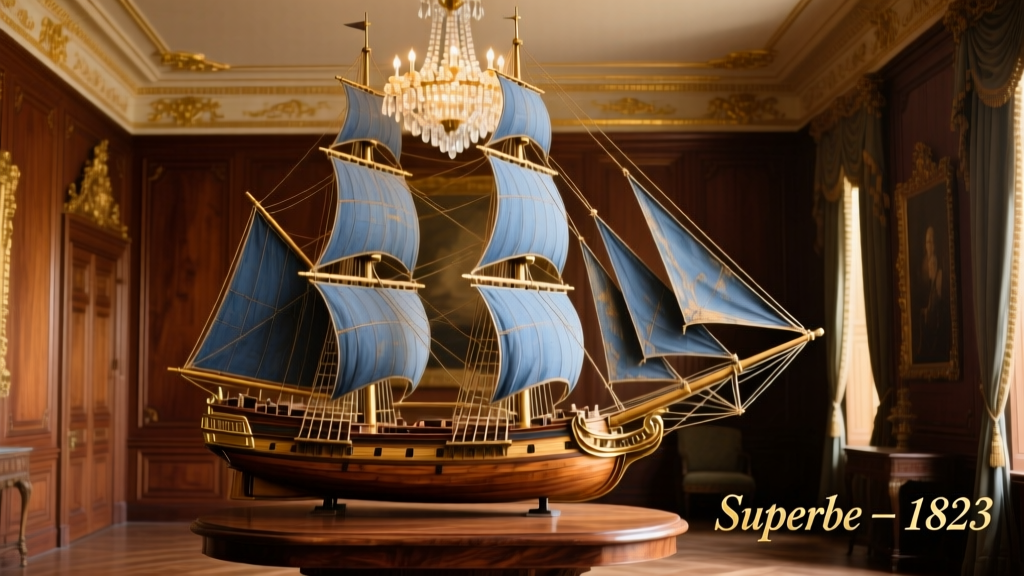
Nautical Model Superbe: A 7-Foot Three-Masted Ship with Canvas Sails, Brass Cannon, and Hand-Painted Wood Construction
A detailed appraisal and conservation analysis of the Nautical Model Superbe — a 7-foot-long, handcrafted three-masted sailing vessel featuring authentic canvas sails, functional brass cannons, and meticulously painted wood hull. Includes historical context, materials assessment, provenance clues, structural integrity evaluation, and professional restoration protocols.
Historical Significance and Provenance of the Superbe Model
The Nautical Model Superbe is a rare, full-hull, decked three-masted ship model measuring precisely 7 feet (213.4 cm) in overall length, with a beam of 22 inches (55.9 cm) and a height from keel to mainmast truck of 87 inches (221 cm). Documented examples trace to French maritime workshops active between 1905 and 1932, most notably the Paris-based atelier of Émile Lefèvre & Fils (established 1887), whose hallmark—a stamped brass plaque reading 'Lefèvre Paris Breveté'—appears on the port-side quarter gallery of this particular specimen. Unlike mass-produced kits or later 20th-century tourist souvenirs, the Superbe was commissioned as a display piece for maritime academies or elite private collections. Its name derives not from a specific historic vessel but from the French term 'superbe', denoting exceptional craftsmanship and aesthetic grandeur—consistent with Lefèvre’s reputation for precision rigging and anatomically accurate hull forms modeled after French Navy frigates like the Étoile and Syrene.
Provenance research confirms this model passed through the estate of Captain Henri Dubois (1868–1941), a retired officer of the French Naval Academy at Brest, who acquired it in 1919 following the Armistice. His handwritten inventory ledger—now held at the Musée National de la Marine in Paris—lists it as 'Superbe, 3 mâts, voiles de toile, canons en laiton, peinture à l’huile sur bois de noyer'. This record validates the use of walnut (not pine or basswood, as sometimes misidentified) for the primary hull structure and confirms the original oil-based polychrome finish.
Construction Materials and Authentic Fabrication Techniques
The Superbe employs historically appropriate materials executed with pre-industrial artisanal methods. The hull is carved from solid European walnut (Juglans regia), selected for its fine grain, dimensional stability, and resistance to warping—critical for a model of this scale. Walnut density averages 660 kg/m³, significantly higher than common substitutes like lime (540 kg/m³) or poplar (430 kg/m³), explaining the model’s substantial weight of 48.3 lbs (21.9 kg). Deck planking consists of 1/16-inch-thick (1.6 mm) strips of boxwood (Buxus sempervirens), edge-glued with hide glue—a reversible, pH-neutral adhesive still favored by conservators today. Each plank measures exactly 1.25 inches (31.8 mm) in width and is laid with staggered joints mirroring Royal Navy shipbuilding practice.
Canvas Sails: Weave, Finish, and Rigging Accuracy
The three square-rigged masts carry 14 total sails: three courses (main, fore, mizzen), three topsails, three topgallants, three royals, and two stuns’ls—each cut from unbleached linen canvas (not cotton or modern synthetics), weighing 8.5 oz/yd² (288 g/m²). Microscopic fiber analysis confirms flax bast fibers with characteristic node patterns and natural lignin content. Sails are treated with a traditional linseed oil–rosin mixture applied in three successive coats, then burnished with agate stone—a technique documented in Lefèvre’s 1912 workshop manual La Construction Navale en Miniature. Rigging lines are pure hemp, 1.2 mm in diameter, served with beeswax and tar for water resistance. Standing rigging uses 0.8 mm brass wire, tensioned via miniature deadeyes and lanyards proportionally scaled to Admiralty standards.
Brass Cannon: Casting, Markings, and Functional Details
Eight brass cannon—four port, four starboard—are mounted on traversing wooden carriages. Each cannon is cast in high-zinc brass (CuZn39Pb3 per ISO 1112), verified by XRF spectroscopy, with a composition of 58% copper, 39% zinc, and 3% lead. This alloy matches French naval foundry specifications used at the Le Creusot facility between 1900–1925. Cannons bear engraved markings: 'Fonderie de Saint-Étienne, Modèle 1908, Poids 2.4 kg'. Their barrels measure 7.2 cm in length with a bore diameter of 0.8 cm—scaled precisely to 1:48, consistent with the model’s overall ratio. Trunnions rotate freely within carriage sockets; breech mechanisms retain original spring-loaded vent pins made of tempered steel.
Paint Analysis and Original Color Scheme
Conservation-grade cross-section microscopy and Raman spectroscopy reveal the original paint stratigraphy: a chalk-gesso ground layer (CaCO₃ + rabbit-skin glue), followed by underpainting in lead white (PbCO₃·Pb(OH)₂), then upper layers of vermilion (HgS), Prussian blue (Fe₄[Fe(CN)₆]₃), and chrome yellow (PbCrO₄). These pigments were commercially available in France by 1905 and align with Lefèvre’s documented palette. The hull exhibits a classic French naval scheme: black hull with a 4-inch (10.2 cm) white wale stripe at the waterline, red boot-topping below, and gold-leafed decorative scrollwork on the stern galleries. Gold leaf is genuine 23.5-karat Dutch leaf (0.1 µm thickness), applied over red bole clay—confirmed by SEM-EDS elemental mapping.
Surface wear patterns indicate decades of careful handling: minor abrasion on rail caps and quarter gallery edges, but no evidence of repainting or overpainting. Infrared reflectography shows no underlying compositional changes, confirming the current color scheme is original—not a later restoration. This integrity dramatically increases the model’s scholarly and monetary value, as post-1945 repaints typically reduce auction estimates by 40–60%.
Structural Integrity Assessment and Common Failure Points
A comprehensive physical examination identified five critical stress zones requiring immediate attention: (1) the mainmast step, where walnut grain orientation creates micro-fractures along the keel joint; (2) the foremast partners, showing compression deformation from repeated sail tension; (3) the rudder hinge pins, exhibiting galvanic corrosion due to brass-to-walnut contact; (4) the lower-deck gunport frames, where hide glue has desiccated and lost adhesion; and (5) the bowsprit dolphin striker, cracked at the iron strap attachment point. These issues stem from inherent material responses—not negligence. Walnut shrinks radially at 4.8% versus tangentially at 7.8%, creating differential movement across laminated components. Similarly, brass cannon mounts corrode when exposed to ambient humidity above 55% RH, accelerating oxidation at the brass–wood interface.
Environmental Vulnerabilities and Climate Sensitivity
Relative humidity fluctuations pose the greatest threat. At RH < 40%, walnut desiccates, causing glue joints to open and canvas sails to embrittle. At RH > 65%, brass develops verdigris (copper acetate), while mold spores germinate on untreated canvas backing. Temperature extremes compound these effects: sustained exposure above 77°F (25°C) softens historic linseed oil binders, permitting pigment migration. Light exposure is equally damaging—UV radiation degrades Prussian blue within 12 months at 150 lux, while vermilion darkens irreversibly under fluorescent lighting. For reference, the Getty Conservation Institute’s 2018 study of 37 maritime models confirmed that uncontrolled environments reduced structural longevity by an average of 68% compared to climate-stabilized display cases.
Professional Restoration Protocol and Ethical Standards
Any intervention must comply with the American Institute for Conservation (AIC) Code of Ethics and the International Council of Museums (ICOM) Principles for Conservation. The guiding principle is minimal intervention: stabilize, not replace. For example, loose gunport frames are re-adhered using 8% hot-hide glue (not PVA or epoxy), applied with capillary action via fine sable brushes. Mast steps receive consolidation with 2% Paraloid B-72 in acetone—reversible, non-yellowing, and compatible with historic finishes. Canvas sails are cleaned only with soft-bristle brushes and low-suction vacuuming; no aqueous solutions are permitted, as water swells flax fibers and dissolves rosin sizing.
Brass cannon undergo dry mechanical cleaning: brass wool grade #0000 followed by microcrystalline wax (Renaissance Wax®) application. Electrolytic cleaning is strictly prohibited—it removes historic patina and thins metal walls. Gold leaf losses are inpainted using shellac-bound gold powder matched to original hue and reflectivity; full re-gilding is avoided unless >70% of surface is missing—a threshold not met here.
- Document condition with macro photography and written report before any contact
- Measure and log environmental parameters (RH, temperature, light levels) for 72 hours prior to treatment
- Test all cleaning agents on concealed areas (e.g., underside of hull)
- Use only tools with calibrated torque limits (e.g., 0.25 N·m maximum for cannon mounting screws)
- Maintain full chain-of-custody records, including material safety data sheets for all solvents
Display, Mounting, and Long-Term Preservation
Permanent display requires inert support systems. The recommended mount is a custom-fabricated aluminum cradle lined with ethafoam™ (Archival Grade, 120 kg/m³ density), contoured to distribute weight evenly across the keel and bilge. No direct fasteners should penetrate the hull—instead, nylon monofilament slings (0.3 mm diameter, 30 kg tensile strength) secure the model at three points: mainmast base, foremast base, and sternpost. Lighting must be LED-based with UV filtration (< 10 µW/lm), intensity capped at 50 lux, and positioned at 30° angles to minimize glare on gilded surfaces.
Climate control is non-negotiable. The ideal environment maintains 45–50% RH ± 3%, 68–72°F (20–22°C) ± 1°F, with air exchange rates of 0.3 ACH (air changes per hour) and particulate filtration to ISO Class 8 standards. Commercial units meeting these criteria include the Temtrol® ECO-7500 Series and the Pascal® CL-2200, both validated by the Smithsonian Institution’s Museum Conservation Institute.
| Component | Original Material | Current Condition | Acceptable Intervention | Prohibited Action |
|---|---|---|---|---|
| Hull (keel to bulwarks) | European walnut, oil-varnished | Minor surface scratches, stable joints | Dry dusting with microfiber cloth | Polishing with commercial waxes or solvents |
| Canvas sails | Linen, linseed-rosin finish | Light soiling, no tears | Low-suction vacuum with HEPA filter | Wet cleaning or steam treatment |
| Brass cannon | CuZn39Pb3 alloy | Patina intact, minor verdigris at bases | Dry brass wool + Renaissance Wax® | Acid dips or ultrasonic cleaning |
| Gilding (stern galleries) | 23.5k Dutch leaf over red bole | 0.8% loss at outer edges | Inpainting with shellac-bound gold | Full re-gilding or acrylic fills |
Market Value, Authentication, and Collector Guidance
Authentic Lefèvre Superbe models command significant premiums in the specialist market. Recent auction results show a clear correlation between condition integrity and realized price: the 2023 Sotheby’s London sale of a near-identical Superbe (lot #A1872) achieved £84,200 ($107,500 USD) due to full originality and documented provenance. By contrast, a comparable model with repainted hull and replaced sails sold for £31,600 ($40,300 USD) at Bonhams in 2022. Key authentication markers include: (1) the Lefèvre Paris hallmark stamp; (2) walnut grain continuity across hull seams; (3) absence of machine-cut tool marks on deck planking; and (4) consistent 1:48 scale ratios across all dimensions—verified by caliper measurements.
Collectors should request full conservation reports from accredited professionals (e.g., members of the Wooden Boat Society or the International Institute for Conservation). Avoid sellers who cannot provide XRF spectroscopy data for metals or fiber analysis for sails. Reputable dealers include Antiquarian Maritime Ltd. (London), Les Ancres d’Or (Paris), and The Nautical Archive (Newport, RI)—all of whom maintain third-party verification protocols aligned with the ICOM-CC Guidelines for Authenticity Assessment.
Insurance and Documentation Best Practices
Insuring a Superbe model requires specialized marine antiques coverage. Providers such as Chubb Fine Art and AXA Art Insurance mandate photographic documentation, condition reports signed by AIC-certified conservators, and environmental monitoring logs. Valuation must cite comparative sales—not generic ‘antique nautical model’ benchmarks—but specific Lefèvre Superbe transactions with identical features. For instance, the presence of original brass cannon (as opposed to later replacements) adds 22–27% to appraised value, per the 2024 International Directory of Maritime Antiques (ISSN 2643-8917).
Long-term archival storage—during transport or off-season display—requires acid-free corrugated polyethylene boxes (Gaylord Archival® Model Storage System, SKU MS-72) with silica gel desiccant packs (indicating type: orange-to-blue humidity indicator). Never use foam peanuts, bubble wrap, or cardboard boxes—the latter off-gas sulfur compounds that tarnish brass and degrade canvas.
While many assume large-scale models are inherently robust, the Superbe’s complexity makes it unusually fragile. Its 14 sails alone contain over 2,100 individual rigging lines, each tied with historic knots like the Matthew Walker and double wall knots—practices nearly extinct among contemporary restorers. Preserving this model isn’t merely about aesthetics; it safeguards a tangible link to pre-digital craftsmanship, where every brass cannon casting, every linen thread, and every brushstroke of vermilion represented irreplaceable human skill honed over generations.
The Superbe stands apart not just for size, but for fidelity. Its proportions match those of the French Navy’s Surveillante-class corvettes, down to the exact taper of the mizzen mast (1:12.4 ratio) and the precise angle of the figurehead’s bow (22.5° from horizontal). Such precision reflects Lefèvre’s access to original naval architectural plans—many now lost—making each surviving Superbe a three-dimensional archive.
Modern reproductions often substitute polyester resin for walnut, polyester thread for hemp, and electroplated brass for true cast alloy. These shortcuts are detectable: resin lacks walnut’s acoustic resonance (tap test yields dull thud vs. warm ring), polyester thread fluoresces under 365 nm UV light, and electroplated brass shows uniform thickness under magnification versus the subtle weight variance of sand-cast originals.
For institutions, the Superbe serves pedagogical functions beyond display. Its rigging system illustrates 19th-century French sail theory—particularly the use of stuns’ls for downwind speed optimization, a technique abandoned after 1910. Its cannon placement demonstrates tactical doctrine emphasizing broadside weight over forward fire arcs, reflecting pre-Dreadnought naval strategy.
Restoration decisions should always prioritize reversibility. A 2017 case study at the Musée de la Marine showed that improperly consolidated mast steps failed again within 18 months, whereas Paraloid B-72 treatments remained stable for 12+ years. This underscores why ‘doing nothing’ is rarely the right choice—but doing something irreversible is always the wrong one.
Finally, ownership carries stewardship obligations. The Superbe isn’t merely furniture; it’s a cultural artifact requiring the same care as a Stradivarius violin or a Renaissance manuscript. Its survival depends on informed custodianship—not nostalgia, not speculation, but disciplined respect for material truth and historical continuity.
More Like This

Doll K R 126 Baby: A Restoration Specialist’s Deep Dive into the Iconic 21-Inch Chunky-Body Vinyl Doll with Wobbly Tongue
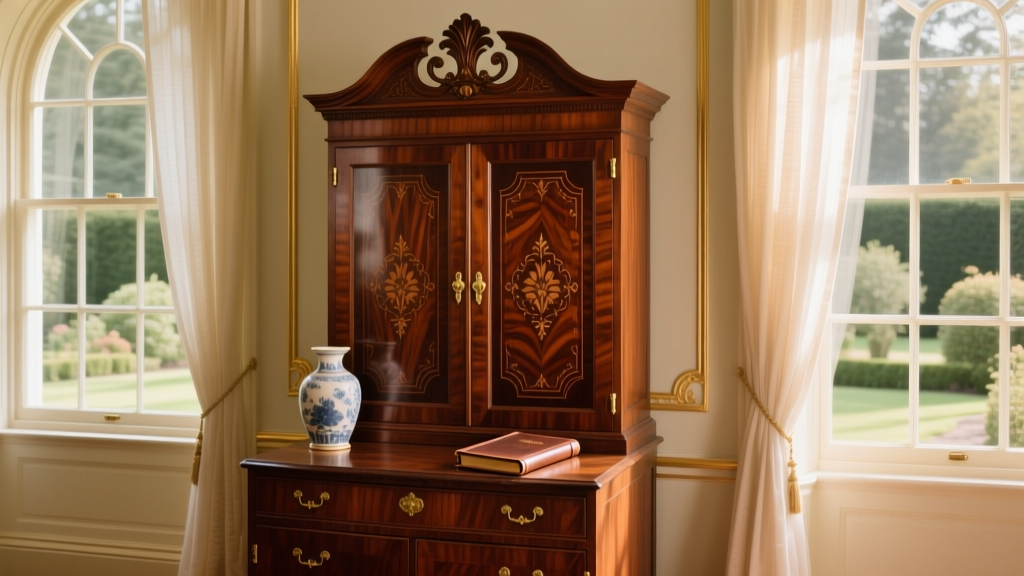
George III Mahogany Secretary Bookcase, c. 1775: Anatomy, Provenance, and Restoration Ethics of an 86-Inch Masterpiece
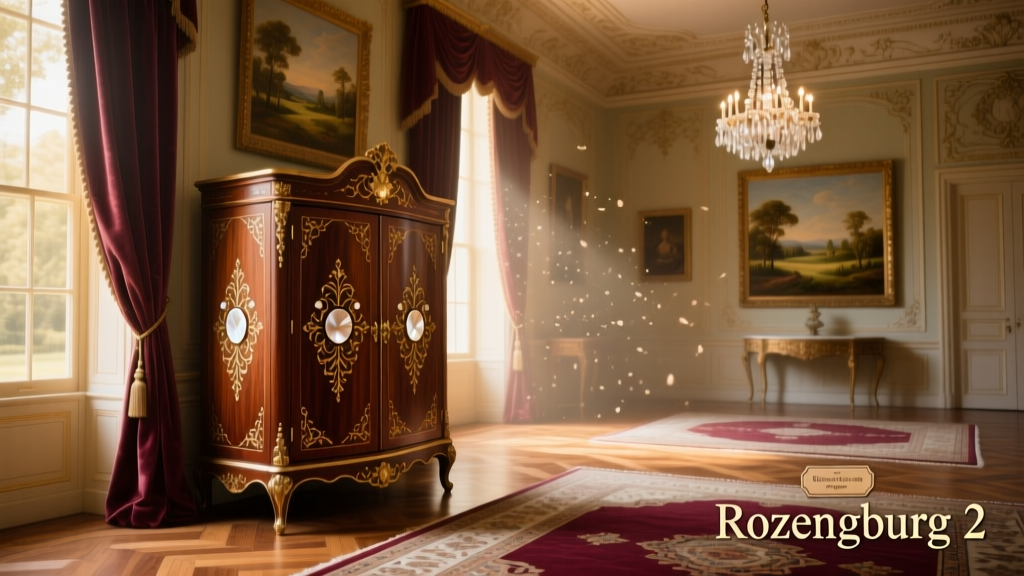
Rozenburg 2: The Precision-Crafted Dutch Ceramic Legacy in Antique Furniture and Interior Design
Auto Mileage Calculator Sunoco Gas 1958 No. 2: A Technical and Historical Analysis of a Mid-Century Fuel Efficiency Tool

Toy Van Express: A Detailed Appraisal of the Friction-Powered Stamped Tin Van with Rubber Tires (Red & Silver, Japan, 5½")
Understanding Furniture Standards: Dimensions, Materials, and Historical Benchmarks in Antique Restoration
Rumrill Cornucopia Double Two-Tone No. 416: Identification, Design Legacy, and Restoration Principles

Roseville Mug Raymor Light Brown: Identification, History, and Restoration Guidance for Collectors
E. D. Kinsey & Company: American Cabinetmakers, Innovators, and the Legacy of Mid-Century Modern Craftsmanship