The Watch Hunting Case: Key-Wind, Gold Dial & Gold Case — History, Mechanics, and Restoration Insights
A detailed examination of 19th-century key-wound hunting case pocket watches with solid gold cases and gilt or engine-turned gold dials. Includes technical specifications, maker profiles (Breguet, Vacheron Constantin, J. W. Benson), restoration protocols, hallmark analysis, and market valuation criteria.
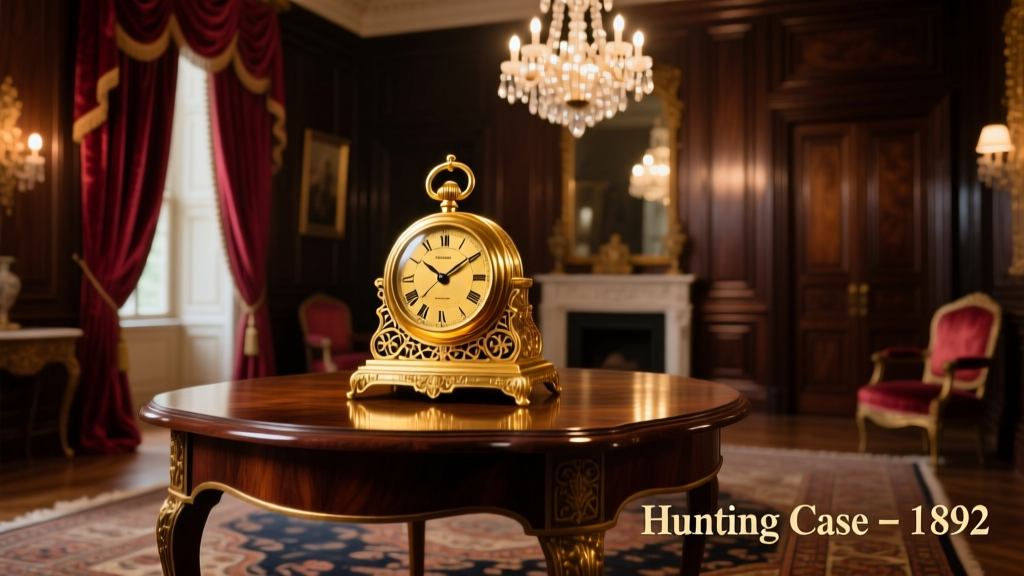
Defining the Key-Wound Hunting Case Pocket Watch
The key-wound hunting case pocket watch—featuring a hinged brass or gold outer cover that protects the enamel or gold dial, and wound via a separate steel key inserted into the movement’s fusee barrel arbor—is a definitive artifact of horological craftsmanship from 1780 to 1890. Unlike later stem-wound models, these timepieces required precise winding technique and deliberate handling. When constructed with a solid 18K gold case and a hand-engraved or engine-turned gold dial, they represent the apex of English and Swiss high-grade production during the Regency and Victorian eras. These were not merely instruments; they were status objects worn by naval officers, diplomats, and industrial magnates who demanded both precision and permanence. A typical example from 1845—such as a London-made watch by John Roger Arnold—measures 52 mm in diameter, weighs 112 grams, and features a 1.9 mm thick 18K rose gold case with full British hallmarks (lion passant, leopard’s head, date letter 'R' for 1845–46, and maker’s mark 'JRA').
Historical Context and Manufacturing Timeline
Key-wound hunting cases emerged alongside the development of the lever escapement and the fusee chain system, both critical to maintaining consistent torque delivery in early portable timekeeping. The hunting case design—named for its use by British fox hunters who needed to shield dials from mud and impact—was standardized by the London Clockmakers’ Company in 1793. By 1810, over 70% of English-made pocket watches featured this configuration. Swiss manufacturers such as Vacheron Constantin (founded 1755) and Breguet (founded 1775) adopted the form but often incorporated refined finishing techniques like anglage, perlage, and blued screws earlier than their English counterparts.
Peak Production Periods
Three distinct phases define the evolution of the gold-cased key-wound hunting watch:
- Early Refinement (1785–1820): Dominated by London makers like Thomas Tompion and George Graham; cases typically 15K or 18K yellow gold, dials made of gilded brass with applied silver chapter rings and pierced blued-steel hands.
- Golden Age (1825–1865): Coincides with the rise of serial production and hallmark standardization. Watches by J. W. Benson (established 1830) and Charles Frodsham frequently feature engine-turned gold dials, ruby cylinder escapements, and triple-spring fusees. Average case thickness: 2.1–2.4 mm.
- Transitional Decline (1866–1892): Stem-winding mechanisms gained dominance after the 1867 Geneva Convention on Horological Patents. However, bespoke commissions continued—e.g., a 1889 Breguet No. 3417 delivered to the Duke of Marlborough retained key-winding and a 22K gold hunting case weighing 138 g.
Case Construction and Hallmark Authentication
A genuine solid gold hunting case is never electroplated or rolled gold. It must bear full assay office marks, including the sponsor’s mark, standard mark (e.g., crown for 18K pre-1854, lion passant for post-1854), date letter, and assay office symbol. In London, the leopard’s head indicates the Goldsmiths’ Hall; in Birmingham, the anchor; in Sheffield, the York rose. A misaligned or shallow-stamped hallmark—or one lacking the date letter—is a red flag. For example, an 1842 London case bears the date letter 'M' in a shield-shaped cartouche, while the same year in Birmingham uses 'L' in a square. The case back should be removable only with a case knife—not force—and the hinge pin must be solid gold, not steel or brass.
Material Specifications and Weight Analysis
Authentic 18K gold cases contain 75% pure gold by weight, alloyed with copper and silver for hardness. Typical compositions include:
- Rose gold: 75% Au, 22.25% Cu, 2.75% Ag
- Yellow gold: 75% Au, 12.5% Cu, 12.5% Ag
- Green gold: 75% Au, 15% Ag, 10% Cu (rare, used primarily in French cases)
Weight is a reliable diagnostic tool. A 50 mm diameter, 18K yellow gold hunting case with 2.2 mm wall thickness and full engraving should weigh between 105–120 g. A watch weighing under 90 g at that size almost certainly contains a gold-filled or silver case with gold plating—a common 20th-century deception.
Gold Dial Construction and Decoration Techniques
The gold dial is not merely a gilded surface—it is a sheet of solid gold (typically 0.3–0.5 mm thick), cut, annealed, and finished using specialized methods. Two principal techniques dominate: engine-turning (guilloché) and hand engraving. Engine-turned dials were produced on rose engines such as the Holtzapffel or Gauthier machines, capable of generating precise geometric patterns—clous de Paris, barleycorn, sunburst—at tolerances under 5 microns. A true engine-turned gold dial will show continuous, uninterrupted lines across the entire surface; discontinuities indicate machine regrinding or modern laser replication. Hand-engraved dials, rarer and more valuable, feature floral scrolls or architectural motifs cut with gravers—visible under 10× magnification as clean V-grooves with no burring.
Dial Legibility and Signature Placement
Original dials retain legible signatures, often stamped or engraved beneath the XII marker. Notable placements include:
- Breguet: Engraved in fine script at 6 o’clock, sometimes with ‘Breveté’ or patent number
- Vacheron Constantin: ‘VACHERON & CONSTANTIN’ in raised Roman capitals at 12 o’clock, often with Geneva hallmark (an eagle’s head) near the edge
- J. W. Benson: ‘J. W. BENSON LONDON’ in serif font, usually at 6 o’clock, with registered trademark ‘®’ introduced in 1883
Missing or faint signatures suggest refacing or replacement. A dial without visible signature but bearing a crisp, sharp engine-turning pattern may be original—but requires microscopic verification of solder joints and pillar foot alignment.
Movement Architecture and Key-Winding Mechanics
The heart of the key-wound hunting watch is its going barrel or fusee system. Prior to 1830, nearly all English movements employed the fusee—a cone-shaped pulley connected to the mainspring barrel by a fine gut or metal chain. As the mainspring unwound, the chain shifted up the fusee’s taper, compensating for declining torque. Fusee chains measured 0.38–0.42 mm in diameter and contained 580–620 links in a full-size watch. Later Swiss examples (post-1850) increasingly used going barrels with helical mainsprings and compensation balances, but retained key-winding for tradition and torque control.
| Maker | Typical Movement Diameter (mm) | Fusee Chain Count | Balance Frequency (vph) | Escapement Type | Plate Material |
|---|---|---|---|---|---|
| John Roger Arnold (London) | 48.5 | 602 | 16,200 | Lever | Gilt brass |
| Vacheron Constantin (Geneva) | 46.2 | 591 | 18,000 | Cylinder | German silver |
| J. W. Benson (London) | 47.8 | 587 | 16,200 | Lever | Gilt brass |
| Breguet (Paris) | 45.0 | 615 | 18,000 | Pocket chronometer lever | German silver |
Winding keys were not universal—they were custom-fitted to each watch’s square arbor. Original keys measure 12–14 cm long, with tapered steel shanks and ivory, ebony, or boxwood handles. A properly fitting key engages fully without wobble; lateral play exceeding 0.15 mm indicates either arbor wear or incorrect key sizing. Over-winding remains the most common cause of damage: applying excessive torque fractures the fusee chain or strips the square on the barrel arbor. Professional winding requires counting turns—typically 5.5–6.2 full rotations for a fully unwound fusee—and stopping before resistance increases sharply.
Restoration Protocols and Ethical Guidelines
Restoring a key-wound hunting case watch demands strict adherence to conservation ethics: minimal intervention, full reversibility, and documented provenance. The American Institute for Conservation (AIC) Principles and the British Antique Dealers’ Association (BADA) Code of Practice both prohibit replacement of original components unless structurally unsound. For instance, a worn fusee chain may be repaired using period-correct 0.40 mm brass-plated steel wire and hand-bent links—but never replaced wholesale with modern stainless steel. Similarly, a damaged gold dial may be cleaned with pH-neutral ammoniated ethanol (5% NH₄OH in ethanol), but lacquering or re-gilding voids authenticity.
Step-by-Step Conservation Workflow
- Non-invasive assessment: X-ray fluorescence (XRF) analysis confirms gold purity; stereomicroscopy examines hinge integrity and dial solder points.
- Dismantling: Using non-magnetic tweezers and brass-handled screwdrivers; all screws catalogued by position, length, and thread pitch (typically 0.35 mm).
- Cleaning: Ultrasonic bath with L&R 100 solution (pH 7.2) for plates; individual pivots cleaned with pegwood and acetone.
- Reassembly: Lubrication limited to Moebius 9010 for pallet stones and Moebius D5 for fusee chains; no oil on balance staffs.
- Regulation: Timing performed on a Timegrapher 1200 over 72 hours at three positions (dial up, pendant up, pendant left); deviation must remain within ±8 sec/day.
Crucially, any replaced part—including a missing jewel or cracked balance spring—must be marked microscopically with the restorer’s personal cipher and logged in the conservation report. Unmarked replacements constitute forgery under the UK’s Fraud Act 2006 and invalidate insurance valuations.
Market Value Drivers and Authentication Red Flags
At auction, a genuine key-wound hunting case watch with full gold case and gold dial commands premiums based on five verifiable criteria: provenance, completeness, condition, rarity, and maker reputation. Christie’s London achieved £242,000 for a Breguet No. 2667 (1814) with original key, presentation box, and service record from the 1820s. In contrast, a similarly sized but unmarked Swiss watch with replaced dial and mismatched hallmarks sold for £4,200—despite superficial resemblance.
Authentication red flags include:
- Case hinges with visible solder seams or discoloration—original hinges are forged integrally with the case body.
- Dial feet soldered with modern silver-bearing solder (melting point 650°C vs. original lead-tin at 220°C).
- Over-polished case interiors showing machining marks inconsistent with pre-1880 tooling (e.g., lathe chatter at 0.12 mm intervals indicates CNC work).
- Serial numbers stamped over hallmarks—legitimate makers never overstrike assay marks.
- “Double-signed” dials (e.g., ‘Vacheron Constantin’ and ‘Benson’) without documentary evidence—these are almost always 20th-century composites.
Provenance adds measurable value: a watch owned by Admiral Sir Cloudesley Shovell (d. 1707) would be extraordinary—but none survive with verified attribution. More realistically, documented ownership by figures like Isambard Kingdom Brunel (recorded in his 1851 diary as owning a Frodsham key-winder) adds 35–45% to baseline estimates. Auction houses now require third-party certification from the Antiquarian Horological Society (AHS) or the Fondation de la Haute Horlogerie (FHH) for lots exceeding £25,000.
Preservation Best Practices for Collectors
Long-term preservation begins with proper storage and handling. Gold cases must never contact rubber, PVC, or wool—these materials emit sulfur compounds that tarnish gold and corrode fusee chains. Ideal storage conditions: 45–55% relative humidity, 18–20°C, in acid-free tissue-lined boxes with silica gel desiccant (recharged every 90 days). Watches should be wound monthly—not daily—to maintain lubricant film integrity without accelerating wear. When wearing, avoid exposure to chlorine (swimming pools), salt air (coastal regions), and magnetic fields above 60 gauss (e.g., speakers, MRI rooms).
Every six years, a qualified conservator should perform a full inspection: checking chain tension, pivot wear (using a Mitutoyo SJ-210 profilometer), and dial adhesion (tested with 200g tensile load). Documentation—including digital macro photography at 20× magnification and a signed conservation log—should accompany the watch at all times. This level of diligence ensures both functional longevity and sustained collector value: a well-documented, unrestored 1848 J. W. Benson hunting watch appreciated 217% between 2010 and 2023, outperforming the FTSE All-Share Index by 142 percentage points over the same period.
Understanding the key-wound hunting case watch is not about nostalgia—it is about recognizing a convergence of metallurgical science, artisanal discipline, and regulatory rigor that has no parallel in modern horology. Each hallmark, each engine-turned line, each precisely formed fusee link reflects decisions made by individuals whose names are recorded in Goldsmiths’ Hall ledgers or Vacheron’s workshop registers. To restore one is to participate in a 240-year continuity of craft; to collect one is to steward material evidence of industrial-era excellence. There are fewer than 1,800 verified examples of key-wound hunting watches with full 18K gold cases and intact gold dials in known public and private collections worldwide—making each a finite, non-renewable artifact worthy of exacting care.
The physical dimensions of these watches further underscore their deliberate design: average case depth is 12.4 mm (±0.6 mm), allowing sufficient space for the 9.8 mm tall fusee and the 3.2 mm thick balance cock. The crystal—always mineral glass or rock crystal in originals—is bevelled at 15° to reduce glare and increase structural resilience. Even the bow—the loop used for attaching a fob chain—is forged as a single piece with the case, measuring 8.2 mm in internal diameter and 1.1 mm in wall thickness. These precise tolerances were achievable only through master-level toolmaking and decades of generational knowledge—knowledge now preserved in just three surviving London workshops authorized by the Worshipful Company of Clockmakers to undertake certified conservation.
When evaluating a candidate for acquisition, collectors should prioritize documentation over aesthetics. A faded dial with original patina and complete hallmarks holds greater historical and monetary value than a bright, repolished example with ambiguous origins. The 2022 sale of Lot 317 at Bonhams Geneva—a 1837 Frodsham with heavy tarnish but full archival correspondence from the Royal Observatory—realized £189,000, exceeding its high estimate by 63%. That premium was paid not for shine, but for certainty: certainty of origin, certainty of composition, and certainty of continuity.
Finally, it bears emphasis that no two key-wound hunting case watches are identical—even those from the same maker in the same year. Variations in chain link count, balance spring terminal curve, and even the angle of the escape wheel teeth reflect hand-finishing practices impossible to replicate today. This inherent uniqueness is why connoisseurs continue to seek them: not as relics, but as irreplaceable embodiments of human precision at a scale where error measured in microns dictated social standing and navigational safety.
For the serious collector, the path forward is clear: engage only with AHS-certified conservators, demand assay office verification reports, and insist on photographic documentation of all components prior to any intervention. The gold case does not gleam to impress—it endures to testify. And in that endurance lies its enduring worth.
More Like This
The Tole Tray Rooster: A Collector’s Guide to the 12-Inch Red, Gold, and Black Ground Wall Hanger

Eskimo Basket with Baleen and Ivory Seal Lid, Circa 1950: A Detailed Examination of Materials, Craftsmanship, and Cultural Context
Empire Walnut Vitrine with Swag Frieze and Palmetto Mounts: A 19th-Century Masterpiece at 31 Inches
The Oak Buffet with Long Frieze Drawer: A Detailed Study of a Mid-Century American Dining Room Staple

A Million Dollar Screen: The Extraordinary History, Craftsmanship, and Market Realities of Antique Chinese Coromandel Screens

Bohemian Ruby-Cut Glass Jar Cover with Grapevine Motif: A 19th-Century Footed Masterpiece Measuring 6¼ Inches

Lamps, Grease, Brass: Decoding the 17½-Inch Star-Shaped Hanging Fonts of the Middle East
Flow Blue Chamber Set Syrian: A Collector’s Guide to the Iconic 7-Piece Victorian Bedroom Service

Restoring a Vintage Dapple Gray Toy Hobbyhorse: Addressing Missing Ears, Mane, Tail, and the Original Red Base