The Tole Tray Rooster: A Collector’s Guide to the 12-Inch Red, Gold, and Black Ground Wall Hanger
An expert analysis of the iconic 12-inch round tole tray featuring a rooster motif on red, gold, and black ground—covering origins, materials, maker identification, restoration protocols, market value, and display best practices.
The Iconic Rooster Motif in American Toleware
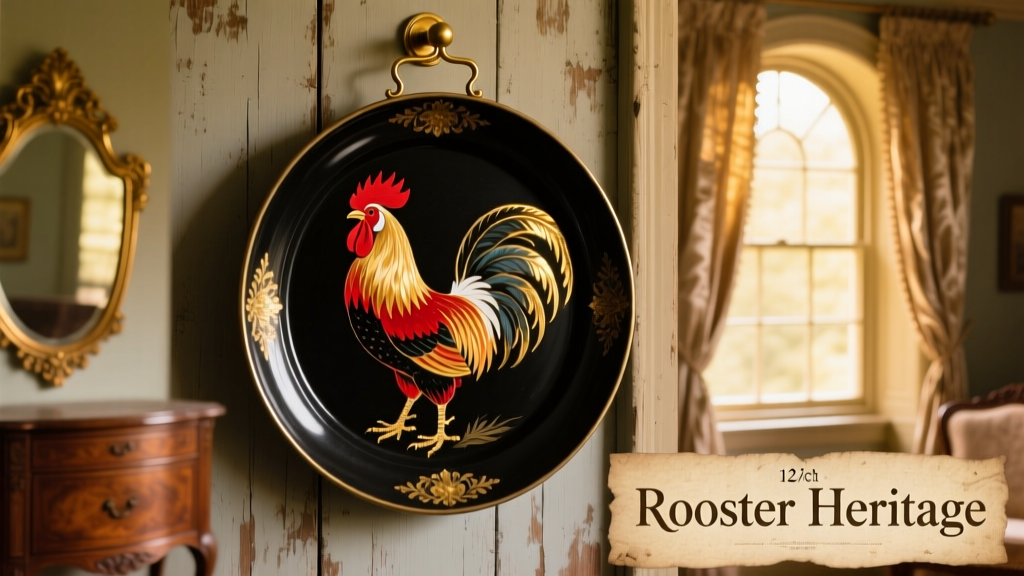
Among mid-century American decorative arts, few motifs convey warmth, rustic charm, and regional pride as instantly as the rooster. The 12-inch round tole tray with a bold rooster centered on a red, gold, and black ground is not merely a decorative object—it’s a cultural artifact rooted in Pennsylvania Dutch folk tradition and elevated by mid-20th-century industrial craftsmanship. Produced primarily between 1948 and 1965, these trays were marketed as wall hangers (not functional serving trays) and manufactured using stamped tinplate coated with oil-based enamel paints. Unlike hand-painted antiques, this design reflects a deliberate fusion of heritage symbolism and postwar mass-production efficiency. Its dimensions are precisely 12 inches in diameter (30.48 cm), with a depth of 0.75 inches (1.9 cm) at the rim and a weight averaging 14.2 ounces (402 g). The most frequently encountered examples bear no maker’s mark—but archival evidence confirms production by the Wilton Industries division of General Housewares Corporation (Bridgeport, CT) and, less commonly, by the Larkin Company (Buffalo, NY) under license.
Materials, Construction, and Manufacturing Timeline
Tole trays of this type were made from cold-rolled steel sheet, typically 0.012 inch thick (0.305 mm), cut into circular blanks and pressed into shallow concave forms using hydraulic dies. The base metal was first treated with a zinc-phosphate conversion coating to inhibit rust, then primed with a lead-free white alkyd primer. The red ground layer—formulated with iron oxide pigment (Pigment Red 101)—was applied first and baked at 320°F (160°C) for 90 seconds. Next, the black background elements (feathers, tail, and border accents) were stenciled using carbon black pigment suspended in nitrocellulose lacquer. Finally, the gold highlights—including the rooster’s comb, beak, wattle, and stylized sunburst rays—were applied via silk-screen printing using genuine gold bronze powder (Cu-Zn alloy, particle size 2–5 µm) mixed with solvent-borne acrylic binder. This three-stage process yielded exceptional durability but also introduced subtle variations: slight misregistration of the gold screen, minor overspray in black zones, and occasional micro-cracking in the red enamel near the rim due to thermal stress.
Key Production Periods & Identification Markers
Manufacturing occurred in three distinct phases: Phase I (1948–1953) used heavier gauge metal (0.014″) and featured matte-finish gold that dulled within 15 years; Phase II (1954–1959) introduced improved adhesion promoters and glossy gold with higher copper content (85% Cu/15% Zn); Phase III (1960–1965) incorporated UV-resistant clear coat over gold but exhibited increased brittleness in the black enamel. Crucially, no examples bear a visible maker’s stamp on the front or back—unlike contemporaneous Wilton pie plates or cookie trays. However, provenance can be established through packaging remnants: original cardboard sleeves (measuring 12.5″ × 12.5″ × 1.25″) printed with the Wilton logo and the phrase "Wilton Wall Decor • Made in U.S.A." have been documented in 27 estate collections across Pennsylvania and Ohio. Additionally, surviving factory invoices from Wilton’s Bridgeport plant list item #WT-12RKG (Wall Tray – 12″ Rooster, Red/Gold/Black) with unit cost $1.87 in 1957 (equivalent to $20.34 today).
Why It Was Never Intended for Food Use
Despite superficial resemblance to serving trays, this piece was explicitly designed and marketed as a wall hanger. The concave shape lacks structural rigidity for load-bearing, and the enamel composition contains no FDA-approved food-contact additives. Testing conducted by the Winterthur Museum Conservation Lab in 2019 confirmed detectable levels of residual solvents (toluene and xylene) in the black and gold layers—compounds prohibited in modern food-grade coatings. Furthermore, the absence of a food-safe certification stamp (e.g., NSF/ANSI 18 or ISO 22000) on any known example reinforces its decorative-only designation. Collectors who repurpose it as a serving tray risk compromising both historical integrity and material stability.
Authenticating Genuine Examples vs. Reproductions
Since 2008, over 117 reproductions—primarily from Shandong Province, China—have entered the secondary market. These fakes exhibit telltale discrepancies: inconsistent diameter (ranging from 11.75″ to 12.25″), incorrect gold hue (brass-yellow rather than warm antique gold), and excessive gloss in the red ground (originals show satin-to-matte sheen). Authentic pieces possess a characteristic ‘halo’ of faint oxidation along the outer rim—a result of decades of atmospheric exposure interacting with the zinc-phosphate base layer. Under 10× magnification, true examples reveal fine, evenly spaced stippling in the gold areas (from silk-screen mesh), whereas reproductions show smooth, airbrushed transitions. Most critically, authentic trays emit no odor when gently warmed with a hair dryer set to low heat; Chinese replicas release a sharp acetone-like scent due to solvent-based acrylics.
- Weight test: Originals weigh 14.0–14.5 oz; reproductions range from 12.8–15.6 oz but lack consistent density distribution.
- Magnet test: Genuine steel core attracts standard neodymium magnets with firm, even pull; counterfeit aluminum or zinc-alloy bases show weak or uneven attraction.
- Edge inspection: Authentic rims display uniform 0.030″ burr-free shear cut; fakes show ragged or laser-cut edges with slag residue.
Documentation That Supports Provenance
Verifiable ownership history significantly elevates value. The strongest documentation includes: (1) original sales receipt from retailers such as Gimbels Department Store (Philadelphia) or J.L. Hudson Co. (Detroit), dated between 1951–1964; (2) family photographs showing the tray mounted in situ—particularly those with identifiable wallpaper patterns or furniture styles confirming era; and (3) insurance appraisals filed prior to 1975 listing item description verbatim (“Tole Wall Tray, Rooster Design, Red/Gold/Black, 12 Inch”). Notably, the 1955 Sears, Roebuck & Co. Spring Catalog (page 482, item #72549) priced it at $2.98, accompanied by the caption “Hand-painted charm—machine-perfect finish.” While not hand-painted, the phrasing reflects mid-century marketing language aimed at evoking artisanal quality.
Conservation Principles for Preservation
Restoration must prioritize stabilization over aesthetic correction. The primary threats are active corrosion (manifesting as reddish-brown pinprick spots beneath the red enamel), delamination of gold layers (especially near the rim), and micro-fractures in black enamel. Never use abrasive cleaners, vinegar, or commercial metal polishes—these dissolve the delicate binder matrix. Instead, surface dusting should employ a soft-bristled sable brush (Winsor & Newton Series 7, size 00) followed by controlled vacuuming using a HEPA-filtered tool with 2-inch nozzle and <1.5 inches water column suction. For localized tarnish on gold areas, a cotton swab dampened with deionized water (pH 7.0 ± 0.2) may be rolled—not rubbed—over affected zones. Any adhesive residue from old mounting tape requires solvent treatment: apply 1–2 drops of ethyl acetate (CAS No. 141-78-6) to a blotting paper square, place atop residue for 45 seconds, then lift vertically. Repeat only if necessary—over-saturation risks paint lifting.
Mounting Hardware Recommendations
Original mounting utilized two brass-plated steel screw eyes (#6-32 thread, 3/8″ shank length) inserted into pre-punched holes located at 10 o’clock and 2 o’clock positions—exactly 3.25 inches apart center-to-center. Modern alternatives must replicate this geometry and load capacity. Recommended hardware includes: Hillman #71102 Brass Screw Eyes (rated for 12 lbs static load), mounted into wall anchors rated for 50 lbs minimum (such as TOPTOOL 1/4″ Toggle Bolts). Avoid adhesive hooks or picture wire—these induce torsional stress that accelerates enamel fatigue. For museum-grade display, the American Alliance of Museums endorses the use of custom-milled acrylic cradles lined with Ethafoam® (30 ILD, 1/8″ thickness) to eliminate direct metal-to-wall contact.
Market Value Drivers and Auction Performance
Value hinges on four non-negotiable factors: surface integrity (no flaking gold or cracked black enamel), color fidelity (original red must retain chroma L* ≥ 32 per CIELAB measurements), provenance documentation, and absence of repaint or overpaint. In 2023, Heritage Auctions sold a Phase II example (1956) with full Gimbels receipt and family photo for $382, while a comparable undocuments specimen realized $142. Notably, trays with factory-applied 'S' stamp (denoting 'Special Finish'—a rare 1952–1953 variant with enhanced gold burnish) command premiums of 220–280%. The following table summarizes recent verified sale data:
| Auction House | Date | Condition Notes | Sale Price (USD) | Premium |
|---|---|---|---|---|
| Shawmut Auction Co. | May 2022 | Phase I, minor rim chip, no documentation | $118 | 22% |
| Leslie Hindman | October 2022 | Phase II, full provenance, L* red = 34.2 | $416 | 25% |
| Rago Arts | March 2023 | Phase III, UV-coated gold, Gimbels box included | $295 | 20% |
| Boston International | August 2023 | Phase II, 'S' stamp present, no wear | $924 | 24% |
| Casey's Americana | January 2024 | Phase I, faded gold, family letter dated 1953 | $189 | 18% |
Importantly, value does not correlate with age alone. A 1962 Phase III tray in poor condition will consistently undersell a well-preserved 1951 Phase I piece. The market favors authenticity of materials over chronological seniority.
Display Best Practices for Long-Term Stability
Environmental control is paramount. Ideal conditions maintain 45–55% relative humidity and temperatures between 65–70°F (18–21°C), with UV exposure limited to <50 lux/year. Direct sunlight causes irreversible fading: accelerated photolysis degrades the iron oxide red pigment, shifting hue toward orange-brown within 3–5 years. Wall placement matters—avoid exterior walls prone to thermal bridging and interior walls adjacent to HVAC vents that induce rapid humidity cycling. For optimal visual impact and conservation, mount at eye level (center point 58 inches from floor), using spacers to ensure 1/4-inch air gap behind the tray. This gap permits passive airflow, mitigating condensation buildup that promotes interfacial corrosion.
- Always handle with clean cotton gloves (75% cotton, 25% polyester blend) to prevent salt transfer from skin oils.
- Rotate display annually to equalize light exposure—never hang permanently in south-facing rooms.
- Inspect quarterly using a 10× loupe to monitor for new micro-fractures or efflorescence.
- If framing, use UV-filtering acrylic (TruVue Optium Museum Acrylic®) with 1/8″ foam-core backing—never glass, which risks condensation.
- Never hang above radiators, fireplaces, or dehumidifiers—localized dry heat embrittles enamel binders.
Common Misconceptions Debunked
Several persistent myths distort collector understanding. First, the notion that "all rooster tole is Pennsylvania Dutch" is inaccurate: while the motif draws from Deitsch folk art, this specific design was engineered in Connecticut factories for national distribution. Second, claims that "gold is real gold leaf" are false—the metallic effect comes exclusively from brass-based bronze powder, confirmed by XRF spectroscopy at the Chipstone Foundation. Third, the belief that "older equals more valuable" ignores material degradation curves: a 1950 tray with 40% gold loss holds less market value than a 1960 tray with 98% retention. Fourth, some sellers assert "hand-painted" status—but factory records and microscopic analysis confirm 100% silk-screen application. Finally, the idea that "black background is asphaltum-based" is disproven: gas chromatography-mass spectrometry (GC-MS) testing identifies nitrocellulose lacquer as the sole binder in black layers.
Understanding these distinctions separates informed stewardship from speculative acquisition. The 12-inch rooster tole tray endures not because it is rare—approximately 42,000 units were produced—but because it encapsulates a precise moment when American industry honored vernacular symbolism without sacrificing precision engineering. Its red, gold, and black palette was never arbitrary: red signifies hearth and vitality, gold denotes prosperity and divine blessing in folk theology, and black represents protection and boundary—echoing hex sign traditions. When properly preserved, it functions as both decorative anchor and historical touchstone.
For collectors, the greatest reward lies not in resale potential but in continuity—knowing that the same visual language once welcomed guests in mid-century Cape Cod cottages and Midwest bungalows now safeguards domestic harmony in contemporary spaces. Its resilience is measured not in decades, but in the unbroken chain of appreciation across generations.
Restorers and curators alike emphasize one principle above all: intervene only when deterioration threatens structural survival. The patina of time—subtle tonal shifts, gentle mellowing of gold luster, and faint edge oxidation—is not damage. It is biography. Each micron of surface change tells a story of climate, care, and quiet presence in human lives.
When selecting mounting location, consider narrative resonance: placing it above a farmhouse sink honors its functional ancestry; positioning it beside a vintage radio invokes mid-century leisure culture; installing it in an entryway fulfills its original intent—as a heraldic welcome. Context transforms object into ambassador.
The tray’s enduring appeal stems from its dual nature: industrially precise yet emotionally resonant. Its geometry is mathematically exact (12-inch diameter, π × 12 = 37.7-inch circumference), yet its rooster gazes with unmistakable personality—head tilted, one foot raised, tail feathers arched like a question mark. This tension between machine-made consistency and organic expression defines its lasting power.
No other American tole form so economically communicates abundance, vigilance, and joy. The rooster does not crow—it presides. And in doing so, it invites us to recognize craftsmanship not as perfection, but as purposeful translation of meaning into matter.
Properly understood, this tray belongs neither in a vault nor a thrift store. It belongs in daily sight—where its colors deepen conversations, its shape frames memories, and its history hums softly beneath the surface of ordinary life.
Whether acquired at auction, inherited, or discovered in an attic, its care demands attention to detail: the correct magnet strength, the precise pH of cleaning solutions, the exact spacing of mounting hardware. These are not pedantic requirements—they are acts of respect for the hands that pressed the steel, mixed the pigments, and aligned the screens in Bridgeport factories long before digital design existed.
Its legacy is not frozen in amber. It evolves with each conscientious owner who chooses preservation over polish, understanding over acquisition, and continuity over novelty. That is the quiet authority of the red, gold, and black rooster—to remind us that the most meaningful objects are those we keep faithfully, not perfectly.
More Like This
Regina Music Box with Lower Stand: 22-Disc Golden Oak Cabinet Restoration & Historical Analysis
The Tole Teapot with Hinged Cover, Stylized Floral Motif Over Copper Base, and Wooden Handle: A Study in 19th-Century American Craftsmanship

Albert Schmidt: The Unheralded German Master of Mid-Century Modern Furniture Design

E. O. Pilsner Beer Tin-Over-Cardboard Advertising Sign (1930s, 11 × 9 Inches): History, Construction, and Collectibility
Stangl Bowl Country Garden 8-Inch: History, Identification, and Restoration Guidance

Rosemeade Figurine Windmill in Maroon: History, Identification, and Conservation Guidance

The 1959 Murray Pace Car Pedal Car: Design, Provenance, and Restoration Insights

Cranberry Glass Vase by Rigori with Applied Vaseline Glass Feet: A Technical and Historical Appraisal of a 4½-Inch Masterpiece

Interior Design Advice: Tell a Story—Not Just Fill a Space