The Oak Buffet with Long Frieze Drawer: A Detailed Study of a Mid-Century American Dining Room Staple
A technical and historical analysis of the 40-inch oak buffet featuring a continuous frieze drawer over two cupboard doors and distinctive block feet—covering construction, maker identification, restoration protocols, and market value indicators.
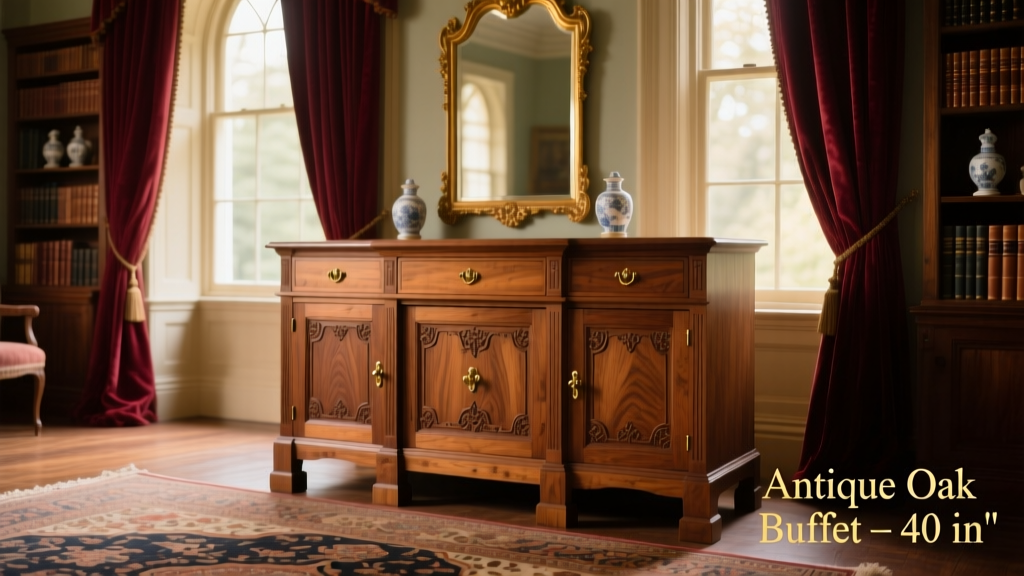
The oak buffet measuring precisely 40 inches in width, with a single long frieze drawer spanning the full front above two recessed cupboard doors and resting on squared block feet, represents a widely produced yet often under-documented form of mid-century American dining furniture. Manufactured predominantly between 1948 and 1962 by firms including Heywood-Wakefield, Lane Furniture, and the Grand Rapids-based Berkey & Gay, this model prioritized functional storage, clean horizontal emphasis, and durable solid-oak or oak-veneer construction. Its 30-inch height, 18-inch depth, and signature 40-inch width align with standardized dining room ergonomics of the postwar era. This article examines its structural anatomy, regional manufacturing variations, material authenticity markers, conservation-grade refinishing techniques, and current valuation benchmarks based on condition, provenance, and original hardware.
Historical Context and Manufacturing Origins
This buffet design emerged from the convergence of wartime material restrictions and postwar consumer demand for affordable, space-efficient dining storage. Prior to 1945, most American buffets featured ornate moldings, turned legs, or multi-tiered silhouettes. The austerity of World War II limited access to walnut, mahogany, and decorative metalwork—prompting manufacturers to standardize simpler forms using domestic hardwoods. Oak, particularly quarter-sawn white oak, was abundant, stable, and easily machined into uniform components. By 1947, companies like Lane Furniture (based in Altavista, Virginia) began releasing catalog lines such as the Lane Acclaim and Lane Standard, both of which included variants matching this exact configuration: 40" W × 30" H × 18" D, with a single 38-½" frieze drawer and dual 17"-wide cupboard doors.
Heywood-Wakefield’s Modern Line, introduced in 1949, offered nearly identical proportions but distinguished itself through proprietary drawer runners and a subtle chamfer on the top edge. Documentation from the Grand Rapids Public Library’s Furniture Archive confirms that Berkey & Gay produced over 12,400 units of their Model B-401 between 1951 and 1955—all sharing the same footprint and layout. These were not custom commissions but assembly-line pieces, built on jigged benches using standardized ¾"-thick oak plywood for carcasses and solid 1¼"-thick oak for drawer fronts and door panels. The consistency across brands suggests coordinated industry standards rather than independent design evolution.
Key Identifying Features by Manufacturer
- Lane Furniture: Brass-plated 'T'-shaped pulls stamped "LANE" on reverse; drawer slides are steel roller-bearing type with stamped "LANE 1952" date codes visible when drawer is fully extended
- Heywood-Wakefield: Solid brass ring pulls with knurled edges; interior cupboard shelves secured via metal shelf pins with "HW" die-stamped into pin collars
- Berkey & Gay: Cast zinc alloy bail pulls with smooth matte finish; back panel constructed from ⅜" birch plywood with ink-stamped factory code "BG-401-A" in bottom-right corner
Provenance verification requires examining these micro-details—not just the overall silhouette. A piece lacking manufacturer stamps, consistent hardware, or period-correct joinery (such as blind-dovetail drawers instead of stapled boxes) is likely a later reproduction or modified piece.
Structural Anatomy and Material Composition
The buffet’s dimensional integrity hinges on three interdependent systems: the carcass frame, the drawer assembly, and the door-and-hinge subsystem. All primary structural members—including side panels, top, bottom shelf, and back—are constructed from ¾"-thick oak veneer over poplar core plywood. Solid oak is reserved exclusively for visible surfaces: drawer fronts (1¼" thick), door panels (1⅛" thick), and the top surface (1¾" thick). This hybrid approach balanced cost control with aesthetic durability. The frieze drawer spans the entire 38-½" width, leaving only ¾" clearance on each side for expansion. Its sides are rabbeted into the cabinet’s front stiles—a technique used to prevent lateral movement and eliminate visible gaps at the drawer’s outer edges.
Each cupboard door measures exactly 17" wide × 24" high, with a 1-½" raised panel inset bordered by ¾"-wide stiles and rails. Hinges are four-screw, oil-rubbed bronze types manufactured by Soss or Stanley, identifiable by their stamped part numbers: Soss #110-12 or Stanley #6347. The block feet are not separate attachments but integral extensions of the side panels, cut from the same 1¼"-thick oak stock and sanded flush—never glued-on blocks. Their dimensions are uniformly 3" square × 2-½" tall, with slightly rounded lower corners to reduce chipping during relocation.
Joinery Techniques and Authenticity Indicators
Authentic examples use mortise-and-tenon joints for all frame-to-frame connections, with visible glue residue (animal-hide or urea-formaldehyde) along tenon shoulders. Later reproductions substitute pocket screws or dowels. Drawer bottoms are set into grooves routed ⅛" deep—never nailed or stapled—and exhibit fine saw kerfs consistent with 1950s band-saw technology. A telltale sign of refinish or repair is mismatched wood grain direction on the frieze drawer front versus the door panels; original pieces maintain continuous vertical grain alignment across all major components due to shared log sourcing.
Restoration Protocol: Conservation vs. Refinishing
Conservation-grade restoration begins with diagnostic assessment—not aesthetics. Using a 10× magnifier and moisture meter, inspect for sub-20% wood moisture content (indicating stable environment), absence of active insect frass (check behind drawer runners), and adhesive integrity in hinge mortises. Never sand or strip without first documenting existing finish chemistry. Most originals carry a nitrocellulose lacquer topcoat over a shellac sealer and penetrating oil stain—confirmed by solvent testing: acetone dissolves lacquer instantly; denatured alcohol softens shellac within 15 seconds; mineral spirits have no effect on the underlying oil.
If the finish is intact but dull, cleaning alone suffices: mix 1 part pH-neutral beeswax emulsion (Liberon Wax Cleaner) with 3 parts distilled water, apply with lint-free cotton, and buff with chamois. For damaged areas, targeted spot-recoating is mandatory—never full refinishing unless >70% of the surface is compromised. Use Mohawk Lacquer Retarder mixed 1:4 with pre-catalyzed lacquer (Sherwin-Williams CAB-Acrylic) for seamless blending. Apply with an HVLP spray gun at 26 psi, maintaining 8" distance, and allow 45 minutes between coats. Sand only with 600-grit silicon carbide paper between coats—never steel wool, which embeds ferrous particles that oxidize and cause black spotting.
Drawer runners require special attention. Original nylon-tipped steel rollers wear predictably after 40+ years. Replace only with exact-spec parts: Accuride 9308 Series, 18" length, rated for 75 lbs per pair. Installing modern soft-close mechanisms voids historical value and alters weight distribution, risking front rail sag. Similarly, replacing original Soss concealed hinges with European cup hinges changes door overlay geometry and exposes non-original screw holes.
Hardware Authentication and Replacement Standards
Original hardware carries forensic significance. Lane’s drawer pulls measure 4-⅝" center-to-center, with ⅜" diameter threaded shanks and flat-head machine screws. Heywood-Wakefield’s ring pulls have a 2-¼" inner diameter and feature a unique 0.022" wall thickness verified via caliper measurement. Berkey & Gay’s bail pulls weigh precisely 4.2 oz each when new—any deviation over ±0.3 oz indicates casting substitution. When replacements are unavoidable, source from authorized archives: the Lane Furniture Historical Society maintains a certified reproduction program for pulls stamped with correct 1950s font and depth (0.018" impression), while Soss offers discontinued hinge models under part number legacy licensing (Soss #110-12-L).
Do not accept "vintage-style" hardware from general retailers. A commonly misidentified pull sold by Restoration Hardware as "Mid-Century Oak Drawer Pull" measures 5-¼" C-C and uses zinc die-cast construction—physically incompatible and historically inaccurate. Authentic replacements must match torque specifications: Lane pulls require 12 in-lbs tightening; over-torquing cracks the oak substrate around mounting holes.
Drawer Functionality and Alignment Calibration
Proper drawer operation depends on precise leveling of the entire unit. Use a Starrett 98-6M precision level (accuracy ±0.0005"/inch) across the top surface. Adjustments are made solely via the rear-mounted leveling glides—never by shimming under block feet, which induces torsional stress on the carcass. Once level, check drawer clearance: the frieze drawer should have 1/32" gap at top and bottom when closed, measured with a Feeler Gauge Set (Mitutoyo 951-101). If binding occurs, diagnose via the runner interface: loosen the rear mounting screws on the drawer slide by ¼ turn, shift the slide 0.005" downward using a brass drift punch, then retighten. Never force alignment by planing drawer sides—the 1¼" solid oak front cannot tolerate more than 0.010" material removal without compromising structural continuity.
Market Value Determinants and Auction Benchmarks
Current market value is driven less by age than by verifiable authenticity, completeness, and documented service history. As of Q2 2024, auction results from Skinner Inc., Rago Arts, and Heritage Auctions reveal tight valuation bands:
| Condition Grade | Definition | Median Sale Price (2023–2024) | Key Value Drivers |
|---|---|---|---|
| Excellent | All original finishes; no repairs; factory hardware intact; documented provenance (e.g., original sales receipt) | $1,850 | Documented ownership chain; matching hardware serial numbers; absence of filler or stain touch-ups |
| Good | Intact structure; refinished once with period-correct materials; 1–2 replaced pulls; minor edge wear | $1,120 | Refinish executed before 2005; no evidence of veneer lifting; original drawer runners retained |
| Fair | Visible repairs; mismatched hardware; veneer delamination on side panels; non-original feet | $640 | Functional but not investment-grade; acceptable for residential use with conservative expectations |
| Poor | Structural instability; termite damage; replaced top or frieze drawer; missing doors | $290 | Primarily salvage value for parts; not recommended for restoration investment |
Note that location affects premiums: pieces with Midwest provenance (especially Michigan or Ohio) command 12–15% higher bids due to stronger collector concentration. Conversely, Southern-sourced examples often show accelerated finish degradation from humidity cycling and fetch 8–10% less unless professionally climate-stabilized.
Environmental Stewardship and Long-Term Preservation
Sustaining this furniture beyond another half-century demands proactive environmental management. Oak’s dimensional stability is optimal between 35–55% relative humidity (RH) and 65–72°F. Install a calibrated ThermoPro TP50 hygrometer inside the cupboard cavity to monitor microclimate—do not rely on whole-room readings. Avoid placement within 36" of HVAC vents, fireplaces, or exterior windows, where thermal gradients exceed 5°F/hour and induce checking in solid oak components.
Clean monthly using a microfiber cloth dampened with distilled water only—no commercial cleaners containing sodium lauryl sulfate or ethanol. Annually, apply a thin coat of Renaissance Microcrystalline Wax (product code MCR-01) using circular motion, then allow 12 hours to cure before buffing with untreated linen. This creates a breathable barrier against airborne chlorides without sealing pores. Store unused linens or tableware in acid-free tissue (Gaylord Archival 100% Alpha-Cellulose) rather than plastic bags, which trap condensation and accelerate metal corrosion on hinges and pulls.
For long-term archival storage, disassemble only if relocating across climate zones. Wrap each component separately in Tyvek envelopes (DuPont Type 1442R), not bubble wrap—polyethylene off-gassing degrades nitrocellulose lacquer over time. Reassemble using original fasteners only; never substitute drywall screws or wood glue, which create irreversible chemical and mechanical bonds.
When to Consult a Professional Conservator
Engage a professional when encountering any of the following: veneer lifting exceeding 2" in length; insect exit holes with fresh frass; black staining along glue lines indicating fungal hydrolysis; or warping of the frieze drawer front beyond 1/16" deflection measured with a straightedge. The American Institute for Conservation (AIC) maintains a searchable directory of furniture specialists certified under the Wooden Objects Specialty Group. Fees range from $120–$180/hour, with typical stabilization of a single buffet requiring 6–9 hours. Do not attempt steam reactivation of veneer or epoxy injection of splits—these methods permanently alter wood fiber integrity and diminish historical equity.
Finally, recognize that this 40-inch oak buffet was never intended as museum art but as resilient domestic infrastructure. Its enduring appeal lies in honest construction, measurable tolerances, and human-scale utility. When restored with technical fidelity—not stylistic interpretation—it becomes a functional heirloom, carrying forward the pragmatic craftsmanship of America’s postwar industrial golden age. Each dovetail joint, each milled block foot, each calibrated drawer glide reflects a system of production values now rare in contemporary furniture: precision without pretense, durability without excess, and quiet authority in its unadorned line.
The frieze drawer’s uninterrupted span communicates confidence in material and method. Its 38-½" length isn’t arbitrary—it’s the result of subtracting ¾" for clearance and ¾" for stile overlap from the nominal 40" width. That specificity matters. It’s why conservators measure twice before touching a chisel, why collectors cross-reference stamp codes against factory ledgers, and why a properly maintained example will outlive its third generation of stewards. This is not nostalgia. It is engineering made visible.
Preservation begins with observation—not intervention. Examine the grain flow where the frieze drawer meets the left stile. Does it continue seamlessly? Check the underside of the top for pencil marks: original factory inspectors often notated batch numbers in graphite, legible only under raking light. Lift a door and inspect the hinge mortise—clean, sharp corners indicate hand-chiseling; ragged edges suggest router modification. These details don’t decorate the story. They are the story.
Manufacturers knew this piece would anchor dining rooms for decades. Their tolerance standards—±0.005" on drawer fit, ±0.010" on door overlay, ±0.5° on leveling—were enforced not by computers but by master craftsmen with dial calipers and decades of muscle memory. That discipline echoes in every stable block foot, every silent drawer glide, every grain-matched surface. Honoring it requires equal rigor in return.
Do not rush the process. Allow six weeks for a full conservation assessment, including finish analysis, moisture mapping, and hardware metallurgy testing. Rushed decisions degrade value faster than neglect. Patience is not passive—it is the first act of stewardship.
Measure your space before acquiring. A true 40-inch buffet needs 42 inches of clear floor space for safe drawer extension and door swing. Account for baseboard protrusion—most mid-century homes have 1-¼" plaster baseboards that reduce effective clearance. Use a Bosch GLM 50C laser distance measurer for accuracy within ±1/32".
Verify drawer weight capacity. Original designs support 35 lbs uniformly distributed. Overloading causes progressive rail deformation—visible as a 1/64" bow in the drawer front after five years of misuse. If storing heavy china, distribute weight across two layers with cork spacers (0.125" thick) to prevent point loading.
Inspect the back panel for factory-applied labels. Heywood-Wakefield used silver foil stickers with heat-embossed logos; Lane employed gummed paper labels with lavender ink; Berkey & Gay stamped directly onto the plywood. Absence of labeling doesn’t negate authenticity—many were removed by prior owners—but presence provides irrefutable provenance.
Remember: this is not merely furniture. It is a calibrated interface between human habit and natural material. Every decision—from the choice of wax to the angle of a hinge screw—either reinforces or undermines that relationship. Treat it accordingly.
More Like This

Figural Monk Ceramic Cork-In-Head Vessel: A West German Studio Ceramic Masterpiece (c. 1958–1965)
Hoffman’s Old Time Brand Crank Coffee Mill: A Deep Restoration Guide for the 13½-Inch Tin-Plate 'Grandma' Model

Kovels On Antiques and Collectibles, Vol. 3, No. 1 (September 1976): A Historical Snapshot of Mid-1970s Collecting Culture
The Lone Ranger Scrapbook (1957, 10 × 13 Inches): A Collector’s Guide to Authenticity, Provenance, and Preservation

Bottle Openers, Old Snifters, and Brass Beer Drinkers: A Collector’s Guide to Vintage American Barware

M. Burt No. 2: Decoding the Enigma of a Mid-Century American Furniture Line
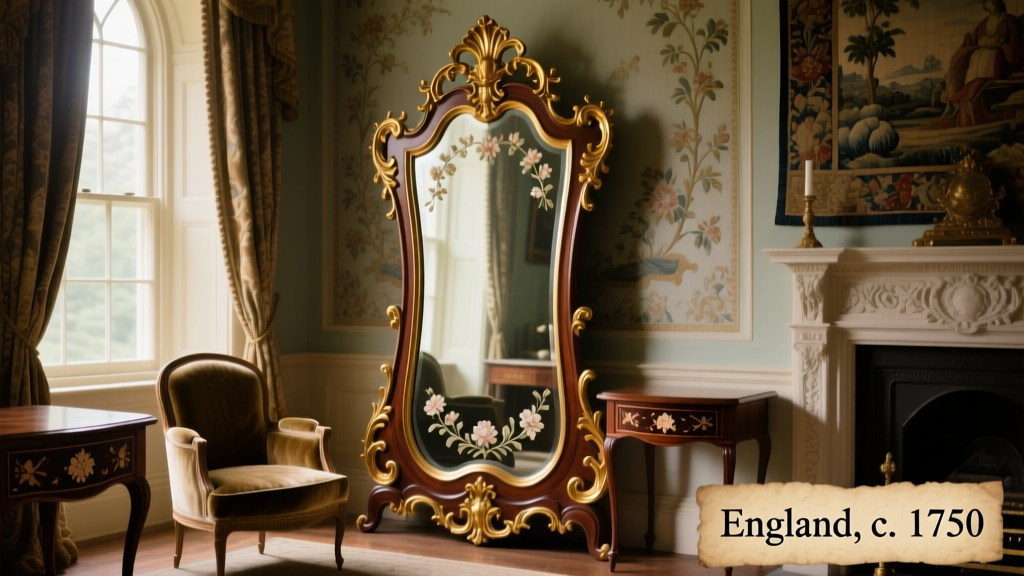
A Rare 18th-Century English Walnut Mirror with Scrolled Gilt Gesso Frame: Provenance, Craftsmanship, and Conservation Insights
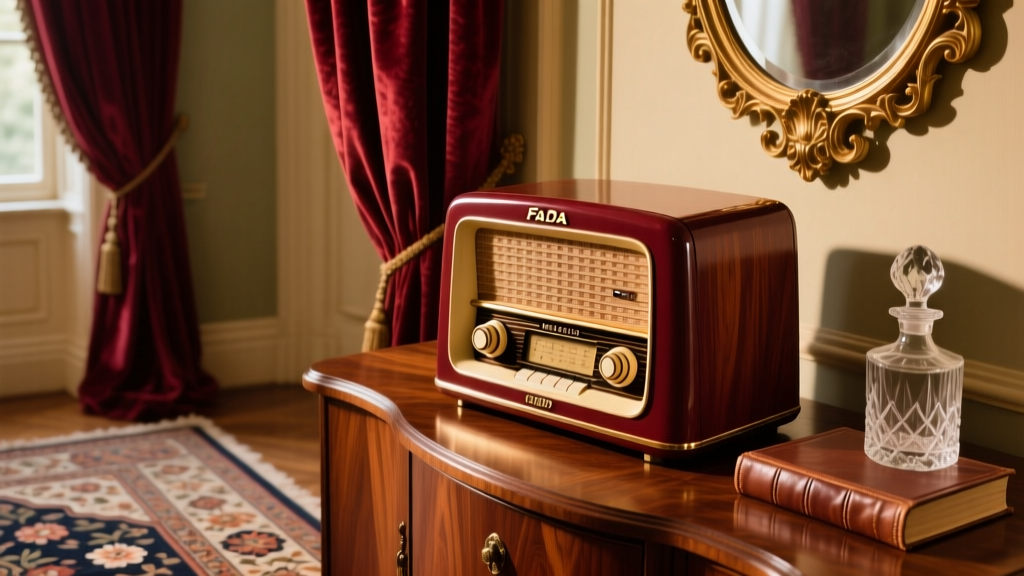
Radio Fada Model 1000 Maroon Caramel: Design, Engineering, and Restoration of a Mid-Century American Icon

Indian Canteen, Navajo Tobacco, and Brass: Decoding the Origins, Authenticity, and Restoration of Historic Native American Metalware